
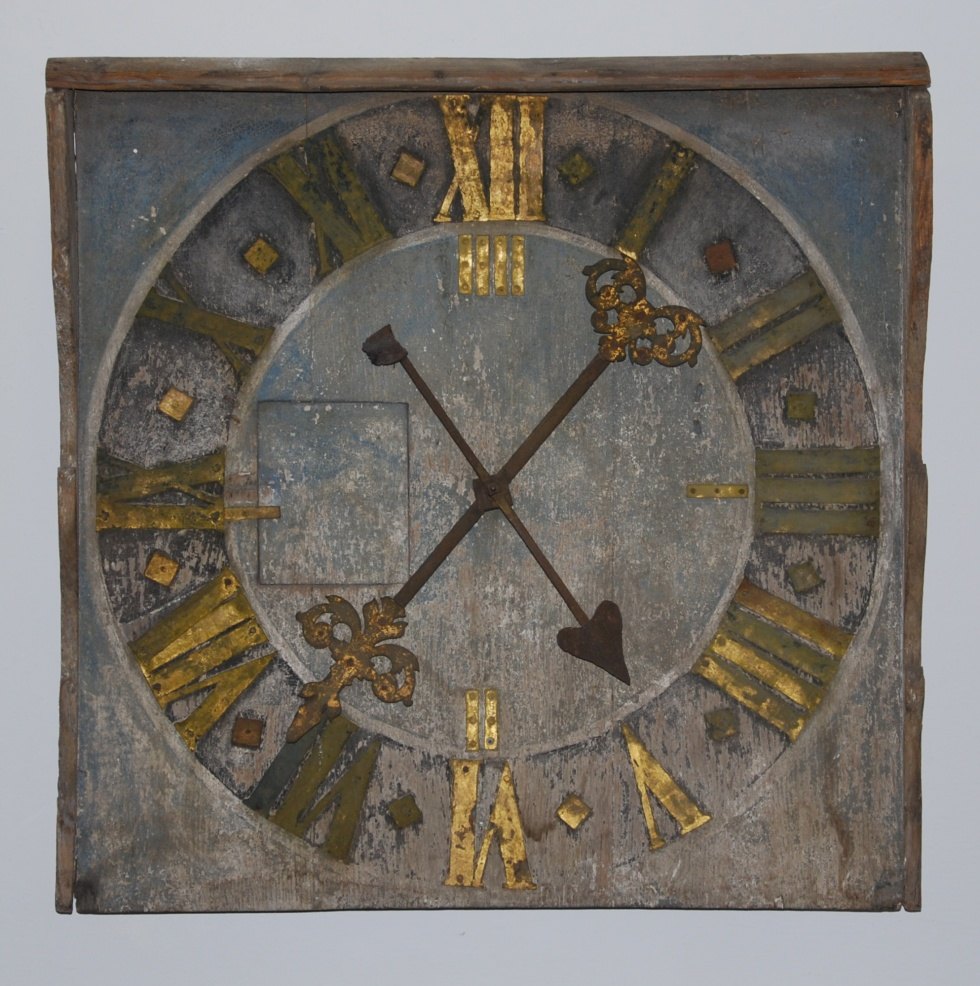
Clocks · Tower clock
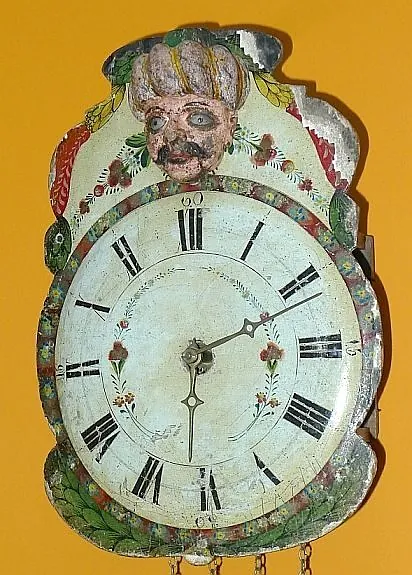
Tower clock, mid 18th century
- Maker / attribution
- Unrecorded in source
- Date
- mid 18th century
- Historical period
- Precision & Scientific Horology (1750 – 1850)
- Country of origin
- Unrecorded in source
- Object type
- Tower clock
- Materials / technique
- Holz, Eisen
- Dimensions
- H 116 cm, B 117,5 cm, T 15 cm
- Holding institution
- Museum Schloss Moritzburg Zeitz
- Accession / object no.
- VI/D - 30 (inventory number) 16991 (technical number)
- Credit line
- Museum Schloss Moritzburg Zeitz
- Catalogue title (original)
- Zifferblatt der Turmuhr von St. Nikolai (German)
View the source record ↗ (opens another website in a new tab)Suggest a correction
Record summary
Held and catalogued by Museum Schloss Moritzburg Zeitz (object number VI/D - 30 (inventory number) 16991 (technical number)), this is a tower clock, dated mid 18th century. The Atlas places it in the Precision & Scientific Horology period (1750 – 1850) of its Clocks collection. Materials and techniques recorded by the source: Holz, Eisen. Recorded dimensions: H 116 cm, B 117,5 cm, T 15 cm. The record is illustrated with 3 photographs.
Assembled from the source record's structured fields. Dates and attributions are given as the source states them; where a field is missing the Atlas leaves it blank rather than estimating.
Catalogue description
Catalogue description from Museum Schloss Moritzburg Zeitz
Das Zifferblatt schmückte einst die Zeitzer Kirche St. Nikolai. Der 1147 erstmals erwähnte romanische Bau war die Pfarrkirche der Unterstadt. Ihr Standort auf dem heutigen Nikolaiplatz schien kein guter Ort für eine Kirche zu sein. Wiprecht von Groitzsch brannte 1079 den Vorgängerbau des Gotteshauses, die Jakobskirche, nieder. Nach dem letzten Gottesdienst, 1821, wurde die baufällige Nikolaikirche an den Maurermeister Topschall für 380 Taler verkauft. Der Kaufvertrag verpflichtete ihn zum Abriss der Kirche bis spätestens 31. 12. 1823. einige Jahrzehnte schmückte eine Grünanlage diesen Ort. Heute verläuft hier eine viel befahrene Straße. (Museum Schloss Moritzburg Zeitz)
Shown in the original language of the source catalogue. An editor-reviewed English translation has not yet been published; we do not publish machine translations as authoritative text.
Historical context
Precision & Scientific Horology (1750 – 1850)
Harrison solves longitude; Mudge invents the lever; Breguet's Paris workshop defines the modern watch.
The age of the deadbeat escapement, compensated pendulums and observatory regulators. Domestic clocks spread through the middle classes: English longcase and bracket clocks, French gilt-bronze mantel clocks, Viennese Biedermeier wall clocks, Black Forest painted-shield clocks, and the first American shelf clocks.
Read the period in the timelineMore clocks from this periodEarlier: Early Modern Horology
Atlas type guide
Turret, tower and public clocks
The first mechanical clocks of the late thirteenth and fourteenth centuries were large iron striking clocks in towers, monasteries and cathedrals, driven by falling weights and controlled by a verge escapement with a foliot or wheel balance. They struck a bell rather than displaying the time, and only gradually acquired dials. Public clocks ordered civic life, regulating markets, work and worship.
From the seventeenth century the pendulum and then the anchor and pinwheel escapements made turret clocks far more accurate. In the nineteenth century firms such as Dent, Smith of Derby, Gillett & Johnston, J. F. Weule and Collin made cast-iron flatbed movements, and Edmund Beckett Denison's gravity escapement for the Great Clock of Westminster (1859) became the standard for accurate tower clocks.
What to look for
- Frame construction: early wrought-iron 'birdcage' or posted frames versus later cast-iron flatbed or plate-and-spacer frames.
- The escapement: verge and foliot, anchor, pinwheel or double three-legged gravity escapement.
- Striking and chiming trains with count wheels or rack striking.
- Maker's plates and dates cast or engraved on the frame.
Dating clues
- Wedged and riveted wrought-iron frames generally predate 1700.
- Flatbed cast-iron movements date from about 1840 onward.
- Electrical synchronisation and electric winding appear from about 1900.
General guidance written by the Atlas editors about this kind of object. It is not a statement about this particular piece; for that, rely on the source record above and on physical examination.
Related records
Clocks · c. 1780
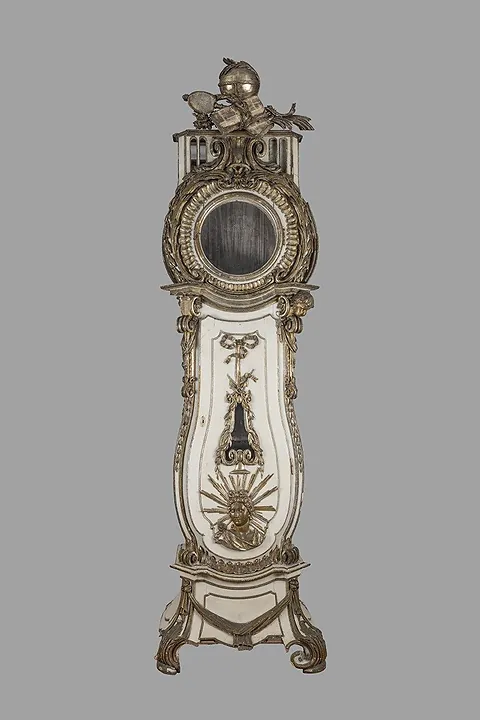
Longcase clock by Louis George, Eberswalde, c. 1780
Museum Eberswalde
Clocks · 1780s (inferred: the museum dates the style to the 1780s and the music includes Gluck's Iphigénie en Tauride of 1779)
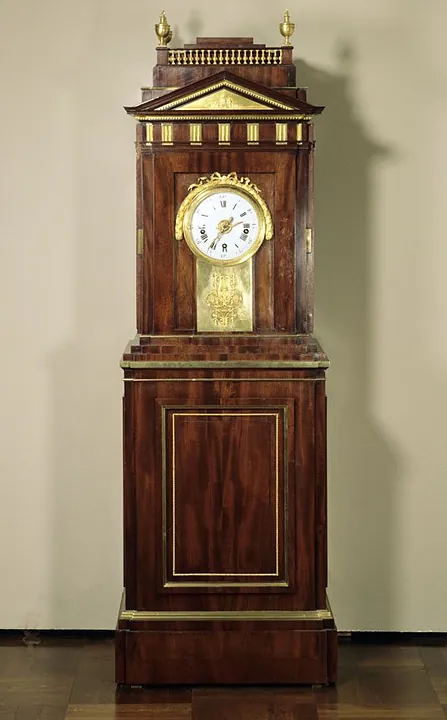
Musical longcase clock, Roentgen workshop, Neuwied, 1780s
Badisches Landesmuseum Karlsruhe
Clocks · 1740–1760
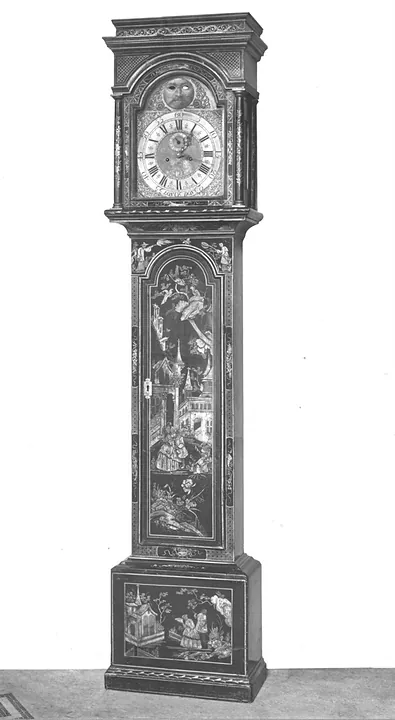
Longcase clock, English, 1740–1760, japanned wood, John Ellicott
Victoria and Albert Museum, London
Clocks · 1740–60
Tall clock by Samuel Bagnall, United States, 1740–60
The Metropolitan Museum of Art, New York
Clocks · c.1750
Long-case clock, English, ca. 1750, by Richard Peyton of Gloucester
Victoria and Albert Museum, London
Clocks · 1750–1800
Bracket clock in metal case with scroll handles and flamed-shaped top signed by Pierre Seignoret, Clockmaket to the the Comte d'Artois
Victoria and Albert Museum, London
Clocks · c. 1750
Clock by Georg Gfell, Germany, c. 1750
German Clock Museum
Clocks · 1750–1799
Cuckoo / black forest clock, Germany, 1750–1799
Badisches Landesmuseum Karlsruhe