
Clocks · Table clock
Table clock by Vincent & Cie., France, 1834–1855
- Maker / attribution
- Vincent & Cie. (Created)
- Date
- 1834–1855
- Historical period
- Precision & Scientific Horology (1750 – 1850)
- Country of origin
- France
- Place
- Paris
- Object type
- Table clock
- Materials / technique
- Gold / Bronze / Rauleder / Email / Messing / Silber / gegossen / vergoldet / feuervergoldet
- Dimensions
- Länge: 13.4 cm, Höhe: 42.3 cm, Breite: 26.5 cm, Gewicht: 1573 g
- Holding institution
- Städtisches Museum Meerane
- Accession / object no.
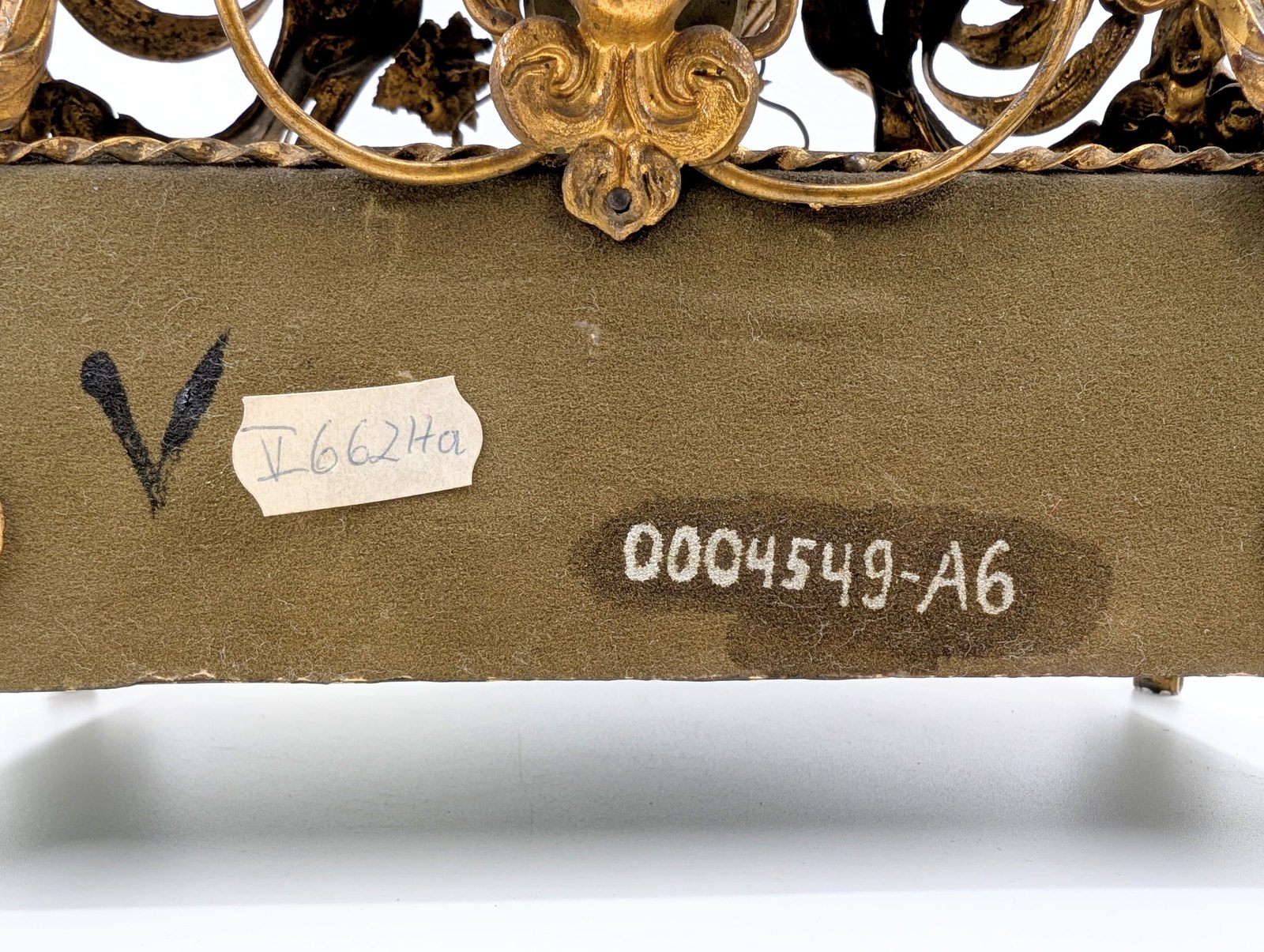
- 0004549-A6
- Credit line
- Städtisches Museum Meerane
- Catalogue title (original)
- Französische Tischuhr mit Weinblattdecor - zwischen 1834 - 1855 (German)
View the source record ↗ (opens another website in a new tab)Suggest a correction
Record summary
Held and catalogued by Städtisches Museum Meerane (object number 0004549-A6), this is a table clock by Vincent & Cie., made in Paris, France, dated 1834–1855. The Atlas places it in the Precision & Scientific Horology period (1750 – 1850) of its Clocks collection. Materials and techniques recorded by the source: Gold / Bronze / Rauleder / Email / Messing / Silber / gegossen / vergoldet / feuervergoldet. Recorded dimensions: Länge: 13.4 cm, Höhe: 42.3 cm, Breite: 26.5 cm, Gewicht: 1573 g. The record is illustrated with 6 photographs.
Assembled from the source record's structured fields. Dates and attributions are given as the source states them; where a field is missing the Atlas leaves it blank rather than estimating.
Catalogue description
Catalogue description from Städtisches Museum Meerane (German)
Die fein gearbeitete Tischuhr stammt von den Pariser Uhrmachern „Vincent & Cie“ sowie von einem weiteren, der nur unter der Punzierung „Farret a Paris“ in Erscheinung tritt. Auf dem Uhrwerk sind beide Produzenten durch ihre Prägung der Nachwelt erhalten geblieben. Die Punzierung der Firma „Vincent & Cie” trägt hierbei den Zusatz „Medaille d'argent”, den sie 1834 für ihre Arbeiten erhalten hat. Da die Firma im Jahr 1855 mit einer Goldmedaille ausgezeichnet wurde, muss die Uhr zwischen 1834 und 1855 entstanden sein. Die Uhr und ihr schmuckvoll in Ajour gearbeiteter Rahmen aus Weinblättern und Akanthus stehen auf einem quadratischen Podest, dessen Vorderseite eine für den Stil des Barock und Rokoko übliche Wölbung in Richtung des Betrachters aufweist. Diese Wölbung wird von einem vergoldeten Bronzedekor mit C-Schwüngen und floralen Motiven verziert. An den vier Ecken des Podestes befindet sich jeweils ein vergoldetes Bronzeelement aus halben Rocailen und einem Muschelmotiv, das die Füße des Podestes bildet. Der Rahmen auf dem Podest besteht aus sich ineinander wölbenden und überlappenden, ajour gearbeiteten Weinreben, Weinblättern, Akanthus, Rocaillen und vereinzelten anderen Naturformen. Das Uhrwerk befindet sich in einem zylindrischen Gefäß, das in der Mitte des Gehäuses zentriert durch die feinen in ajour gearbeiteten Naturformen zu schweben scheint. Die Oberfläche des Gefäßes ist mit feinen Rocaillen und Naturformen überzogen, die sich leicht von der Oberfläche abheben und nur bei näherer Betrachtung eine Form bilden. Das Zifferblatt der Uhr ist aus Email gefertigt und die römischen Zahlen sind königsblau gestaltet. Die zwei Zeiger besitzen jeweils einen Dreipass, dessen dünne Spitze das Ende der Zeiger formt. Um das Zifferblatt erhebt sich eine Zarge, die mit einem Schmuckband mit Dreipässen verziert ist. Dieses hielt das mittlerweile nicht mehr vorhandene Schutzglas mithilfe eines Bolzens der nun verweist am oberen Rand der Zarge hervorsteht. Auf der Rückseite des zylindrischen Gefäßes ist das Uhrwerk der Konstruktion einsehbar, da der Verschluss fehlt. Zu sehen ist ebenfalls die silberne Glocke. Im Inneren des Rahmens, der das Uhrwerk hält, ist ein schlichtes, rundes Pendel zu erkennen.
Shown in the original language of the source catalogue. An editor-reviewed English translation has not yet been published; we do not publish machine translations as authoritative text.
Historical context
Precision & Scientific Horology (1750 – 1850)
Harrison solves longitude; Mudge invents the lever; Breguet's Paris workshop defines the modern watch.
The age of the deadbeat escapement, compensated pendulums and observatory regulators. Domestic clocks spread through the middle classes: English longcase and bracket clocks, French gilt-bronze mantel clocks, Viennese Biedermeier wall clocks, Black Forest painted-shield clocks, and the first American shelf clocks.
Read the period in the timelineMore clocks from this periodEarlier: Early Modern Horology
Atlas type guide
Bracket, table and spring-driven clocks
Spring-driven clocks freed timekeeping from the hanging weight. The coiled mainspring, documented from the fifteenth century, made portable table clocks possible; to even out its declining force, makers used the fusee, a conical pulley connected to the barrel by a gut line or chain. Renaissance table clocks from Augsburg and Nuremberg — drum-shaped, square or tower-shaped in gilt brass — were luxury scientific objects, often with astronomical dials and alarms.
After the pendulum, English makers developed the bracket clock: a wooden case with a carrying handle, a short pendulum with a verge escapement, and often repeating work to sound the hours on demand at night. Later examples use the anchor escapement. In the nineteenth century, 'table clock' became a broad term for spring clocks of every nationality.
What to look for
- A fusee in the movement (cone-shaped pulley) and the type of line — gut or chain.
- Verge escapement with a short bob pendulum, often with a decoratively engraved backplate.
- Repeat cords or buttons that make the clock strike again on demand.
- Gilt-brass engraved cases and horizontal dials on Renaissance pieces.
- Case shapes: inverted bell, bell top, break-arch, lancet or balloon.
Dating clues
- Drum and tower table clocks: c. 1520–1650.
- Ebony veneered English bracket clocks with verge escapements: c. 1670–1800.
- Engraved backplates were usual on English clocks until c. 1800, then generally plain.
General guidance written by the Atlas editors about this kind of object. It is not a statement about this particular piece; for that, rely on the source record above and on physical examination.
Related records
Clocks · 1750–1800
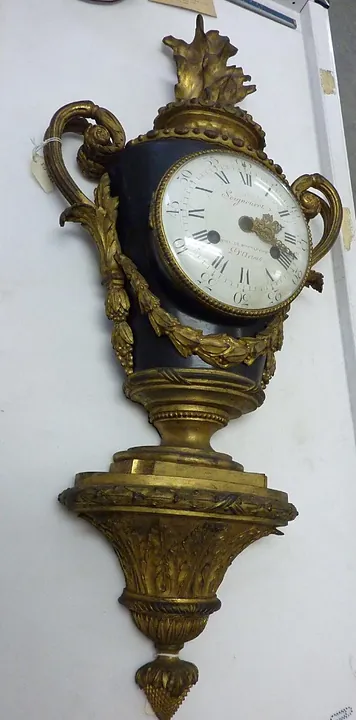
Bracket clock in metal case with scroll handles and flamed-shaped top signed by Pierre Seignoret, Clockmaket to the the Comte d'Artois
Victoria and Albert Museum, London
Clocks · 1756
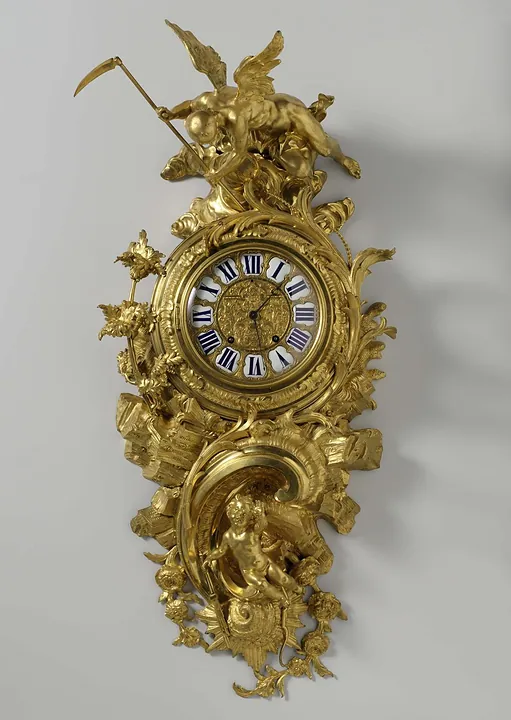
Mantel clock, France, 1756
Rijksmuseum
Clocks · c. 1764–70
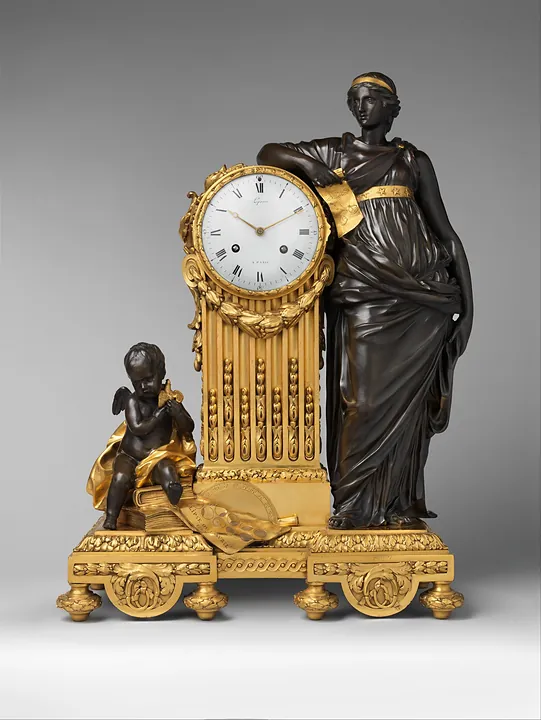
Mantel clock by Jean-André Lepaute, France, c. 1764–70
The Metropolitan Museum of Art, New York
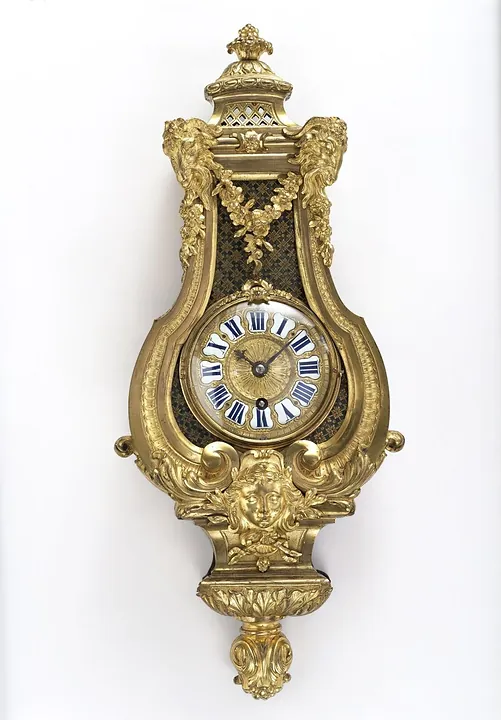
Clocks · 1760–1860
'Pendule d'alcove' wall clock, gilt-bronze and boulle marquetry, Paris, 1760-1860
Victoria and Albert Museum, London
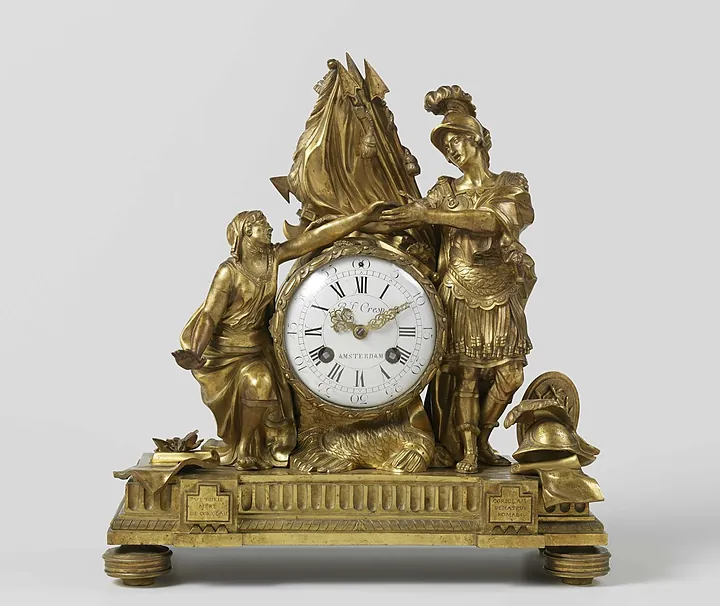
Clocks · 1760
Mantel clock, France, 1760
Rijksmuseum
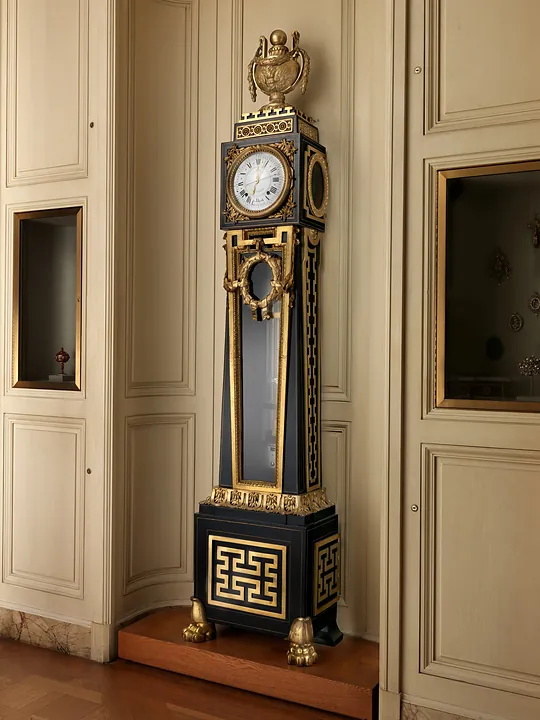
Clocks · c. 1768–70
Longcase astronomical regulator by Ferdinand Berthoud, France, c. 1768–70
The Metropolitan Museum of Art, New York
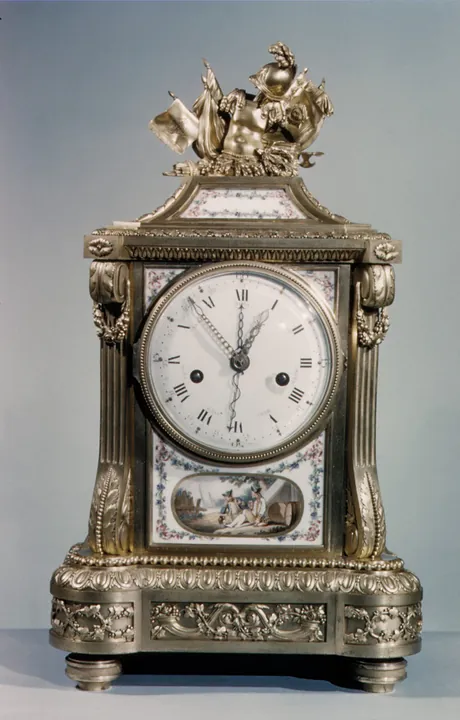
Clocks · c. 1775
Clock by Porcelain plaques by Sèvres Manufactory, France, c. 1775
The Metropolitan Museum of Art, New York
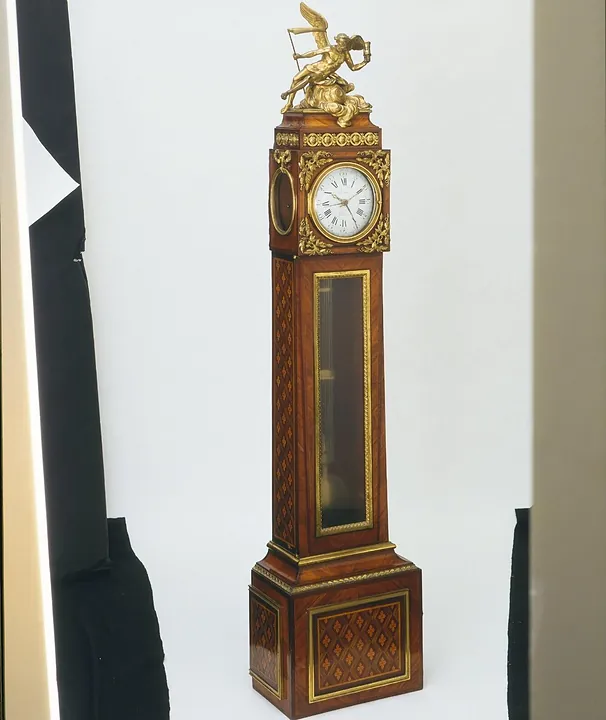
Clocks · 1770–1775
Longcase clock (régulateur) by Robert Robin, France, 1770–1775
Victoria and Albert Museum, London