
Clocks · Alarm clock
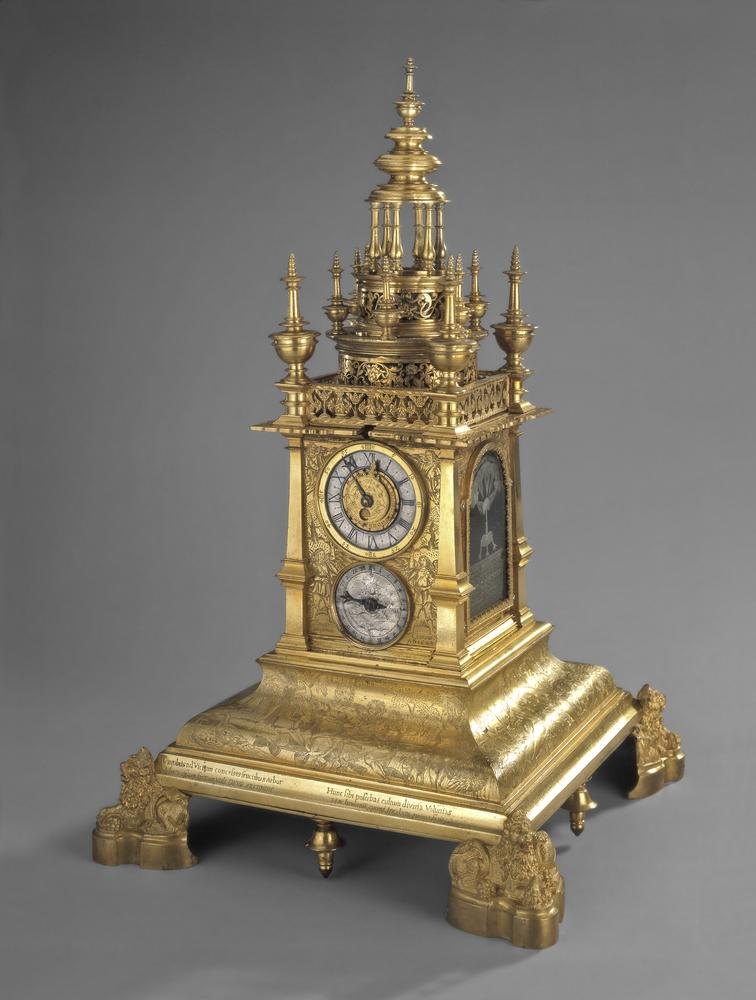
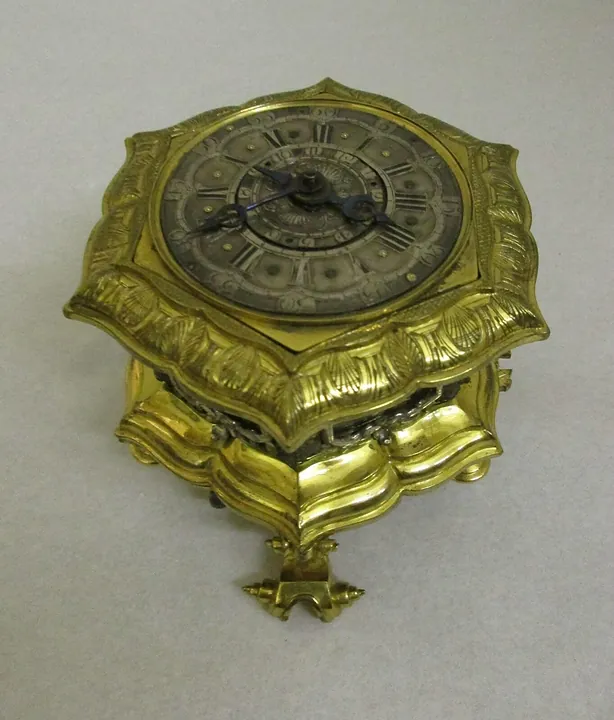
Table clock by Lucas Weydmann
- Maker / attribution
- Lucas Weydmann (Made by)
- Date
- 1648
- Historical period
- Early Modern Horology (1600 – 1750)
- Country of origin
- Poland
- Place
- Kraków
- Object type
- Alarm clock
- Materials / technique
- glass
- Dimensions
- Height: 47 centimetres Width: 28 centimetres Depth: 28 centimetres
- Holding institution
- British Museum
- Accession / object no.
- 1867,0716.4
- Credit line
- British Museum, London
- Catalogue title (original)
- Table clock by Lucas Weydmann (English)
View the source record ↗ (opens another website in a new tab)Suggest a correction
Record summary
Held and catalogued by British Museum (object number 1867,0716.4), this is an alarm clock by Lucas Weydmann, made in Kraków, Poland, dated 1648. The Atlas places it in the Early Modern Horology period (1600 – 1750) of its Clocks collection. Materials and techniques recorded by the source: glass. Recorded dimensions: Height: 47 centimetres Width: 28 centimetres Depth: 28 centimetres. The record is illustrated with 6 photographs.
Assembled from the source record's structured fields. Dates and attributions are given as the source states them; where a field is missing the Atlas leaves it blank rather than estimating.
Catalogue description
Description — British Museum
Table clock; verge escapement (converted to 'cow-tail' pendulum); spring-driven; alarum (now missing); hour and quarter-striking on two trains (without fusees); third striking mechanism (with fusee) repeats the hours on a larger bell; both housed in base of clock-case; dial-plate with two dials, upper indicates the age, phase and aspect of the moon as well as having concentric hour and minute hands; lower indicates the time according to the twenty-four hour system; engraved case set with wheel-engraved glass panels on either side; dated.
Curator's comments — British Museum
The following text is the entry for this object from the unpublished catalogue of pre-pendulum clocks by John Leopold, former Assistant Keeper of Horology at the Museum. This information is unedited and should be used accordingly. xxxxxxxxxxxxxxxxxxxxxxxxxxxxxxxxxxxxxxxxxxxxxxxxxxxxxxxxxxx TABERNACLE CLOCK BY LUCAS WEYDMANN, CRACOW,… 1648 Presented by Octavius S. Morgan, 9 Pall Mall. Bibliography. Exh. London 1850 no.416. Milham (1923) 128, 130. Postcards (1925) no.13. Baillie 1 (1929) 378. Benis (1944) 10. Baillie 2 (1947) 339. Tomkiewicz (1952) 61, pl.XXII. Paszkiewicz (1964). Lloyd (1964) 73. Paszkiewicz (1969). Siedlecka (1976) 67-8, fig.14. Tait (1983) 26-9 (incorrectly claims that part of the top structure is missing; the description of the striking sequence is also incorrect). Wayman (2000) - front cover, 72, fig.4.49-50 (analysis of the 19th cent. main spring going). The engravings associated with the glass windows: Paskiewicz (1964). Tait (1983) 29. Siedlecka (1976) seems to quote for the engraved glass: Paskiewicz (1969). Exh. London 1850 describes briefly: "416. A Clock, by L.Weidman. Xvi cent: O. Morgan, Esq. M.P." (This is pamphlet D 21.) SIGNATURE. Engraved at the bottom of the front panel of the case: Lucas Cracow Weijdman AD 16 48 Scratched on the base plate: "Chretien Le Cadet a chantilly Le 6 june 1686"; also: "chapron". On the outside of the lower plate of the after-strike movement is scratched: "Chretien le Cadet". Scratched on the top of the first circular disc of the top: "Pauve a Paris 24 Juin 1773" and "De Lamotte 1 May 1782 1790 20 Mars". Scratched in the blueing of the mainspring of the going train: "Monginot 1807 Mai". Scratched on the brazed cap of the barrel of the going train: "5 tours" and "Ludovic Alphane Totus-mondus Anno 1838"; the pinned cap just has "5 tours". On the centre bar (going-side) is scratched: "Touttemonde 1838". Several moving parts of the going train have a scratched "M". On the inside of the alarm plate is scratched "haut". Description: Case and dials. The case is contructed very largely of brass, gilded on all the visible surfaces. It consists of the base, four vertical panels, and the top structure. Base and top structure are latched to the plates of the movement. The seven brass latches (four for the base and three for the top) have large ornamental handles or flags, which are visible throught the glass panels in the sides; these are pierced and engraved with flowers; the position of the eighth flag is taken by the plate of the alarm train (see below). The latches are attached to the movement plates by steel screws. The profiled part of the base is cast as a single piece of brass, gilded on the visible surfaces only. Its centre portion carries four feet to secure the principal movement, and two feet to attach the after-strike movement; all feet are riveted. The curved surfaces are engraved with representations of the Fall, with appropriate texts, as follows. Front: the Lord showing the Tree of Life to Adam and Eve, with: "Omnibus ad Victum concessis fructibus Arbor Vnica quam sacram vult DEVS excipitur Hunc sibi poscebat cultum divina Voluntas Hæc hominum generi lex data prima fuit" (Among all the fruit allowed for food God wishes one tree to be excepted as sacred, The Divine Will demanded that it be tended for Itself: That was the first law given to mankind.) Right side: Adam and Eve, with: "Angelici coetus lætos duxere triumphos Et viguere suis cuncta creata bonis Rumpitur invidia Satanas et mille per astus Insonti insidias exitiumque parat" (The heavenly host conducts its happy triumph And all creation flourishes by its benefits; The jealousy of Satan is broken, and through a thousand tricks He prepares the ambush and the downfall of the innocent.) Back: Eve takes the apple, with: "Succedunt fraudes credenti imponitur eheu Quam tristi lapsu corruit Heua parens Appetit exhorret vetita tamen arbore fructus Carpere quæ poterat vincere victa cadit" (Alas, the tricks played on the credulous succeed, Through what sad lapse mother Eve went to ruin: The fruit on the forbidden tree attracts and terrifies her, She fall victim to plucking which she could have overcome.) Left side: Death and the Angel chase Adam and Eve, with: "Dum perstabat homo sancta in pietate fideque Arbitrium vidit cuncta Creata sequi Lapsus in interitum traxit genus omne reoque Præsentem intentat machina trina necem" (While man stood firm in holy piety and faith He saw all creation follow his dominion. Having fallen he has dragged all his decendants into annihilation, and for the guilty This threefold machine 1) indicates that death is at hand.) The bottom of the base is covered by a gilded copper base plate, with a hinged lid to allow access to the after-strike movement; the plate is gilded on the underside only, the lid on both sides. The lid has a circular aperture to accomodate the bell, which is carreid by a steel stand screwed with two screws. The outside of the base plate and the inside of the lid are decorated with a geometric patern of circles and straight lines (similar to the decoration of the backplate of the after-strike movement). The baseplate is a re-used engraved printing plate, which was incompletely scraped so that bits of ornament and portions of Latin texts (in mirror immage) remain visible. Four cast and gilded brass feet, shaped as lions with split bodies, fit over the corners of the cast base and the baseplate; they are each secured by a screw which passes through the foot and the plate into the base. At the middle of the sides four turned gilded brass finials are screwed to the baseplate. The four vertical panels are the front and the back panels, which are secured by two lugs top and bottom which fit into holes in the base and the top structure, and two side panels, which are held friction tight. The front pannel is engraved with a landscape and four angels; at the bottom is the signature (see above). It carries two profiled.
Inscriptions & marks
inscription; case; Lucas Weydmann Cracow A.D. 1648; inscription; glass panel; SPLENDOR VANESCENS
Provenance
Donated by:, Octavius Morgan
Historical context
Early Modern Horology (1600 – 1750)
Huygens' pendulum and balance spring transform accuracy; English makers develop the anchor and deadbeat escapements.
Huygens's pendulum (1656–57) improved clock accuracy from about a quarter of an hour to under a minute a day. The anchor escapement (c. 1670) and the long seconds pendulum created the longcase clock; London makers such as Fromanteel, Knibb, Tompion and Quare led European clockmaking, and French makers created the Boulle pendule.
Read the period in the timelineMore clocks from this periodEarlier: Renaissance Horology
Atlas type guide
Alarm clocks
Alarm work is among the oldest clock functions: monastic clocks woke monks for night prayers, and Renaissance table clocks often carried an alarm disc set by a pin. A separate spring or weight is released at the set time and drives a hammer against a bell. Some early alarms also lit a candle by striking a flint — the 'tinder pistol' alarm.
The cheap, mass-produced alarm clock arrived in the second half of the nineteenth century. American firms such as Seth Thomas and Westclox (the 'Big Ben' of 1910) and German makers such as Junghans and Kienzle made millions of drum-shaped alarms with pin-pallet escapements. Electric, quartz and digital alarm clocks followed in the twentieth century.
What to look for
- A separate alarm-setting dial or disc and an extra winding key.
- Twin bells on top (common after c. 1920) or a bell enclosed in the base.
- Pin-pallet escapements in inexpensive factory alarms.
- Trademarks and patent dates on dial or back.
Dating clues
- Renaissance alarm table clocks: sixteenth to seventeenth centuries.
- Drum alarm clocks: from the 1870s.
- Luminous dials with radium paint: c. 1910–1960.
General guidance written by the Atlas editors about this kind of object. It is not a statement about this particular piece; for that, rely on the source record above and on physical examination.
Read next:Anchor (recoil) escapement
Related records
Clocks · Early 17th century
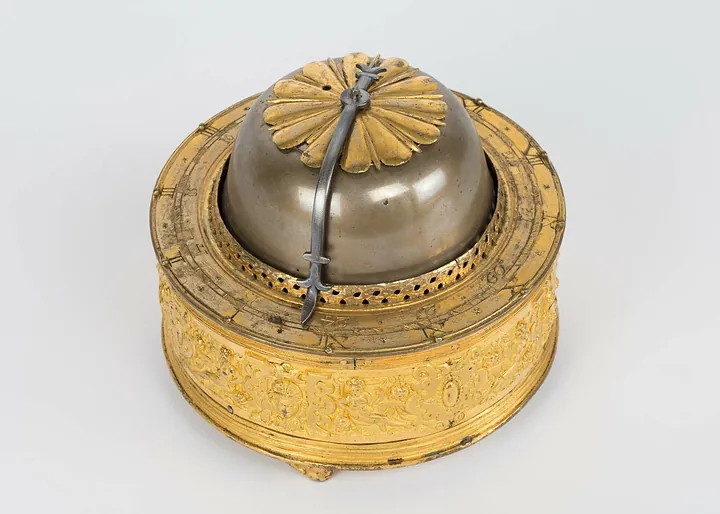
Table clock, probably Denmark, early 17th century
German Clock Museum
Clocks · 1590–1610
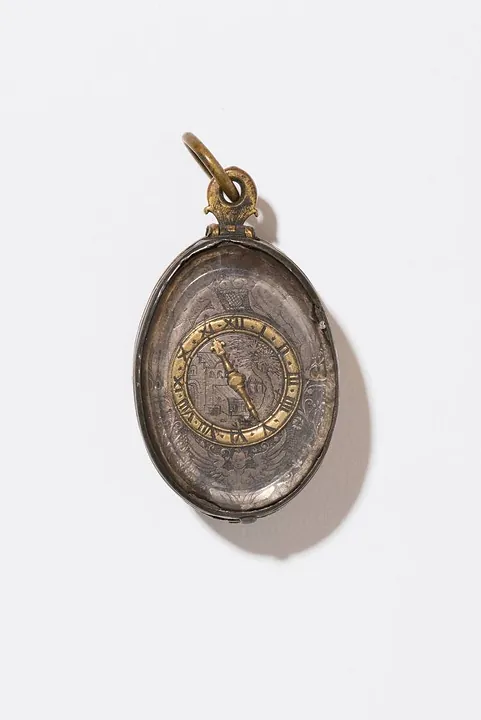
Clock, France, 1590–1610
MAK – Museum of Applied Arts
Clocks · c. 1600
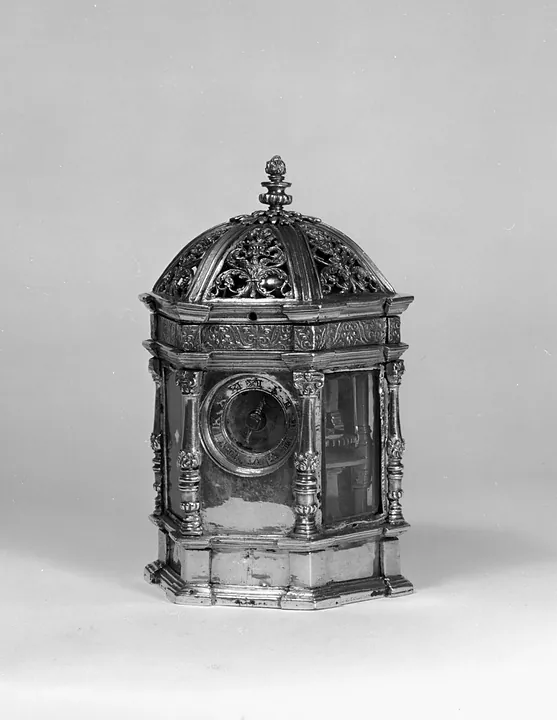
Table Clock, sheet brass, engraved, pierced and gilt, Paris, ca.1600, signed 'B(?) Pichard, à Paris'
Victoria and Albert Museum, London
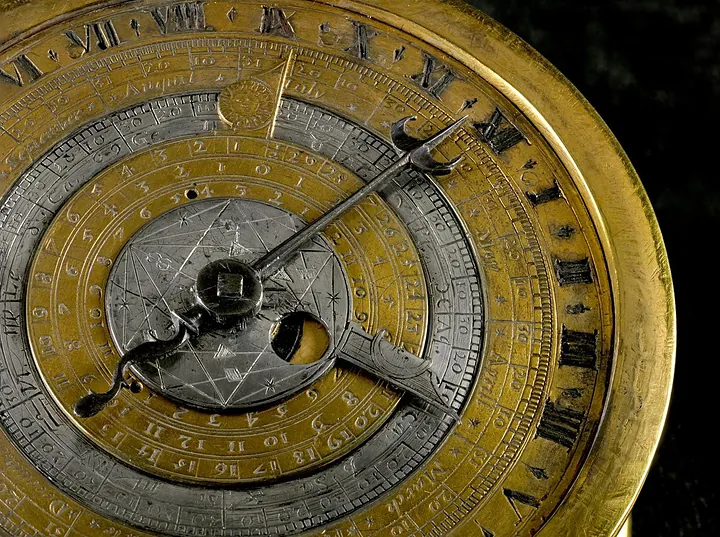
Clocks · 1598–1603
Circular table-clock with calendrical and lunar indications made by Nicholas Vallin in London between 1598 and 1603.
Science Museum Group, London
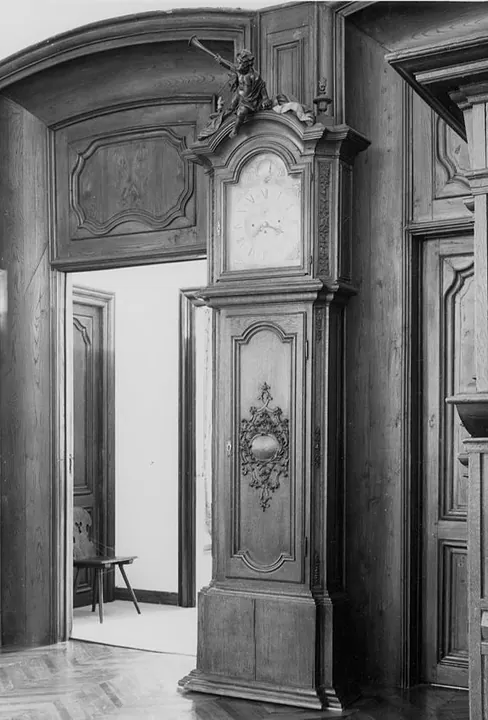
Clocks · 1600–1699
Clock by Joannes Volcker, Belgium, 1600–1699 (no. AP_10156031)
Royal Institute for Cultural Heritage
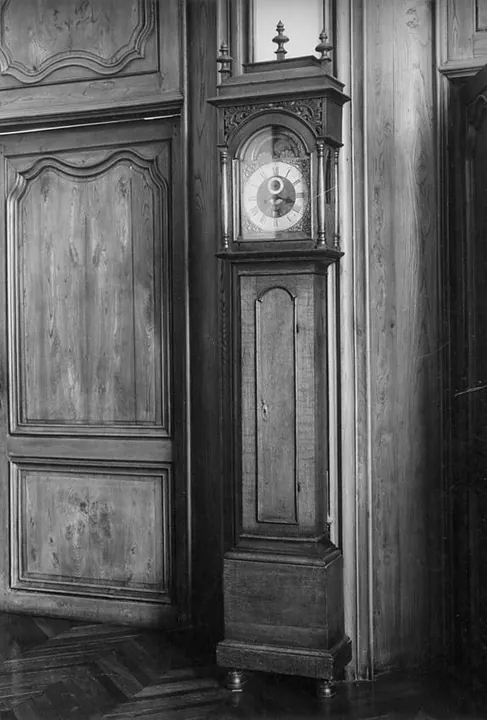
Clocks · 1600–1699
Clock by Joannes Volcker, Belgium, 1600–1699 (no. AP_10156032)
Royal Institute for Cultural Heritage
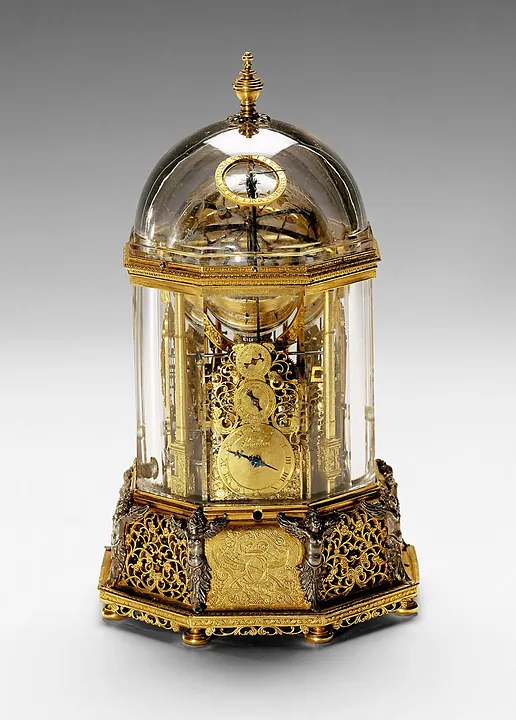
Clocks · 1600–1699
Clock attributed to Jobst Bürgi, Czech Republic, 1600–1699
Fine Arts Museum Vienna
Clocks · 1600–1700
Clock, Germany, 1600–1700
Victoria and Albert Museum, London