
Wristwatches · Wristwatch
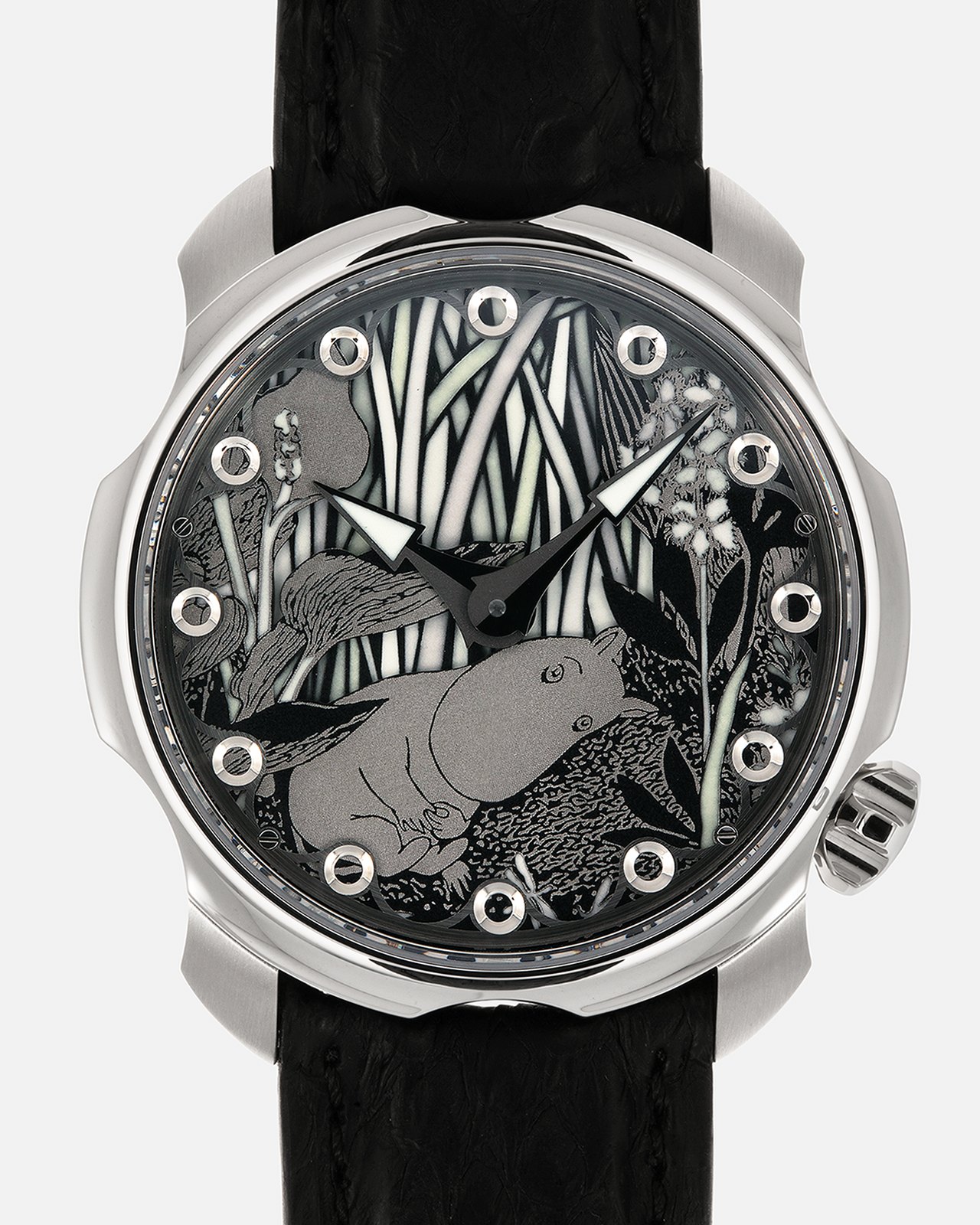
Sarpaneva X Moomin ‘Pitch Black, 2020
- Maker / attribution
- Sarpaneva (maker)
- Date
- 2020
- Historical period
- Contemporary Horology (2010 – Present)
- Country of origin
- Unrecorded in source
- Object type
- Wristwatch
- Dimensions
- Case 42 mm
- Stock no.
- Product 7415767040087
- Credit line
- Dealer listing, S.Song Watches (product 7415767040087)
- Catalogue title (original)
- Sarpaneva X Moomin ‘Pitch Black' (English)
View the source record (dealer listing) ↗ (opens another website in a new tab)Suggest a correction
Record summary
Catalogued by S.Song Watches (dealer), Seattle (stock number Product 7415767040087), this is a wristwatch by Sarpaneva, dated 2020. The Atlas places it in the Contemporary Horology period (2010 – Present) of its Wristwatches collection. Recorded dimensions: Case 42 mm. The record is illustrated with 6 photographs.
Assembled from the source record's structured fields. Dates and attributions are given as the source states them; where a field is missing the Atlas leaves it blank rather than estimating.
Catalogue description
Dealer description — S.Song Watches
While Finland may not be as widely recognised for horology as some other countries, it is home to one of the industry’s most unique independent watchmakers: Sarpaneva. Renowned for its signature moonphase watches featuring a melancholic Moonface said to be modelled after the face of founder Stepan Sarpaneva himself, the brand has developed a devoted, cult-like following in recent years. Launched in 2020 as a limited edition, Sarpaneva introduced this Moomin watch to celebrate one of the world’s most beloved comic strips—the Moomins—as a tribute to the iconic characters, their distinctive design, and their deep cultural significance in Scandinavian heritage. Created by Swedish-Finnish illustrator and author Tove Jansson in 1945, the Moomins are whimsical, hippo-like creatures that have since become cultural icons, inspiring generations through books, comics, television, film, and more. Their distinctive art style, particularly the richly detailed, dreamlike environments, clearly influenced the design of these special timepieces. These illustrated landscapes also provide a fitting canvas for Sarpaneva to showcase his artistic craft and sensibilities. The Sarpaneva x Moomin variant offered here today was originally released in four colourways, and is limited to just 25 pieces each. Each version is distinguished by its uniquely coloured handset: Flame Blue, Red Gold, Steel Rhodium, and Pitch Black. This particular example features the Pitch Black hands and is housed in Sarpaneva’s signature case design, crafted from high-grade Outokumpu steel (a Helsinki-based producer of stainless steel) and finished with finely executed brushing throughout. Measuring 42mm in diameter and 11.4mm thick, it strikes a well-balanced profile on the wrist. The screw-down crown is thoughtfully placed at 4:00 for ergonomic comfort, while the sapphire crystal is treated with multiple layers of anti-reflective coating for superior legibility. The dial here offers a truly unique and immersive visual experience. Composed of three individual skeletonised layers, it beautifully recreates a scene from Tove Jansson’s 1955 classic Moominsummer Madness , depicting Moomintroll lying on a bed of moss, gazing into the water as he listens to the rustle of wings and the gentle buzz of bees around him. This intricate artwork comes alive in the dark, brought to life by nine different Super-LumiNova pigments. The highly ornate index ring, representing the hours, is hand-finished and adds another layer of craftsmanship to the dial. Personally, I find the Pitch Black hands particularly appealing as they lend a strong monochromatic character to the piece, which feels especially appropriate. Why? It echoes the original black-and-white book illustrations with a quiet, thoughtful authenticity. As someone who appreciates the nuance and depth of black-and-white analogue photography, this variant resonates deeply with me. It captures the essence of the artwork in a way that feels both honest and emotional—its magic amplified all the more when the lume begins to glow in the dark. At the heart of the Sarpaneva x Moomin is a modified self-winding, 25-jewel, SOPROD Cal. A10, meticulously finished and partially visible through a skeletonised winding mass. This structure features several white gold weights and is adorned with Sarpaneva’s signature Moonface. It also offers a power reserve of up to 42 hours when fully wound. Sarpaneva watches occupy a unique space in the world of independent horology, known not just for their striking aesthetics but for the deep connection they maintain with their Finnish roots. Stepan Sarpaneva’s ability to embed his homeland into every aspect of his creations is both thoughtful and authentic, from the Moomin-inspired storytelling and locally sourced Outokumpu steel, to the watch roll produced by one of Finland’s oldest textile makers. That being said, this watch is more than just a functional time-telling tool—it’s a true piece of art, a celebration of creativity, and a window into a whimsical world shaped by nostalgia, imagination, and quiet reflection.
Historical context
Contemporary Horology (2010 – Present)
Silicon components, connected watches, optical-lattice research clocks and a thriving independent scene.
Smartwatches became the world's best-selling watches, while mechanical watchmaking focuses on craft, innovation (silicon components, new escapements) and independent makers.
Read the period in the timelineMore wristwatches from this periodEarlier: Mechanical Renaissance
Atlas type guide
Wristwatches
Bracelet watches were worn by women from the early nineteenth century — Breguet made one for Caroline Murat, Queen of Naples, in 1810–12 — but the wristwatch only became a man's instrument with military use and aviation in the early twentieth century. Between the World Wars it overtook the pocket watch; the 1920s and 1930s brought rectangular Art Deco cases, water-resistant cases and the first automatic winding systems.
After 1945 the wristwatch became a carrier of identity — dress watches, sports and dive watches, chronographs, calendars — produced by Swiss, American, Japanese, German, Soviet and Chinese industries. The quartz revolution after 1969 and the mechanical renaissance since the 1990s, including the rise of independent watchmakers, complete the story.
What to look for
- The reference number (between the lugs or inside the case back) and serial number, the starting point for dating.
- The calibre: its maker and number are often stamped under the dial or on the bridge.
- Originality of dial, hands and crown — refinished ('redial') dials are common.
- Case material marks: 18K/750, 14K/585, stainless steel, gold-filled, plated.
Dating clues
- Wire-lug cases: before c. 1925.
- Water-resistant screw-down cases: from 1926.
- Quartz movements: from 1969; sapphire crystals widespread after c. 1980.
General guidance written by the Atlas editors about this kind of object. It is not a statement about this particular piece; for that, rely on the source record above and on physical examination.
Related records
Wristwatches · 2021
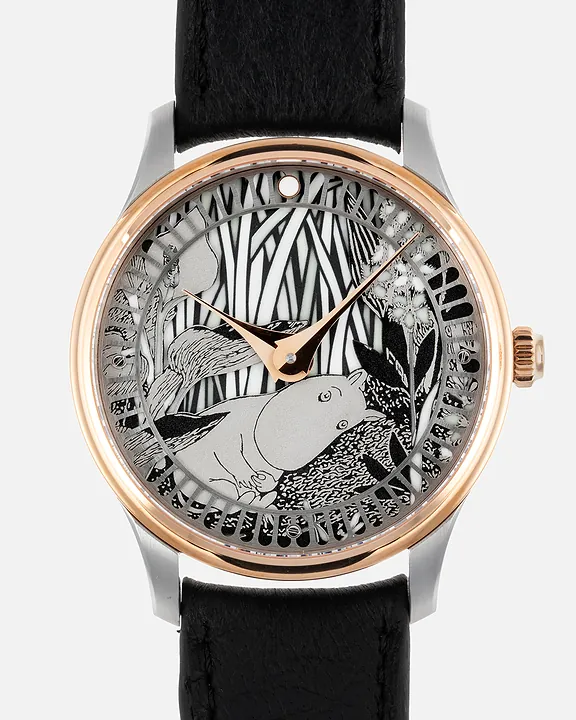
Sarpaneva S.U.F. Moomin 'The Hour Glass' Edition, 2021
S.Song Watches (dealer), Seattle
Wristwatches · 2020
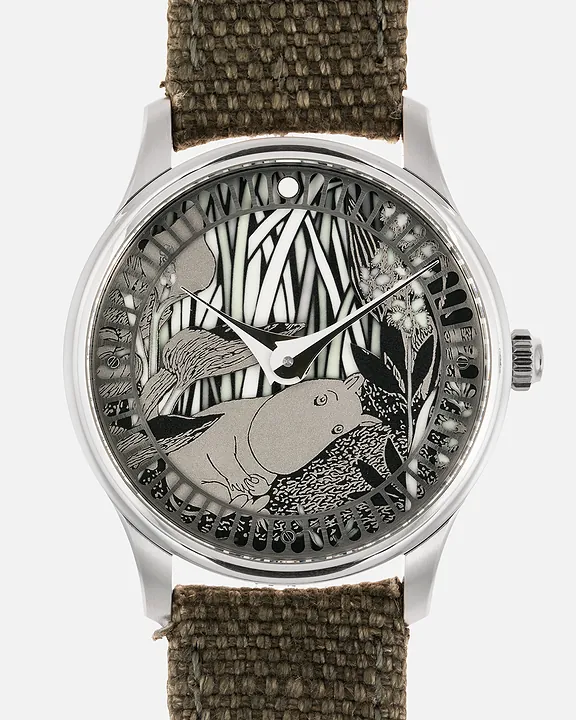
Sarpaneva S.U.F. Moomin, 2020
S.Song Watches (dealer), Seattle
Wristwatches · 2010
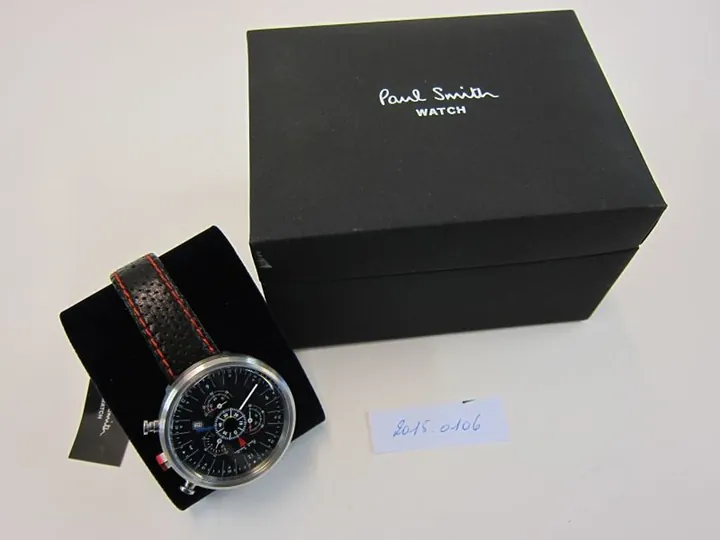
Wristwatch, 2010
Modemuseum Hasselt
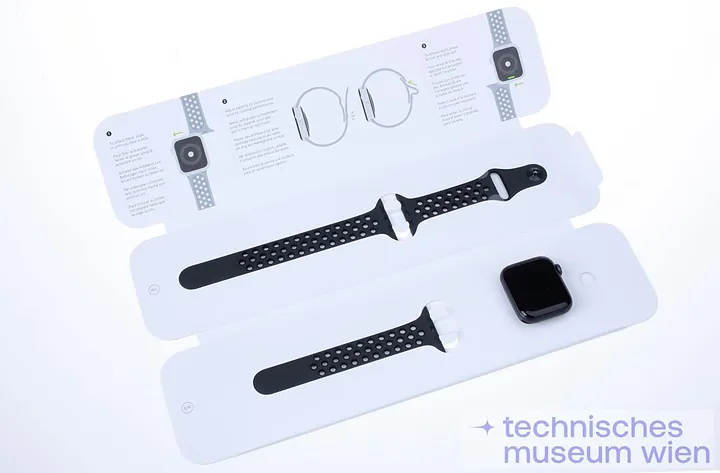
Wristwatches · 2018 (Series 4 released in September 2018; '1977' in the source is the model number A1977)
Apple Watch Series 4 (GPS, 40 mm, model A1977), 2018
Vienna Museum of Science and Technology
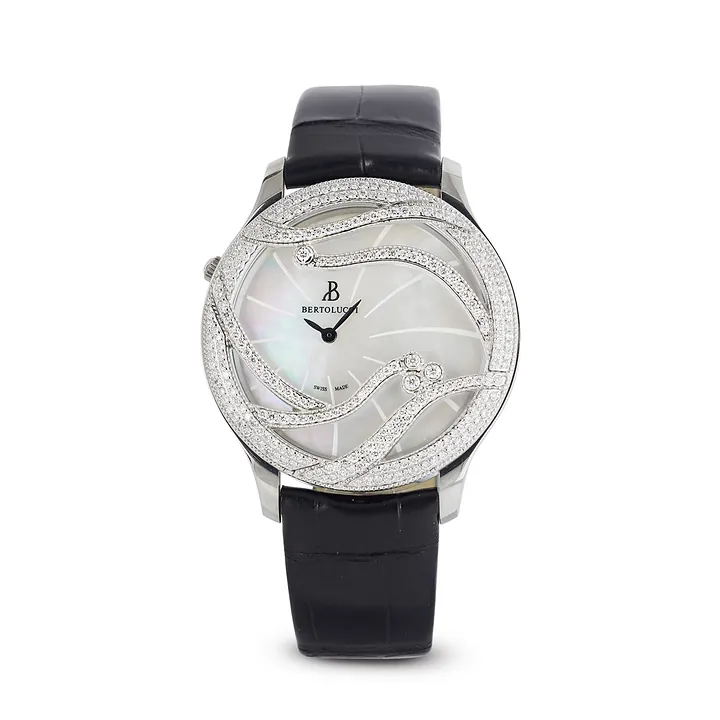
Wristwatches · c. 2010s
Bertolucci Stria III, ref. 11513.50.45.B88.6C1.501, c. 2010s
Antiquorum auction archive, Geneva
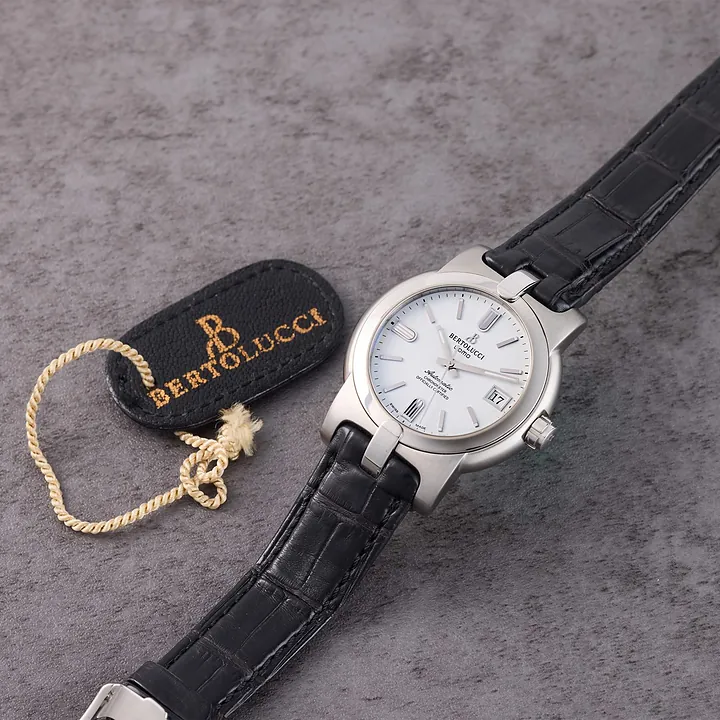
Wristwatches · c. 2010s
Bertolucci Uoma, ref. 824.51.41.10B, c. 2010s
Antiquorum auction archive, Geneva

Wristwatches · c. 2010s
Breguet Type XXI, ref. 3810, c. 2010s (Antiquorum Lot 381-24)
Antiquorum auction archive, Geneva

Wristwatches · c. 2010s
Breguet Type XXI, ref. 3810, c. 2010s (Antiquorum Lot 386-229)
Antiquorum auction archive, Geneva