
Wristwatches · Wristwatch
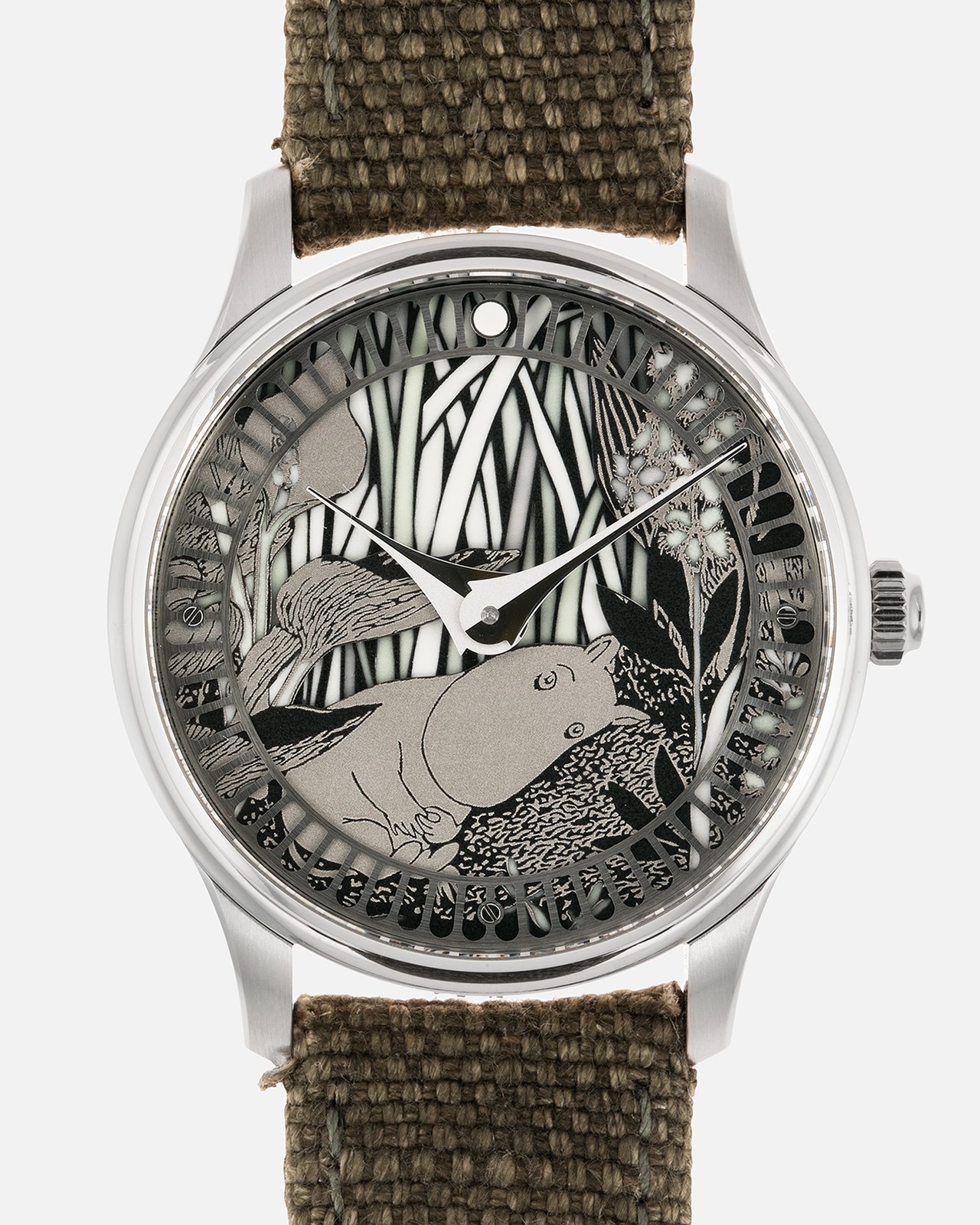
Sarpaneva S.U.F. Moomin, 2020
- Maker / attribution
- Sarpaneva (maker)
- Date
- 2020
- Historical period
- Contemporary Horology (2010 – Present)
- Country of origin
- Unrecorded in source
- Object type
- Wristwatch
- Dimensions
- Case 38.7 mm
- Stock no.
- Product 6767110553687
- Credit line
- Dealer listing, S.Song Watches (product 6767110553687)
- Catalogue title (original)
- Sarpaneva S.U.F. Moomin (English)
View the source record (dealer listing) ↗ (opens another website in a new tab)Suggest a correction
Record summary
Catalogued by S.Song Watches (dealer), Seattle (stock number Product 6767110553687), this is a wristwatch by Sarpaneva, dated 2020. The Atlas places it in the Contemporary Horology period (2010 – Present) of its Wristwatches collection. Recorded dimensions: Case 38.7 mm. The record is illustrated with 6 photographs.
Assembled from the source record's structured fields. Dates and attributions are given as the source states them; where a field is missing the Atlas leaves it blank rather than estimating.
Catalogue description
Dealer description — S.Song Watches
While not exactly known for horology like some other countries, Finland undoubtedly possesses one of the most unique and distinctive independent watchmakers in the industry- Sarapeneva. Known for his frowning moon-faced watches, the brand has grown in recent times with a cult-like following. Launched in 2020 to celebrate the 75th anniversary of one of the most famous comic strips in the world, The Moomins- Sarapaneva, under his more affordable S.U.F. line, launched the Moomin as an ode to the iconic comic strip's characters, design, and position within Scandinavian culture. Considering its fantastical inspiration, the Moomin's construction is certainly rather sensible given its 38.7mm stainless steel case featuring a simple domed bezel with polished and brushed surfaces, and pronounced lugs that flow with the case. Strapped to a green canvas strap, the Moomin's entire aesthetic is monochromatic, with its dial taking on several shades of grey. That being said, there is more that lies in the Moomin's dial than first meets the eye. Fitted with interesting blued steel hands, at first glance, the Moomin's only source of colour is its hands, with Moomin, the cartoon character, and the scene around him all devoid of colour. Yet, in the dark, the dial takes the appearance of stained glass with greens, blues and oranges, all lighting up the Moomin's dial in the dark with eight different colours thanks to hand-painted Technicolour Super-Luminova. Limited to just 75 pieces across three-hand colours with 25 pieces each, this is a rare watch from a unique independent watchmaker that certainly knows how to create some truly stunning watches. With many watch collectors nostalgic for the Moomins together with the uniqueness and fun of the luminous multi-coloured dial, this S.U.F. Moomin was a huge sit, selling out instantly and becoming hugely desirable.
Historical context
Contemporary Horology (2010 – Present)
Silicon components, connected watches, optical-lattice research clocks and a thriving independent scene.
Smartwatches became the world's best-selling watches, while mechanical watchmaking focuses on craft, innovation (silicon components, new escapements) and independent makers.
Read the period in the timelineMore wristwatches from this periodEarlier: Mechanical Renaissance
Atlas type guide
Wristwatches
Bracelet watches were worn by women from the early nineteenth century — Breguet made one for Caroline Murat, Queen of Naples, in 1810–12 — but the wristwatch only became a man's instrument with military use and aviation in the early twentieth century. Between the World Wars it overtook the pocket watch; the 1920s and 1930s brought rectangular Art Deco cases, water-resistant cases and the first automatic winding systems.
After 1945 the wristwatch became a carrier of identity — dress watches, sports and dive watches, chronographs, calendars — produced by Swiss, American, Japanese, German, Soviet and Chinese industries. The quartz revolution after 1969 and the mechanical renaissance since the 1990s, including the rise of independent watchmakers, complete the story.
What to look for
- The reference number (between the lugs or inside the case back) and serial number, the starting point for dating.
- The calibre: its maker and number are often stamped under the dial or on the bridge.
- Originality of dial, hands and crown — refinished ('redial') dials are common.
- Case material marks: 18K/750, 14K/585, stainless steel, gold-filled, plated.
Dating clues
- Wire-lug cases: before c. 1925.
- Water-resistant screw-down cases: from 1926.
- Quartz movements: from 1969; sapphire crystals widespread after c. 1980.
General guidance written by the Atlas editors about this kind of object. It is not a statement about this particular piece; for that, rely on the source record above and on physical examination.
Related records
Wristwatches · 2020
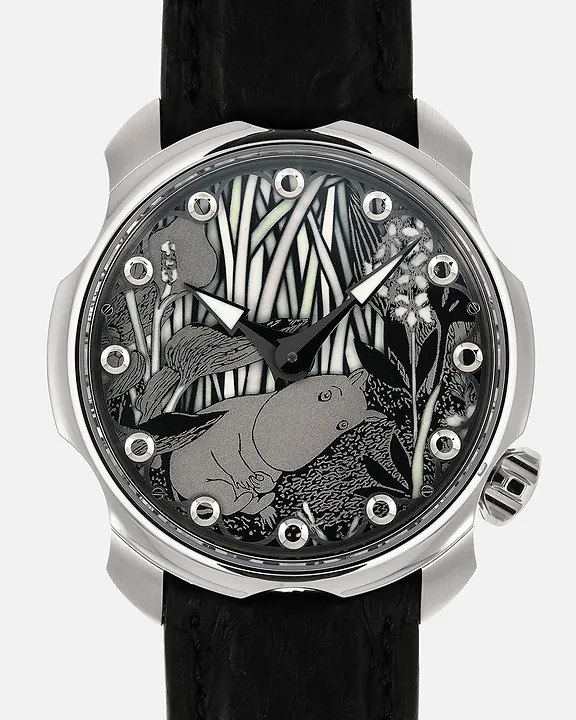
Sarpaneva X Moomin ‘Pitch Black, 2020
S.Song Watches (dealer), Seattle
Wristwatches · 2021
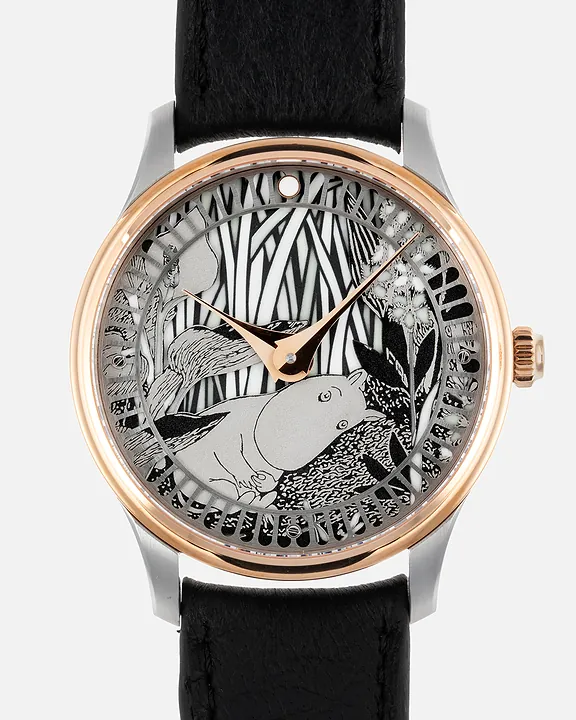
Sarpaneva S.U.F. Moomin 'The Hour Glass' Edition, 2021
S.Song Watches (dealer), Seattle
Wristwatches · 2010
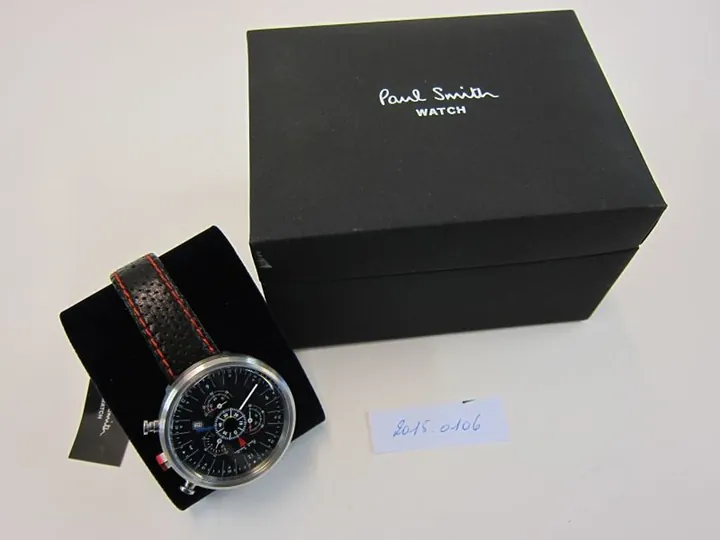
Wristwatch, 2010
Modemuseum Hasselt
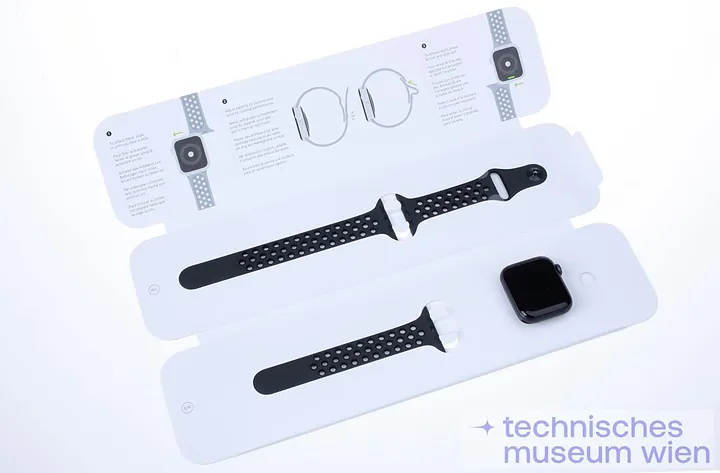
Wristwatches · 2018 (Series 4 released in September 2018; '1977' in the source is the model number A1977)
Apple Watch Series 4 (GPS, 40 mm, model A1977), 2018
Vienna Museum of Science and Technology
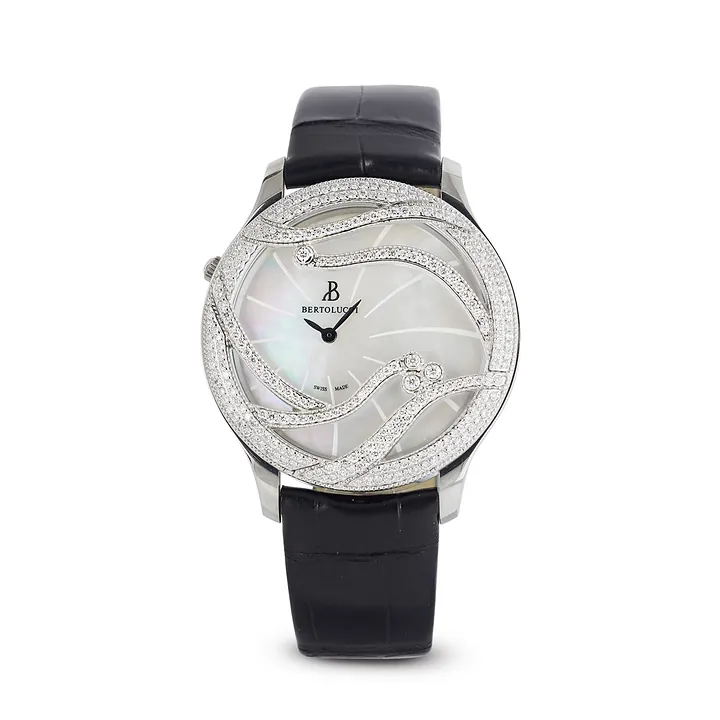
Wristwatches · c. 2010s
Bertolucci Stria III, ref. 11513.50.45.B88.6C1.501, c. 2010s
Antiquorum auction archive, Geneva
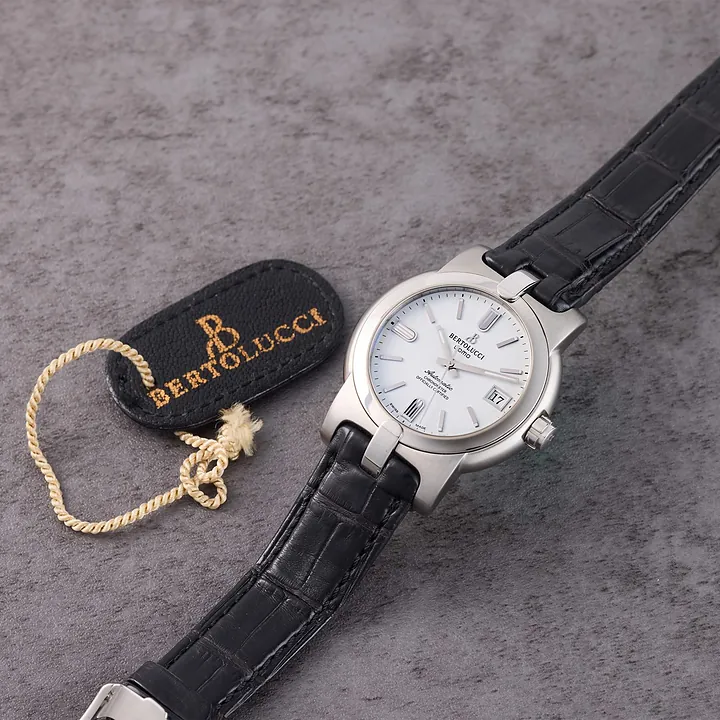
Wristwatches · c. 2010s
Bertolucci Uoma, ref. 824.51.41.10B, c. 2010s
Antiquorum auction archive, Geneva

Wristwatches · c. 2010s
Breguet Type XXI, ref. 3810, c. 2010s (Antiquorum Lot 381-24)
Antiquorum auction archive, Geneva

Wristwatches · c. 2010s
Breguet Type XXI, ref. 3810, c. 2010s (Antiquorum Lot 386-229)
Antiquorum auction archive, Geneva