
Wristwatches · Wristwatch
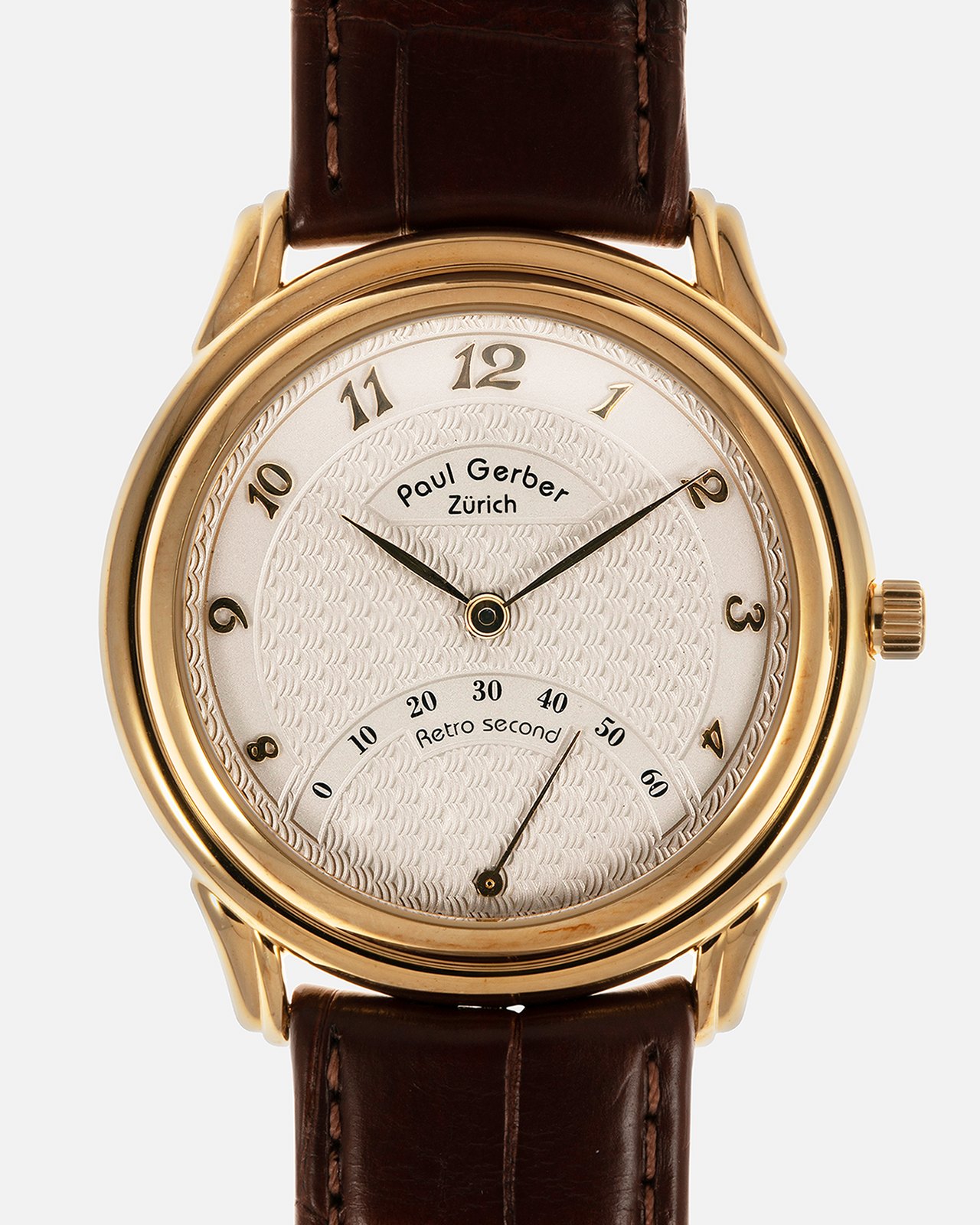
Paul Gerber Retro Second 153SP YG, 2024
- Maker / attribution
- Paul Gerber (maker)
- Date
- 2024
- Historical period
- Contemporary Horology (2010 – Present)
- Country of origin
- Unrecorded in source
- Object type
- Wristwatch
- Dimensions
- Case 36 mm
- Stock no.
- Product 7425144750167
- Credit line
- Dealer listing, S.Song Watches (product 7425144750167)
- Catalogue title (original)
- Paul Gerber Retro Second 153SP YG (English)
View the source record (dealer listing) ↗ (opens another website in a new tab)Suggest a correction
Record summary
Catalogued by S.Song Watches (dealer), Seattle (stock number Product 7425144750167), this is a wristwatch by Paul Gerber, dated 2024. The Atlas places it in the Contemporary Horology period (2010 – Present) of its Wristwatches collection. Recorded dimensions: Case 36 mm. The record is illustrated with 6 photographs.
Assembled from the source record's structured fields. Dates and attributions are given as the source states them; where a field is missing the Atlas leaves it blank rather than estimating.
Catalogue description
Dealer description — S.Song Watches
As an avid lover of independent watchmaking, I’ve come to realise that some timepieces in this realm demand more than just a general appreciation for horology; they call for a deeper understanding of the nuances, philosophies, and technical thinking that shape them. The watch on offer today, the Paul Gerber Retro Second 153SP, is one such example. Paul Gerber may not be the first name to come up in conversations about independent watchmaking—unless you're a seasoned enthusiast with your ear to the ground—but within the world of haute horlogerie, he commands a quiet reverence. Operating from his Zurich atelier since 1976 and now semi-retired, Gerber is a longstanding member of the esteemed AHCI (Académie Horlogère des Créateurs Indépendants). Over the decades, he has built a legacy defined by technical brilliance, understated innovation, and fearless creativity. As a watchmaker, Paul Gerber has never shied away from unconventional ideas. His creations are highly technical, full of character, and often fly under the radar of the mainstream. Yet for those in the know, a Paul Gerber timepiece is a rare and compelling embodiment of independent watchmaking at its most imaginative. This ethos is perhaps best illustrated by his collaborative work with Franck Muller on the Superbia Humanitatis —recognised by Guinness World Records in 2005 as the most complicated wristwatch ever made at the time, with a staggering 1,116 components. Gerber also holds the distinction of creating the smallest wooden clock, with a movement just 2.2 cm high, and earlier on in 1997, he also helped develop the Cal. F2001-5 alarm movement for Fortis’s pioneering automatic chronograph with an integrated mechanical alarm function. Starting with the 153SP’s well-proportioned 36mm x 8.5mm case, the case alone is an ornate work of art. Crafted from 18-carat yellow gold, it showcases a distinctive double-stepped design that extends seamlessly from the bezel onto its elegantly tapered lugs. Encased within is a dial that appears understated at first glance. Aesthetically, it straddles the fine line between classical and modern, thanks to an intricate engine-turned guilloché motif that spans across the entire dial’s surface. A finely blasted chapter ring on the top half frames the elegant Breguet numeral markers, while a cartouche bearing the brand logo sits proudly at 12:00. At the centre are a set of matching gold feuille hands, elegant in form, yet understated enough to let the dial's textures and layout take the spotlight. Finally, arguably the most distinctive feature is the 60-second retrograde seconds display positioned on the lower half of the dial—a complication that, according to some sources, Paul Gerber himself pioneered. Though minimal in its appearance, the dial offers a wealth of detail that rewards close inspection. Like the man himself, the 153SP’s design is not only impeccably refined but also quietly captivating. Powering the 153SP from within is the Paul Gerber manual-winding Cal. 15, a heavily modified Peseux 7001. While the base Peseux 7001 calibre originally features a standard sub-seconds design, Gerber extensively reworked it to accommodate a retrograde seconds mechanism. To achieve this, he developed a unique three-part brass ring that sits atop the movement and houses the retrograde mechanism. The main ring is milled with precise cutouts, while the other two sections serve as bridges to support the rack, pinion, and spring. Once the ring is in place, the spring, rack, and cam are then carefully assembled. The hairspring, extremely delicate, is shaped and tuned to provide just the right amount of torque to snap the seconds hand back without affecting overall timekeeping. The cam is then meticulously adjusted to ensure smooth travel and a crisp, reliable reset of the seconds hand as each minute passes. Though the concept may sound straightforward when described in words, building and fine-tuning the retrograde system from scratch is incredibly challenging and time-consuming due to the intricacies of each component involved. As mentioned earlier, the Retro Second 153SP is a timepiece that appears simple from a distance, but its true character emerges upon closer inspection. For collectors seeking a subtle-looking yet highly technical addition to their rotation, this is an opportunity to own a piece of independent watchmaking from a celebrated, yet often underappreciated, master watchmaker who infuses his work with both ingenuity and distinctive personality.
Historical context
Contemporary Horology (2010 – Present)
Silicon components, connected watches, optical-lattice research clocks and a thriving independent scene.
Smartwatches became the world's best-selling watches, while mechanical watchmaking focuses on craft, innovation (silicon components, new escapements) and independent makers.
Read the period in the timelineMore wristwatches from this periodEarlier: Mechanical Renaissance
Atlas type guide
Wristwatches
Bracelet watches were worn by women from the early nineteenth century — Breguet made one for Caroline Murat, Queen of Naples, in 1810–12 — but the wristwatch only became a man's instrument with military use and aviation in the early twentieth century. Between the World Wars it overtook the pocket watch; the 1920s and 1930s brought rectangular Art Deco cases, water-resistant cases and the first automatic winding systems.
After 1945 the wristwatch became a carrier of identity — dress watches, sports and dive watches, chronographs, calendars — produced by Swiss, American, Japanese, German, Soviet and Chinese industries. The quartz revolution after 1969 and the mechanical renaissance since the 1990s, including the rise of independent watchmakers, complete the story.
What to look for
- The reference number (between the lugs or inside the case back) and serial number, the starting point for dating.
- The calibre: its maker and number are often stamped under the dial or on the bridge.
- Originality of dial, hands and crown — refinished ('redial') dials are common.
- Case material marks: 18K/750, 14K/585, stainless steel, gold-filled, plated.
Dating clues
- Wire-lug cases: before c. 1925.
- Water-resistant screw-down cases: from 1926.
- Quartz movements: from 1969; sapphire crystals widespread after c. 1980.
General guidance written by the Atlas editors about this kind of object. It is not a statement about this particular piece; for that, rely on the source record above and on physical examination.
Related records
Wristwatches · 2024
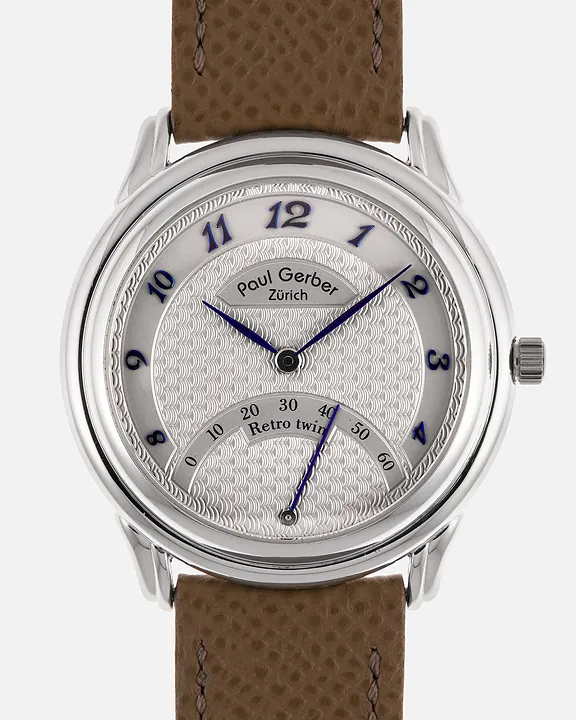
Paul Gerber Retro Twin Ref. 157 White Gold, 2024
S.Song Watches (dealer), Seattle
Wristwatches · 2010
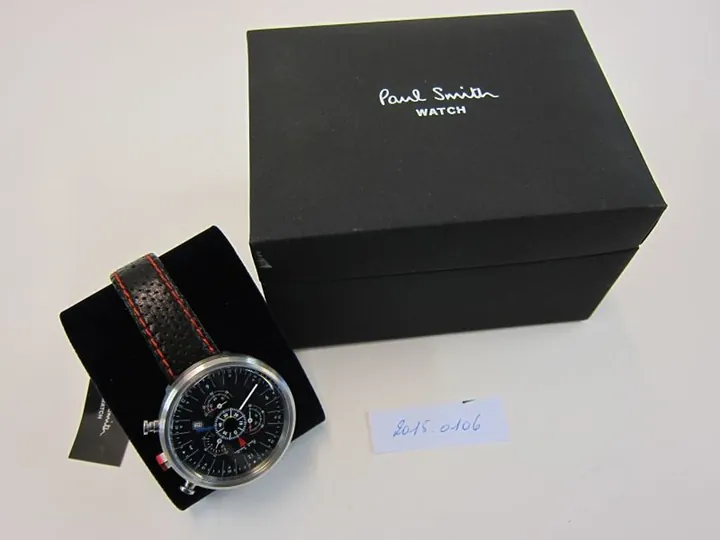
Wristwatch, 2010
Modemuseum Hasselt
Wristwatches · 2018 (Series 4 released in September 2018; '1977' in the source is the model number A1977)
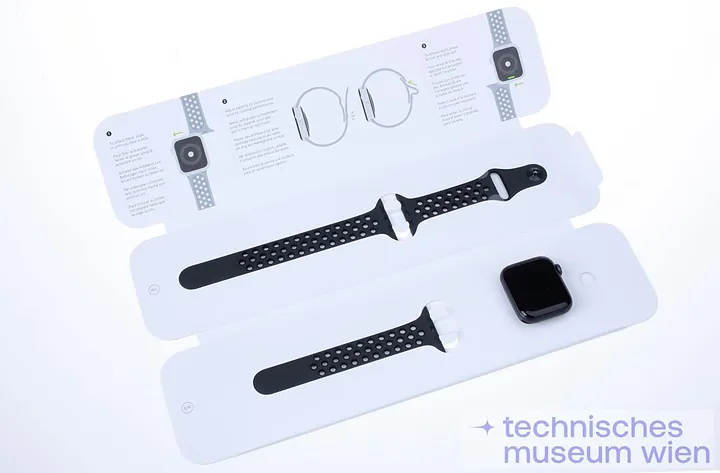
Apple Watch Series 4 (GPS, 40 mm, model A1977), 2018
Vienna Museum of Science and Technology
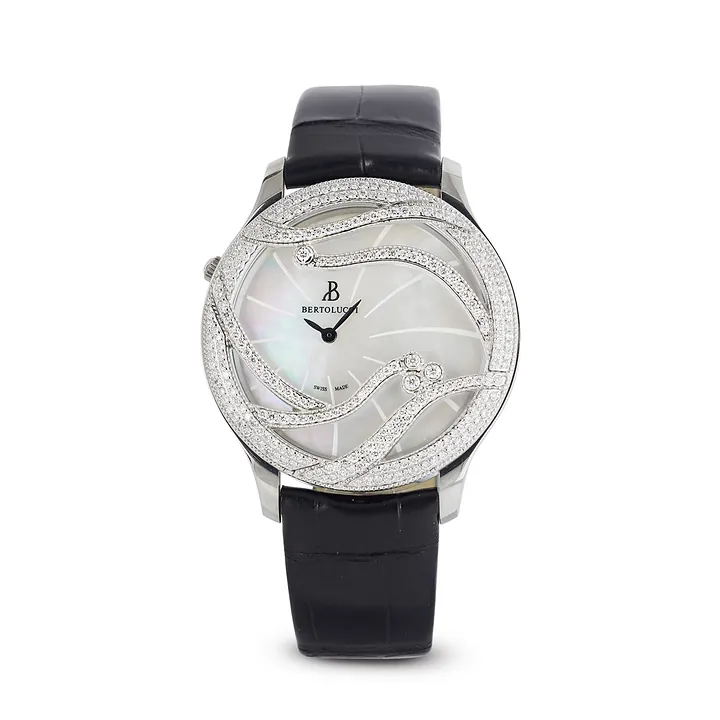
Wristwatches · c. 2010s
Bertolucci Stria III, ref. 11513.50.45.B88.6C1.501, c. 2010s
Antiquorum auction archive, Geneva
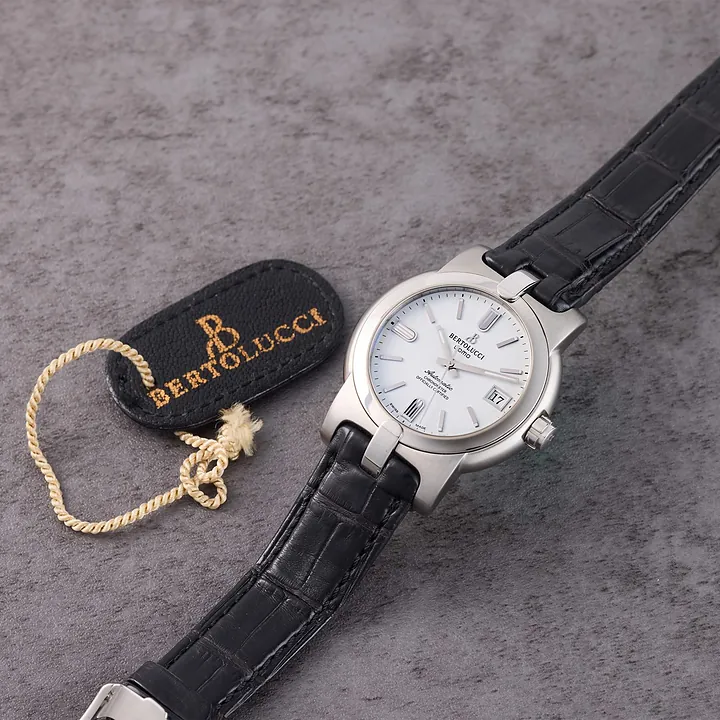
Wristwatches · c. 2010s
Bertolucci Uoma, ref. 824.51.41.10B, c. 2010s
Antiquorum auction archive, Geneva

Wristwatches · c. 2010s
Breguet Type XXI, ref. 3810, c. 2010s (Antiquorum Lot 381-24)
Antiquorum auction archive, Geneva

Wristwatches · c. 2010s
Breguet Type XXI, ref. 3810, c. 2010s (Antiquorum Lot 386-229)
Antiquorum auction archive, Geneva

Wristwatches · Sold in September 2010
Breitling Cosmonaute, ref. A 22322, Sold in September 2010
Antiquorum auction archive, Geneva