
Wristwatches · Wristwatch
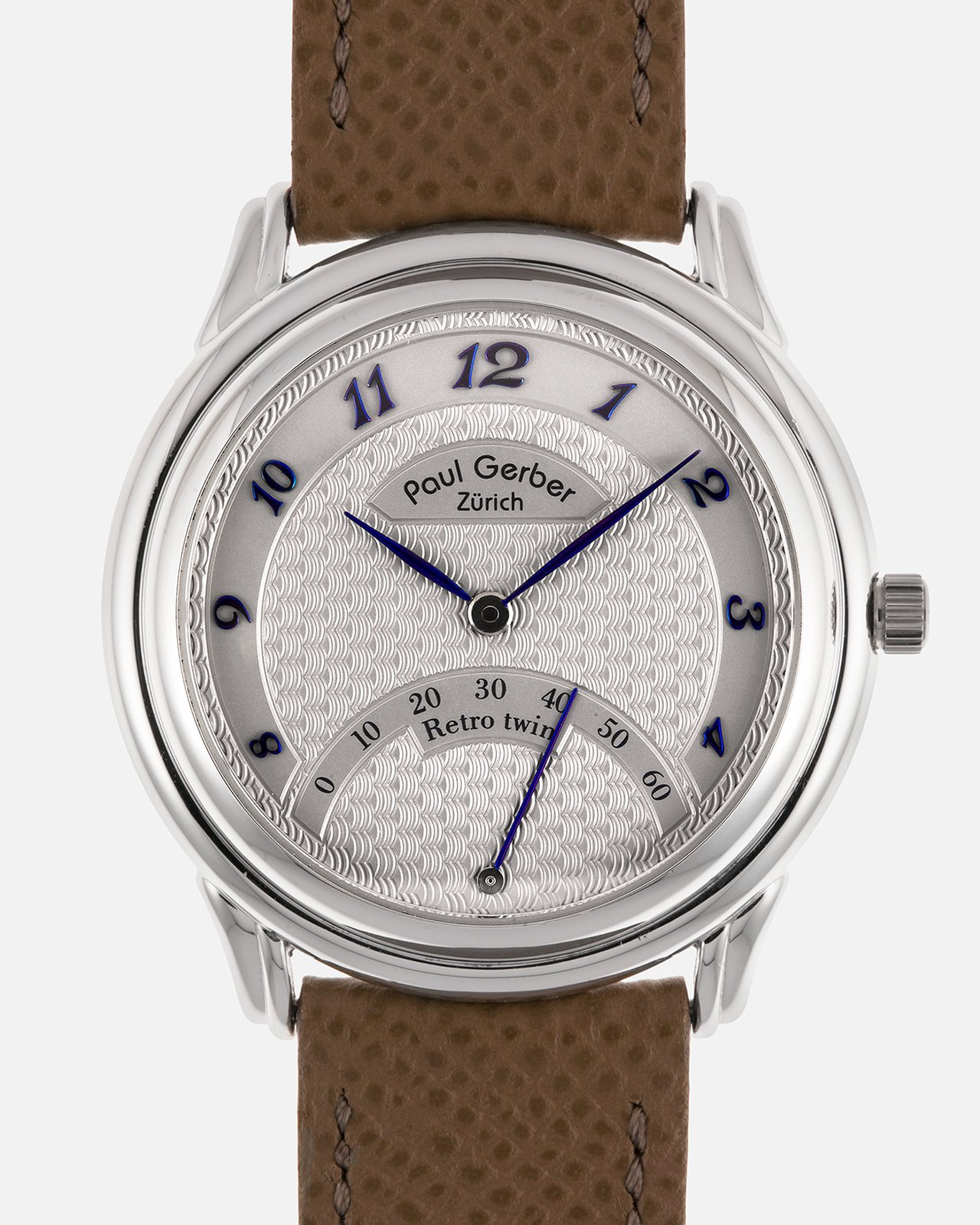
Paul Gerber Retro Twin Ref. 157 White Gold, 2024
- Maker / attribution
- Paul Gerber (maker)
- Date
- 2024
- Historical period
- Contemporary Horology (2010 – Present)
- Country of origin
- Unrecorded in source
- Object type
- Wristwatch
- Materials / technique
- white gold
- Dimensions
- Case 36 mm
- Stock no.
- Product 7717319245911
- Credit line
- Dealer listing, S.Song Watches (product 7717319245911)
- Catalogue title (original)
- Paul Gerber Retro Twin Ref. 157 White Gold (English)
View the source record (dealer listing) ↗ (opens another website in a new tab)Suggest a correction
Record summary
Catalogued by S.Song Watches (dealer), Seattle (stock number Product 7717319245911), this is a wristwatch by Paul Gerber, dated 2024. The Atlas places it in the Contemporary Horology period (2010 – Present) of its Wristwatches collection. Materials and techniques recorded by the source: white gold. Recorded dimensions: Case 36 mm. The record is illustrated with 6 photographs.
Assembled from the source record's structured fields. Dates and attributions are given as the source states them; where a field is missing the Atlas leaves it blank rather than estimating.
Catalogue description
Dealer description — S.Song Watches
Long before independent watchmaking became fashionable, Paul Gerber had already established himself as one of the industry's great technical minds. Working from his atelier in Zürich since the 1970s, Gerber quietly earned the respect of fellow watchmakers through a remarkable catalogue of inventions, modifications, and complications. A long-standing member of the AHCI, he is perhaps best known for his work behind the scenes, having contributed to some of modern horology's most ambitious projects, including the legendary Franck Muller ‘Superbia Humanitatis’. Yet despite these achievements, Gerber's own watches remain surprisingly underappreciated, produced in very small numbers and admired primarily by those who appreciate independent watchmaking in its purest form. The Retro Twin perfectly encapsulates that philosophy. Introduced in 2001 as the successor to the Retro Second, it retained Gerber's patented flyback retrograde seconds display while introducing one of the most fascinating automatic winding systems ever conceived. Instead of relying on a conventional central rotor, the movement employs two overlapping platinum micro rotors that rotate independently on different planes, their paths intersecting without ever touching one another. The result is not only a highly efficient winding system but also one of the most visually captivating movements of the modern era, offering an extraordinary sense of depth that changes constantly as the twin rotors dance across the movement. Even today, more than two decades later, it remains unlike anything else in watchmaking. Here we have the Paul Gerber Retro Twin Ref. 157 in 18-carat white gold. While technically driven by its remarkable movement, the watch is equally distinguished by its understated elegance. The stepped case is unlike anything else on the market, with beautifully sculpted lugs that appear to flow effortlessly away from the caseband, giving the watch an architectural quality that feels both classical and contemporary. Measuring just 36mm in diameter, it embraces proportions that have aged remarkably well, allowing every detail to remain perfectly balanced. The dial is no less impressive. Executed in silver with multiple layers of engine-turned guilloché, it displays an extraordinary level of craftsmanship without ever feeling excessive. The outer chapter ring is framed by delicately engraved borders, while the centre and retrograde seconds register each feature their own distinct guilloché patterns, creating subtle changes in texture as light moves across the surface. Blued Breguet numerals and elegant leaf hands provide a striking contrast against the silver backdrop, lending the watch a quiet vibrancy that photographs rarely manage to capture. The retrograde seconds indication at 6:00 remains the defining visual feature of the dial, its hand sweeping gracefully through sixty seconds before instantly snapping back to zero in one fluid motion. Turning the watch over reveals the true masterpiece. Based on a heavily reworked Peseux 700 architecture, Gerber's Calibre 15 is transformed into something entirely unique through the addition of the patented twin-rotor winding system and retrograde seconds mechanism. While the engineering itself is remarkable, what truly distinguishes the movement is its three-dimensional architecture. The overlapping platinum rotors create an ever-changing landscape of bridges, gears, screws, and wheels beneath them, producing an almost kinetic sculpture that rewards prolonged observation. Finished entirely by hand with circular graining, polished bevels, and heat-blued screws throughout, the movement embodies everything enthusiasts admire about independent watchmaking: technical ingenuity paired with traditional craftsmanship. As far as wearability goes, the 36mm white gold case sits beautifully on the wrist. Its compact proportions are complemented by the elongated sculptural lugs, giving the watch a presence that feels larger than its dimensions might suggest. Measuring 11mm thick, the stepped case and lugs cleverly disguise its height, creating the illusion of a much slimmer watch while allowing the remarkable depth of the movement to be fully appreciated. It is a thoughtful piece of design that perfectly complements the technical ingenuity found within. Independent watchmaking may enjoy more attention today than ever before, but Paul Gerber has never seemed interested in the spotlight. He has simply continued working away with the same quiet dedication that has defined his career for decades. If there is an underappreciated master of independent watchmaking, Paul Gerber is surely one of them.
Historical context
Contemporary Horology (2010 – Present)
Silicon components, connected watches, optical-lattice research clocks and a thriving independent scene.
Smartwatches became the world's best-selling watches, while mechanical watchmaking focuses on craft, innovation (silicon components, new escapements) and independent makers.
Read the period in the timelineMore wristwatches from this periodEarlier: Mechanical Renaissance
Atlas type guide
Wristwatches
Bracelet watches were worn by women from the early nineteenth century — Breguet made one for Caroline Murat, Queen of Naples, in 1810–12 — but the wristwatch only became a man's instrument with military use and aviation in the early twentieth century. Between the World Wars it overtook the pocket watch; the 1920s and 1930s brought rectangular Art Deco cases, water-resistant cases and the first automatic winding systems.
After 1945 the wristwatch became a carrier of identity — dress watches, sports and dive watches, chronographs, calendars — produced by Swiss, American, Japanese, German, Soviet and Chinese industries. The quartz revolution after 1969 and the mechanical renaissance since the 1990s, including the rise of independent watchmakers, complete the story.
What to look for
- The reference number (between the lugs or inside the case back) and serial number, the starting point for dating.
- The calibre: its maker and number are often stamped under the dial or on the bridge.
- Originality of dial, hands and crown — refinished ('redial') dials are common.
- Case material marks: 18K/750, 14K/585, stainless steel, gold-filled, plated.
Dating clues
- Wire-lug cases: before c. 1925.
- Water-resistant screw-down cases: from 1926.
- Quartz movements: from 1969; sapphire crystals widespread after c. 1980.
General guidance written by the Atlas editors about this kind of object. It is not a statement about this particular piece; for that, rely on the source record above and on physical examination.
Related records
Wristwatches · 2024
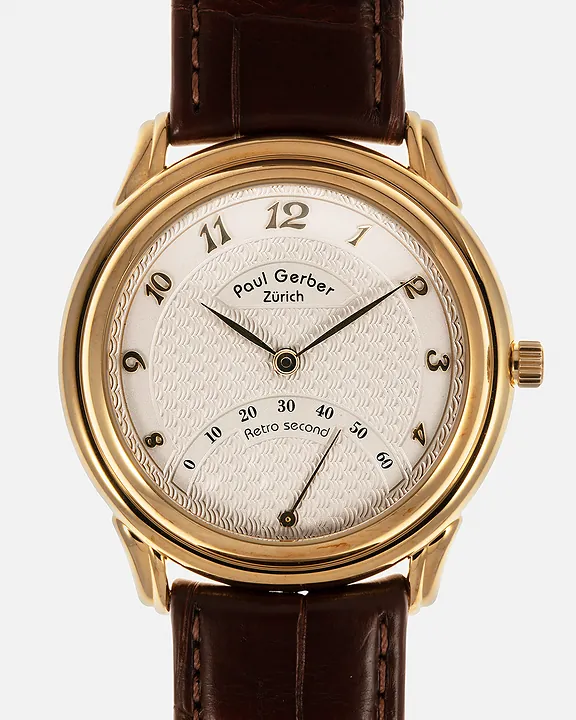
Paul Gerber Retro Second 153SP YG, 2024
S.Song Watches (dealer), Seattle
Wristwatches · 2010
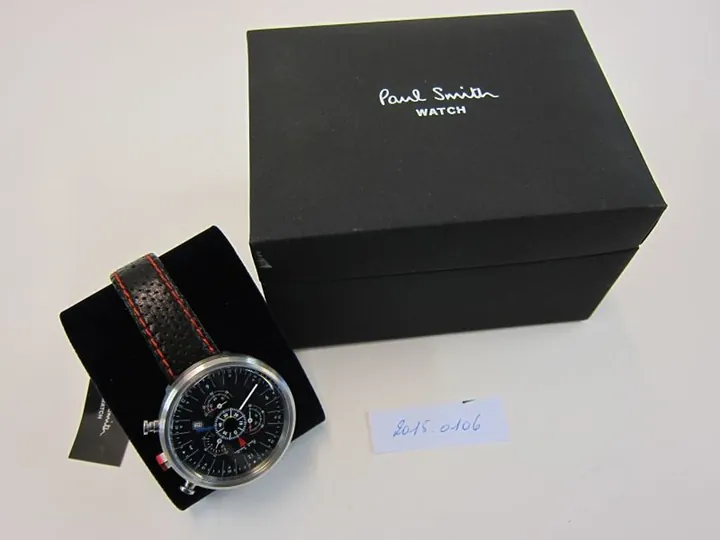
Wristwatch, 2010
Modemuseum Hasselt
Wristwatches · 2018 (Series 4 released in September 2018; '1977' in the source is the model number A1977)
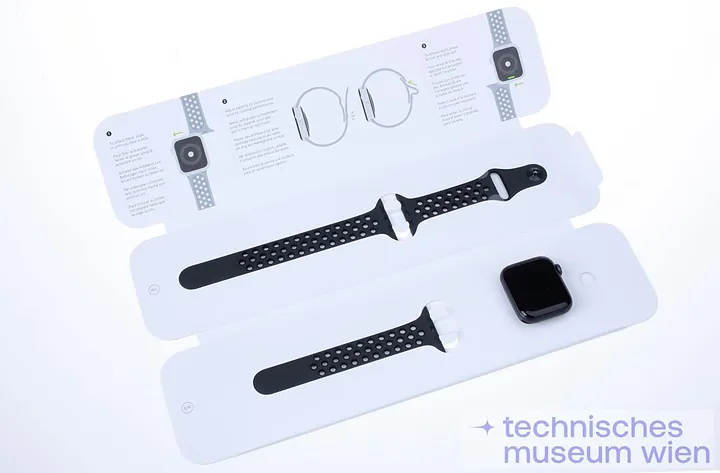
Apple Watch Series 4 (GPS, 40 mm, model A1977), 2018
Vienna Museum of Science and Technology
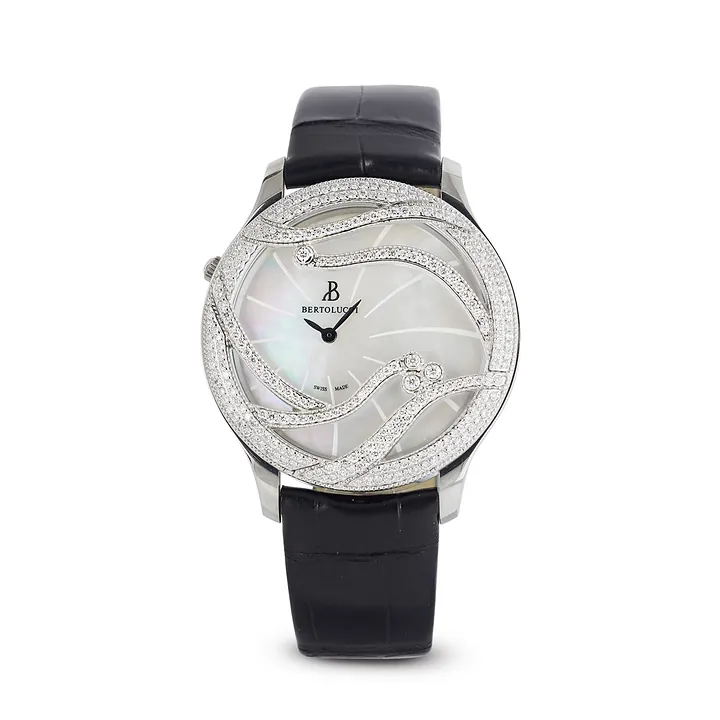
Wristwatches · c. 2010s
Bertolucci Stria III, ref. 11513.50.45.B88.6C1.501, c. 2010s
Antiquorum auction archive, Geneva
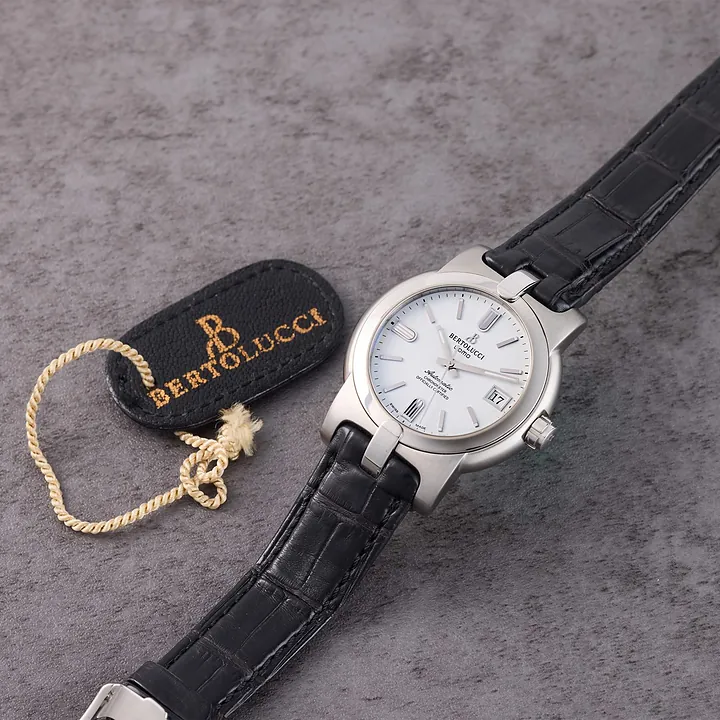
Wristwatches · c. 2010s
Bertolucci Uoma, ref. 824.51.41.10B, c. 2010s
Antiquorum auction archive, Geneva

Wristwatches · c. 2010s
Breguet Type XXI, ref. 3810, c. 2010s (Antiquorum Lot 381-24)
Antiquorum auction archive, Geneva

Wristwatches · c. 2010s
Breguet Type XXI, ref. 3810, c. 2010s (Antiquorum Lot 386-229)
Antiquorum auction archive, Geneva

Wristwatches · Sold in September 2010
Breitling Cosmonaute, ref. A 22322, Sold in September 2010
Antiquorum auction archive, Geneva