
Wristwatches · Wristwatch
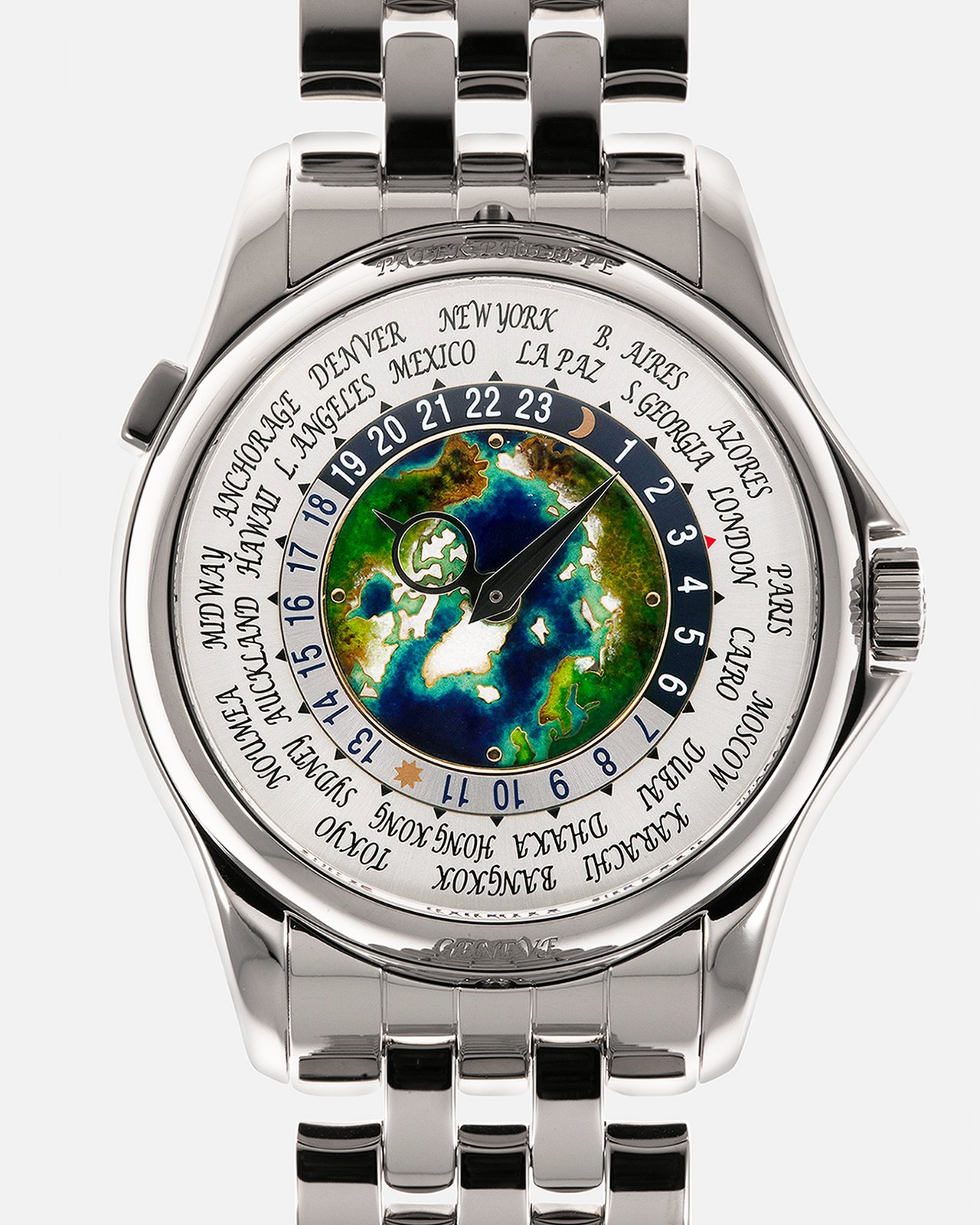
Patek Philippe World Time Cloisonné 5131P, 2021
- Maker / attribution
- Patek Philippe (maker)
- Date
- 2021
- Historical period
- Contemporary Horology (2010 – Present)
- Country of origin
- Switzerland
- Object type
- Wristwatch
- Dimensions
- Case 39.5 mm
- Stock no.
- Product 7551652495447
- Credit line
- Dealer listing, S.Song Watches (product 7551652495447)
- Catalogue title (original)
- Patek Philippe World Time Cloisonné 5131P (English)
View the source record (dealer listing) ↗ (opens another website in a new tab)Suggest a correction
Record summary
Catalogued by S.Song Watches (dealer), Seattle (stock number Product 7551652495447), this is a wristwatch by Patek Philippe, made in Switzerland, dated 2021. The Atlas places it in the Contemporary Horology period (2010 – Present) of its Wristwatches collection. Recorded dimensions: Case 39.5 mm. The record is illustrated with 6 photographs.
Assembled from the source record's structured fields. Dates and attributions are given as the source states them; where a field is missing the Atlas leaves it blank rather than estimating.
Catalogue description
Dealer description — S.Song Watches
Watch brands often have complications that define their identity, and for Patek Philippe, that distinction belongs to the minute repeater or the perpetual calendar chronograph. That being said, there is another complication close behind that the historic watchmaker is just as well known for: the World Time. The World Time is an ingenious and quietly romantic way of showing 24 time zones at once, and Patek Philippe’s connection to this poetic complication goes back to the 1930s through their work with Louis Cottier, the Geneva-based watchmaker who patented the modern mechanism in 1931. By 1937, Patek had already put the complication into a wristwatch, which was the brand’s response to an era of increasingly faster and farther travel. Eight decades later, even in a world where phones tell the time across continents, the world time remains an indispensable pillar of Patek’s catalog of offerings—proof of its timelessness and enduring relevance in the modern world. What we have here is one of the most striking expressions of Patek’s world time—the 5131P. Introduced in yellow gold in 2008 and later in white, pink, and finally platinum in 2017, it quickly became a key reference within the lineage, and its significance only grew after production ended in 2021, with the 5231 eventually taking its place. Beyond the mechanics, the 5131 is a true work of art, featuring a hand-painted cloisonné enamel dial depicting the Earth from a North Pole perspective, an artistic centrepiece we’ll explore in more detail shortly. The 5131P begins with a platinum case measuring 39.5mm × 10.6mm, blending different finishes with an understated elegance, featuring a brushed caseback, a polished mid-case, and a gently rounded bezel. As we all know, world time watches often risk appearing cluttered with text and markers, but Patek avoided this by moving its signature off the dial entirely, engraving “PATEK PHILIPPE” at 12:00 and “GENEVE” at 6:00 on the bezel. A pusher at 10:00 allows quick world-time adjustments, while a small diamond set flushed at 6:00 of the bezel quietly signals the platinum case—a hallmark of all platinum Patek Philippe watches. The case is paired with a full platinum bracelet: lavish, weighty, and unmistakable on the wrist. The hands also remain faithful to traditional world-time styling, with an open-tipped hour hand and a dauphine minute hand that balance clarity with elegance. At the heart of the watch, the dial is where the 5131P truly comes alive. Its cloisonné enamel map is more than decoration; it is a miniature masterpiece. Centered on a North Pole view of the Earth, the map is framed by the famous Cottier 24-hour ring with day/night indication and the outer city ring showing the world’s 24 principal time zones, seamlessly combining practical utility with artistic expression. While we’re on the topic of the dial, I believe it’s worth elaborating on the complexities of the cloisonné enamel technique employed by Patek, because this is where the 5131 truly shines. This is a highly detailed process which begins with fine gold wires shaped specifically to outline each continent and applied to a base plate. The spaces within these partitions (or cloisons) are then meticulously filled with enamel paste and fired multiple times in a kiln, gradually building the rich colours and subtle depth that make each map unique. The entire process is painstaking and unforgiving; even a speck of dust or minor error can compromise hours of effort. Because each dial is made entirely by hand, no two are ever identical, and production remains extremely limited, with only a handful of enamel artisans creating fewer than 40 dials per year. The result is a miniature work of art that reflects both Patek’s technical mastery and its commitment to craft. Powering the 5131P from within is Patek Philippe’s self-winding Cal. 240 HU, abbreviated for “ Heures Universelle ”, or world-time. Through the exhibition caseback, you can admire the beautifully finished calibre in full view: a patented Gyromax balance wheel, a self-compensating free-sprung balance spring, a 22-carat gold micro-rotor, and beautiful Côte de Genève (Geneva Stripes) finishing throughout. It also bears the Patek Philippe Seal, the standard introduced by Patek in 2009 to guarantee precision, finishing, and overall craftsmanship. Fully wound, the Cal. 240 HU offers a power reserve of up to 48 hours. Once a tool for guiding travellers through a rapidly globalising world, the world time complication now serves as a poetic reminder of an era when watchmaking combined function and artistry. Ideal for those whose interests span multiple cities and cultures, owning a world time like the 5131 today isn’t about checking the hour in Paris or Tokyo—it’s about carrying that spirit of curiosity, appreciating a craft honed over generations, and wearing a watch that quietly reflects how you move through the world and the perspective you bring to it. There’s also a certain naïve magic in the idea of wearing the world on your wrist, a charm that I, along with many fellow enthusiasts, find deeply compelling.
Historical context
Contemporary Horology (2010 – Present)
Silicon components, connected watches, optical-lattice research clocks and a thriving independent scene.
Smartwatches became the world's best-selling watches, while mechanical watchmaking focuses on craft, innovation (silicon components, new escapements) and independent makers.
Read the period in the timelineMore wristwatches from this periodEarlier: Mechanical Renaissance
Atlas type guide
Military, pilot and travel watches
The wristwatch owes much of its adoption by men to warfare and aviation. Wristlets — small pocket watches soldered with lugs and worn on a strap — were used in colonial campaigns and became standard equipment in the First World War, with protective grilles over the crystal ('shrapnel guards'). Louis Cartier's Santos (1904), designed for the aviator Alberto Santos-Dumont, is often cited as an early purpose-made pilot's watch.
In the Second World War governments specified watches in detail: the German B-Uhr observation watches, the American A-11, and the British 'W.W.W.' (the 'Dirty Dozen' set of 1945). After the war, jet travel brought GMT and world-time watches, which show two or more time zones at once — Louis Cottier's world-time mechanism and the Rolex GMT-Master (1955) are examples.
What to look for
- Military markings on the case back: broad arrow, issue numbers, 'W.W.W.', 'A.T.P.'
- High-legibility black dials with luminous Arabic numerals; oversized crowns for gloved hands.
- 24-hour hands and rotating 24-hour bezels or city rings on GMT/world-time watches.
- Wire lugs on early wristlets converted from pocket watches.
Dating clues
- Wire-lug wristlets: c. 1900–1925.
- Military specifications of the Second World War: 1939–1945.
- GMT and world-time wristwatches: mainly after 1950.
General guidance written by the Atlas editors about this kind of object. It is not a statement about this particular piece; for that, rely on the source record above and on physical examination.
Related records

Clocks · 1965–1975
Quartz master clock QM 1, with movement by Patek Phillippe, Switzerland, 1965–1975. Supplied by English Clock Systems.
Science Museum Group, London

Instruments · 1965–1984
Chronometer by Patek Philippe and Kelvin Hughes, England, 1965–1984
Science Museum Group, London

Pocket Watches · c. 1895
Patek Philippe pocket watch, c. 1895
Antiquorum auction archive, Geneva

Pocket Watches · c. 1900
Patek Philippe Chronometro Gondolo, c. 1900
Antiquorum auction archive, Geneva

Wristwatches · c. 2010s
Breguet Type XXI, ref. 3810, c. 2010s (Antiquorum Lot 381-24)
Antiquorum auction archive, Geneva

Wristwatches · c. 2010s
Breguet Type XXI, ref. 3810, c. 2010s (Antiquorum Lot 386-229)
Antiquorum auction archive, Geneva

Wristwatches · Sold in September 2010
Breitling Cosmonaute, ref. A 22322, Sold in September 2010
Antiquorum auction archive, Geneva

Wristwatches · c. 2010
Corum Bubble Chrono, ref. 396.150.20, c. 2010
Antiquorum auction archive, Geneva