
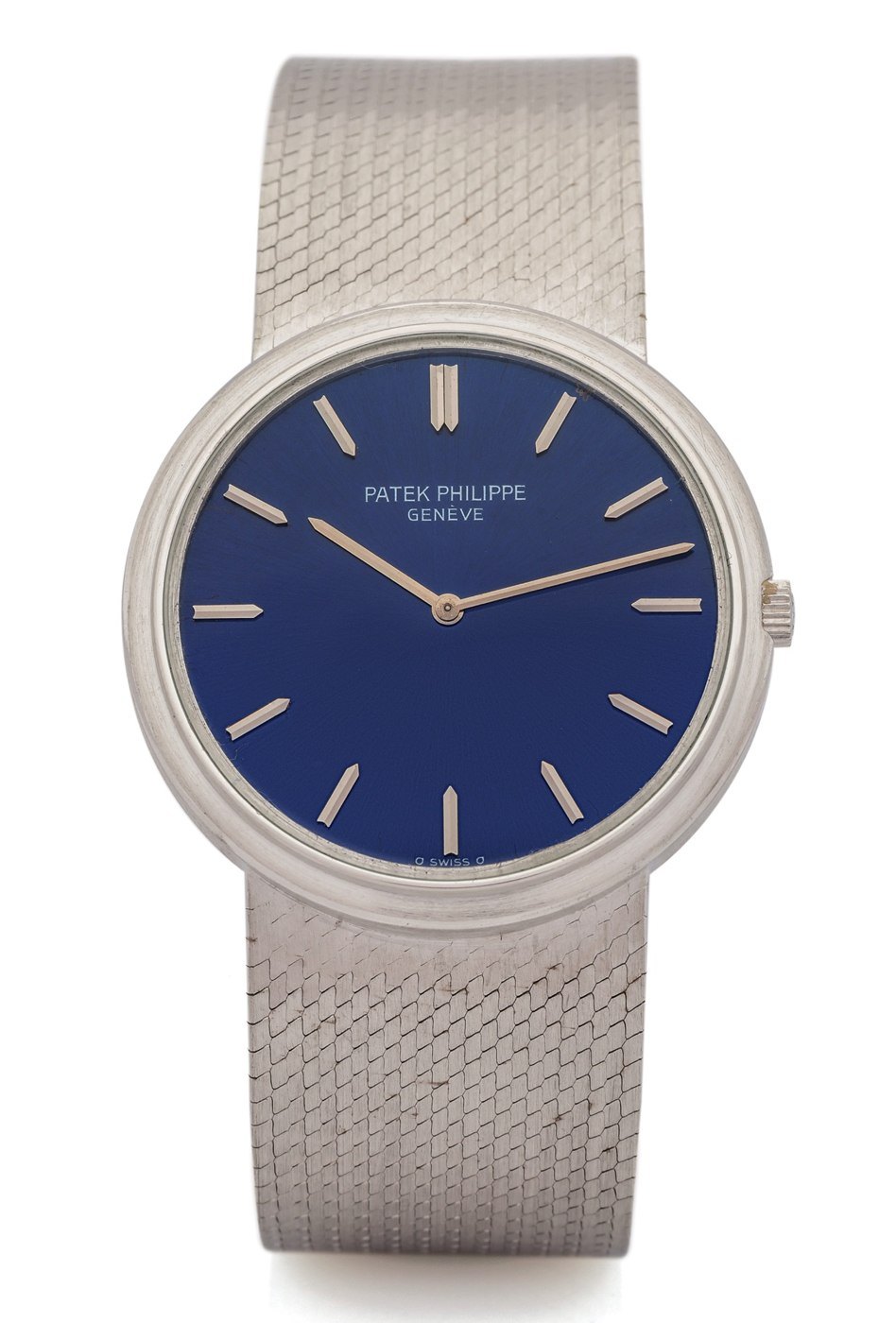
Wristwatches · Self-winding wristwatch
Patek Philippe Ref. 3606/1 Wristwatch
- Maker / attribution
- Patek Philippe (source attribution)
- Date
- 1973
- Historical period
- Quartz Revolution (1969 – 1990)
- Country of origin
- Switzerland
- Object type
- Self-winding wristwatch
- Dimensions
- 33 mm
- Holding institution
- Antiquorum
- Accession / object no.
- 534
- Credit line
- Antiquorum
- Catalogue title (original)
- PATEK PHILIPPE REF. 3602 AUTOMATIC WHITE GOLD \nPatek Philippe, Genève, movement No. 1283817, No. 527282, Ref. 3606/1. Made in \n1973, sold on March 20th, 1974. \nFine, self winding, 18K white gold wr (English)
View the source record ↗ (opens another website in a new tab)Suggest a correction
Record summary
Held and catalogued by Antiquorum (object number 534), this is a self-winding wristwatch attributed to Patek Philippe, made in Switzerland, dated 1973. The Atlas places it in the Quartz Revolution period (1969 – 1990) of its Wristwatches collection. Recorded dimensions: 33 mm. The record is illustrated with 1 photograph.
Assembled from the source record's structured fields. Dates and attributions are given as the source states them; where a field is missing the Atlas leaves it blank rather than estimating.
Catalogue description
Original object description
Dating from 1973 and sold initially in 1974, this self-winding Patek Philippe reference 3606/1 is crafted from 18K white gold. Its two-part brushed and polished case connects to a matching integrated bracelet finished with a linen texture, and it features a sapphire crystal, hooded lugs, and a snap-on back. White gold baton hands and faceted baton indices indicate the hours and minutes against a blue dial. Powering the watch is the rhodium-plated, 36-jewel Calibre 28-255 automatic movement, which bears the Geneva Seal and utilizes a 21K gold outer segment on its winding rotor. This mechanism is fitted with a free-sprung Gyromax balance adjusted across five positions, isochronism, and varied temperatures. An archival extract issued by Patek Philippe accompanies the piece.
Case and Dial Design
Measuring 33 mm in diameter and 7 mm in depth, the solid 18K white gold two-piece case displays contrasting polished and brushed finishes and is sealed with a snap-on metal back. The case flows smoothly into an integrated 18K white gold bracelet adorned with a textured linen pattern, bringing the total closed length to approximately 155 mm; hooded lugs conceal the attachment points to maintain a continuous line. Positioned beneath a protective sapphire crystal, the blue dial is accented with white gold baton hands and matching faceted baton markers.
Movement and Mechanical Specifications
The watch is driven by the automatic Patek Philippe Calibre 28-255, an in-house movement carrying 36 jewels, rhodium finishings, and the Geneva Seal. Its self-winding mechanism is weighted along the periphery by a 21K gold segment for enhanced winding efficiency. The regulating system includes a lever escapement, an integrated shock-protection system, and a free-sprung Gyromax balance combined with a self-compensating flat balance spring, regulated in five distinct physical positions as well as against isochronism and thermal fluctuations.
Provenance and Authenticity
Patek Philippe archival documentation confirms the watch's construction in 1973 and its subsequent sale on March 20, 1974, as corroborated by an auction house Extract from the Archives. Signatures from Patek Philippe appear on the dial, case, and movement. The serial records note movement number 1283817 and case number 527282.
Inscriptions & marks
1283817
Historical context
Quartz Revolution (1969 – 1990)
Seiko's Astron begins mass quartz timekeeping; traditional industries contract sharply.
Quartz and digital watches transformed the market after 1969. Swiss employment collapsed, Japanese and Hong Kong production soared, and the Swatch (1983) helped the Swiss industry recover; mechanical watches survived as luxury goods.
Read the period in the timelineMore wristwatches from this periodEarlier: Modern Mechanical Horology
Atlas type guide
Automatic (self-winding) watches
Self-winding watches use the wearer's motion to wind the mainspring. Abraham-Louis Perrelet and Breguet made 'perpétuelle' pocket watches with oscillating weights in the late eighteenth century, but the principle only became practical in the wristwatch. John Harwood patented a bumper automatic in 1923; Rolex's Perpetual rotor (1931) winding in one direction, and later bidirectional rotors (Eterna, Felsa Bidynator), established the modern form. Micro-rotors (Universal Genève, Buren) and peripheral rotors made automatic watches thinner.
What to look for
- A semicircular rotor turning 360° over the movement, or a 'bumper' weight that rebounds between springs.
- 'Automatic', 'Perpetual' or 'Self-winding' on the dial.
- A sealed screw-back case, since automatic watches are wound less often by the crown.
Dating clues
- Bumper automatics: 1923–c. 1955.
- Full rotors: from 1931 (Rolex); widespread after c. 1950.
- Micro-rotors: from 1954–1958.
General guidance written by the Atlas editors about this kind of object. It is not a statement about this particular piece; for that, rely on the source record above and on physical examination.
Related records

Clocks · 1965–1975
Quartz master clock QM 1, with movement by Patek Phillippe, Switzerland, 1965–1975. Supplied by English Clock Systems.
Science Museum Group, London

Instruments · 1965–1984
Chronometer by Patek Philippe and Kelvin Hughes, England, 1965–1984
Science Museum Group, London

Pocket Watches · c. 1895
Patek Philippe pocket watch, c. 1895
Antiquorum auction archive, Geneva

Pocket Watches · c. 1900
Patek Philippe Chronometro Gondolo, c. 1900
Antiquorum auction archive, Geneva

Wristwatches · 1970
Wristwatch by Heno, Switzerland, 1970
Museum Rotterdam
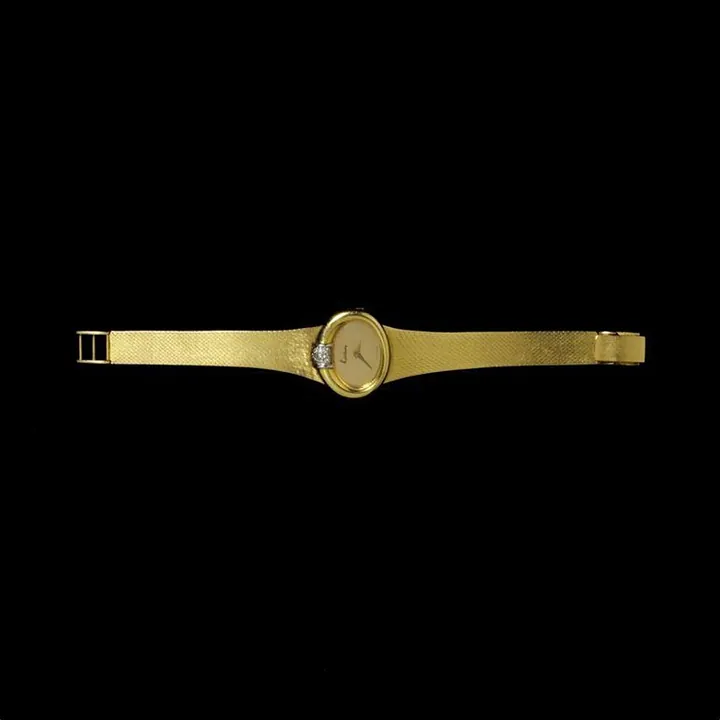
Wristwatches · 1973
Woman's watch, gold with diamonds set in platinum. Made for Kutchinsky, London by Chopard et Cie. Switzerland, 1973
Victoria and Albert Museum, London
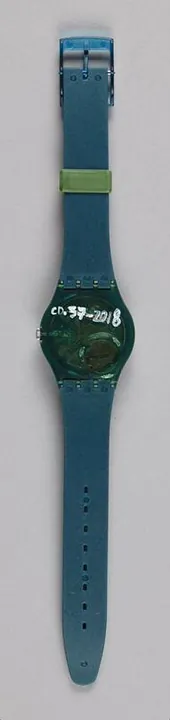
Wristwatches · 1985–1991
Swatch dummy watch: Blue Leaves GN104 design
Victoria and Albert Museum, London
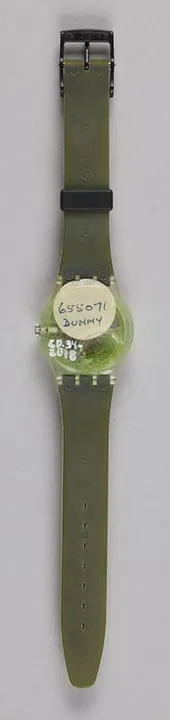
Wristwatches · 1985–1991
Swatch dummy watch: Technosphere GK101 design
Victoria and Albert Museum, London