
Wristwatches · Wristwatch
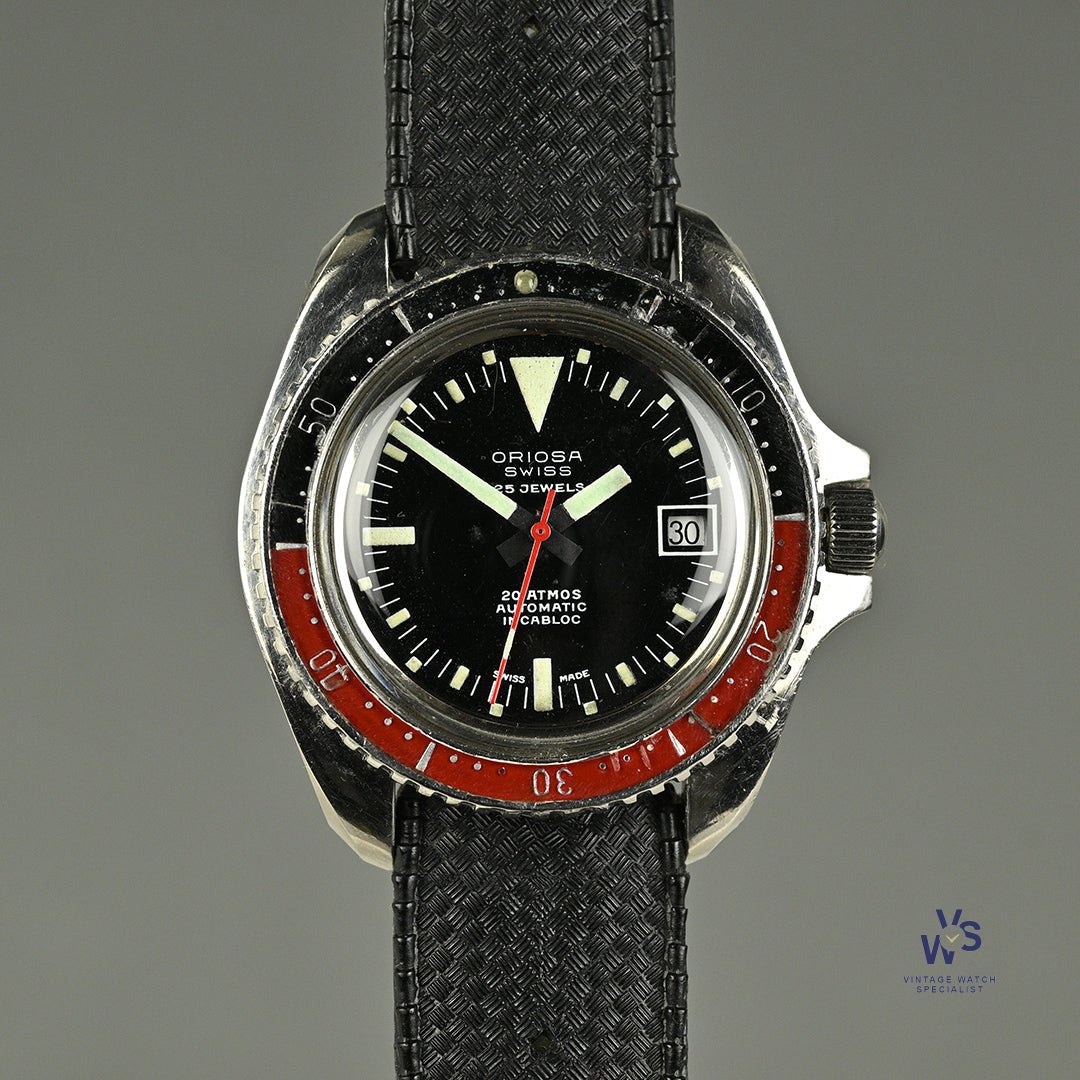
Oriosa Automatic, Swiss Dive Watch, 'Coke' Bezel, ref. 844 'Monnin' Cased, 1970s
- Maker / attribution
- Oriosa (maker)
- Date
- 1970s
- Historical period
- Quartz Revolution (1969 – 1990)
- Country of origin
- Switzerland
- Object type
- Wristwatch
- Dimensions
- Case 41 mm
- Stock no.
- vws4204
- Credit line
- Dealer listing, Vintage Watch Specialist (vws4204)
- Catalogue title (original)
- Oriosa Automatic - Swiss Dive Watch - 'Coke' Bezel - Reference 844 'Monnin' Cased - 1970s (English)
View the source record (dealer listing) ↗ (opens another website in a new tab)Suggest a correction
Record summary
Catalogued by Vintage Watch Specialist (dealer), United Kingdom (stock number vws4204), this is a wristwatch by Oriosa, made in Switzerland, dated 1970s. The Atlas places it in the Quartz Revolution period (1969 – 1990) of its Wristwatches collection. Recorded dimensions: Case 41 mm. The record is illustrated with 6 photographs.
Assembled from the source record's structured fields. Dates and attributions are given as the source states them; where a field is missing the Atlas leaves it blank rather than estimating.
Catalogue description
Dealer description — Vintage Watch Specialist
During the 1960s and 1970s, many smaller Swiss watch brands produced exceptionally capable dive watches by combining proven Swiss movements with specialist cases and components supplied by dedicated manufacturers. Oriosa was one such brand, offering robust professional-style sports watches that shared engineering with far better-known names while retaining their own identity. This example is housed in the distinctive stainless-steel dive case commonly referred to by collectors as the 'Monnin case.' The nickname has become synonymous with this particular design, although the case itself was manufactured by MRP SA , one of Switzerland's leading specialist case makers. MRP supplied cases to numerous watch manufacturers during the period, producing designs that were renowned for their strength, water resistance and practical functionality. Inside the case is the respected ETA 2788 CD , a 25-jewel Swiss automatic movement featuring a quick-set date and Incabloc shock protection. Introduced during the 1970s, the calibre earned a reputation for reliability and ease of servicing, making it a natural choice for professional sports watches designed for everyday wear. With its substantial case, rotating dive bezel and dependable ETA movement, this Oriosa represents the golden era of Swiss mechanical dive watches, when specialist component manufacturers enabled smaller brands to produce watches of genuinely impressive quality. What's on Offer Offered here is a handsome Oriosa Automatic Diver , dating from the late 1970s , featuring the sought-after MRP SA 'Monnin' style stainless-steel case and powered by the reliable ETA 2788 CD automatic movement. The glossy black dial offers outstanding legibility, with oversized luminous baton markers, a prominent triangular 12 o'clock marker and broad luminous hands that perfectly capture the purposeful design language of professional dive watches from the era. A vivid red central seconds hand provides an attractive splash of colour, while the framed date window at 3 o'clock completes the clean, functional layout. Surrounding the dial is the original bi-colour black and red rotating bezel—universally known as a 'Coke' bezel —which gives the watch tremendous vintage character. The combination of the black dial, red accents and brushed steel case creates an unmistakably seventies aesthetic. The screw-down case houses the 25-jewel ETA 2788 CD automatic movement, offering dependable timekeeping and an approximate 45-hour power reserve. The caseback is stamped with the MRP reference and Swiss patent markings associated with this distinctive case design. Measuring 41mm across, the watch has excellent wrist presence while remaining comfortable thanks to its flowing case profile. Finished with a classic black Tropic-style rubber strap, it is an excellent example of a lesser-known Swiss diver that delivers genuine vintage appeal without the premium attached to more famous names. The stainless-steel case displays honest signs of wear consistent with a vintage tool watch. Surface scratches, small marks and polishing evidence are present throughout the case and bezel, adding to its authentic character rather than detracting from it. The original black and red rotating bezel remains attractive, showing age-related fading, scratches and minor wear that are entirely in keeping with a watch of this period. The luminous bezel pip remains present. The glossy black dial is particularly well preserved, retaining crisp white printing and excellent contrast. The luminous material on the hands and hour markers has aged evenly, while the red seconds hand remains vibrant. The framed date aperture is clean and functions correctly. The acrylic crystal remains clear with only light signs of use, and the watch is fitted to a black Tropic-style rubber strap that suits the period perfectly. Although the dial is marked 20 ATM , this represents the watch's original factory specification. As with all vintage dive watches, modern water resistance cannot be guaranteed without current pressure testing.
Historical context
Quartz Revolution (1969 – 1990)
Seiko's Astron begins mass quartz timekeeping; traditional industries contract sharply.
Quartz and digital watches transformed the market after 1969. Swiss employment collapsed, Japanese and Hong Kong production soared, and the Swatch (1983) helped the Swiss industry recover; mechanical watches survived as luxury goods.
Read the period in the timelineMore wristwatches from this periodEarlier: Modern Mechanical Horology
Atlas type guide
Dive and water-resistant watches
Keeping water and dust out of a wristwatch was a long-standing challenge. Rolex's screw-down Oyster case (1926) and Omega's Marine (1932) were landmarks; in the early 1950s Blancpain's Fifty Fathoms and Rolex's Submariner defined the professional dive watch with rotating bezels for timing dives, luminous dials and high water resistance. The ISO 6425 standard (1982) later codified what a 'diver's watch' must do.
Dive watches became icons of post-war design and exploration, and their evolution — helium escape valves, ceramic bezels, saturation-diving depth ratings — records the history of underwater work.
What to look for
- Unidirectional or bidirectional rotating bezel with minute markings.
- Screw-down crown and case back; depth rating printed on the dial.
- Luminous hands and markers (radium before c. 1960, tritium c. 1960–1998, then Super-LumiNova).
- Reference numbers on the case between the lugs or inside the back.
Dating clues
- Screw-down Oyster cases: from 1926.
- Professional dive watches: from 1953.
- Tritium 'T' marks on dials: c. 1960–1998.
General guidance written by the Atlas editors about this kind of object. It is not a statement about this particular piece; for that, rely on the source record above and on physical examination.
Related records

Wristwatches · 1970
Wristwatch by Heno, Switzerland, 1970
Museum Rotterdam

Wristwatches · 1960–1986
'Tri-Compax' calendar chronograph wristwatch in gold case, by Universal, Geneva, Switzerland, 1960–1986.
Science Museum Group, London

Wristwatches · 1969–1970
Beta 21 Quartz wristwatch movement, made in Switzerland, 1970.
Science Museum Group, London

Wristwatches · c. 1969
Omega Speedmaster Moonwatch, ref. 145022-69st, c. 1969
Antiquorum auction archive, Geneva
Wristwatches · c. 1969
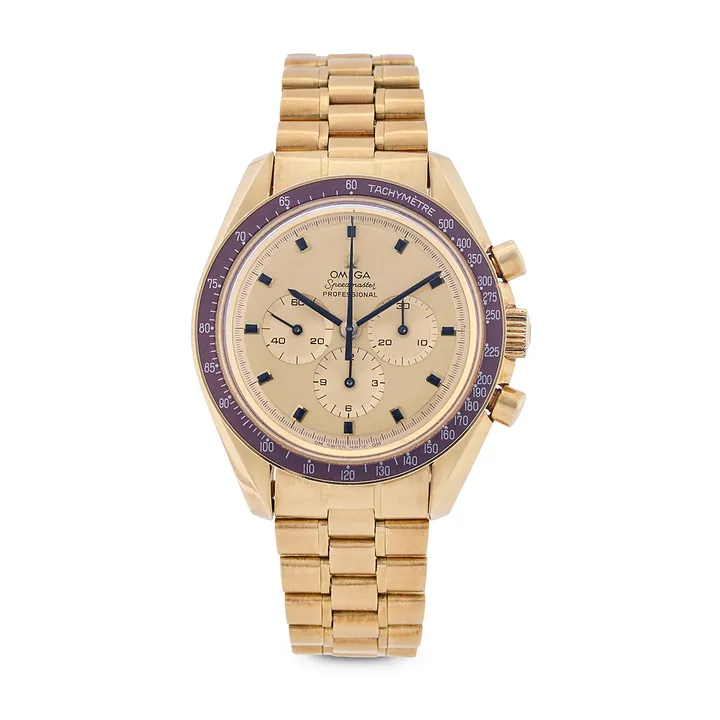
Omega Speedmaster Professional Apollo XI, ref. 145.022-69, c. 1969
Antiquorum auction archive, Geneva
Wristwatches · 1969
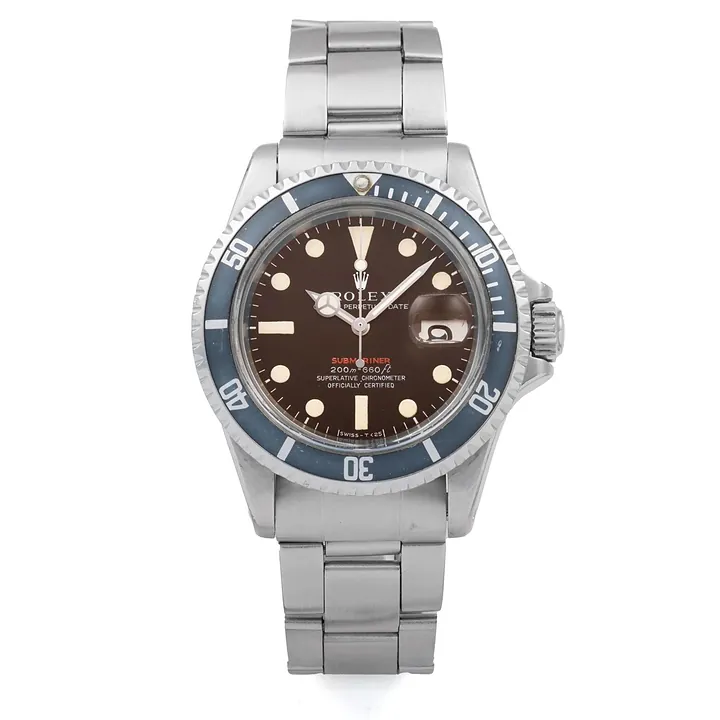
Rolex "red" Submariner, ref. 1680, 1969
Antiquorum auction archive, Geneva
Wristwatches · c. 1969
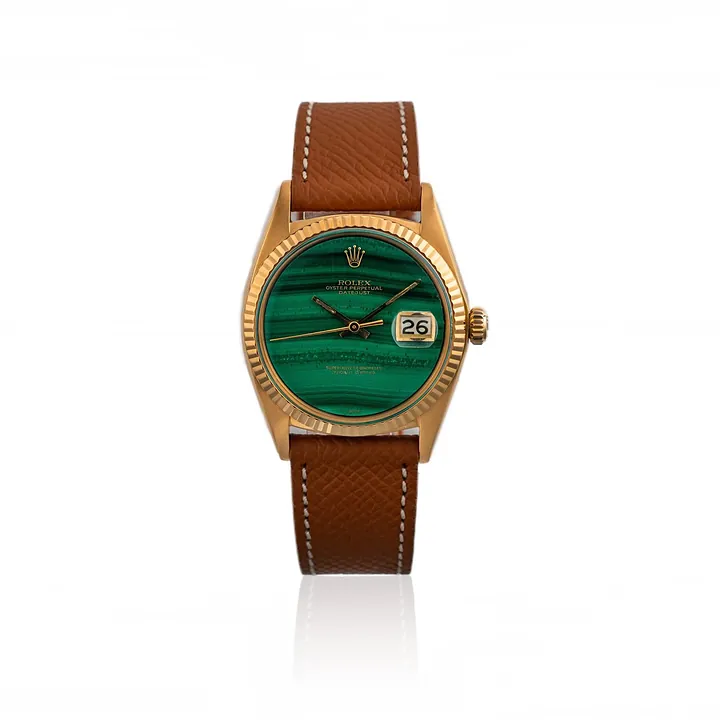
Rolex Date Just, ref. 1601, c. 1969
Antiquorum auction archive, Geneva
Wristwatches · 1969
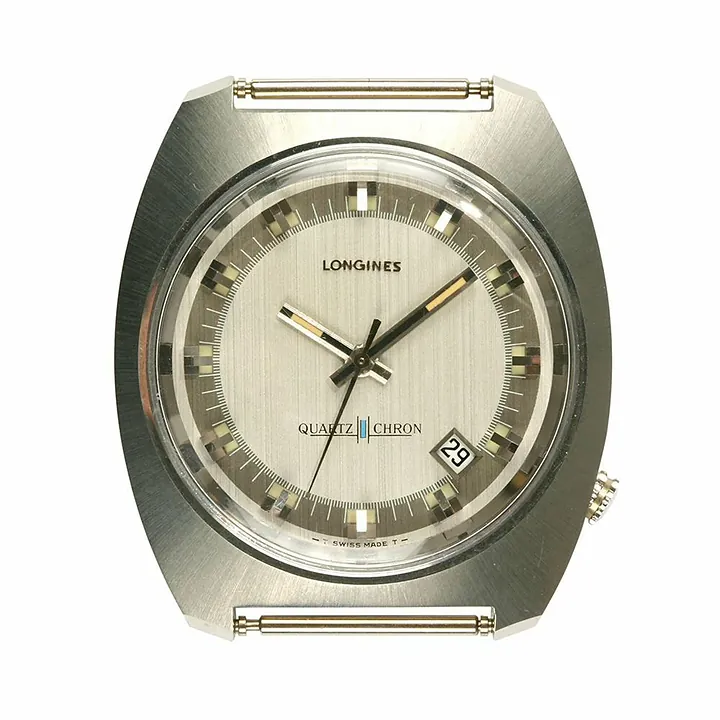
Wristwatch by Francillon und Cie (Longines), Switzerland, 1969
German Clock Museum