
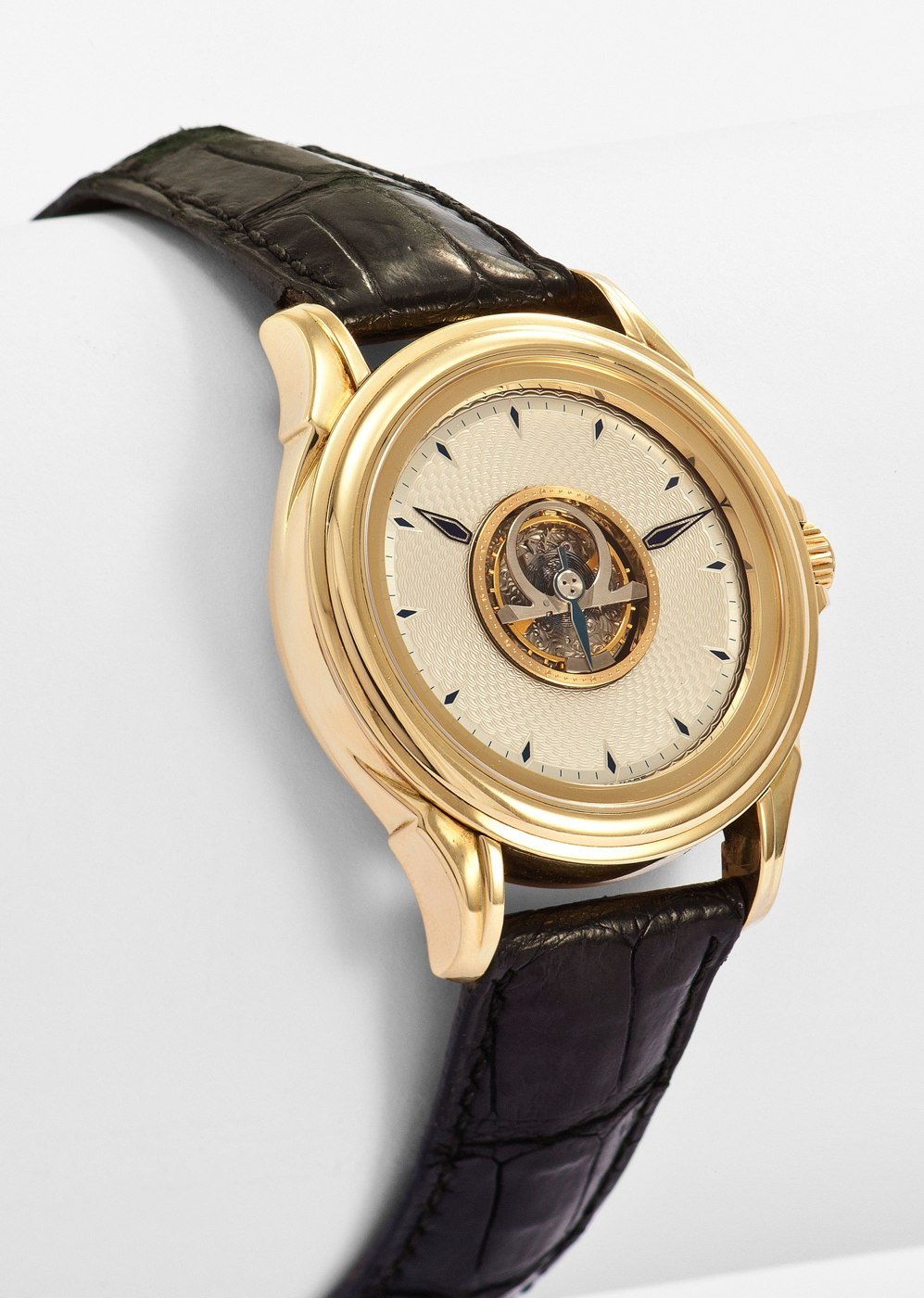
Wristwatches · Self-winding tourbillon wristwatch
Omega De Ville Central Tourbillon No. 11
- Maker / attribution
- Omega (source attribution)
- Date
- 1994
- Historical period
- Mechanical Renaissance (1990 – 2010)
- Country of origin
- Switzerland
- Object type
- Self-winding tourbillon wristwatch
- Materials / technique
- 18K yellow gold
- Holding institution
- Antiquorum
- Accession / object no.
- 49
- Credit line
- Antiquorum
- Catalogue title (original)
- OMEGA DE VILLE, CENTRAL TOURBILLON, NO. 11 YELLOW GOLD\nOmega, De Ville - Central Tourbillon, No. 11. Launched in 1994 as the world's first automatic wristwatch with central tourbillon\nregulator in h (English)
View the source record ↗ (opens another website in a new tab)Suggest a correction
Record summary
Held and catalogued by Antiquorum (object number 49), this is a self-winding tourbillon wristwatch attributed to Omega, made in Switzerland, dated 1994. The Atlas places it in the Mechanical Renaissance period (1990 – 2010) of its Wristwatches collection. Materials and techniques recorded by the source: 18K yellow gold. The record is illustrated with 1 photograph.
Assembled from the source record's structured fields. Dates and attributions are given as the source states them; where a field is missing the Atlas leaves it blank rather than estimating.
Catalogue description
Original object description
Produced in 1994 for the centenary of the Omega brand, this De Ville Central Tourbillon is registered as piece number 11 and represents the first automatic wristwatch equipped with a central tourbillon. Its three-part 18K yellow gold case measures 39 mm in diameter and 13 mm in height, featuring stepped downward-curved lugs, a rounded stepped bezel, a sapphire crystal, and an embossed case back that incorporates the winding and setting crown to maintain unbroken case flanks. The dial plate, executed in guilloché-engraved silvered gold with blue-printed lozenge indexes, displays the hours and minutes via blue lozenge hands printed on two revolving, superimposed sapphire crystal discs. Positioned at the very center, the one-minute flying tourbillon carriage is shaped as the Omega letter symbol, housing a monometallic balance with a self-compensating Breguet hairspring. The automatic Caliber 1170 mechanism includes 48 jewels, a lateral lever escapement, oeil-de-perdrix and fausses côtes decoration, and a solid platinum winding rotor. Graded AAA by the cataloguer for excellent overall preservation, the piece exhibits visible case scratches alongside original hands, an as-new dial, an 18K yellow gold folding clasp, and an original Omega presentation box.
Inscriptions & marks
11
Historical context
Mechanical Renaissance (1990 – 2010)
Mechanical watches return as cultural objects; independent watchmaking flourishes.
Mechanical watches returned as cultural and luxury objects. Complications, tourbillons and new materials proliferated; independent watchmakers such as George Daniels, F.P. Journe and Philippe Dufour revived artisanal watchmaking; collecting vintage watches became a major field.
Read the period in the timelineMore wristwatches from this periodEarlier: Quartz Revolution
Atlas type guide
Automatic (self-winding) watches
Self-winding watches use the wearer's motion to wind the mainspring. Abraham-Louis Perrelet and Breguet made 'perpétuelle' pocket watches with oscillating weights in the late eighteenth century, but the principle only became practical in the wristwatch. John Harwood patented a bumper automatic in 1923; Rolex's Perpetual rotor (1931) winding in one direction, and later bidirectional rotors (Eterna, Felsa Bidynator), established the modern form. Micro-rotors (Universal Genève, Buren) and peripheral rotors made automatic watches thinner.
What to look for
- A semicircular rotor turning 360° over the movement, or a 'bumper' weight that rebounds between springs.
- 'Automatic', 'Perpetual' or 'Self-winding' on the dial.
- A sealed screw-back case, since automatic watches are wound less often by the crown.
Dating clues
- Bumper automatics: 1923–c. 1955.
- Full rotors: from 1931 (Rolex); widespread after c. 1950.
- Micro-rotors: from 1954–1958.
General guidance written by the Atlas editors about this kind of object. It is not a statement about this particular piece; for that, rely on the source record above and on physical examination.
Related records

Instruments · 1950–1976
Omega Megaquartz 2400 marine chronometer, 1950–1976
Science Museum Group, London

Instruments · 1960–1979
Stopwatch / timer by Omega, 1960–1979
Science Museum Group, London

Instruments · 1960–1979
Stopwatch / timer by Omega, Switzerland, 1960–1979
Science Museum Group, London

Instruments · 1960–1979
Stopwatch by Omega, Swiss made, single-button type reading 0 - 60 seconds in fifths and 0 - 5 minutes in minutes on subsidiary dial, 1960-79.
Science Museum Group, London
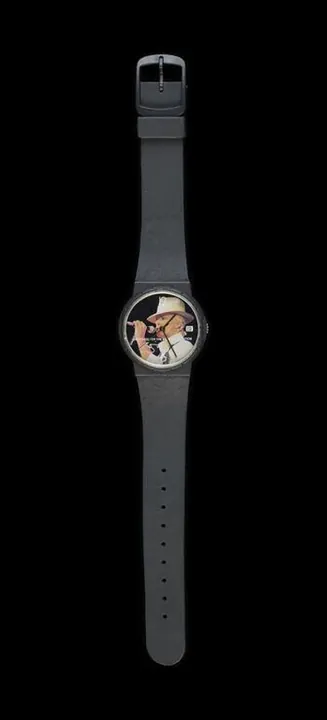
Wristwatches · 1991
Limited edition watch designed by Eta relating to David Bowie's Serious Moonlight live tour, 1991
Victoria and Albert Museum, London

Wristwatches · 2008
Wristwatch by Breitling?, 2008
Museum Rotterdam

Wristwatches · c. 1990s
Audemars Piguet Bamboo, c. 1990s
Antiquorum auction archive, Geneva

Wristwatches · c. 1990
Audemars Piguet Huitieme Perpetual Calendar, ref. 25696PT, c. 1990
Antiquorum auction archive, Geneva