
Wristwatches · Wristwatch
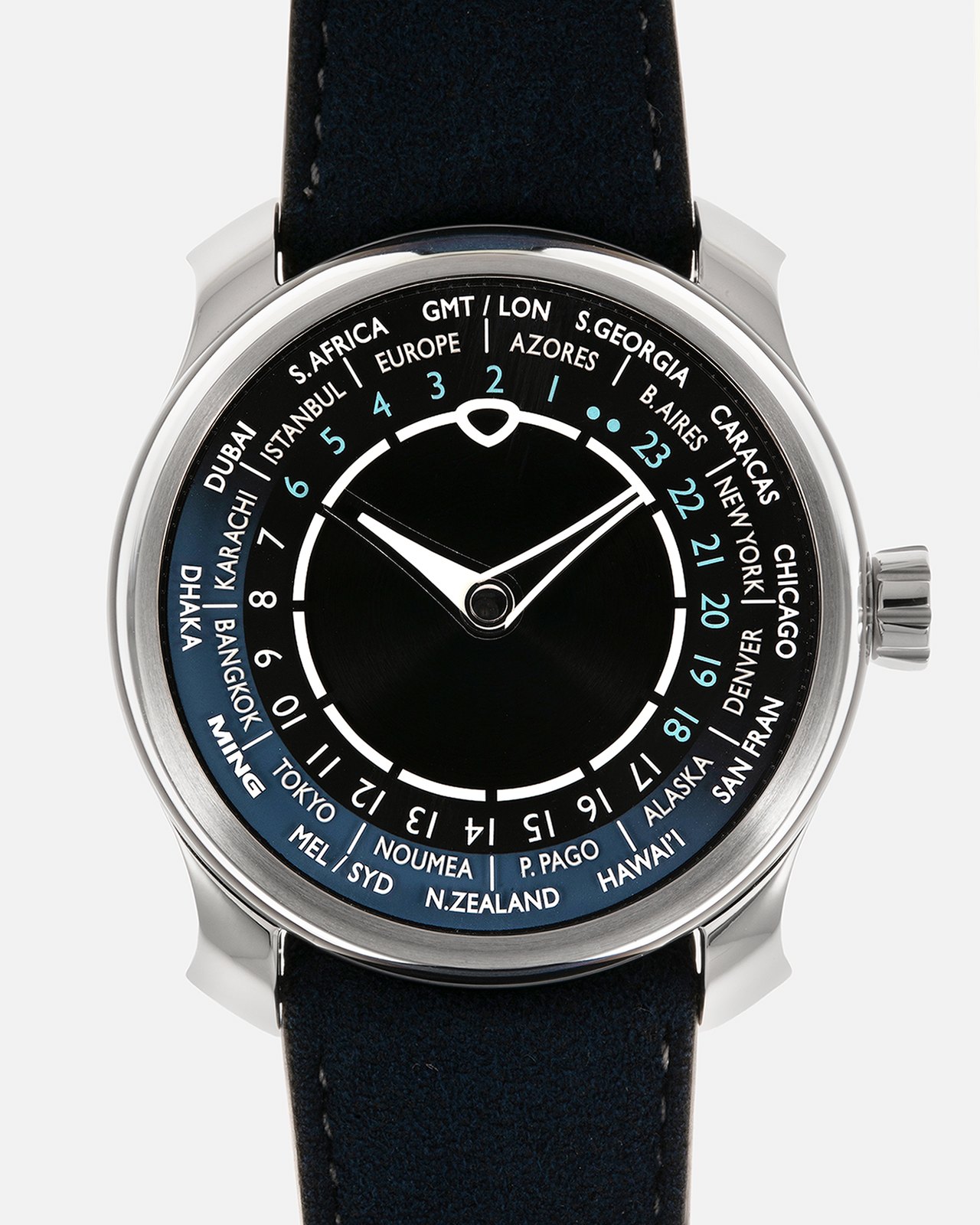
Ming 29.01 Worldtimer, 2024
- Maker / attribution
- MING (maker)
- Date
- 2024
- Historical period
- Contemporary Horology (2010 – Present)
- Country of origin
- Unrecorded in source
- Object type
- Wristwatch
- Dimensions
- Case 40 mm
- Stock no.
- Product 7468706824279
- Credit line
- Dealer listing, S.Song Watches (product 7468706824279)
- Catalogue title (original)
- Ming 29.01 Worldtimer (English)
View the source record (dealer listing) ↗ (opens another website in a new tab)Suggest a correction
Record summary
Catalogued by S.Song Watches (dealer), Seattle (stock number Product 7468706824279), this is a wristwatch by MING, dated 2024. The Atlas places it in the Contemporary Horology period (2010 – Present) of its Wristwatches collection. Recorded dimensions: Case 40 mm. The record is illustrated with 6 photographs.
Assembled from the source record's structured fields. Dates and attributions are given as the source states them; where a field is missing the Atlas leaves it blank rather than estimating.
Catalogue description
Dealer description — S.Song Watches
Establishing oneself as an independent watch brand is no small undertaking. In a market greatly saturated with a vast array of watches and dominated by longstanding Swiss watchmaking juggernauts, the odds are typically overwhelmingly stacked against newcomers. History has repeatedly shown that many independent brands have struggled to survive, with some absorbed by larger conglomerates and others quietly disappearing altogether. Long-time MING enthusiasts will know that the 19 Series represented some of the brand’s finest work; it was a period where MING fearlessly flexed its design muscles and demonstrated to the watch world what it was technically capable of. Among the standout models, the 19.02 Worldtimer, first introduced in 2019, has always held a special place for me, and likely for many other avid MING fans as well. With its ideal case proportions, practical worldtimer complication, beautifully executed dial, and visually captivating movement, it offered an irresistible package. Fast forward to 2023, and MING returned to the worldtimer complication with a fresh perspective, ushering in a new chapter beginning with the 29.01. As the debut reference of the all-new 29 Series, the 29.01 builds on the legacy of its predecessor while setting the tone for what is to come. As with so many of MING’s designs, the 29.01’s most distinctive feature is its dial. With the brand’s signature hands and sapphire treatment, it’s an absolute stunner. While worldtimers often appear cluttered with excessive text and numerical markers, the 29.01 stands out for its clarity and outstanding sense of depth and balance. This is achieved through careful spacing and layout, where every element on the dial is meticulously arranged and spaced to avoid visual fatigue. Despite the amount of information presented here, the dial still feels open, thoughtfully segmented, and never claustrophobic. I especially appreciate the decision to leave the central portion open, as it helps create a nice contrast and lends the entire design a welcome sense of breathability. It’s a remarkably palatable layout, and no easy feat for a worldtimer complication. In true MING fashion, the dial of the 29.01 also features a sophisticated multi-layered construction. A sapphire top layer, paired with matching sapphire hands, sits above the metallic worldtimer disc, which showcases a subtle dark blue to black gradient meant to evoke the natural transition from day to night. Adding to the visual depth is the generous application of HyCeram ceramic infused with SuperLumiNova X1, which appears across the sapphire dial, the worldtime disc, and the hands. It is also worth noting the sapphire box that sits atop the dial. According to MING, this component is bonded directly onto the grade 5 titanium case body and serves both as the bezel and the crystal. The result is a rich three-dimensional presence that truly needs to be experienced in person to be fully appreciated. Beyond its dial, the 29.01 is housed in a 40mm x 11.9mm case crafted from grade 5 titanium, featuring MING’s signature openworked flying blade lugs, which are seamlessly integrated into the caseback and secured by four individual screws. As far as case size goes, while the 40mm diameter may sound substantial on paper, the compact lug design ensures the watch wears comfortably on a wide range of wrist sizes. Just like its older sibling, the 19.02, the 29.01 is powered by a self-winding movement from Schwarz Ettienne that was exclusively designed and worked by Ming. In this case, it’s the Cal. ASE 222, which retains the micro-rotor and skeletonised barrel mechanism found in earlier versions. However, several components have been reworked—most notably, an entirely new bridge design finished with a combination of rhodium and contrasting stealthy DLC coating, accentuated by stunning diamond-cut anglage . As for power reserve, the Cal. ASE 222 delivers a charge of up to 70 hours on a full wind.
Historical context
Contemporary Horology (2010 – Present)
Silicon components, connected watches, optical-lattice research clocks and a thriving independent scene.
Smartwatches became the world's best-selling watches, while mechanical watchmaking focuses on craft, innovation (silicon components, new escapements) and independent makers.
Read the period in the timelineMore wristwatches from this periodEarlier: Mechanical Renaissance
Atlas type guide
Military, pilot and travel watches
The wristwatch owes much of its adoption by men to warfare and aviation. Wristlets — small pocket watches soldered with lugs and worn on a strap — were used in colonial campaigns and became standard equipment in the First World War, with protective grilles over the crystal ('shrapnel guards'). Louis Cartier's Santos (1904), designed for the aviator Alberto Santos-Dumont, is often cited as an early purpose-made pilot's watch.
In the Second World War governments specified watches in detail: the German B-Uhr observation watches, the American A-11, and the British 'W.W.W.' (the 'Dirty Dozen' set of 1945). After the war, jet travel brought GMT and world-time watches, which show two or more time zones at once — Louis Cottier's world-time mechanism and the Rolex GMT-Master (1955) are examples.
What to look for
- Military markings on the case back: broad arrow, issue numbers, 'W.W.W.', 'A.T.P.'
- High-legibility black dials with luminous Arabic numerals; oversized crowns for gloved hands.
- 24-hour hands and rotating 24-hour bezels or city rings on GMT/world-time watches.
- Wire lugs on early wristlets converted from pocket watches.
Dating clues
- Wire-lug wristlets: c. 1900–1925.
- Military specifications of the Second World War: 1939–1945.
- GMT and world-time wristwatches: mainly after 1950.
General guidance written by the Atlas editors about this kind of object. It is not a statement about this particular piece; for that, rely on the source record above and on physical examination.
Related records
Wristwatches · 2022
Ming 57.04 Iris Monopusher Chronograph, 2022
S.Song Watches (dealer), Seattle
Wristwatches · 2023
Ming 37.04 Monopusher Chronograph Tantalum, 2023
S.Song Watches (dealer), Seattle
Wristwatches · 2022
Ming 20.01 Series II Agengraphe Chronograph Special Projects Cave, 2022
S.Song Watches (dealer), Seattle
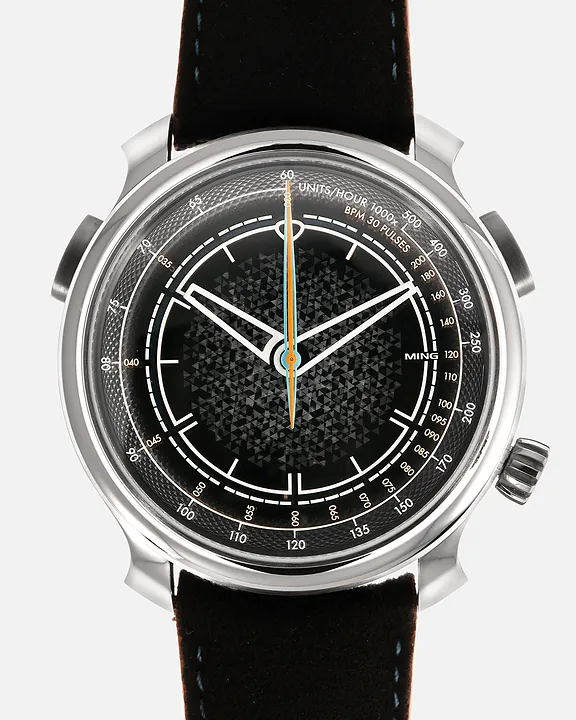
Wristwatches · 2022
Ming 20.01 Series II Agengraphe Chronograph Special Projects Cave, 2022
S.Song Watches (dealer), Seattle
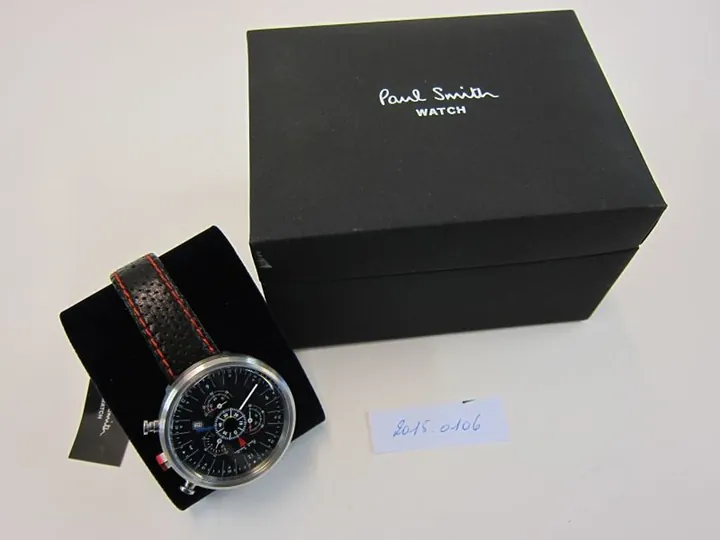
Wristwatches · 2010
Wristwatch, 2010
Modemuseum Hasselt
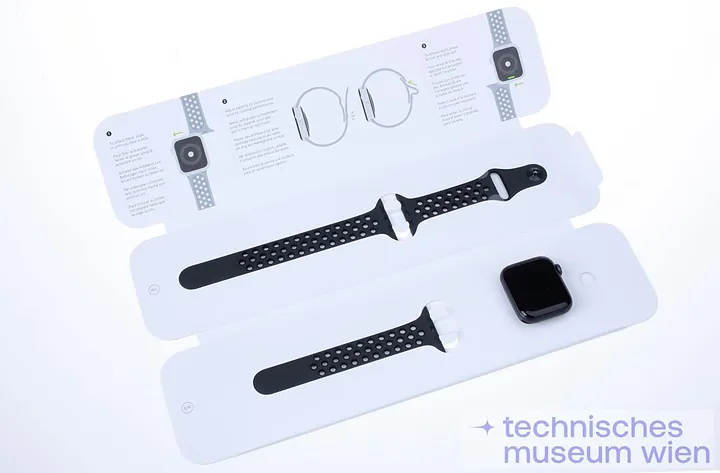
Wristwatches · 2018 (Series 4 released in September 2018; '1977' in the source is the model number A1977)
Apple Watch Series 4 (GPS, 40 mm, model A1977), 2018
Vienna Museum of Science and Technology
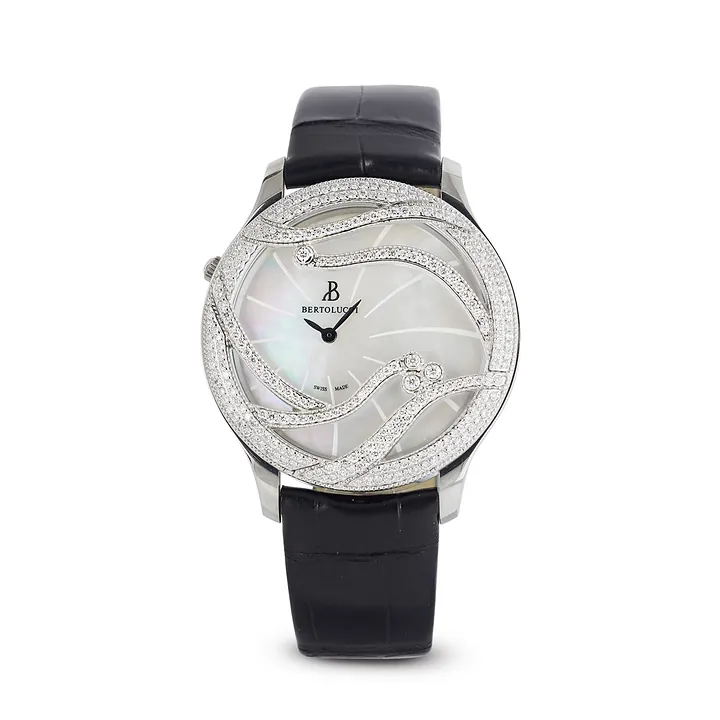
Wristwatches · c. 2010s
Bertolucci Stria III, ref. 11513.50.45.B88.6C1.501, c. 2010s
Antiquorum auction archive, Geneva
Wristwatches · c. 2010s
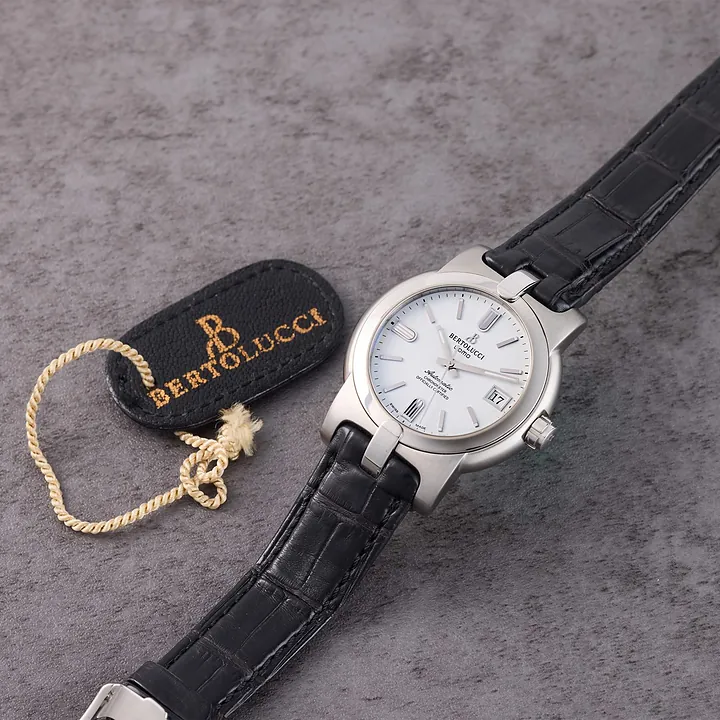
Bertolucci Uoma, ref. 824.51.41.10B, c. 2010s
Antiquorum auction archive, Geneva