
Wristwatches · Wristwatch
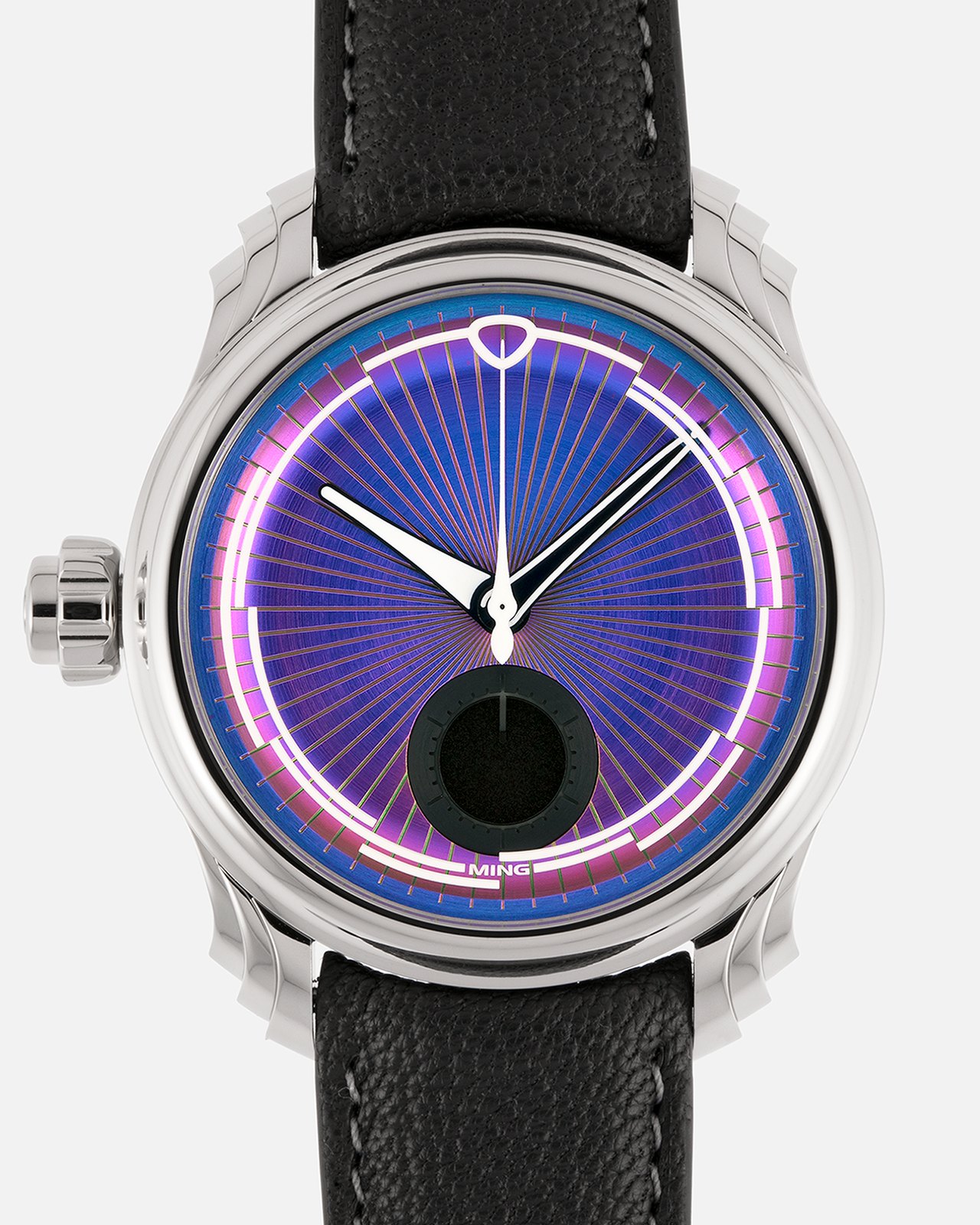
Ming 57.04 Iris Monopusher Chronograph, 2022
- Maker / attribution
- MING (maker)
- Date
- 2022
- Historical period
- Contemporary Horology (2010 – Present)
- Country of origin
- Unrecorded in source
- Object type
- Wristwatch
- Dimensions
- Case 40 mm
- Stock no.
- Product 7834260897879
- Credit line
- Dealer listing, S.Song Watches (product 7834260897879)
- Catalogue title (original)
- Ming 57.04 Iris Monopusher Chronograph (English)
View the source record (dealer listing) ↗ (opens another website in a new tab)Suggest a correction
Record summary
Catalogued by S.Song Watches (dealer), Seattle (stock number Product 7834260897879), this is a wristwatch by MING, dated 2022. The Atlas places it in the Contemporary Horology period (2010 – Present) of its Wristwatches collection. Recorded dimensions: Case 40 mm. The record is illustrated with 6 photographs.
Assembled from the source record's structured fields. Dates and attributions are given as the source states them; where a field is missing the Atlas leaves it blank rather than estimating.
Catalogue description
Dealer description — S.Song Watches
Founded in 2017 by Malaysian designer and photographer Ming Thein, MING has established itself as one of the more recognisable names in contemporary independent watchmaking. Unlike other 'traditional' independent brands, MING has approached watch design from a distinctly different perspective, focusing on case architecture, unconventional dial construction and the interaction of light with different materials. Despite its relatively short history, the brand has developed a remarkably consistent design identity, with its distinctive floating hour markers, sculpted lugs and minimalist displays becoming immediately recognisable. Introduced in August 2025 to commemorate the brand's eighth anniversary, the MING 57.04 Iris represents a significant departure from its earlier creations. Not only does it introduce MING's fifth-generation design language, but it is also the brand's first left-handed or 'destro' watch, housing a manually wound monopusher chronograph movement. Limited to just 100 pieces worldwide, the Iris marks an important milestone for the brand, bringing together several years of development into an entirely new case architecture. Starting with the stainless steel case, the 57.04 measures 40mm in diameter and 11.85mm in thickness, with a relatively compact lug-to-lug measurement of 47.8mm. While previous generations of MING watches were generally characterised by their flowing, organic lug designs, the Iris takes a considerably more architectural approach. Its multi-piece lugs feature a series of stepped, angular surfaces with alternating polished and brushed finishes, lending the watch an almost Art Deco appearance. The crown and integrated chronograph pusher are unusually positioned on the left side of the case, a deliberate design decision that allows for a larger, more tactile winding crown without interfering with the wrist. However, the real attraction of the 57.04 is undoubtedly its extraordinary dial. Aptly named 'Iris', the dial features a deeply dished, radially fluted surface that shifts between shades of turquoise, blue and purple depending on the angle and intensity of light. This unusual effect is achieved through a multiphasic coating applied over a machined brass base, producing an almost iridescent appearance that is difficult to capture in photographs. Rather than relying on a conventional sunburst finish, the radial fluting introduces an additional layer of depth, with the changing colours accentuating the curvature and texture of the dial. As with many of MING's creations, the hour markers are not applied directly to the dial but are instead laser-etched into the underside of the sapphire crystal and filled with luminous material. This creates the illusion of the indices floating above the dial, further emphasising its considerable depth. At 6 o'clock sits an unusual 30-minute chronograph counter, presented through a shaped rotating disc with a sandwich-style construction and luminous detailing. Together with the central chronograph seconds hand, the arrangement offers a remarkably unconventional interpretation of what is otherwise a fairly traditional complication. Turning the watch over reveals the manually wound Sellita for MING Cal. SW562.M1, developed in collaboration with Sellita specifically for this configuration. Operating at 28,800 vibrations per hour with a power reserve of approximately 60 hours, the movement features a central chronograph seconds hand and a 30-minute counter, both operated through the single pusher integrated into the crown. Visually, the movement has been given considerable attention, with an anthracite mainplate contrasted against a large, sculptural 4N-coated three-quarter plate. While not a traditionally hand-finished movement in the manner of some of the more established independent watchmakers, its architecture and contrasting finishes give it a distinctive appearance that is very much in keeping with MING's design philosophy. What I find particularly appealing about the 57.04 Iris is how successfully MING has managed to evolve its design language without losing the identity that made its earlier watches so recognisable. The angular case and almost architectural lugs are considerably more elaborate than those of its predecessors, yet the floating indices, unconventional chronograph display and extraordinary colour-changing dial remain unmistakably MING. With just 100 examples produced, the Iris is not only a rare watch, but also an important reference in the brand's relatively young history, representing the beginning of an entirely new generation of MING design.
Historical context
Contemporary Horology (2010 – Present)
Silicon components, connected watches, optical-lattice research clocks and a thriving independent scene.
Smartwatches became the world's best-selling watches, while mechanical watchmaking focuses on craft, innovation (silicon components, new escapements) and independent makers.
Read the period in the timelineMore wristwatches from this periodEarlier: Mechanical Renaissance
Atlas type guide
Chronographs and split-seconds watches
A chronograph is a watch with an additional seconds hand that can be started, stopped and returned to zero independently of the timekeeping. Louis Moinet built an early example in 1816 and Nicolas Rieussec a recording 'chronographe' in 1821; Adolphe Nicole's heart-shaped reset cam (patented 1862) made the modern return-to-zero possible. Split-seconds (rattrapante) chronographs add a second hand that can be stopped for intermediate times; flyback chronographs restart instantly.
Chronographs were essential tools for doctors (pulsometer scales), artillery (telemeter), engineers and sport. In wristwatches, Valjoux, Venus, Lemania and later the automatic chronographs of 1969 (Zenith El Primero, the Chronomatic Calibre 11 group and Seiko 6139) are milestones.
What to look for
- Push-pieces on the case band or a single button in the crown (monopusher).
- Subsidiary registers for minutes and hours; tachymeter, telemeter or pulsometer scales.
- Column wheel versus cam control visible in the movement.
- Calibre markings of specialist makers (Valjoux, Lemania, Venus, Landeron).
Dating clues
- Pocket chronographs with heart cam reset: after 1862.
- Wrist chronographs: from c. 1910; two-button designs from the 1930s.
- Automatic chronographs: from 1969.
General guidance written by the Atlas editors about this kind of object. It is not a statement about this particular piece; for that, rely on the source record above and on physical examination.
Read next:Flyback chronographChronograph
Related records
Wristwatches · 2023
Ming 37.04 Monopusher Chronograph Tantalum, 2023
S.Song Watches (dealer), Seattle
Wristwatches · 2022
Ming 20.01 Series II Agengraphe Chronograph Special Projects Cave, 2022
S.Song Watches (dealer), Seattle
Wristwatches · 2022
Ming 20.01 Series II Agengraphe Chronograph Special Projects Cave, 2022
S.Song Watches (dealer), Seattle
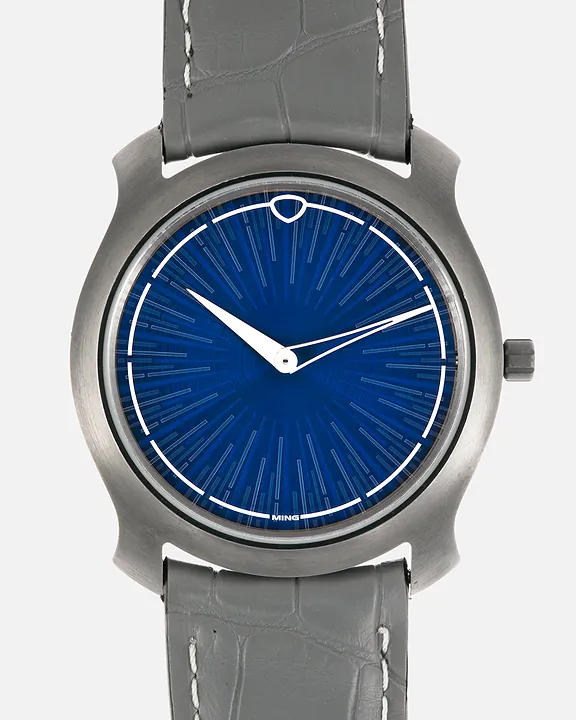
Wristwatches · 2025
Ming Project 21 Souscription Tantalum, 2025
S.Song Watches (dealer), Seattle

Wristwatches · 2010
Wristwatch, 2010
Modemuseum Hasselt
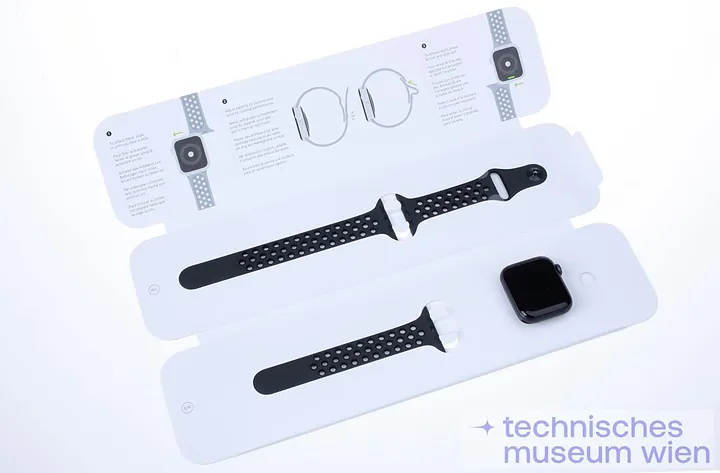
Wristwatches · 2018 (Series 4 released in September 2018; '1977' in the source is the model number A1977)
Apple Watch Series 4 (GPS, 40 mm, model A1977), 2018
Vienna Museum of Science and Technology
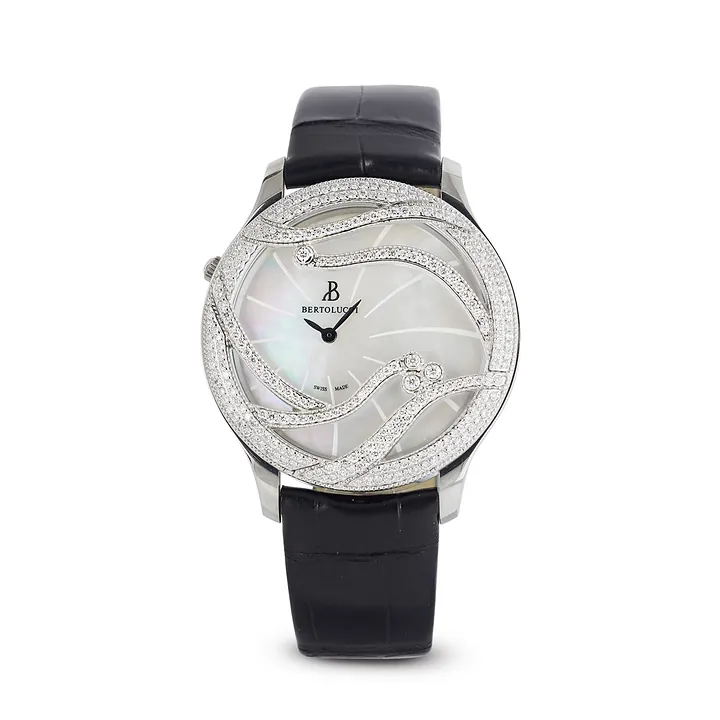
Wristwatches · c. 2010s
Bertolucci Stria III, ref. 11513.50.45.B88.6C1.501, c. 2010s
Antiquorum auction archive, Geneva
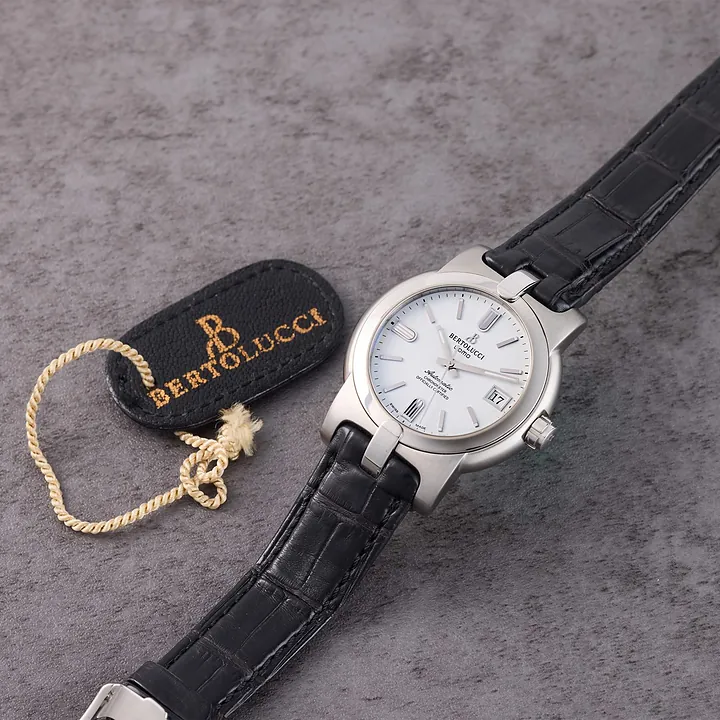
Wristwatches · c. 2010s
Bertolucci Uoma, ref. 824.51.41.10B, c. 2010s
Antiquorum auction archive, Geneva