
Wristwatches · Wristwatch
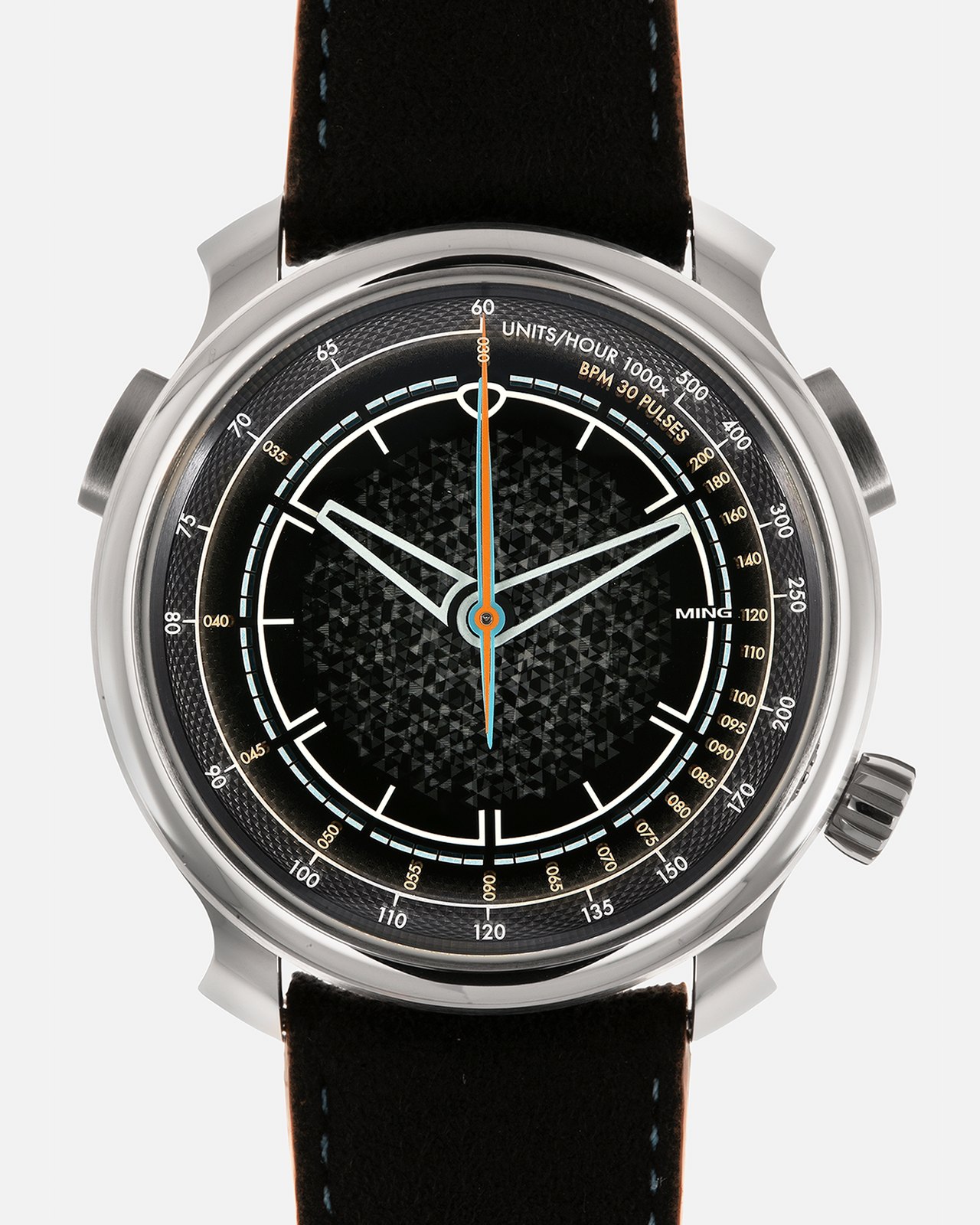
Ming 20.01 Series II Agengraphe Chronograph Special Projects Cave, 2022
- Maker / attribution
- MING (maker)
- Date
- 2022
- Historical period
- Contemporary Horology (2010 – Present)
- Country of origin
- Unrecorded in source
- Object type
- Wristwatch
- Dimensions
- Case 41.5 mm
- Stock no.
- Product 7405535756375
- Credit line
- Dealer listing, S.Song Watches (product 7405535756375)
- Catalogue title (original)
- Ming 20.01 Series II Agengraphe Chronograph Special Projects Cave (English)
View the source record (dealer listing) ↗ (opens another website in a new tab)Suggest a correction
Record summary
Catalogued by S.Song Watches (dealer), Seattle (stock number Product 7405535756375), this is a wristwatch by MING, dated 2022. The Atlas places it in the Contemporary Horology period (2010 – Present) of its Wristwatches collection. Recorded dimensions: Case 41.5 mm. The record is illustrated with 6 photographs.
Assembled from the source record's structured fields. Dates and attributions are given as the source states them; where a field is missing the Atlas leaves it blank rather than estimating.
Catalogue description
Dealer description — S.Song Watches
That being said, if there was a shining light, a name that has defied the odds, through truly original thinking and an unwavering desire for quality, it would have to be MING. While the brand has gained more and more traction in recent years, with the most recent drops selling out, the brand has largely kept a huge secret from the public for a long time—the ‘Special Projects Cave’ (SPC). What is released to the public is already hugely impressive, but little did we all know that MING had another trick up his sleeve. For those who don’t know, the SPC is an invitation-only concept with a focus on creating unique pieces and special editions in extremely limited quantities. Its core principles revolve around fostering relationships, exploring and experimenting with the boundaries of watch design, and creating collaborations. The SPC has been running for a few years now, and it is great to see MING flex and show the world just what they are truly capable of. Offered here today is the MING 20.01 Series II SPC, a design that builds on the foundation of their previous offerings of the 20.01 Concept and 20.01 Mosaic. Needless to say, the MING 20.01 Series II sets the bar even higher in terms of both technical prowess and aesthetic refinement. Limited to only 50 pieces, it comes fitted with a spectacular 41.5mm x 14.5mm grade 5 titanium case with a DLC-coated mid-case band section, as well as MING’s visually stunning hallmark flying blade lugs. The dial of the 20.01 Series II is truly a masterpiece, showcasing a multi-layered design that exudes remarkable visual depth that is not often seen in many watch designs. To break it down for you: the base layer on the 20.01 Series II is a grade 2 titanium plate adorned with a Clous de Paris motif. On top of this lies a sapphire layer, featuring a gradient finish that elegantly transitions to ink-black at its periphery. Finally, another layer of sapphire adds the finishing touch, featuring a captivating tri-tiered mosaic of 3,300 etched triangular elements, MING’s signature luminous HyCeram hour ring at its edge, as well as a set of hands filled with Superluminova X1. Beneath the domed AR-treated sapphire crystal, you'll find the pulsometer and tachymeter scale (both also luminous, by the way) laser-etched on its underside, all seemingly hovering above its stunning dial. The depth achieved here by MING here is truly incredible, creating the illusion of its elements floating above the dial—an effect that leaves enthusiasts, including myself, utterly speechless and thoroughly mesmerised. Powering this watch from within is the formidable manual-winding AgenGraphe Cal. 6361.M1, specially developed and configured for MING by Agenhor, an acclaimed independent watch movement manufacturing company helmed by the legendary Jean-Marc Wiederrecht. Renowned for his pioneering work on some of the most technically complex movements ever made, he also spearheaded the development of the inaugural version of the AgenGraphe calibre as seen in the Fabergé Visionaire Chronograph back in 2017. Architecturally, the AgenGraphe stands out as one of the most unique and sophisticated chronograph movements I’ve ever come across. Unlike conventional movements where the core of the chronograph sits atop the train wheel bridge, the AgenGraphe features a distinct construction with its chronograph module positioned at the very centre of the movement—a distinguishing feature which first debuted in the Fabergé Visionaire Chronograph. True to MING's ethos, the execution and level of finishing demonstrated here are unparalleled, featuring anthracite DLC-coated bridges and plates embellished with diamond-cut anglage , among other exquisite details and superlative finishing techniques. Personally, I'm a massive fan of the 20.01 Series II SPC. Every aspect of this model is impeccably executed, from the meticulously crafted case to the intricately designed dial. The movement is a work of art in itself, and the captivating illusion of floating elements on the dial, coupled with the way it playfully interacts with light, makes this a true masterpiece.
Historical context
Contemporary Horology (2010 – Present)
Silicon components, connected watches, optical-lattice research clocks and a thriving independent scene.
Smartwatches became the world's best-selling watches, while mechanical watchmaking focuses on craft, innovation (silicon components, new escapements) and independent makers.
Read the period in the timelineMore wristwatches from this periodEarlier: Mechanical Renaissance
Atlas type guide
Chronographs and split-seconds watches
A chronograph is a watch with an additional seconds hand that can be started, stopped and returned to zero independently of the timekeeping. Louis Moinet built an early example in 1816 and Nicolas Rieussec a recording 'chronographe' in 1821; Adolphe Nicole's heart-shaped reset cam (patented 1862) made the modern return-to-zero possible. Split-seconds (rattrapante) chronographs add a second hand that can be stopped for intermediate times; flyback chronographs restart instantly.
Chronographs were essential tools for doctors (pulsometer scales), artillery (telemeter), engineers and sport. In wristwatches, Valjoux, Venus, Lemania and later the automatic chronographs of 1969 (Zenith El Primero, the Chronomatic Calibre 11 group and Seiko 6139) are milestones.
What to look for
- Push-pieces on the case band or a single button in the crown (monopusher).
- Subsidiary registers for minutes and hours; tachymeter, telemeter or pulsometer scales.
- Column wheel versus cam control visible in the movement.
- Calibre markings of specialist makers (Valjoux, Lemania, Venus, Landeron).
Dating clues
- Pocket chronographs with heart cam reset: after 1862.
- Wrist chronographs: from c. 1910; two-button designs from the 1930s.
- Automatic chronographs: from 1969.
General guidance written by the Atlas editors about this kind of object. It is not a statement about this particular piece; for that, rely on the source record above and on physical examination.
Read next:Flyback chronographChronograph
Related records
Wristwatches · 2022
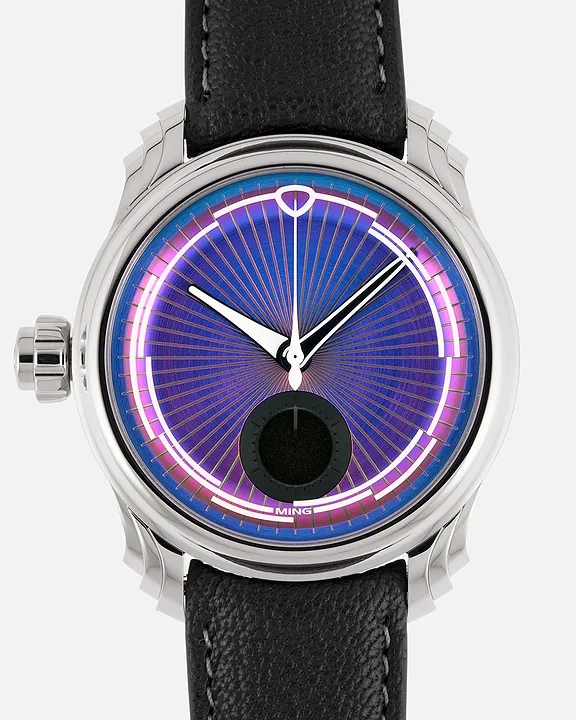
Ming 57.04 Iris Monopusher Chronograph, 2022
S.Song Watches (dealer), Seattle
Wristwatches · 2023
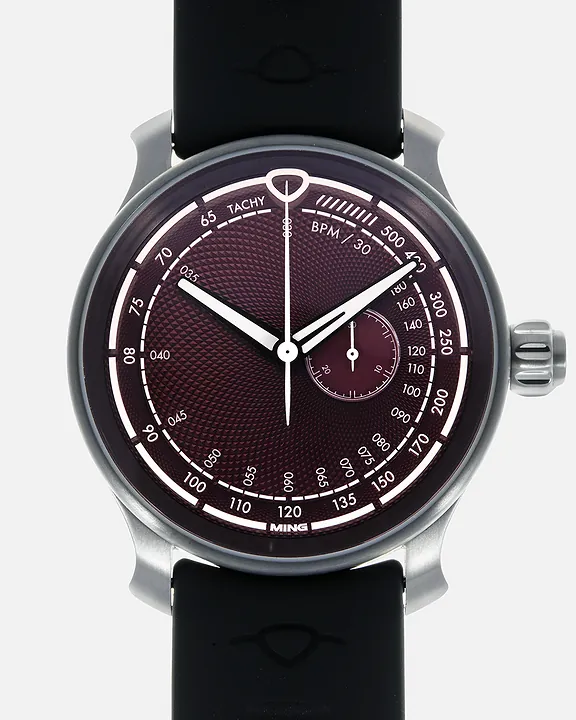
Ming 37.04 Monopusher Chronograph Tantalum, 2023
S.Song Watches (dealer), Seattle
Wristwatches · 2022
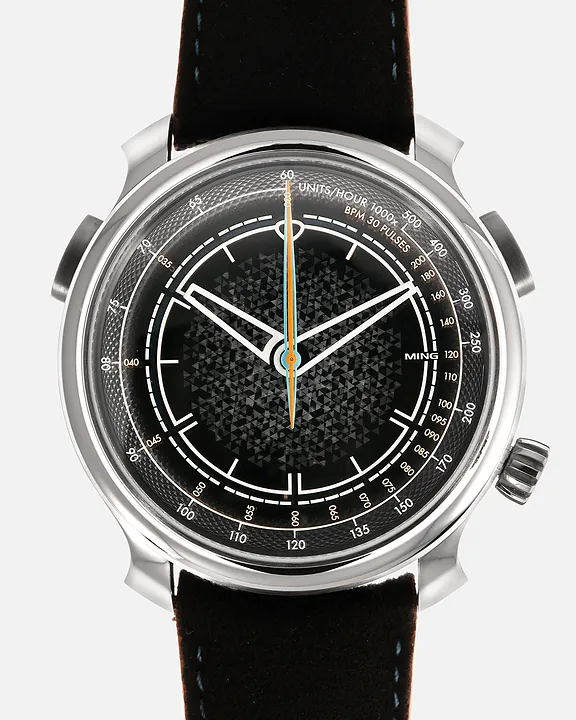
Ming 20.01 Series II Agengraphe Chronograph Special Projects Cave, 2022
S.Song Watches (dealer), Seattle
Wristwatches · 2025
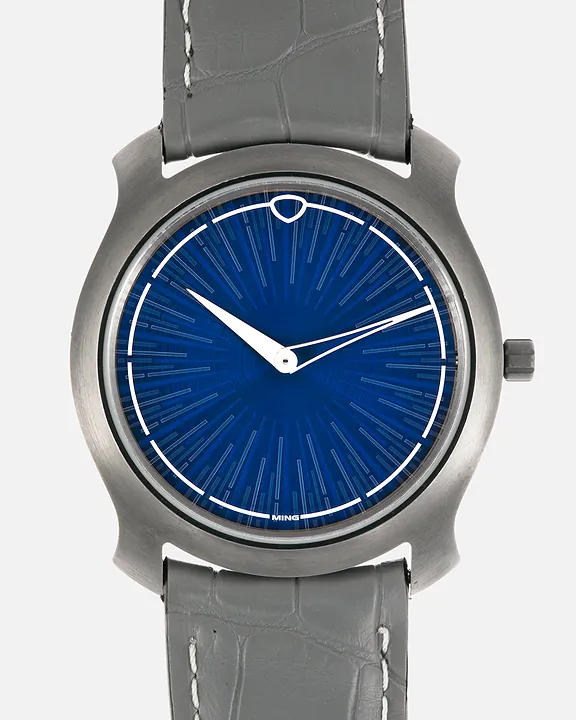
Ming Project 21 Souscription Tantalum, 2025
S.Song Watches (dealer), Seattle

Wristwatches · 2010
Wristwatch, 2010
Modemuseum Hasselt
Wristwatches · 2018 (Series 4 released in September 2018; '1977' in the source is the model number A1977)
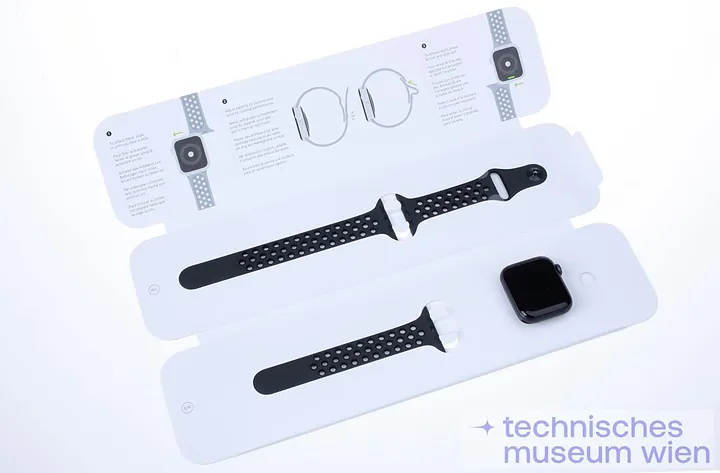
Apple Watch Series 4 (GPS, 40 mm, model A1977), 2018
Vienna Museum of Science and Technology
Wristwatches · c. 2010s
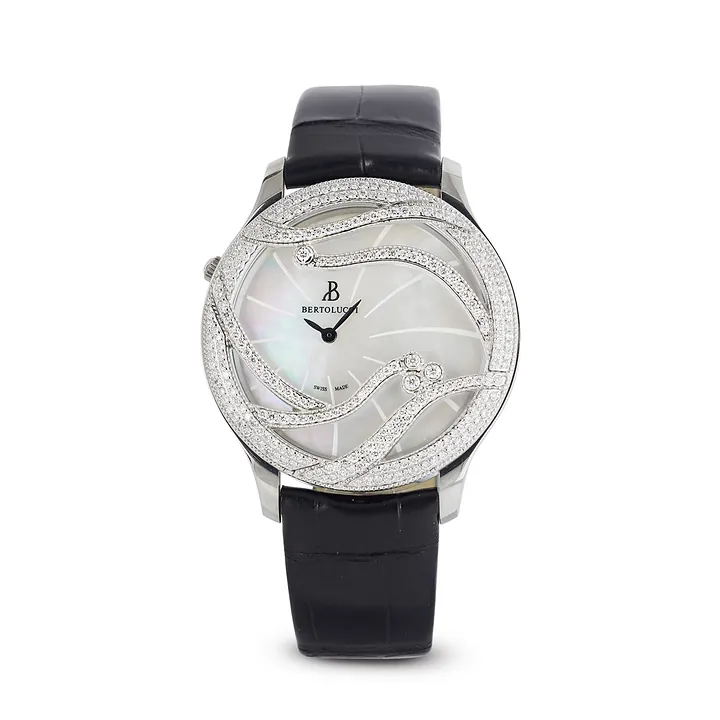
Bertolucci Stria III, ref. 11513.50.45.B88.6C1.501, c. 2010s
Antiquorum auction archive, Geneva
Wristwatches · c. 2010s
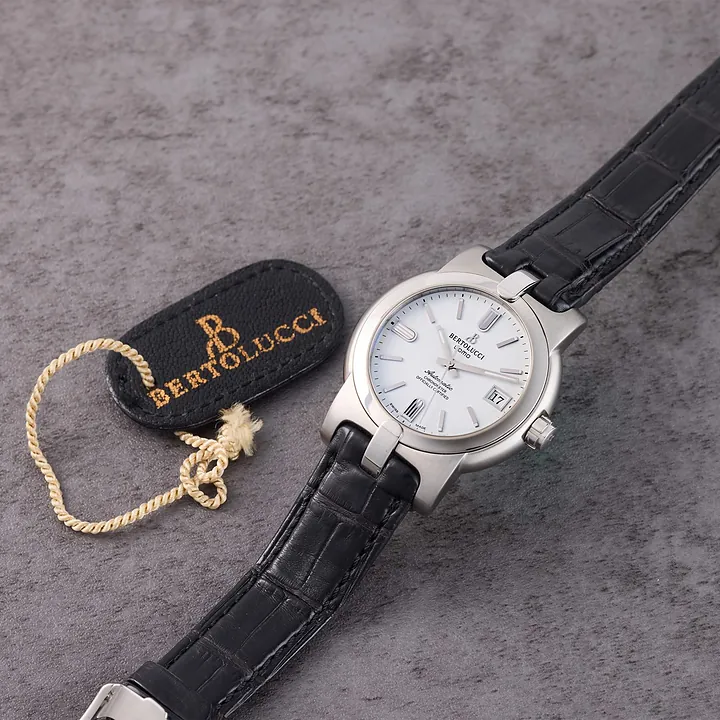
Bertolucci Uoma, ref. 824.51.41.10B, c. 2010s
Antiquorum auction archive, Geneva