
Instruments · Marine chronometer
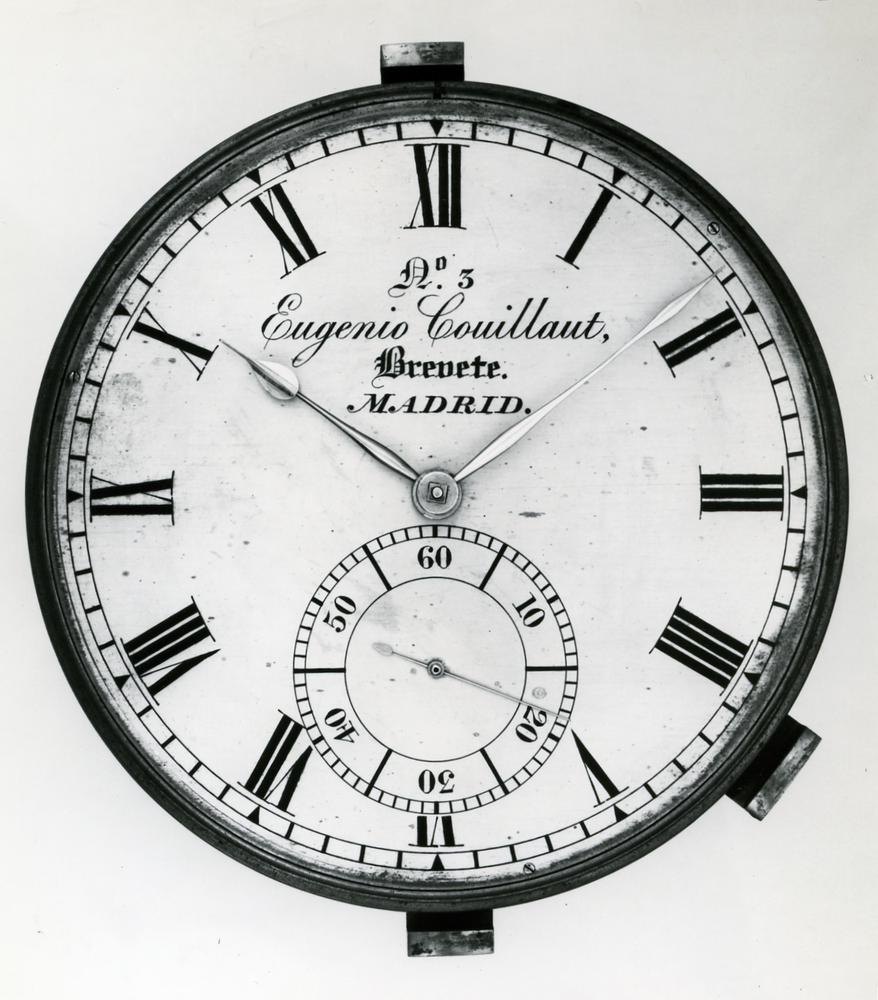
Marine chronometer by Eugenio Couillaut
- Maker / attribution
- Eugenio Couillaut (Made by)
- Date
- 1865–1875
- Historical period
- Industrial Revolution (1850 – 1900)
- Country of origin
- Spain
- Place
- Madrid (city)
- Object type
- Marine chronometer
- Materials / technique
- brass, ebony
- Holding institution
- British Museum
- Accession / object no.
- 1958,1006.1959
- Credit line
- British Museum, London
- Catalogue title (original)
- Marine chronometer; constant force mechanism with detent escapement; movement in brass bowl gimballed in ebony box; tipsy key; engraved silvered brass dial; gold hands (English)
View the source record ↗ (opens another website in a new tab)Suggest a correction
Record summary
Held and catalogued by British Museum (object number 1958,1006.1959), this is a marine chronometer by Eugenio Couillaut, made in Madrid (city), Spain, dated 1865–1875. The Atlas places it in the Industrial Revolution period (1850 – 1900) of its Instruments collection. Materials and techniques recorded by the source: brass, ebony. The record is illustrated with 4 photographs.
Assembled from the source record's structured fields. Dates and attributions are given as the source states them; where a field is missing the Atlas leaves it blank rather than estimating.
Catalogue description
Description — British Museum
Marine chronometer; constant force mechanism with detent escapement; movement in brass bowl gimballed in ebony box; tipsy key; engraved silvered brass dial; gold hands.
Curator's comments — British Museum
Comment from Anthony G. Randall and Richard Good, Catalogue of Watches in the British Museum. Vol. VI (1990) Made by Eugenio Couillaut, c. 1870 Marine Chronometer Signature: On the dial 'Eugenio Couillaut No. 3 Brevete (Patented) MADRID'.(1) Box: The movement contained in a brass bowl of English pattern, with a threaded bezel and fiat glass, the brass circular, grained and lacquered. In the base is a circular escutcheon plate of large diameter with an eccentric winding hole once fitted with a return spring. The bowl is gimballed in the French way to brass brackets in the side of the box. There is a gimbal lock of French pattern. The ebony box has a tipsy key specially made to wind the going barrel. This key rests in a corner gusset. There is provision for another, now missing, in the right-hand side panel between the top and the lid, accessible when the lid is opened. There is also a box lock and carrying handles and a rectangular ivory plate attached to the front of the top. There is no provision for excluding dust in the join between the top and the bottom. Box base 176 mm square, h. 176 mm. Dial and hands: Engraved silvered brass dial, the engraving filled with black wax, fixed with three screws on the edge to the dial plate of the same diameter. Gold hands including the seconds. No reserve of going indication. Movement: Dial plate diam. 106.2mm; front plate diam. 84.0mm; back plate diam. 84.0 mm; frame h. 31.0 mm. Frame: Full plate construction with a detachable barrel bridge and four turned brass pillars each having a central steel shaft with a threaded portion at both ends. The front plate is secured by brass nuts and washers, the back plate by steel nuts and washers. The whole construction is remarkably solid, the brass parts are finished with a fine grain. The dial plate consisting of a disc with circular central aperture is fixed to the front plate by three short turned feet and screws in the edge of the front plate. Going barrel: Fitted with a five-turn stop-work flush on the great wheel end. The arbor has an unsnailed brass boss, the spring is hooked with an eye at both ends, it is probably original but has been considerably shortened and so has lost any signature it may have had. The temper is very uneven. Going train: Heavy construction, the wheels remarkably thick but well finished and grained, the pinions of comparatively low numbers, well finished and polished, but with unusually large diameter pivots. The fourth and escape wheels are fixed with screws to brass collets. Jewelling: The fourth arbor pivots in pierced jewels, those of the escapement in pierced jewels with endstones, a diamond endstone set in a steel ring in the balance cock. The jewelling is of English type, set in brass rings in sinks in the brass frame parts, but the retaining screws are not fitted flush. Escapement: A constant force mechanism in which the going train is used to rewind a spiral spring attached to a brass wheel with four teeth. This wheel is normally held locked by an ordinary detent in compression, unlocked by a discharge roller on the balance staff. Impulse is transmitted to the balance by a brass tooth on the four-armed wheel contacting a radial jewel on the steel impulse roller on die balance staff. At the end of impulse a jewelled tooth on the four-toothed wheel trips a detent in tension holding up a normal fifteen-toothed brass escape wheel. An escape wheel tooth picks up a second jewelled tooth on the four-toothed wheel and rewinds the spiral spring whilst resetting the latter wheel. This type of mechanism gives good results if carefully used and not subjected to external disturbances. However an external shock can easily cause the detent locking the four-armed wheel to release it at the wrong time. At best this will cause the machine to advance by one escape tooth, but it could so happen that rewinding is in progress when the balance is in the unlocking position. The escapement could then be seriously damaged. A numbered of adjustments are incorporated, including bankings for the detent locking the normal escape wheel. Balance: Bimetallic two-armed balance, the steel part of the rim blued, fitted with cylindrical brass compensation weights and brass timing screws in the rim at the ends of the arms. It is held by two screws on a brass collet on the balance staff. Diam. of rim 28.5 mm, h. 3.4 mm. Balance spring: Blued steel helical spring of 11¾ turns, with terminal curves, pinned to a split brass collet with poising tail, and to a brass diamond-shaped stud on the balance cock. Going-train counts: Great wheel (going barrel) 104 teeth, 5 turns stop-work Centre pinion 10 leaves, wheel 80 teeth, 5 arms Third pinion 10 leaves, wheel 75 teeth, 5 arms Fourth pinion 10 leaves, wheel 80 teeth 5 arms Escape pinion 10 leaves, wheel 15 teeth, 5 arms Beats per hour: 14,400 Motion work: Cannon pinion 18 leaves, minute pinion 14 leaves Hour wheel 56 teeth, minute wheel 54 teeth Provenance: Ilbert Collection; in his inventory notebook Ilbert records the acquisition of this chronometer from Malcolm Gardner in 1933. Presented by Mr Gilbert Edgar C.B.E. in 1958. Note: (1) Eugenio Couillant is not recorded in Baillie 1951, but Tardy 1971 mentions a Couillant as having taken out a patent in 1868 for an escapement and a system of compensation. Bibliography: Bertele 1981, p. 217.
Inscriptions & marks
signature; Eugenio Couillaut No.3 Brevete (Patented) MADRID. [dial]
Provenance
Previous owner/ex-collection:, Courtenay Adrian Ilbert; Donated by:, Gilbert Edgar; Acquired 1958
Historical context
Industrial Revolution (1850 – 1900)
American interchangeable-parts manufacture; railroad time standards; Swiss and German factory systems.
Instruments spread into industry, science and sport: stopwatches, chronoscopes, metronomes, watchmen's clocks and time recorders.
Read the period in the timelineMore instruments from this periodEarlier: Precision & Scientific Horology
Atlas type guide
Marine chronometers
A marine chronometer is a precision timekeeper carried at sea to find longitude: the navigator compares local noon, observed with a sextant, with the time at a reference meridian kept by the chronometer. Each hour of difference corresponds to fifteen degrees of longitude. John Harrison proved the method in the 1760s; Pierre Le Roy, Ferdinand Berthoud, John Arnold and Thomas Earnshaw then developed the detent escapement and the compensation balance that made chronometers practical to manufacture.
By the nineteenth century London, Liverpool, Le Locle and Glashütte supplied navies and merchant fleets. A typical box chronometer has a spring-detent escapement, a fusee to equalise mainspring torque, a bimetallic compensation balance with a helical balance spring, and is mounted in gimbals inside a wooden box so that it stays level.
What to look for
- Gimbals and a three-tier wooden box with a glazed inner lid.
- A power-reserve ('up and down') indicator on the dial, usually showing 56 hours on two-day instruments.
- Spring-detent escapement and a cylindrical (helical) balance spring visible through the movement.
- Admiralty or navy marks (broad arrow), and rating certificates from observatories.
- The maker's number on the dial and movement; many makers' registers survive, allowing dating.
Dating clues
- Earnshaw-type spring-detent chronometers became standard after about 1800.
- Auxiliary compensation devices on the balance appear from the mid-nineteenth century.
- Quartz and radio time signals ended routine use of mechanical chronometers in the 1970s and 1980s.
General guidance written by the Atlas editors about this kind of object. It is not a statement about this particular piece; for that, rely on the source record above and on physical examination.
Read next:FuseeDetent escapement
Related records
Instruments · 1831–1870
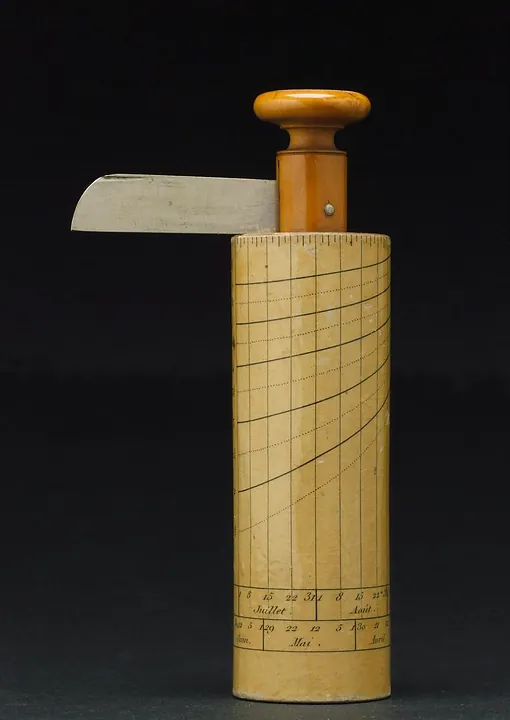
Column dial by Henry Robert, Horloger, au Palais Royal, paper on wood, early 19th century
Science Museum Group, London
Instruments · 1831–1870
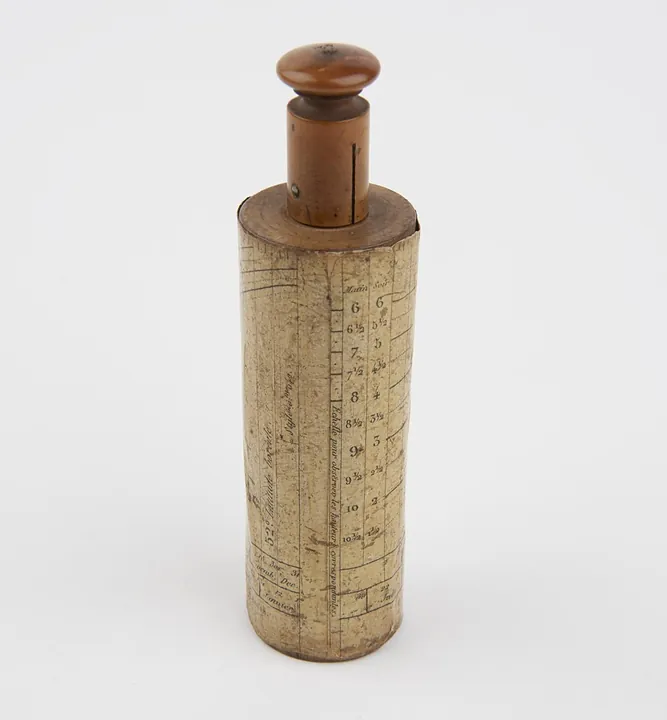
Column sundial for latitude 52 degrees, in boxwood with paper scales by Henry Robert, Horloger, Au Palais Royal, Paris, c.1832
Science Museum Group, London
Instruments · 1831–1870
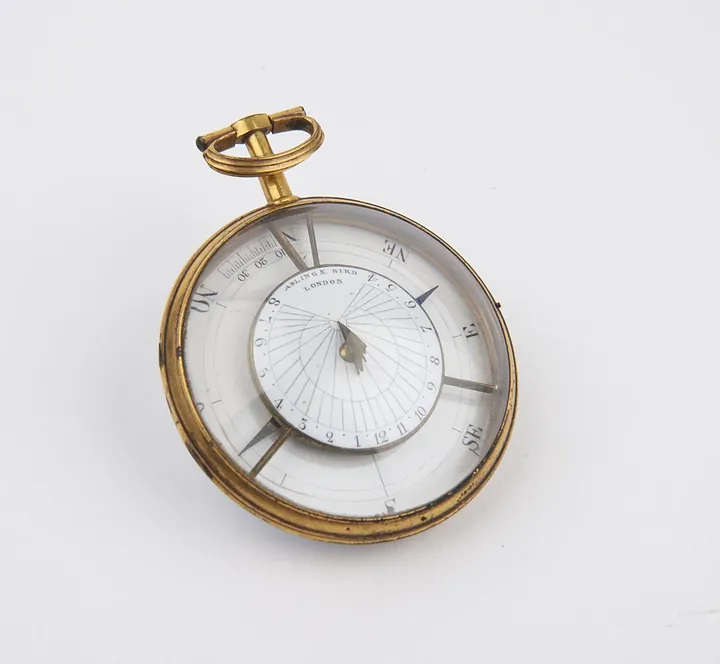
Horizontal compass sundial for latitude for 42 degrees, signed "Asling & Bird, London", in watch type case. English, c.1840.
Science Museum Group, London
Instruments · 1831–1870
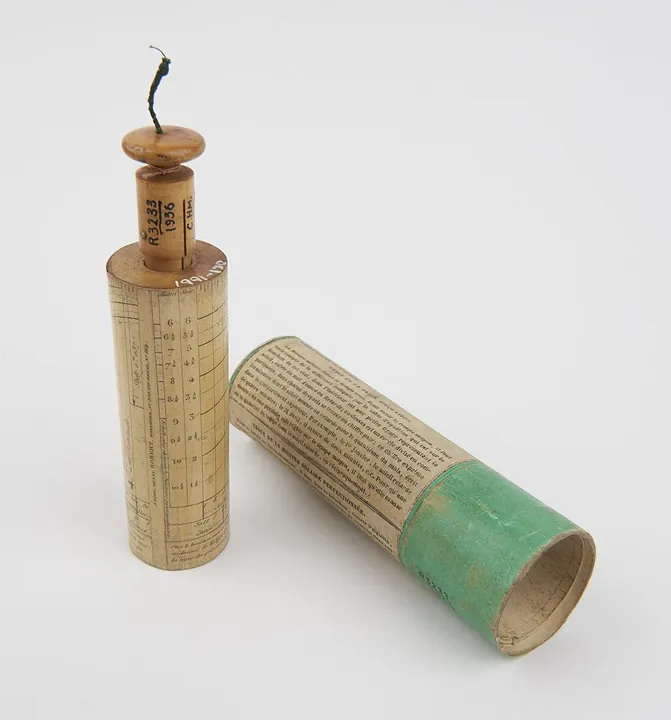
Sundial by Henry Robert, France, 1831–1870
Science Museum Group, London
Instruments · 1831–1870
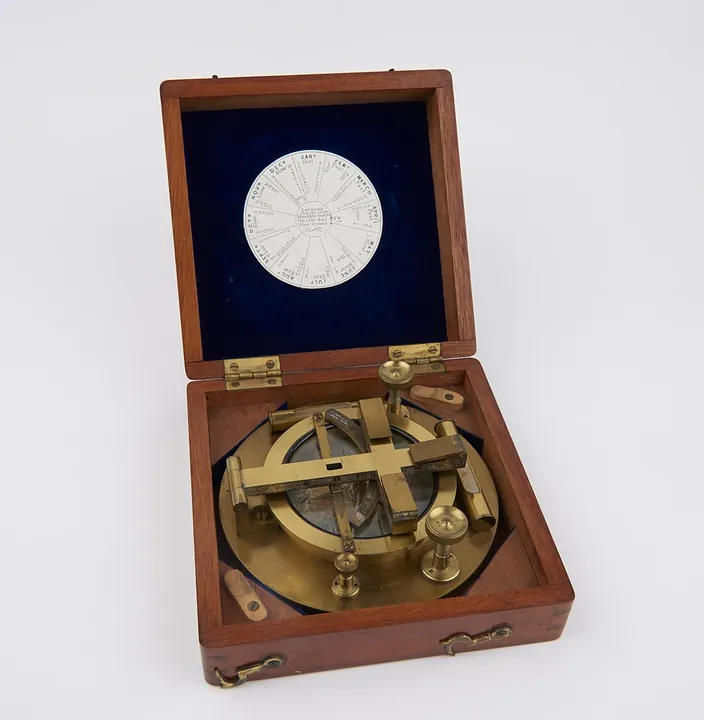
Sundial, in mahogany case
Science Museum Group, London
Instruments · 1848–1874
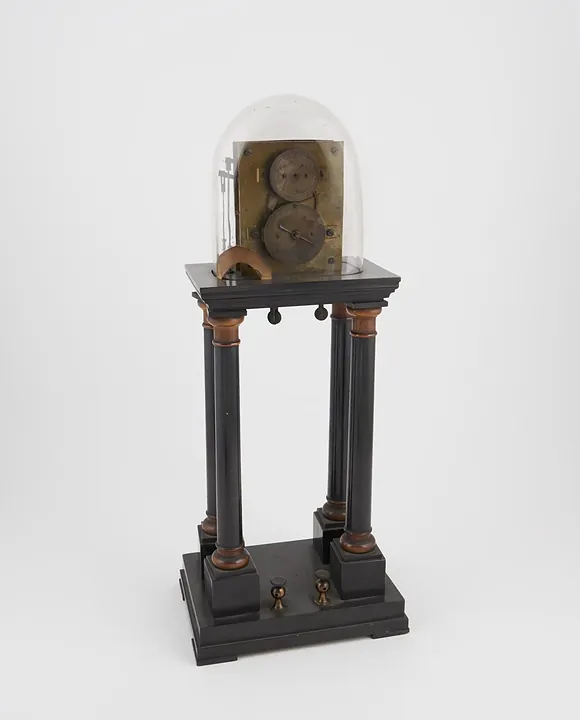
Chronoscope of Hipp type
Science Museum Group, London
Instruments · 1850–1899
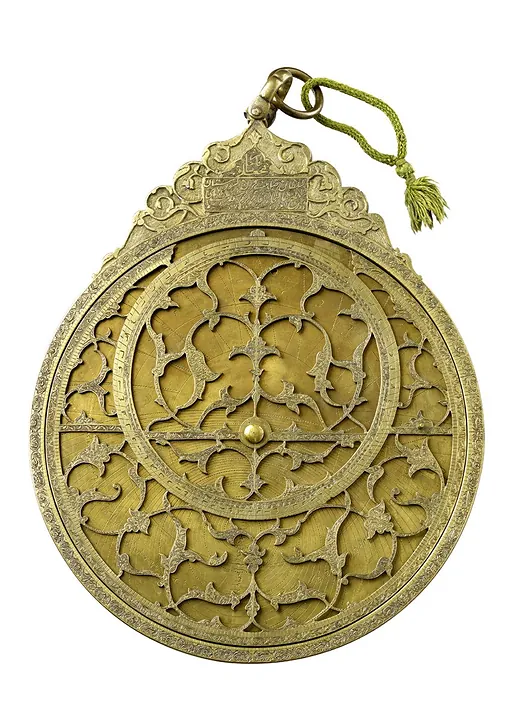
Astrolabe, Islamic world, 1850–1899
Museum of Arts and Crafts, Hamburg
Instruments · 1850–1872
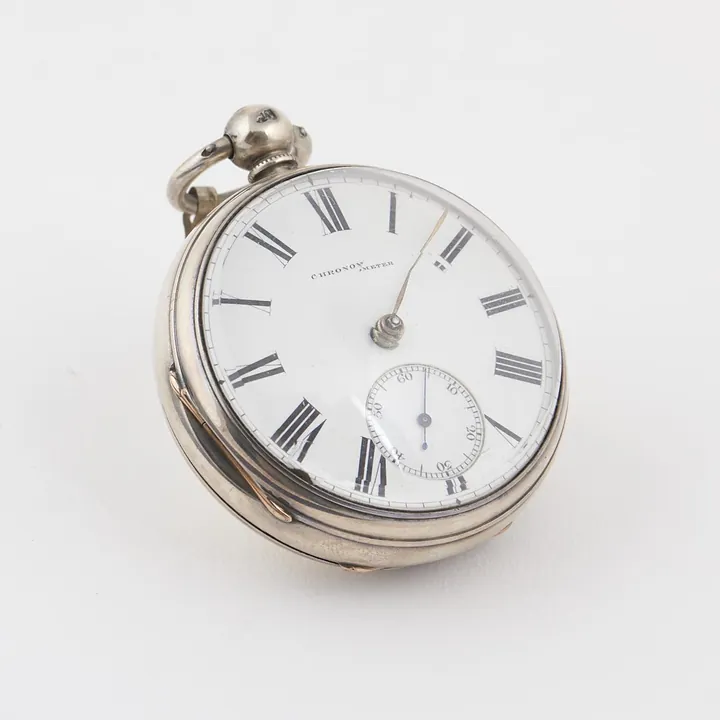
Chronometer watch in silver case by John Arnold and Son, London, no.454/755. Hall marked 1872
Science Museum Group, London