
Instruments · Marine chronometer
Marine chronometer by Ulrich & Co
- Maker / attribution
- Ulrich & Co (Made by); Edwards & Hunter (Made by); Simson (back plate) (Movement made by)
- Date
- 1823-1833; 1838 (altered)
- Historical period
- Precision & Scientific Horology (1750 – 1850)
- Country of origin
- England
- Place
- London (England) (43 Cornhill)
- Object type
- Marine chronometer
- Materials / technique
- brass
- Holding institution
- British Museum
- Accession / object no.
- 1958,1006.1943
- Credit line
- British Museum, London
- Catalogue title (original)
- Marine chronometer by Ulrich & Co (English)
View the source record ↗ (opens another website in a new tab)Suggest a correction
Record summary
Held and catalogued by British Museum (object number 1958,1006.1943), this is a marine chronometer by Ulrich & Co, made in London (England) (43 Cornhill), dated 1823-1833; 1838 (altered). The Atlas places it in the Precision & Scientific Horology period (1750 – 1850) of its Instruments collection. Materials and techniques recorded by the source: brass. The record is illustrated with 6 photographs.
Assembled from the source record's structured fields. Dates and attributions are given as the source states them; where a field is missing the Atlas leaves it blank rather than estimating.
Catalogue description
Description — British Museum
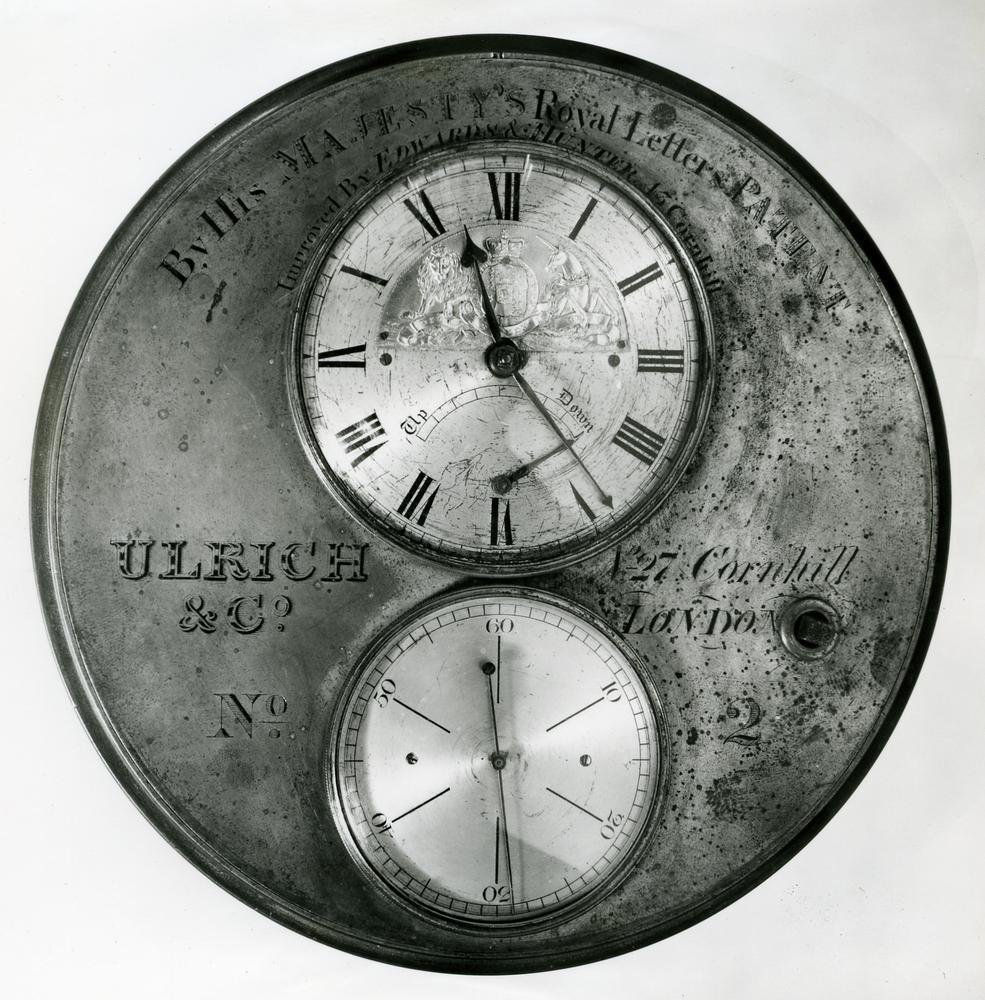
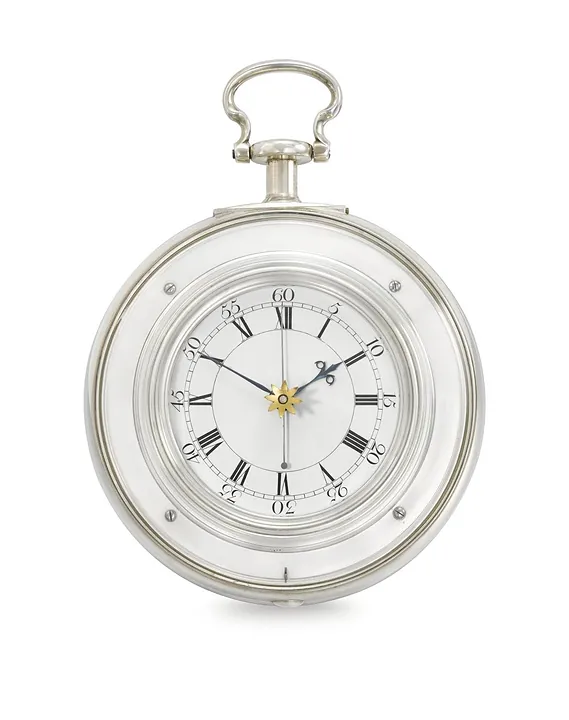
Marine chronometer; fitted with later development of Earnshaw's spring detent escapement; movement in deep brass container; subsidiary dial for hours, minutes and reserve of going, another for seconds; blued steel hands.
Curator's comments — British Museum
Comment from Anthony G. Randall and Richard Good, Catalogue of Watches in the British Museum. Vol. VI (1990) Made by Ulrich and Co, c. 1828 Marine Chronometer Signature: Engraved on the plate in which the dials are set 'ULRICH & co No. 27 Cornhill LONDON No 2. By his MAJESTY'S Royal letters PATENT. Improved by EDWARDS AND HUNTER 43 Cornhill.' The engraving is filled with black wax. Box: The movement contained in a deep brass canister, made from a sheet of strip brass bent and with a soldered butt seam, the bezel and bottom are soldered on. The dial plate rests in a turned rebate with the movement suspended from it. There was once a threaded bezel, but this now missing. There are four tapped holes in the bottom and several filled holes in the side of the canister, probably for some sort of gimbal suspension and levelling weight, all now missing. Diam. 181 mm, h. 185 mm. Dial and hands: A subsidiary dial for hours, minutes and reserve of going, another for seconds. Both dials of silvered engraved brass, the engraving filled with black wax, held by screws to the dial plate. In the upper dial the coat of arms of George IV, raised and held with three screws, probably made of gold. Each dial is protected by a brass bezel with knurled edge snapping into a turned sink in the dial plate, and with a raised glass. The short square near the edge of the dial plate is for winding. Blued steel hands. Movement: On the inside of the back plate, under the fourth wheel driving the seconds hand the punched ébauche marks I over I.W. The front plate is similarly marked by the foot of die maintaining detent cock. Dial plate diam. 170 mm; front plate diam. 153 mm; back plate diam. 153 mm; frame h. 107.5 mm, excluding added plate 3.0 mm th. on which the escapement is mounted. Frame: Full plate construction of the most massive proportions, with four balluster turned pillars, the back plate retained by two screws into die flanged end of each pillar. The end of each pillar is reduced and passes into a positioning hole in the back plate. Each of the plates is about 3.2 mm (⅛in) thick, the dial plate slightly less. This is secured by four short turned feet passing into holes in the front plate and screws set in the edge of the front plate. Covering the original back plate and secured by two steady pins and three screws is a brass disc of the same diameter and thickness. On it are planted the escape arbor, the detent and two steel pillars to carry the balance bridge. On the underside is scratched 'This Back Plate, 'Scaped and Sprung & c by Simson ay 1838'. The name is partly erased by file marks. There are several filled and unfilled holes in the back plate and it seems likely that the chronometer was originally fitted with one of Ulrich's constant force escapements. There are also several carefully filled holes in the front plate and in the plate carrying the escapement. Fusee: Very coarse pitch brass reversed fusee with a modified English stop-work. The maintaining ratchet wheel is steel and cut with a large number of exceedingly fine teeth. There are two maintaining detents pivoted in a cock on the front plate and the front plate itself. Each is returned by a spiral spring round its arbor and has a double nose acting on the ratchet wheel, and each acts half a tooth pitched before or after the other. The fusee groove is marked by the pressure of the exceedingly large chain. The mainspring barrel opens with a snap-on cover at both ends. There are two mainsprings of very great strength separated by a brass disc in the middle of the barrel. One at least has been rehooked by hook and eye to the barrel wall. Each spring has a bride to hold the last coil against the barrel wall. The arbor is a composite of steel and brass, unsnailed, with the two hooks and squared at both ends. One brass setting-up ratchet and click is fitted on the dial side of the front plate, the other inside the back plate. The squared part of the arbor has a short extension under the dial for setting up. The fusee is wound by a large brass wheel squared to the end of its arbor under the dial plate, in permanent mesh with a large brass pinion pivoted in the dial plate and the front plate and with an extended square beyond the dial. Going train: The fusee and offset centre arbor are pivoted in the frame. The third and fourth wheels are pivoted between a potence on the back plate and the back plate itself. There is an additional wheel pivoted like the third and fourth wheels, meshing with a large pinion on the escape pinion arbor, and carrying a long arbor on an extended lower pivot. This arbor is pivoted in the dial plate and carries the seconds hand. The difference in style, thickness and colour of the brass of the centre, third and fourth wheels when compared with the wheel driving the seconds hand, and the style and finish of the pinions suggest that the centre wheel and the third and fourth wheels and pinions may all be later replacements. The present centre wheel is held by three screws on its collet which also has three filled holes, and is considerably thicker than the height of the collet boss positioning it. This suggests that the original train wheels were too thin to withstand the very great driving force and may have started to buckle. The third and fourth arbors also appear to have been replanted. Jewelling: Only the pivots of the escapement arbors run in pierced jewels with endstones. A diamond endstone set in a blued steel ring is fitted on the balance bridge. The end of the seconds indicating arbor pivot in the back plate rests on a brass plug held by two screws in a sink in the plate like an endstone jewel setting. Escapement: As now fitted it is a development of Earnshaw's escapement. The brass escape wheel is probably a later substitution after the alterations in 1838. It is not crossed out and only one screw is fitted to hold it on its collet. The collet is drilled and tapped for two screws, the wheel drilled for only one. The stee.
Inscriptions & marks
signature; ULRICH & Co No.27 Cornhill LONDON No2. By his MAJESTY'S Royal letters PATENT. Improved by EDWARDS AND HUNTER 43 Cornhill. [dial plate]; signature; This BackPlate,'Scaped and Sprung & c by Simson ay 1838 [backplate]
Provenance
Previous owner/ex-collection:, Courtenay Adrian Ilbert; Donated by:, Gilbert Edgar; Acquired 1958
Historical context
Precision & Scientific Horology (1750 – 1850)
Harrison solves longitude; Mudge invents the lever; Breguet's Paris workshop defines the modern watch.
The longitude problem was solved by the marine chronometer and lunar distance methods; dividing engines made precision scales possible, and observatories set time by transit instruments.
Read the period in the timelineMore instruments from this periodEarlier: Early Modern Horology
Atlas type guide
Marine chronometers
A marine chronometer is a precision timekeeper carried at sea to find longitude: the navigator compares local noon, observed with a sextant, with the time at a reference meridian kept by the chronometer. Each hour of difference corresponds to fifteen degrees of longitude. John Harrison proved the method in the 1760s; Pierre Le Roy, Ferdinand Berthoud, John Arnold and Thomas Earnshaw then developed the detent escapement and the compensation balance that made chronometers practical to manufacture.
By the nineteenth century London, Liverpool, Le Locle and Glashütte supplied navies and merchant fleets. A typical box chronometer has a spring-detent escapement, a fusee to equalise mainspring torque, a bimetallic compensation balance with a helical balance spring, and is mounted in gimbals inside a wooden box so that it stays level.
What to look for
- Gimbals and a three-tier wooden box with a glazed inner lid.
- A power-reserve ('up and down') indicator on the dial, usually showing 56 hours on two-day instruments.
- Spring-detent escapement and a cylindrical (helical) balance spring visible through the movement.
- Admiralty or navy marks (broad arrow), and rating certificates from observatories.
- The maker's number on the dial and movement; many makers' registers survive, allowing dating.
Dating clues
- Earnshaw-type spring-detent chronometers became standard after about 1800.
- Auxiliary compensation devices on the balance appear from the mid-nineteenth century.
- Quartz and radio time signals ended routine use of mechanical chronometers in the 1970s and 1980s.
General guidance written by the Atlas editors about this kind of object. It is not a statement about this particular piece; for that, rely on the source record above and on physical examination.
Related records
Instruments · 1731–1776
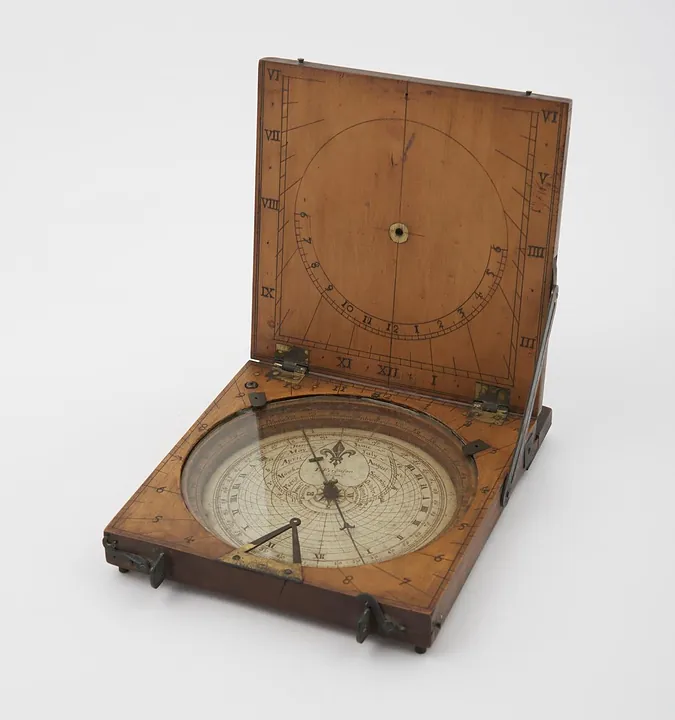
Azimuth compass sundial by James Ferguson, London, England, 1731–1776. Could also be used as a tablet sundial - string gnomon is missing (see note).
Science Museum Group, London
Instruments · 1738–1777
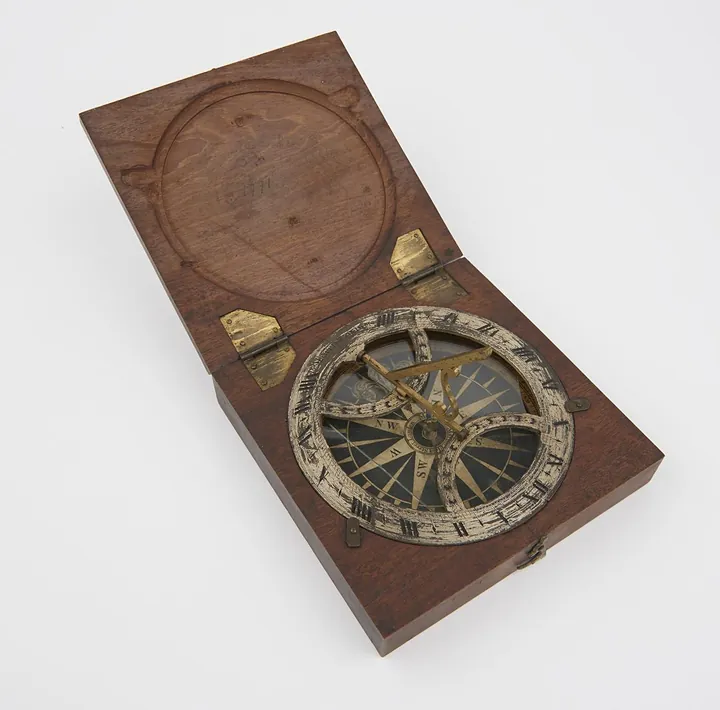
Azimuth sundial 4 3/8" diam, with folding gnomon fitted in mahogany case, made by B. Martin
Science Museum Group, London
Instruments · 1750–1800
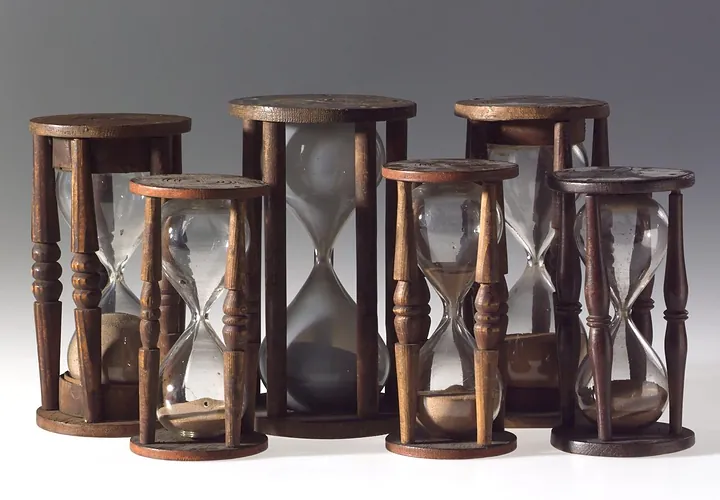
Single sand glass in four pillared wooden mount. 17 minutes. Horne Type B. Second half of the 18th century
Science Museum Group, London
Instruments · 1751–1825
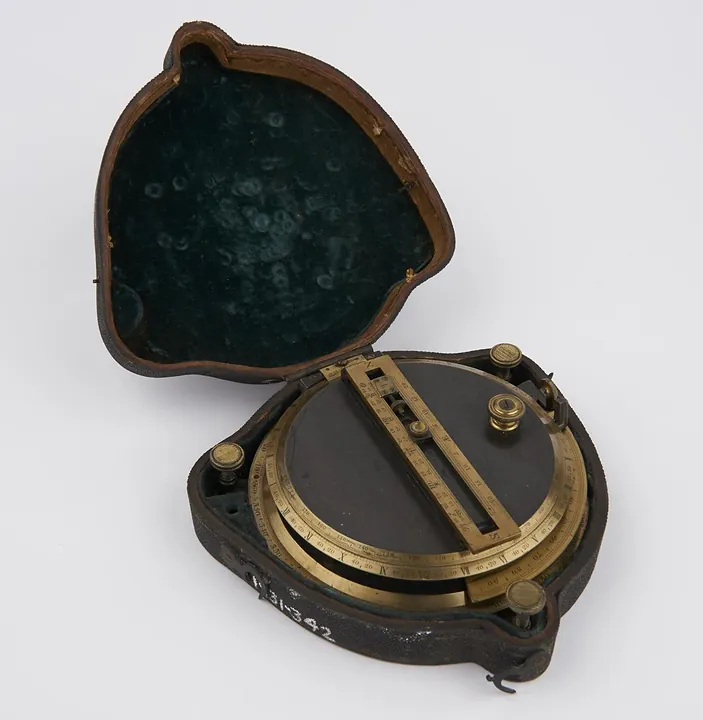
Sundial, by Troughton, in case. Invented and made by Troughton
Science Museum Group, London
Instruments · 1751–1850
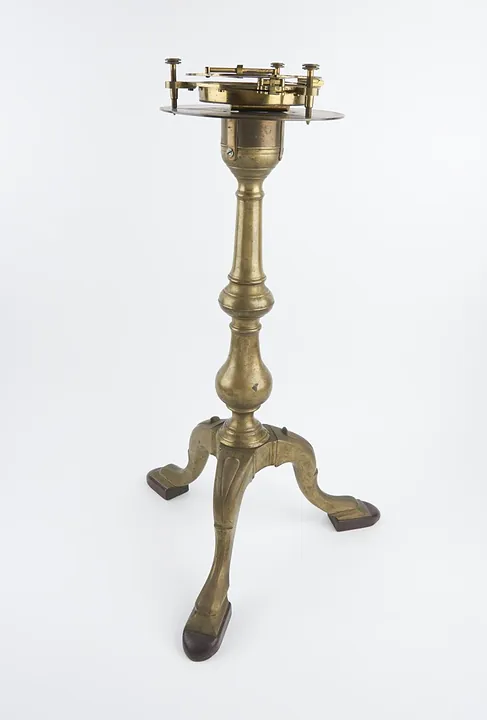
Universal Sundial; by Dollond and large brass stand, engraved "Dollond London" 6-inch hours circle, divided to 2 min, 3 levelling screws
Science Museum Group, London
Instruments · 1760–1769
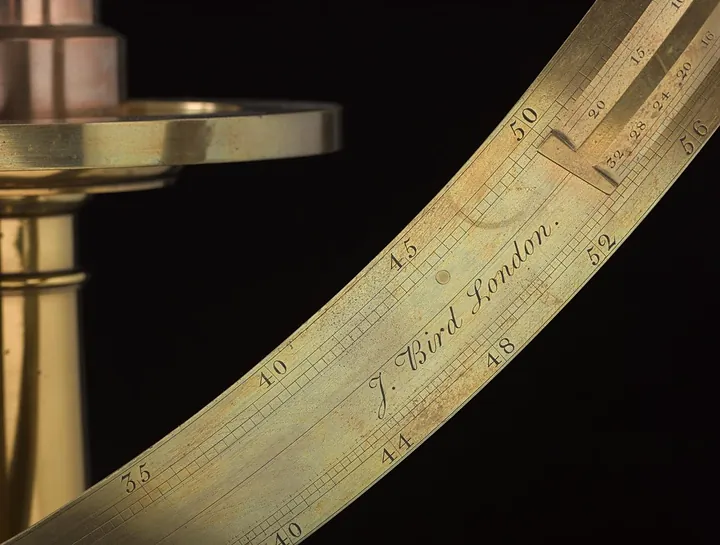
Armillary / astronomical instrument by John Bird, England, 1760–1769
Science Museum Group, London
Instruments · 1763–1829
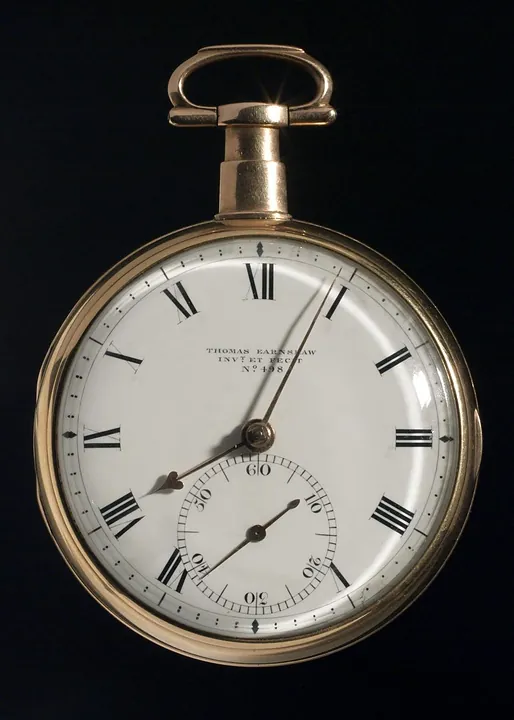
Chronometer watch by Thomas Earnshaw No.498, with later barrel cover numbered 2829, balance cock and regulator. In 18 ct. gold case hallmarked 1807/8
Science Museum Group, London
Instruments · 1770
Marine timekeeper 'H5' by John Harrison and Son, England, 1770
Science Museum Group, London