
Clocks · Longcase clock
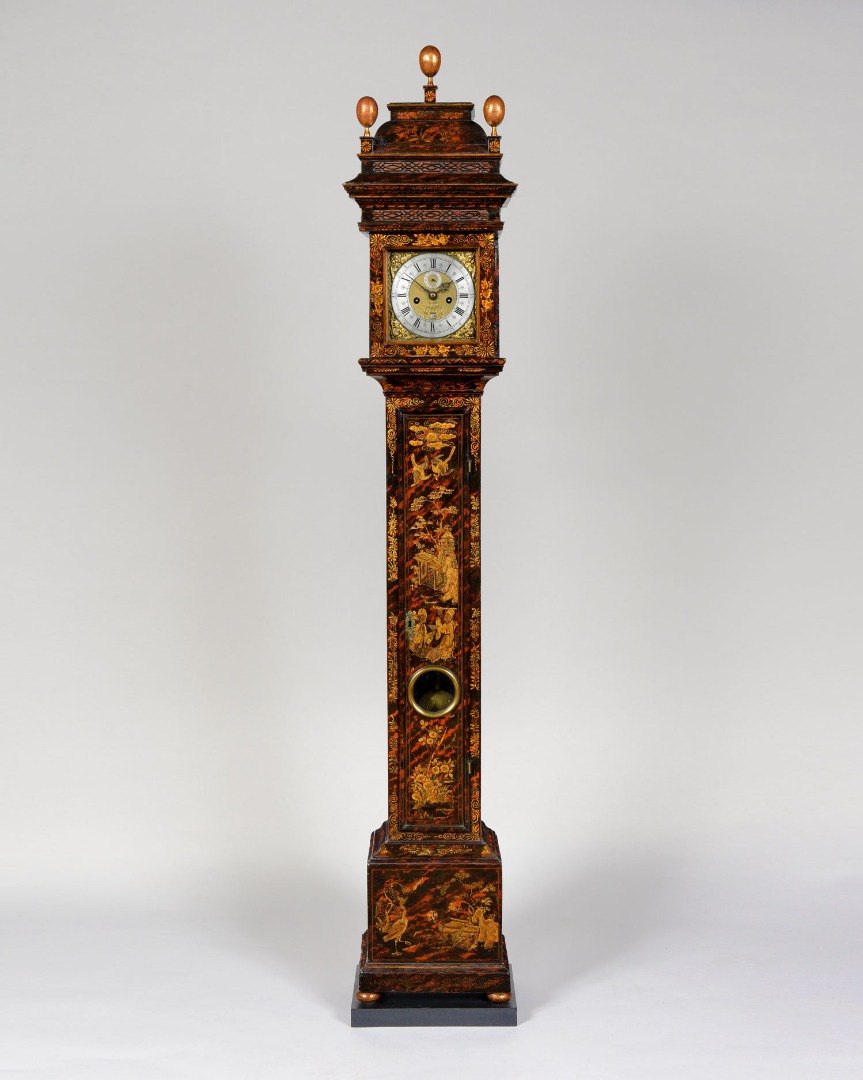
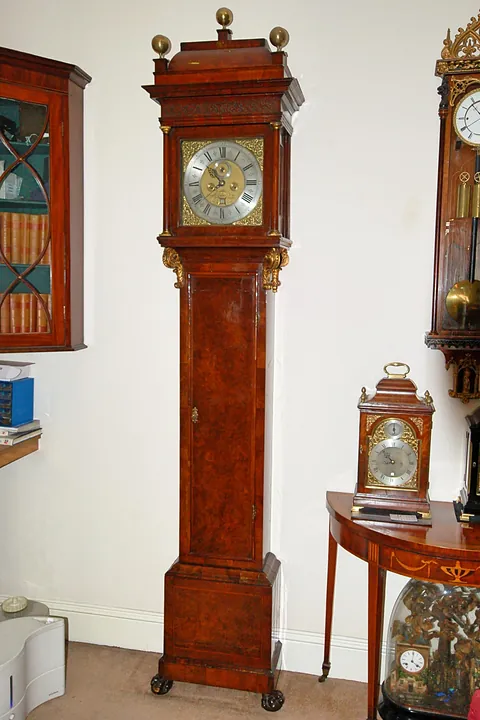
Longcase clock by Manley, Norwich
- Maker / attribution
- Manley (maker)
- Date
- c. 1715
- Historical period
- Early Modern Horology (1600 – 1750)
- Country of origin
- United Kingdom
- Place
- Norwich
- Object type
- Longcase clock
- Materials / technique
- tortoiseshell
- Dimensions
- Height 192 cm
- Stock no.
- SKU 411
- Credit line
- Dealer listing, Howard Walwyn (SKU 411)
- Catalogue title (original)
- MANLEY in NORWICH. A rare George I period miniature faux-tortoiseshell longcase clock. (English)
Editor's note
The dial is signed 'Manley in Norwich'; 'in Norwich' is the place, not part of the name.View the source record (dealer listing) ↗ (opens another website in a new tab)Suggest a correction
Record summary
Catalogued by Howard Walwyn Fine Antique Clocks (dealer), London (stock number SKU 411), this is a longcase clock by Manley, made in Norwich, United Kingdom, dated c. 1715. The Atlas places it in the Early Modern Horology period (1600 – 1750) of its Clocks collection. Materials and techniques recorded by the source: tortoiseshell. Recorded dimensions: Height 192 cm. The record is illustrated with 6 photographs.
Assembled from the source record's structured fields. Dates and attributions are given as the source states them; where a field is missing the Atlas leaves it blank rather than estimating.
Catalogue description
Dealer description — Howard Walwyn
A stunning rare George I period miniature faux-tortoiseshell longcase clock of 8-day duration and with hour strike. The 7 inch square brass dial has 4 winged cherub corner spandrels, a wheatear border and a finely matted centre. It has a raised silvered brass chapter ring with the maker’s signature Manley in Norwich . There is a subsidiary seconds dial below XII and an inset date aperture above VI. The blued steel hands are finely pierced and facetted. The elegant miniature faux-tortoiseshell case has an original caddy top surmounted by three gilt wooden ball finials and a pierced sound fret above and below the cornice moulding. The raised gilt chinoiserie figurative decoration is of exceptional quality and is shown to great effect against the faux-tortoiseshell background. The full length trunk door has a brass moulded lenticle to show off the seconds beating pendulum. The base terminates with a plinth which is supported on four turned gilt wooden bun feet. The week duration movement has two plates which are united by four knopped and finned brass pillars. Each train has four wheels, the going with anchor escapement and the strike train with inside countwheel strike sounded on a single bell. Date : circa 1715 Height : 75 ½ in (192 cm) including finial Height : 69 ½ in (176.5 cm) excluding finial Width : 12 ⅛ (31 cm) Depth : 7 ⅞ in (19.75 cm) * Cornelius Manley is recorded as working in Norwich between 1702 and his death in 1722 The photographs do not do justice to this wonderful little clock and its fine slender proportions. The clock is illustrated in figure 6/4 on page 120 of Tom Robinson’s Longcase Clock book. References : B. Loomes, Early Clockmakers of Great Britain:1286-1700 , p.331 B.Loomes, Watchmakers and Clockmakers of the World: Complete 21st Cent A stunning rare George I period miniature faux-tortoiseshell longcase clock of 8-day duration and with hour strike. The 7 inch square brass dial has 4 winged cherub corner spandrels, a wheatear border and a finely matted centre. It has a raised silvered brass chapter ring with the maker’s signature Manley in Norwich . There is a subsidiary seconds dial below XII and an inset date aperture above VI. The blued steel hands are finely pierced and facetted. The elegant miniature faux-tortoiseshell case has an original caddy top surmounted by three gilt wooden ball finials and a pierced sound fret above and below the cornice moulding. The raised gilt chinoiserie figurative decoration is of exceptional quality and is shown to great effect against the faux-tortoiseshell background. The full length trunk door has a brass moulded lenticle to show off the seconds beating pendulum. The base terminates with a plinth which is supported on four turned gilt wooden bun feet. The week duration movement has two plates which are united by four knopped and finned brass pillars. Each train has four wheels, the going with anchor escapement and the strike train with inside countwheel strike sounded on a single bell. Date : circa 1715 Height : 75 ½ in (192 cm) including finial Height : 69 ½ in (176.5 cm) excluding finial Width : 12 ⅛ (31 cm) Depth : 7 ⅞ in (19.75 cm) * Cornelius Manley is recorded as working in Norwich between 1702 and his death in 1722 The photographs do not do justice to this wonderful little clock and its fine slender proportions. The clock is illustrated in figure 6/4 on page 120 of Tom Robinson’s Longcase Clock book. References : B. Loomes, Early Clockmakers of Great Britain:1286-1700 , p.331 B.Loomes, Watchmakers and Clockmakers of the World: Complete 21st Century Edition, p.504 Tom Robinson, The Longcase Clock , p. 12o fig. 6/4, p. 124 Clifford & Yvonne Bird, Norfolk & Norwich -Clocks & Clockmakers, p.130 HW5970
Historical context
Early Modern Horology (1600 – 1750)
Huygens' pendulum and balance spring transform accuracy; English makers develop the anchor and deadbeat escapements.
Huygens's pendulum (1656–57) improved clock accuracy from about a quarter of an hour to under a minute a day. The anchor escapement (c. 1670) and the long seconds pendulum created the longcase clock; London makers such as Fromanteel, Knibb, Tompion and Quare led European clockmaking, and French makers created the Boulle pendule.
Read the period in the timelineMore clocks from this periodEarlier: Renaissance Horology
Atlas type guide
Longcase (tall-case or grandfather) clocks
The longcase clock was born from two seventeenth-century innovations: Christiaan Huygens's pendulum (1656–57) and the anchor escapement (c. 1670). A long seconds pendulum, nearly a metre long, swings with a small arc, and enclosing it together with the driving weights in a tall wooden case protected the mechanism and created a new piece of furniture. London makers such as Ahasuerus Fromanteel, Thomas Tompion and Joseph Knibb set the pattern.
By the eighteenth century longcase clocks were made throughout Britain, the Netherlands, Scandinavia (the Swedish Mora clock), France (the Comtoise from the Franche-Comté), Germany and colonial America. Eight-day movements with two weights became standard in better clocks; thirty-hour clocks with one weight and a rope or chain were cheaper alternatives.
What to look for
- Winding holes in the dial: two (eight-day, going and striking) or none (thirty-hour, pulled up by a chain).
- Brass dials with applied chapter rings (earlier) versus painted iron 'white' dials (after c. 1770 in Britain).
- Moon-phase arches, date apertures, seconds dials and maker's name on the dial.
- Case woods and style: ebonised, walnut marquetry, lacquer, oak or mahogany; regional styles from London, Lancashire, Scotland or America.
- Whether the movement and dial match the case — 'marriages' are common.
Dating clues
- Square brass dials suggest c. 1670–1720; arched brass dials c. 1715–1790.
- Painted (white) dials were made by Birmingham dial-makers from about 1772.
- Comtoise clocks with repoussé pendulums are mostly nineteenth century.
General guidance written by the Atlas editors about this kind of object. It is not a statement about this particular piece; for that, rely on the source record above and on physical examination.
Read next:Deadbeat escapementAnchor escapement
Related records
Clocks · c. 1695–1700
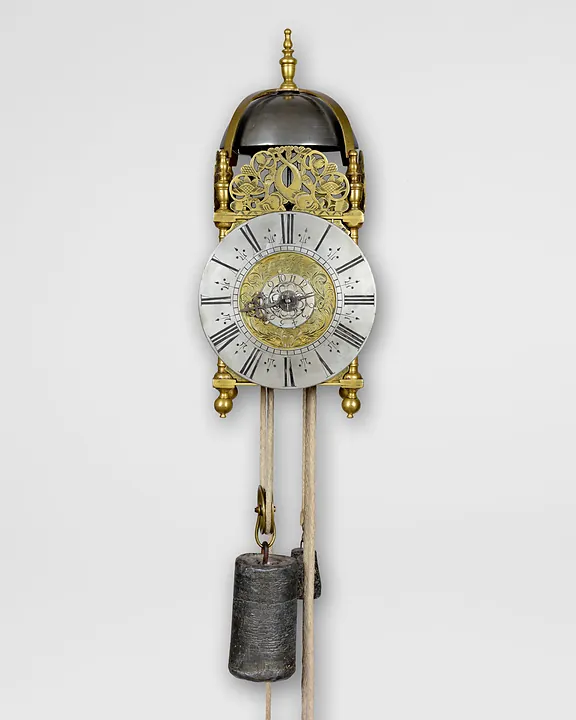
Lantern clock by John Knibb, Oxford, c. 1695–1700
Howard Walwyn Fine Antique Clocks (dealer), London
Clocks · c. 1680–1685
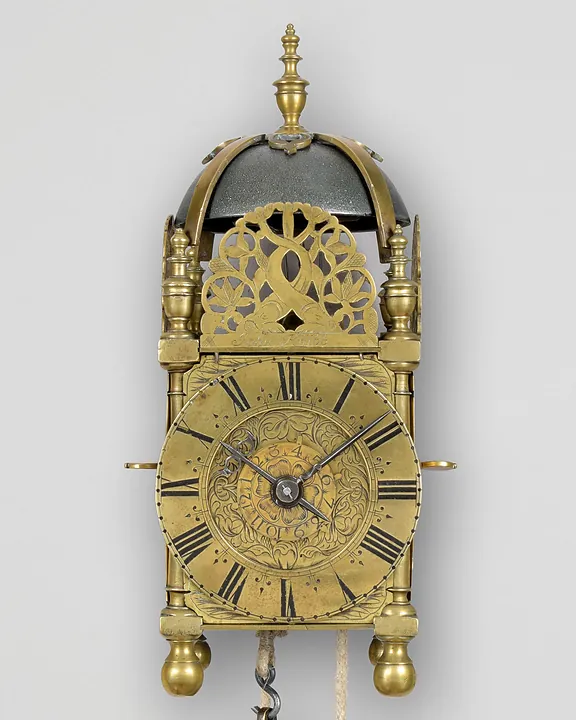
Lantern clock by John Knibb, Oxford, c. 1680–1685
Howard Walwyn Fine Antique Clocks (dealer), London
Clocks · c. 1670
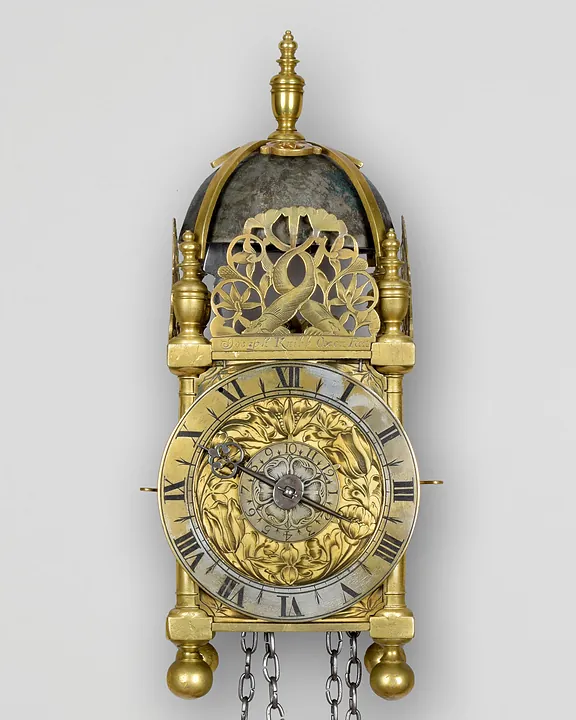
Lantern clock by Joseph Knibb, Oxford, c. 1670
Howard Walwyn Fine Antique Clocks (dealer), London
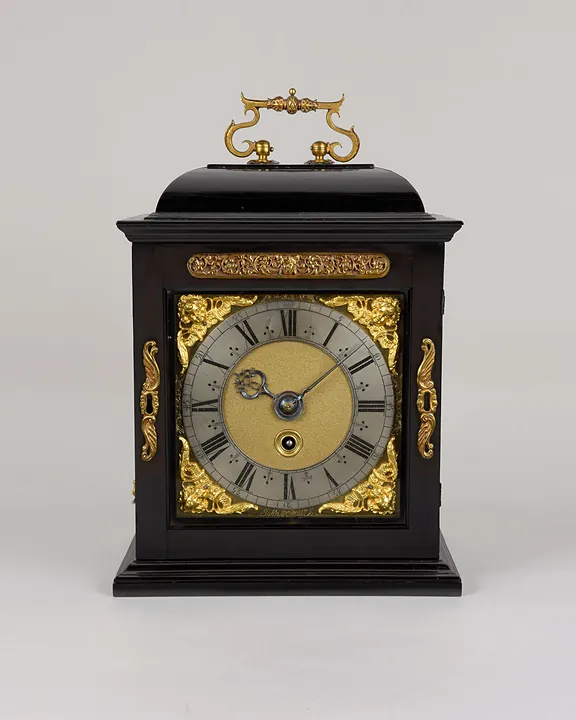
Clocks · c. 1695–1700
Bracket clock by John Knibb, Oxford, c. 1695–1700
Howard Walwyn Fine Antique Clocks (dealer), London
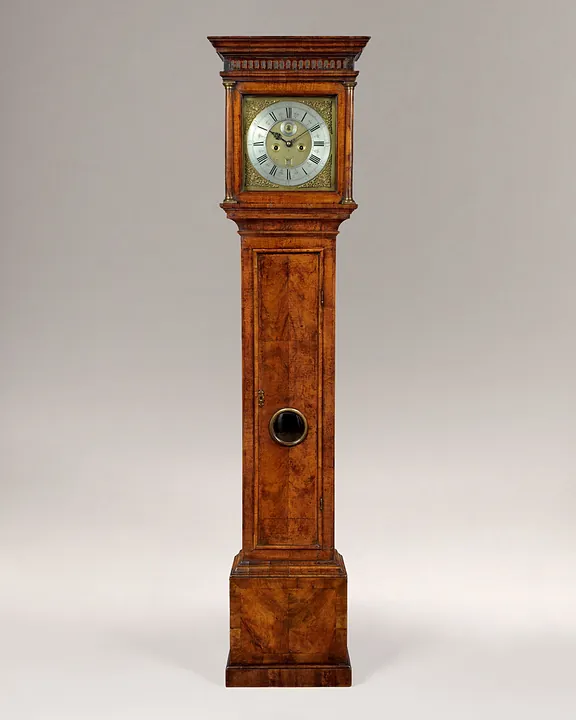
Clocks · c. 1710
Longcase clock by John Witherston, Hereford, c. 1710
Howard Walwyn Fine Antique Clocks (dealer), London
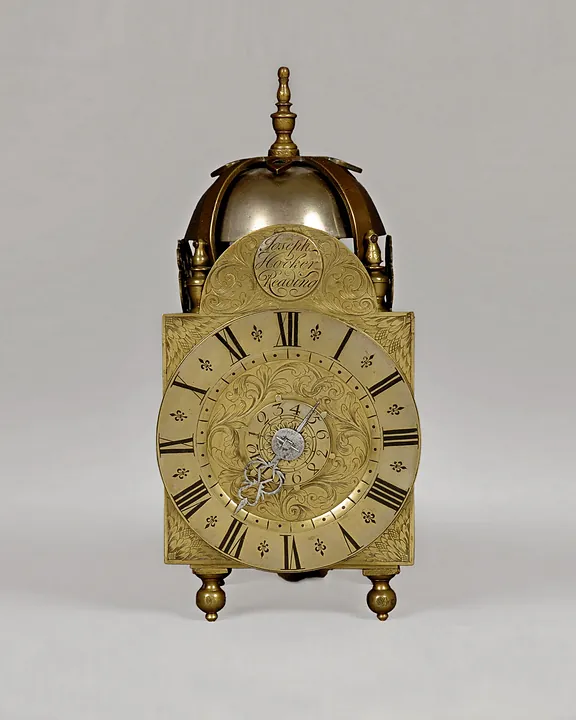
Clocks · c. 1710
Lantern clock by Joseph Hocker, Reading, c. 1710
Howard Walwyn Fine Antique Clocks (dealer), London
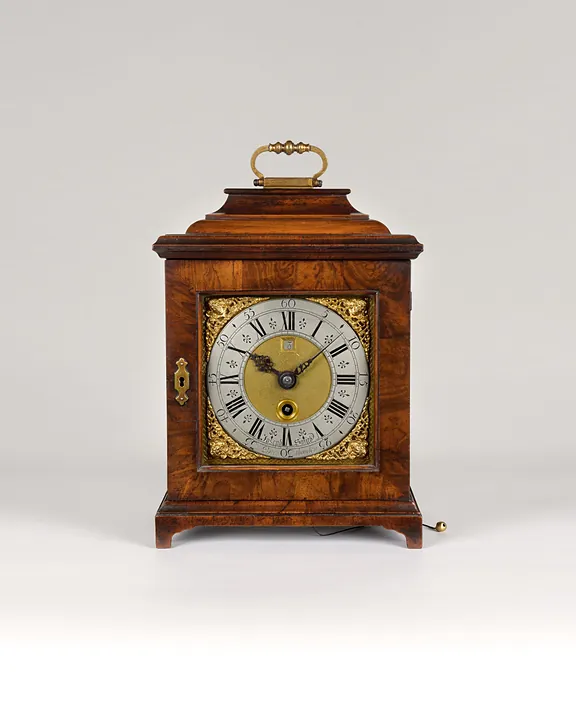
Clocks · c. 1720–1725
Clock by Joseph Smith, Chester, c. 1720–1725
Howard Walwyn Fine Antique Clocks (dealer), London
Clocks · c. 1740
Grandfather Clock by John Wainwright, Wellingborough, c. 1740
Pendulum of Mayfair (dealer), London