
Clocks · Longcase clock
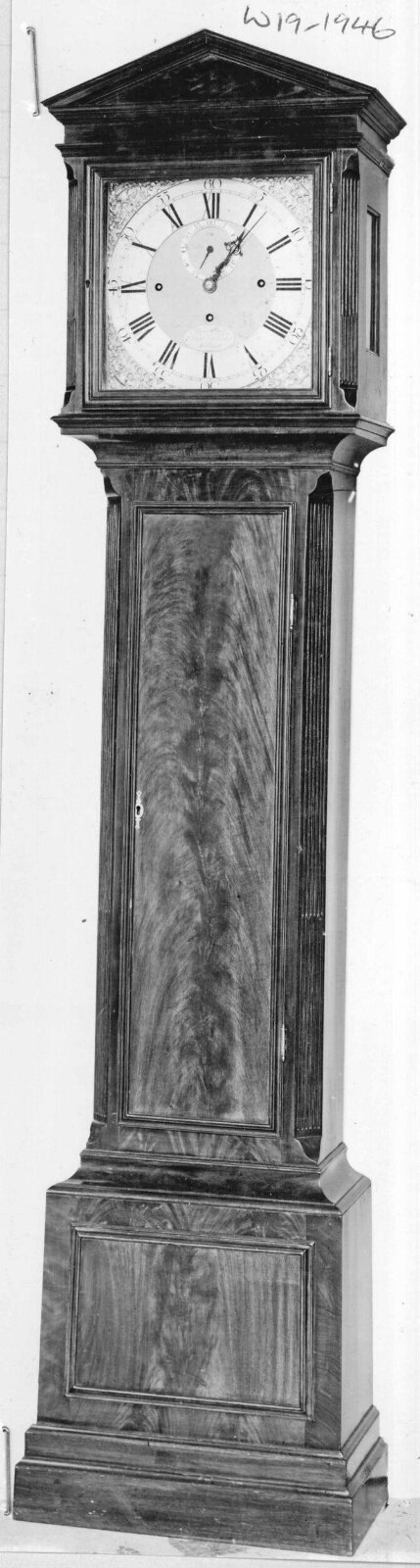
Longcase clock by Benjamin Gray, England, c.1750
- Maker / attribution
- Benjamin Gray (maker); Justin Vulliamy (maker)
- Date
- c.1750
- Historical period
- Precision & Scientific Horology (1750 – 1850)
- Country of origin
- England
- Place
- London
- Object type
- Longcase clock
- Materials / technique
- Mahogany, veneered on oak
- Dimensions
- Height: 207.8 cm; Width: 47.7 cm; Depth: 25.5 cm; Weight: 12.00 kg (w.19:3 weight 10/10/2025 NH)
- Holding institution
- Victoria and Albert Museum, London
- Accession / object no.
- W.19:2-1946
- Credit line
- Bequeathed by Reverend E G Winstanley
View the source record ↗ (opens another website in a new tab)Suggest a correction
Record summary
Held and catalogued by Victoria and Albert Museum, London (object number W.19:2-1946), this is a longcase clock by Benjamin Gray, made in London, England, dated c.1750. The Atlas places it in the Precision & Scientific Horology period (1750 – 1850) of its Clocks collection. Materials and techniques recorded by the source: Mahogany, veneered on oak. Recorded dimensions: Height: 207.8 cm; Width: 47.7 cm; Depth: 25.5 cm; Weight: 12.00 kg (w.19:3 weight 10/10/2025 NH). The record is illustrated with 1 photograph.
Assembled from the source record's structured fields. Dates and attributions are given as the source states them; where a field is missing the Atlas leaves it blank rather than estimating.
Catalogue description
Summary — Victoria and Albert Museum
Gray, of Pall Mall, was clock-maker to George II. Vulliamy emigrated from Switzerland and settled in London early in the 18th century, entering into partnership with Gray. He married Gray's daughter and carried on the business after his death. The family of Vulliamy held the office of clockmaker to the reigning sovereign until the death of Benjamin Lewis Vulliamy in 1854. The case has a plain pedimented hood and the door flanked by chamfered corners with columnar fluting. The brass dial has openwork vase designs in the spandrels. There is a standard clock of closely similar design at Windsor Castle.
Physical description — Victoria and Albert Museum
Case: Mahogany veneer on oak carcass. Interior of trunk employing glue block construction, exterior with chamfered, fluted and wooden strung corners to front. Rectangular trunk door with moulded border. Concave moulding below hood. Sliding hood with similar chamfering as trunk to front, pedimented top, square hinged door with moulded border and rectangular glazed side panels. Plain frieze. Rectangular base with moulded border on double plinth. Inside trunk top, the very insubstantial chops reinforced with additional wood pieces. Opposite these on outside of chops are short runners to locate hood. Cut outs for hinges on inside of trunk door are larger than existing hinges and unused holes are visible. Dial: Brass, 12 inches square. Centre matted. Three plain winding holes, below central, pinned to dial plate is a silvered brass oval plaque engraved Benj: Gray /Just: Vulliamy / London . Urn and two eagle spandrels each located by a single screw. Pinned to the dial plate is the silvered brass chapter ring with an engraved minute band, Arabic minute numerals at intervals of five and Roman hour numerals. Pinned to the dial plate below "XII" is the subsidiary seconds ring of silvered brass with engraved seconds band and Arabic seconds numerals at intervals of five; its diameter is such that lower portion is partially cut away to clear central hole for hands; the 30 is much reduced in size in comparison with the other seconds numerals. Four dial feet attached to movement front plate by pinning. Hands: Pierced steel hour and minute. Seconds hand absent. Movement: Brass and steel, weight driven, quarter chiming, hour striking of 8-day duration with recoil escapement, pendulum regulated. Four pillars, parallel in section with a concave portion at both ends, each riveted to the backplate, pinned to the front. Quarter chiming on eight bells, hour striking on a single bell, both controlled by racks and snails, end of hour rack bent through 90 degrees forming locking surface for gathering pallet. Brass train wheels with four semicircular crossings, cannon and minute wheels with three-spoked crossings, latter located on front plate by a cock. Wheels on going and striking trains significantly thinner than those of chiming train. Where visible, chiming and striking great wheels, and striking warning wheel with scribed lines; roots of some wheel teeth flanked by short marks. Generally, such markings not obvious on chiming wheelwork. Double profile wheel collets of differing shape on striking and chiming trains: striking with domed part against wheel, abutting a short cylindrical portion along arbor on all except warning; chiming with two cylindrical sections, the larger adjacent to the wheel, the smaller portion along arbor. Going train wheels riveted to pinion heads - no collets. Going and striking train pinion heads with detailed differences to those of chiming train. Steel recoil pallets having short vertical stalk to anchor span 9½ teeth of escape wheel; mounted on pallet arbor by brass collet. Steel crutch of oval section. Hammer stop screwed to the inside bacplate above hammer arbor. Chiming greatwheel click is of the type separate from its screw; going and striking clicks of one-piece variety with integral thread. Chiming hammers are discs. Substantial backcock occupies half width of backplate. Description and notes by Francis Brodie, c. 2008
Brief description — Victoria and Albert Museum
Longcase clock with triangular pediment, the case veneered with flame-figured mahogany on a carcase of oak, with simple mouldings; the dial of brass with a silvered chapter ring, engraved with the makers' names.
Inscriptions & marks
Benj: Gray Just: Vulliamy
Provenance
Bequeathed by the Reverend E G Winstanley (RP 138/1946) Maker's details: Benjamin Gray, born 1676, but early years and training do not seem to have been recorded, indeed nothing known for 40 years from 1676. Not a member of the Clockmakers Company, working in the City of Westminster, the City of London having no jurisdiction over Westminster, nor the right to search premises there. The first record of Gray is in 1716, taking on as apprentice Thomas Richard Wacklin, when Gray was at St Martin’s in the Fields. Believed that in 1727, Gray relocated to Pall Mall. Around 1743, formed partnership with François Justin Vulliamy. In 1738 was at St James’s Street West at Ye Sun Dyall in Thatched House Court (Jagger, C., Royal Clocks: The British Monarchy and its Timekeepers 1300-1900, London, 1983). 30 March 1742 was made Watchmaker in ordinary to King George II. 1752 moved to 78 Pall Mall, which was later changed to 68. Gray was perhaps more noted for his watches, specialising in repeating work, and repairing for other makers. Once F.J. Vulliamy joined him in partnership, the greater part of the output was clocks. The partnership usually signed Benj Gray:Just Vulliamy (Smith, R., Personal Communication). Gray died 1764; his name was noted for the quality of his products, if not his output (Jagger, C., Royal Clocks: The British Monarchy and its Timekeepers 1300-1900, London, 1983). Gray seems to have made the fist English pedometer c.1750 (Roberts, D.H., British Longcase Clocks, Westch
Historical context
Precision & Scientific Horology (1750 – 1850)
Harrison solves longitude; Mudge invents the lever; Breguet's Paris workshop defines the modern watch.
The age of the deadbeat escapement, compensated pendulums and observatory regulators. Domestic clocks spread through the middle classes: English longcase and bracket clocks, French gilt-bronze mantel clocks, Viennese Biedermeier wall clocks, Black Forest painted-shield clocks, and the first American shelf clocks.
Read the period in the timelineMore clocks from this periodEarlier: Early Modern Horology
Atlas type guide
Longcase (tall-case or grandfather) clocks
The longcase clock was born from two seventeenth-century innovations: Christiaan Huygens's pendulum (1656–57) and the anchor escapement (c. 1670). A long seconds pendulum, nearly a metre long, swings with a small arc, and enclosing it together with the driving weights in a tall wooden case protected the mechanism and created a new piece of furniture. London makers such as Ahasuerus Fromanteel, Thomas Tompion and Joseph Knibb set the pattern.
By the eighteenth century longcase clocks were made throughout Britain, the Netherlands, Scandinavia (the Swedish Mora clock), France (the Comtoise from the Franche-Comté), Germany and colonial America. Eight-day movements with two weights became standard in better clocks; thirty-hour clocks with one weight and a rope or chain were cheaper alternatives.
What to look for
- Winding holes in the dial: two (eight-day, going and striking) or none (thirty-hour, pulled up by a chain).
- Brass dials with applied chapter rings (earlier) versus painted iron 'white' dials (after c. 1770 in Britain).
- Moon-phase arches, date apertures, seconds dials and maker's name on the dial.
- Case woods and style: ebonised, walnut marquetry, lacquer, oak or mahogany; regional styles from London, Lancashire, Scotland or America.
- Whether the movement and dial match the case — 'marriages' are common.
Dating clues
- Square brass dials suggest c. 1670–1720; arched brass dials c. 1715–1790.
- Painted (white) dials were made by Birmingham dial-makers from about 1772.
- Comtoise clocks with repoussé pendulums are mostly nineteenth century.
General guidance written by the Atlas editors about this kind of object. It is not a statement about this particular piece; for that, rely on the source record above and on physical examination.
Read next:Deadbeat escapementAnchor escapement
Related records
Clocks · c.1730
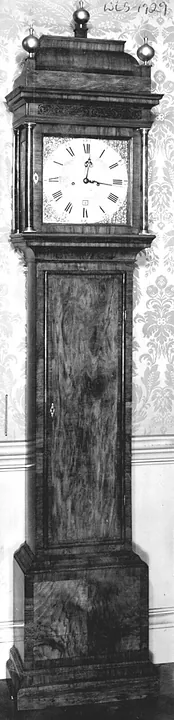
Long case clock, figured walnut, inscribed 'Benj: Gray and Just: Vulliamy, London', made in about 1730
Victoria and Albert Museum, London
Clocks · c. 1745
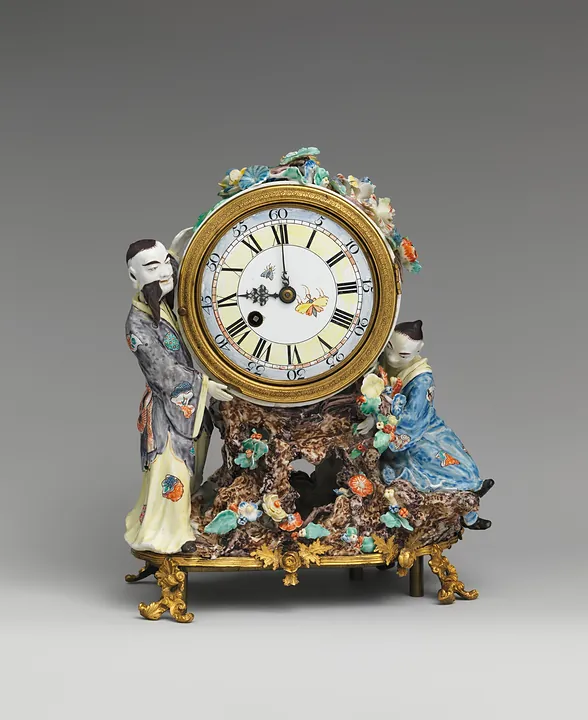
Clock, movement by Benjamin Gray, England, c. 1745
The Metropolitan Museum of Art, New York
Movements & Components · 1730
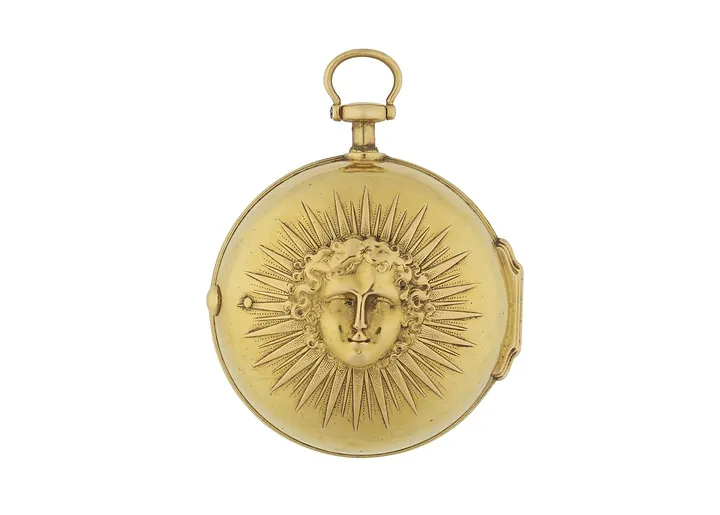
Watch movement by Benjamin Gray, England, 1730
Science Museum Group, London
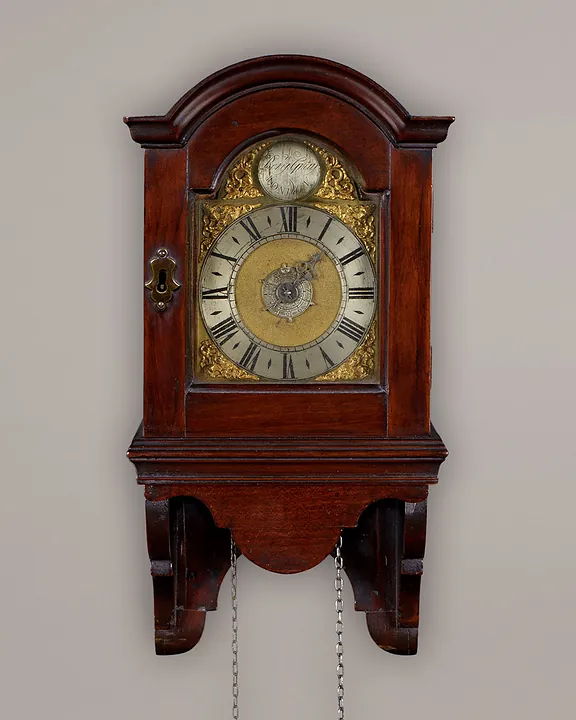
Clocks · c. 1750
Clock by Benjamin Gray, London, c. 1750
Howard Walwyn Fine Antique Clocks (dealer), London
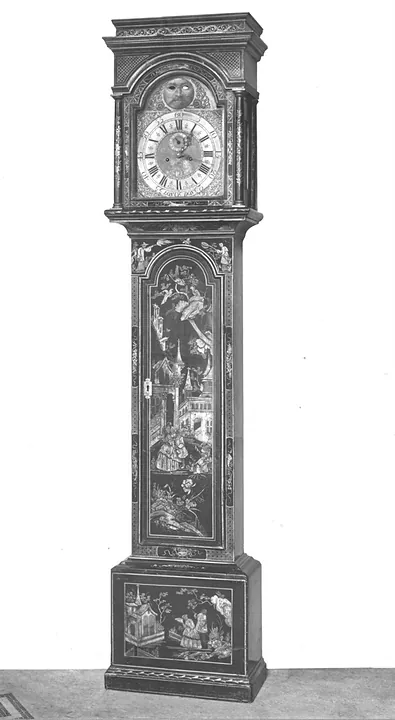
Clocks · 1740–1760
Longcase clock, English, 1740–1760, japanned wood, John Ellicott
Victoria and Albert Museum, London
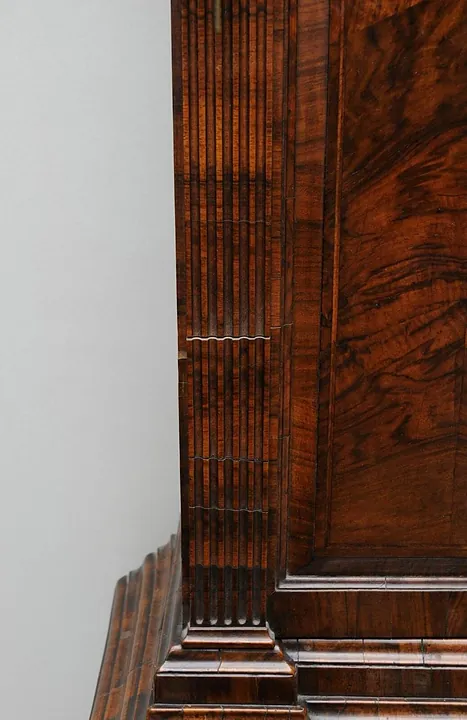
Clocks · c.1750
Long-case clock, English, ca. 1750, by Richard Peyton of Gloucester
Victoria and Albert Museum, London
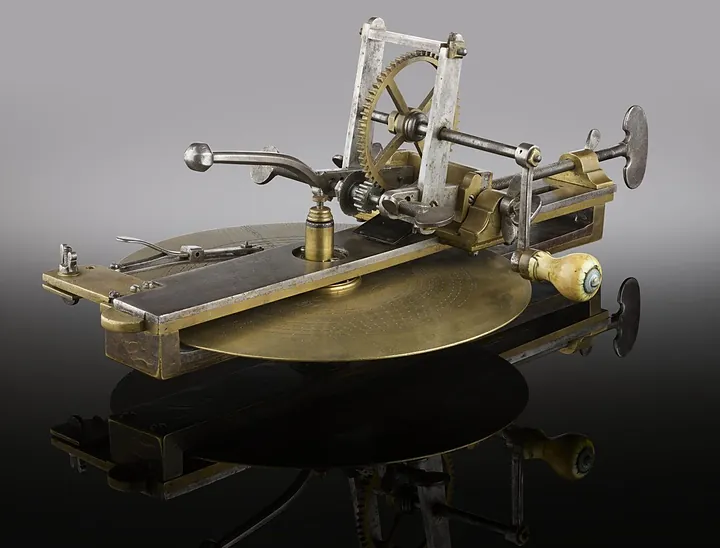
Clocks · 1751
Large wheel engine, signed and dated "John Tipping, Whildon Green, 1751".
Science Museum Group, London
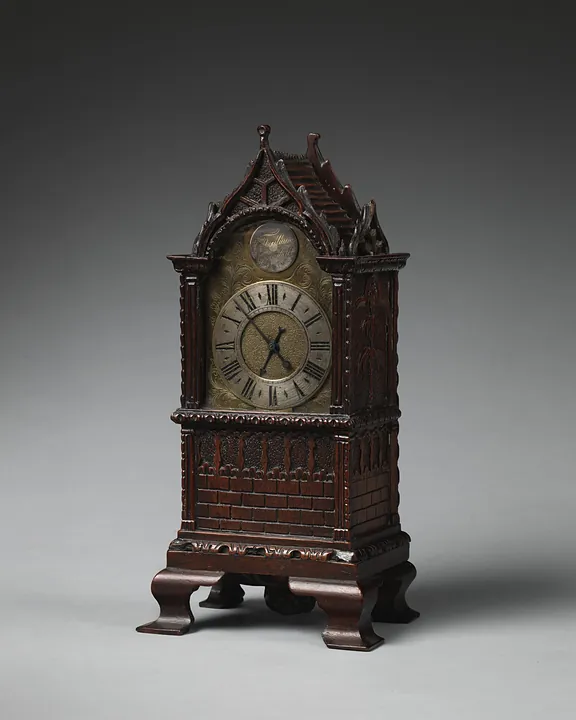
Clocks · 1755
Bracket clock by John Fordham, England, 1755
The Metropolitan Museum of Art, New York