Clocks · Clock
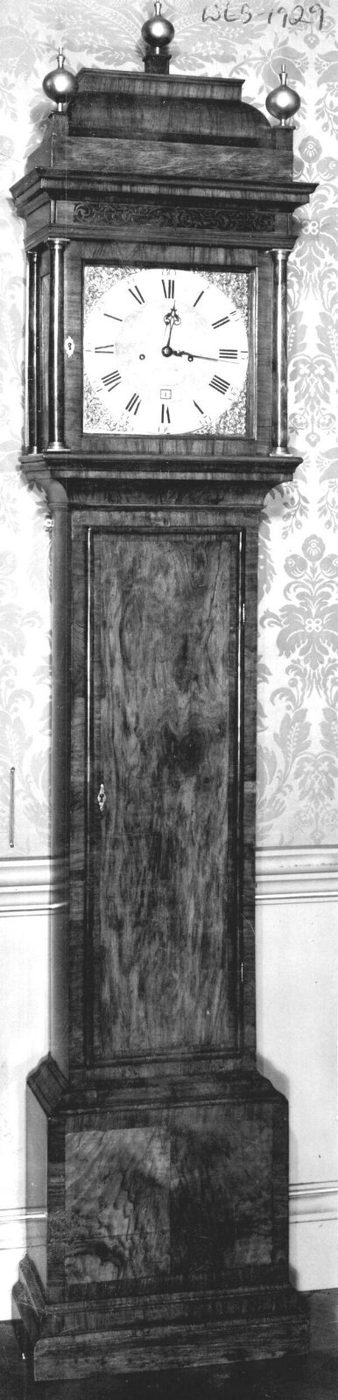
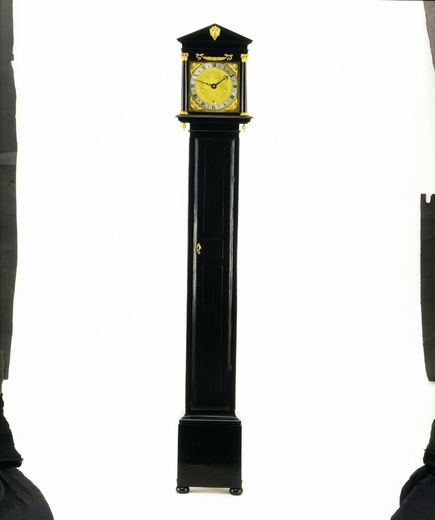
LONG CASE CLOCK Figured walnut Inscribed 'Benj: Gray and Just: Vulliamy, London', made in about 1730
- Maker / attribution
- Benjamin Gray (made); François Justin Vulliamy (made)
- Date
- c.1730
- Historical period
- Early Modern Horology (1600 – 1750)
- Country of origin
- England
- Place
- London
- Object type
- Clock
- Materials / technique
- walnut, brass (alloy)
- Dimensions
- Height: 247.5 cm; Width: 51.6 cm; Depth: 25 cm; Weight: 6 kg (brass weight)
- Holding institution
- Victoria and Albert Museum, London
- Accession / object no.
- W.65:1 to 6-1929
- Credit line
- Given by Mr S E Prestidge [rp 29/9094]
Record summary
Held and catalogued by Victoria and Albert Museum, London (object number W.65:1 to 6-1929), this is a clock by Benjamin Gray, made in London, England, dated c.1730. The Atlas places it in the Early Modern Horology period (1600 – 1750) of its Clocks collection. Materials and techniques recorded by the source: walnut, brass (alloy). Recorded dimensions: Height: 247.5 cm; Width: 51.6 cm; Depth: 25 cm; Weight: 6 kg (brass weight). The record is illustrated with 4 photographs.
Assembled from the source record's structured fields. Dates and attributions are given as the source states them; where a field is missing the Atlas leaves it blank rather than estimating.
Catalogue description
V&A — Summary
Gray, of Pall Mall, was clock-maker to George II. Vulliamy emigrated from Switzerland and settled in London early in the 18th century, entering into partnership with Gray. He married Gray's daughter and carried on the business after his death. The family of Vulliamy held the office of clockmaker to the reigning sovereign until the death of Benjamin Lewis Vulliamy in 1854.
V&A — Physical description
Case: Figured walnut. Rectangular trunk door with convex moulding to edge occupying most of trunk front, attached by decorative brass hinges on inside. Concave moulding below hood. Sliding hood with caddy top flanked by gilded wood finials mounted on short pedestals, a third finial similarly mounted top centre. Front of frieze with textile backed frets. Rectangular hinged square glazed door with applied brass capped columns at front, capped quarter columns to rear; glazed rectangular side apertures. Rectangular base above double plinth. Shaped front to seatboard behind dial. Dial: Brass, 12 inches square. Centre matted. Square calendar aperture with slight bevelling to edges is located below silvered brass oval plaque pinned to dial centre, engraved Benj Gray / Just Vulliamy / London . Female head in foliage spandrels each secured by a single screw to dial corners. A cut out between the two proper left spandrels in dial plate edge accommodates steel piece of strike/silent lever; the lever, mounted on dial underside, prevents rack falling when set to ‘silent’ position. Pinned to the dial plate is the silvered brass chapter ring with engraved minute band, Arabic minute numerals at intervals of five and Roman hour numerals. Pinned to the dial plate below "XII" is the subsidiary seconds ring of silvered brass with engraved seconds band, and at intervals of five, Arabic seconds numerals; its diameter is such that the lower portion is partially cut away to clear central hole for hands. A silvered brass ring with engraved Arabic numerals for the date (1-31) runs behind the dial on three brass pulleys, the lowest one of significantly larger diameter than others, itself having four semicircular crossings. Four dial feet attached to movement front plate by pinning. Hands: Pierced steel hour and minute and plain steel seconds hand. Movement: Brass and steel, weight driven, hour striking of 8-day duration with recoil escapement, pendulum regulated. Five pillars each with a central knop, riveted to the backplate, with four pinned to the frontplate. Fifth pillar, located lower centre of movement, latched at front. Hour striking on bell controlled by snail and rack, end of latter bent through ninety degrees to lock on gathering pallet. Brass train wheels with four semicircular crossings, cannon and minute wheels with three-spoked crossings, latter located to front plate by a cock. Where visible, Great, twenty four-hour and minute wheels with scribed lines; Great wheel with short marks flanking teeth roots. Double profiled wheel collets, the domed portion against wheel adjacent to short cylindrical portion along arbor. Barrel profiled arbors with comparatively short pinion heads. Steel recoil pallets with short vertical stalk, span 9½ teeth of escape wheel. Pallets mounted on pallet arbor by brass collet; oval section steel crutch. Substantial backcock occupies about three-quarters width of backplate. Bevelled edges to certain brass components e.g. bridges and cocks. Steel barrel ratchet clicks with bevelled tail and slight carved detailing. Hammer stop is screwed to inside frontplate above hammer arbor. Brass-faced pendulum bob is supported on a frustum-shaped rating nut with engraved Arabic calibration numerals. Description and notes by Francis Brodie, c. 2008
V&A — Object history
Given by Mr SE Prestidge [RP 29/9094] Remarks: Whilst most makers adopted the break-arch dial and its associated case style during the course of the first quarter of the eighteenth century, a few, notably Tompion and Graham, retained the square dial format. Gray and Vulliamy also chose not to adopt this format for W.65-1929 and a similar example was in the Wetherfield collection but without a caddy to the hood, and is dated c.1760 (Rose, R.E., English Dial Clocks, Woodbridge, 1988). It is worth noting the comment by Vulliamy that F.J. Vuliamy’s longcase clocks had a plain, functional appearance and this easily recognised design continued to be used well into the nineteenth century (Smith, R., Personal Communication), thus making precise dating difficult. Later clocks were numbered but with one exception (c.1777), the earliest numbering of the clocks stared in 1785, possibly after F.J. Vuliiamy succeeded Benjamin Gray (Edwards, E., The Grandfather Clock, Alchrincham, 1949). W.65-1929 appears to be un-numbered. The dial and movement are of a style that would not be out of place in the mid-eighteenth century, including the absence of the quarter-hour scale, half-hour markers and large seconds ring, the plain, knopped pillars and double profiled collets. The rack striking, being of the standard pallet tail locking variety, is another pointer of settled clockmaking practice. The minute hand appears anomalous and is assumed to be a replacement. Vulliamy was known to buy movements in form such makers as Bullock, Jackson and later Holmden. When this started is unclear and may not be the case for the earlier clocks (Edwards, E., The Grandfather Clock, Alchrincham, 1949). Certain features of this clock indicative good quality work such as the latched front plate, the crossed out cannon and minute wheels, the minute wheel being located by a cock, the engraved rating nut, the bevelling of some brass and steel work, and the shaping of the seatboard front. Description and notes by Francis Brodie, c. 2008
V&A gallery label
LONG-CASE CLOCK ENGLISH; about 1730 Figured walnut In the centre of the brass dial is an oval engraved "Benjamin Gray and Justin Vulliamy London". Gray, of Pall Mall, was clock-maker to George II. Vuilliamy emigrated from Switzerland and settled in London early in the 18th century, entering into partnership with Gray, after whose death he carried on the business. The family of Vulliamy held the office of clockmaker to the reigning sovereign until the death of Benjamin Lewis Vuilliamy in 1854. Given by Mr. S.E. Prestidge
Historical context
Early Modern Horology (1600 – 1750)
Huygens' pendulum and balance spring transform accuracy; English makers develop the anchor and deadbeat escapements.
Huygens's pendulum (1656–57) improved clock accuracy from about a quarter of an hour to under a minute a day. The anchor escapement (c. 1670) and the long seconds pendulum created the longcase clock; London makers such as Fromanteel, Knibb, Tompion and Quare led European clockmaking, and French makers created the Boulle pendule.
Read the period in the timelineMore clocks from this periodEarlier: Renaissance Horology
Atlas type guide
Longcase (tall-case or grandfather) clocks
The longcase clock was born from two seventeenth-century innovations: Christiaan Huygens's pendulum (1656–57) and the anchor escapement (c. 1670). A long seconds pendulum, nearly a metre long, swings with a small arc, and enclosing it together with the driving weights in a tall wooden case protected the mechanism and created a new piece of furniture. London makers such as Ahasuerus Fromanteel, Thomas Tompion and Joseph Knibb set the pattern.
By the eighteenth century longcase clocks were made throughout Britain, the Netherlands, Scandinavia (the Swedish Mora clock), France (the Comtoise from the Franche-Comté), Germany and colonial America. Eight-day movements with two weights became standard in better clocks; thirty-hour clocks with one weight and a rope or chain were cheaper alternatives.
What to look for
- Winding holes in the dial: two (eight-day, going and striking) or none (thirty-hour, pulled up by a chain).
- Brass dials with applied chapter rings (earlier) versus painted iron 'white' dials (after c. 1770 in Britain).
- Moon-phase arches, date apertures, seconds dials and maker's name on the dial.
- Case woods and style: ebonised, walnut marquetry, lacquer, oak or mahogany; regional styles from London, Lancashire, Scotland or America.
- Whether the movement and dial match the case — 'marriages' are common.
Dating clues
- Square brass dials suggest c. 1670–1720; arched brass dials c. 1715–1790.
- Painted (white) dials were made by Birmingham dial-makers from about 1772.
- Comtoise clocks with repoussé pendulums are mostly nineteenth century.
General guidance written by the Atlas editors about this kind of object. It is not a statement about this particular piece; for that, rely on the source record above and on physical examination.
Read next:Anchor escapement
Related records
Clocks · 1598-1603
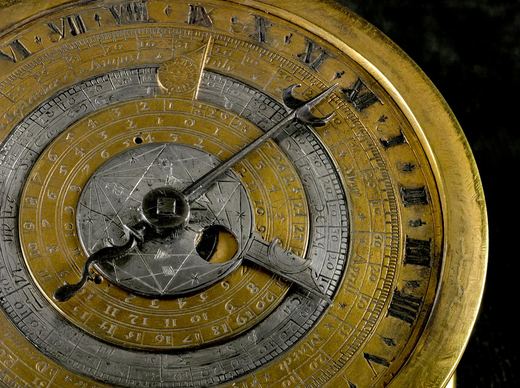
Circular table-clock with calendrical and lunar indications made by Nicholas Vallin in London between 1598 and 1603.
Science Museum Group, London
Clocks · 1611
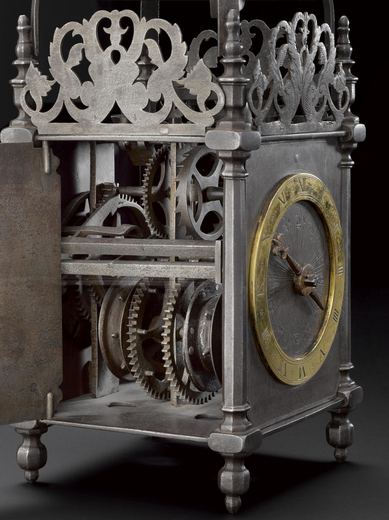
English iron lantern clock, with wheel balance, by John Holloway, Market Lavington, Wiltshire, England, 1611.
Science Museum Group, London
Clocks · 1630
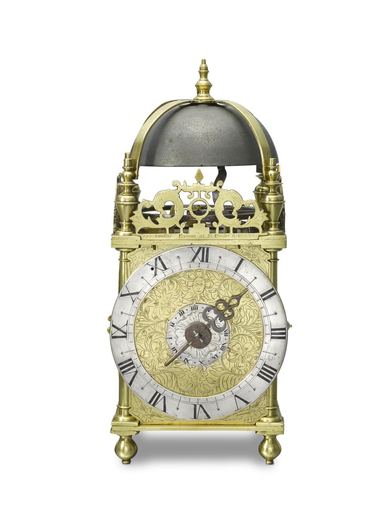
Lantern clock by Forman, Francis, England, 1630
Science Museum Group, London
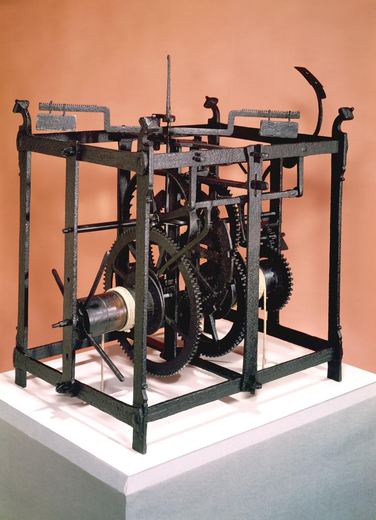
Clocks · 1632-1640
Turret clock, England, 1632-1640
Science Museum Group, London
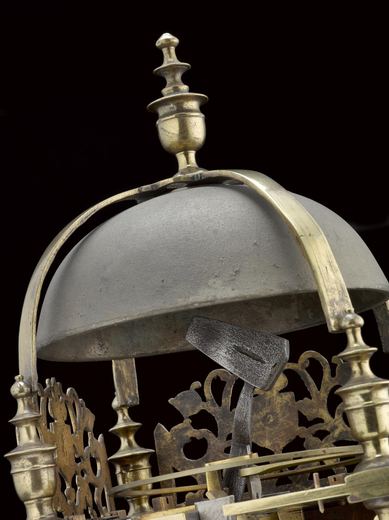
Clocks · 1645-1655
Balance-wheel brass lantern clock, with two driving weights and one counterweight, by Thomas Knifton, Cross Keys, Lothbury, London, England, 1645-1655.
Science Museum Group, London
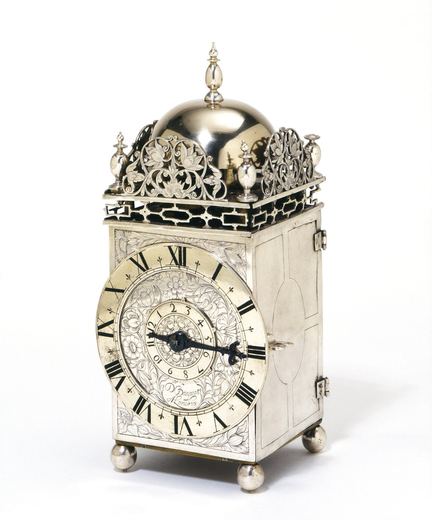
Clocks · ca. 1650
Lantern alarm clock, silver, by David Bouquet, circa 1650
Victoria and Albert Museum, London
Clocks · 1650-1660
Lantern clock by Closon, Peter, England, 1650-1660
Science Museum Group, London
Clocks · ca. 1660
Longcase clock, ca. 1660, English, made by Ahasuerus Fromanteel
Victoria and Albert Museum, London