
Wristwatches · Centre-seconds watch
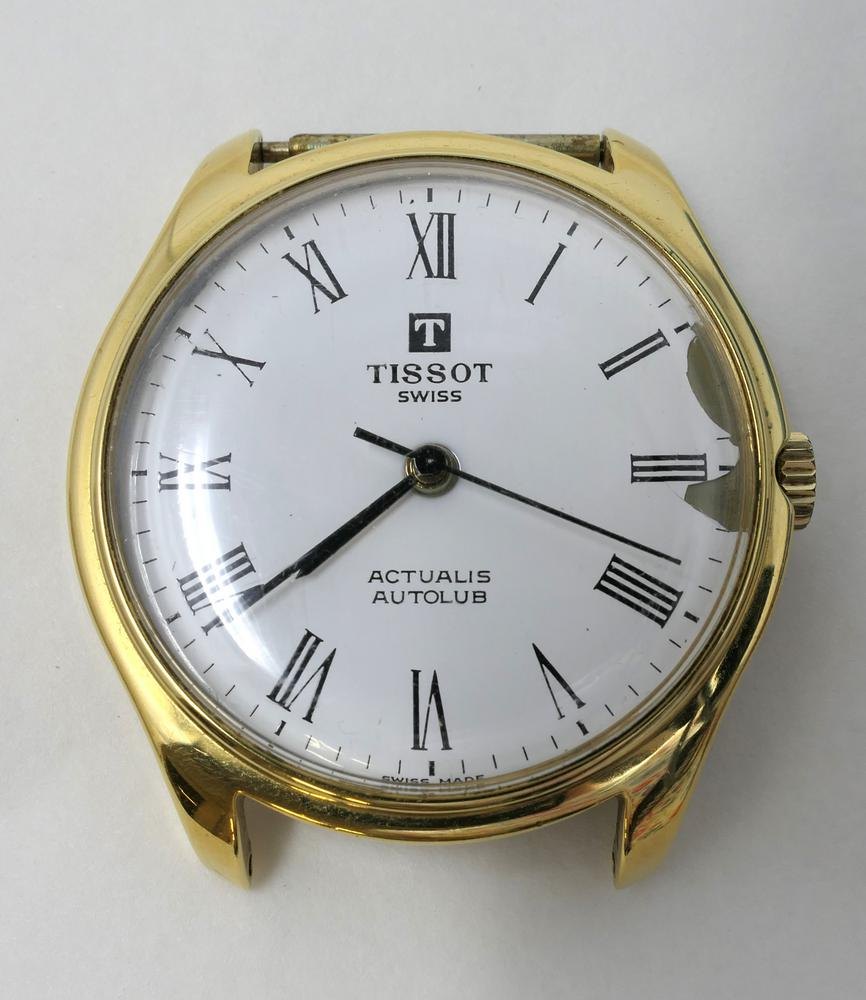
Gold-plated cased centre-seconds club-tooth lever wrist-watch with plastic movement
- Maker / attribution
- Charles Tissot & Fils (Made by)
- Date
- 1972–1978
- Historical period
- Quartz Revolution (1969 – 1990)
- Country of origin
- Switzerland
- Place
- Switzerland
- Object type
- Centre-seconds watch
- Materials / technique
- gold
- Dimensions
- Diameter: 35.50 millimetres (case) Diameter: 29.80 millimetres (dial) Length: 39.90 millimetres Thickness: 10.60 millimetres
- Holding institution
- British Museum
- Accession / object no.
- 1989,0407.13
- Credit line
- British Museum, London
- Catalogue title (original)
- Gold-plated cased centre-seconds club-tooth lever wrist-watch with plastic movement (English)
View the source record ↗ (opens another website in a new tab)Suggest a correction
Record summary
Held and catalogued by British Museum (object number 1989,0407.13), this is a centre-seconds watch by Charles Tissot & Fils, made in Switzerland, dated 1972–1978. The Atlas places it in the Quartz Revolution period (1969 – 1990) of its Wristwatches collection. Materials and techniques recorded by the source: gold. Recorded dimensions: Diameter: 35.50 millimetres (case) Diameter: 29.80 millimetres (dial) Length: 39.90 millimetres Thickness: 10.60 millimetres. The record is illustrated with 4 photographs.
Assembled from the source record's structured fields. Dates and attributions are given as the source states them; where a field is missing the Atlas leaves it blank rather than estimating.
Catalogue description
Description — British Museum
With the exception of the keyless work, balance, springs and barrel, all the movement components are made from plastic. White enamel? dial with Roman hour numerals. Black-painted hour, minute and centre-seconds hands. Gold-plated case with snap-on stainless-steel back.
Curator's comments — British Museum
Comment from Richard Good, Catalogue of Watches in the British Museum. Vol. V (Unpublished manuscript) Made by Charles Tissot & Fils Switzerland, c. 1970 Wrist watch with many parts including the club tooth lever escapement made from plastic. Signature: On the dial the Tissot trade mark and 'TISSOT SWISS ACTUALIS AUTOLUB' and 'SWISS MADE' Case: A two piece case with a rolled gold front and a snap on stainless steel back. The back marked inside 'FOND ACIER INOXYDABLE LUNETTE PLAQUE OR G 10 MICRONS CHs TISSOT & FILS' Under the name is a shield with the name 'Tissot' and 'FAB SUISSE SWISS MADE'. Also the number 81515-1. A two part stem, the two parts being snapped together. With the button removed the movement can be separated from the adaptor ring in which it sits. Dial & Hands: A white painted dial with in black Roman numerals and minute circle. Some of the paint has flaked off around the II to III o'clock area. On the back of the dial in black is the number 50720 also stamped faintly four times is the name 'SOMECO'. The dial has two feet and simply pulls from the movement, a spacing ring lies between the dial and the movement. Black painted hands including the centre seconds hand. Movement: Ebauche Marks: The movement back plate is marked in black with the Tissot 'T' and above this the number 607. Inside the back plate is the number 602. Also under the balance on the back plate is CJ. Frame: The plates are clear plastic with a bridge for the balance. The parts cannot be separated and so only the accessible parts can be fully described with the appearance of some others being mentioned. It is effectively a Roskopf layout with the fourth wheel at the centre of the movement and the motion work driven directly from the minute wheel which is mounted friction tight on the barrel. Barrel: A metal going barrel, approximate diameter 10 mm. Train: All the wheels, including the escape wheel, are solid and of white plastic, moulded in one with their pinions. Jewelling: Metal bearings with an integral pivot. The moulded pinions have holes to receive these pivots. Plastic shock protected bearings to the balance. Escapement: A straight line layout club tooth lever escapement in blue plastic. No. of teeth embraced 3½. Balance & Spring: a monometallic balance with three arms and a plain rim. Balance diameter approximately 10 mm., thickness approx 0.6 mm. A 'self compensating' flat spiral spring of small diameter - approximately 4 mm. Means of Regulation: An index of steel mounted on the inside of the back plate and with a geared segment which meshes with a plastic pinion which can be turned with a screw driver. This is in red to make it readily observable and has three screw driver slots which are surrounded by 18 register marks. There is also a tail to the index. Train Counts and Beat Rate: The great wheel revolves in 6 hours Escape wheel 15 Motion work: cannon pinion 14 minute wheel 84, minute pinion 30 hour wheel 60 Winding System: Positive stem set steel keyless work. Dimensions: Case: Diameter 35.5 mm., height over the glass 10.9 mm. Movement: diameter 26 mm., height 6.3 mm. Provenance: Purchased in 1989 with the aid of funds from the Dingwall Bequest. Note: This watch was also marketed by Smiths Industries. Literature: See 'The Plastics Watch Has Arrived' an editorial in the HJ May 1971 p. 8. See also 'Making the Tissot Plastics Watch' by E. J. Tyler HJ February 1974 p. 20.
Inscriptions & marks
signature; FOND ACIER INOXYDABLE LUNETTE PLAQUE OR G 10 MICRONS CHS TISSOT & FILS Tissot FAB SUISSE SWISS MADE 81515-1 [case back]; signature; T TISSOT SWISS ACTUALIS AUTOLUB [dial]; inscription; 607 T [movement]
Provenance
Purchased from:, James Dowling
Historical context
Quartz Revolution (1969 – 1990)
Seiko's Astron begins mass quartz timekeeping; traditional industries contract sharply.
Quartz and digital watches transformed the market after 1969. Swiss employment collapsed, Japanese and Hong Kong production soared, and the Swatch (1983) helped the Swiss industry recover; mechanical watches survived as luxury goods.
Read the period in the timelineMore wristwatches from this periodEarlier: Modern Mechanical Horology
Atlas type guide
Wristwatches
Bracelet watches were worn by women from the early nineteenth century — Breguet made one for Caroline Murat, Queen of Naples, in 1810–12 — but the wristwatch only became a man's instrument with military use and aviation in the early twentieth century. Between the World Wars it overtook the pocket watch; the 1920s and 1930s brought rectangular Art Deco cases, water-resistant cases and the first automatic winding systems.
After 1945 the wristwatch became a carrier of identity — dress watches, sports and dive watches, chronographs, calendars — produced by Swiss, American, Japanese, German, Soviet and Chinese industries. The quartz revolution after 1969 and the mechanical renaissance since the 1990s, including the rise of independent watchmakers, complete the story.
What to look for
- The reference number (between the lugs or inside the case back) and serial number, the starting point for dating.
- The calibre: its maker and number are often stamped under the dial or on the bridge.
- Originality of dial, hands and crown — refinished ('redial') dials are common.
- Case material marks: 18K/750, 14K/585, stainless steel, gold-filled, plated.
Dating clues
- Wire-lug cases: before c. 1925.
- Water-resistant screw-down cases: from 1926.
- Quartz movements: from 1969; sapphire crystals widespread after c. 1980.
General guidance written by the Atlas editors about this kind of object. It is not a statement about this particular piece; for that, rely on the source record above and on physical examination.
Read next:Identification Centre
Related records

Wristwatches · 1970
Wristwatch by Heno, Switzerland, 1970
Museum Rotterdam

Wristwatches · 1960–1986
'Tri-Compax' calendar chronograph wristwatch in gold case, by Universal, Geneva, Switzerland, 1960–1986.
Science Museum Group, London

Wristwatches · 1969–1970
Beta 21 Quartz wristwatch movement, made in Switzerland, 1970.
Science Museum Group, London

Wristwatches · c. 1969
Omega Speedmaster Moonwatch, ref. 145022-69st, c. 1969
Antiquorum auction archive, Geneva
Wristwatches · c. 1969
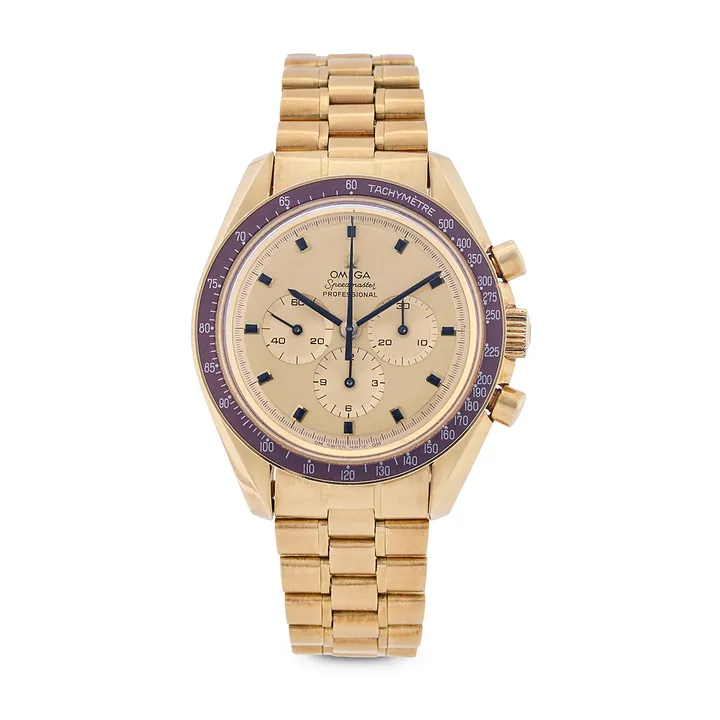
Omega Speedmaster Professional Apollo XI, ref. 145.022-69, c. 1969
Antiquorum auction archive, Geneva
Wristwatches · 1969
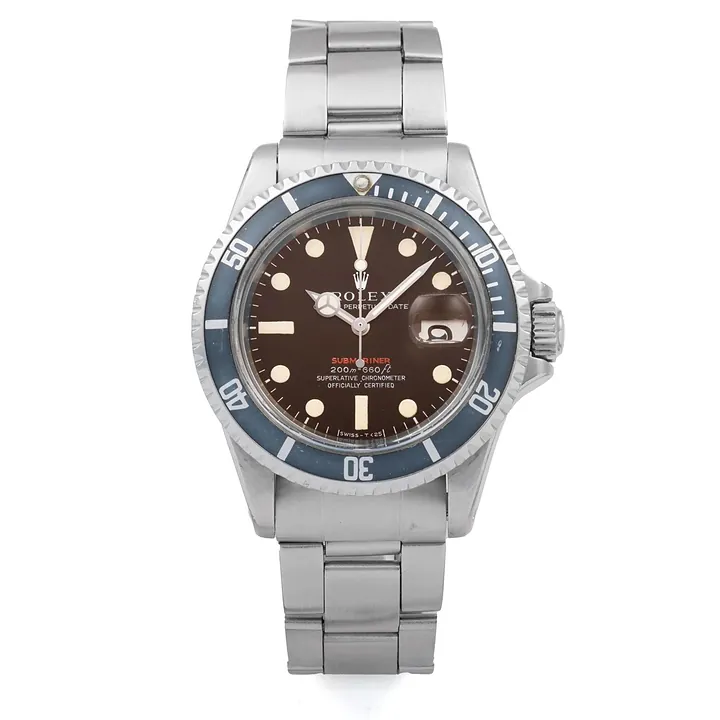
Rolex "red" Submariner, ref. 1680, 1969
Antiquorum auction archive, Geneva
Wristwatches · c. 1969
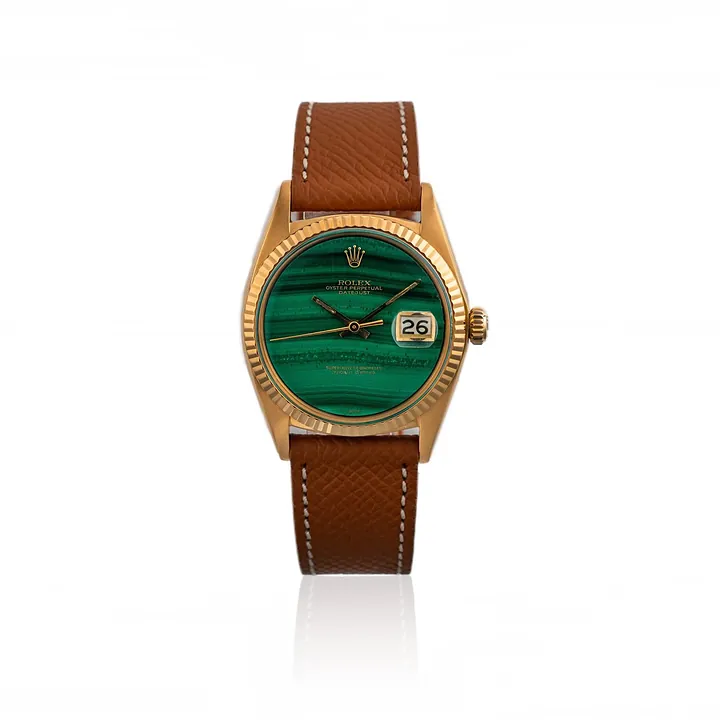
Rolex Date Just, ref. 1601, c. 1969
Antiquorum auction archive, Geneva
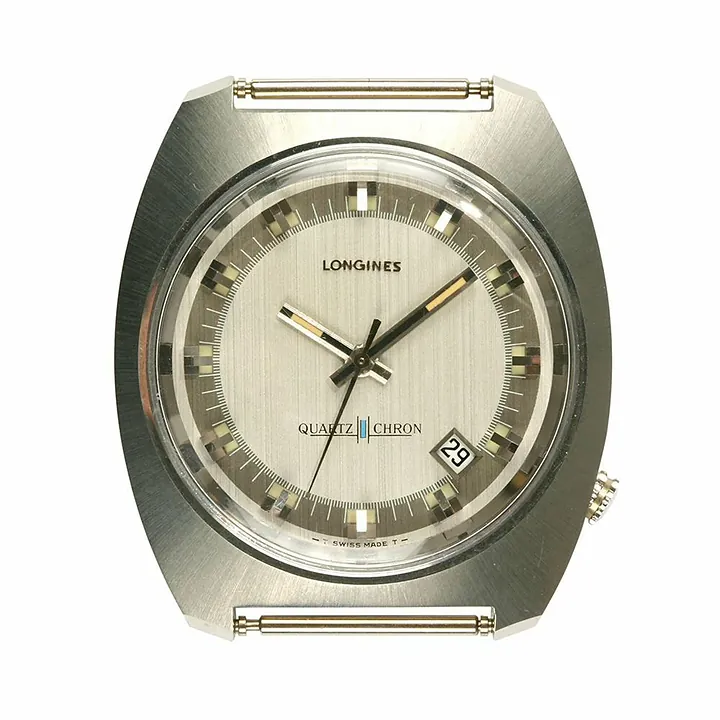
Wristwatches · 1969
Wristwatch by Francillon und Cie (Longines), Switzerland, 1969
German Clock Museum