
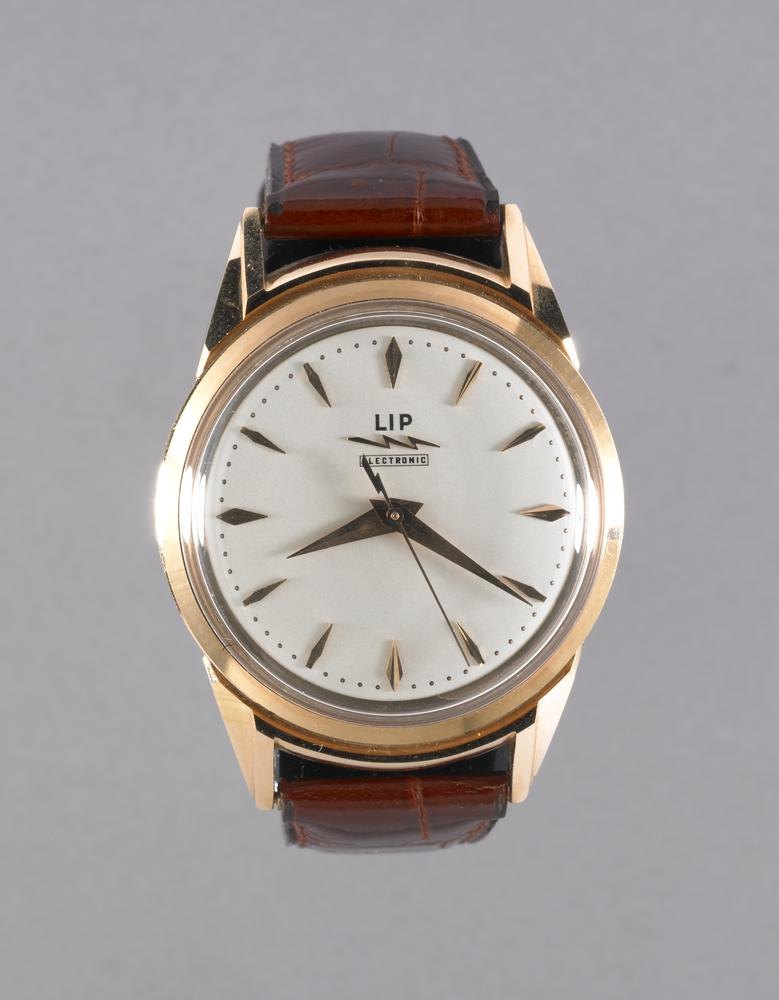
Wristwatches · Centre-seconds watch
Gold-cased electric wrist-watch with two batteries, crocodile-skin strap and leather-covered presentation box
- Maker / attribution
- Lip SA (Made by)
- Date
- 1958–1960
- Historical period
- Modern Mechanical Horology (1945 – 1969)
- Country of origin
- France
- Place
- Besançon
- Object type
- Centre-seconds watch
- Materials / technique
- gold
- Dimensions
- Diameter: 35.50 millimetres (bezel) Length: 250 millimetres (box) Width: 59 millimetres (box)
- Holding institution
- British Museum
- Accession / object no.
- 1986,1024.1
- Credit line
- British Museum, London
- Catalogue title (original)
- Gold-cased electric wrist-watch with two batteries, crocodile-skin strap and leather-covered presentation box (English)
View the source record ↗ (opens another website in a new tab)Suggest a correction
Record summary
Held and catalogued by British Museum (object number 1986,1024.1), this is a centre-seconds watch by Lip SA, made in Besançon, France, dated 1958–1960. The Atlas places it in the Modern Mechanical Horology period (1945 – 1969) of its Wristwatches collection. Materials and techniques recorded by the source: gold. Recorded dimensions: Diameter: 35.50 millimetres (bezel) Length: 250 millimetres (box) Width: 59 millimetres (box). The record is illustrated with 3 photographs.
Assembled from the source record's structured fields. Dates and attributions are given as the source states them; where a field is missing the Atlas leaves it blank rather than estimating.
Catalogue description
Description — British Museum
Wrist-watch. Seventeen-jewel movement with lever escapement and electro-dynamically driven balance. Silver-coloured dial with gold baton hour markers and circle go gold dots for the minutes. Gold hands; centre-seconds hand with lightning-bolt counter-balance. Gold case with integral back and snap-on bezel; back has two screw-on covers for the battery housings and fold-out turn-key for hand-setting. Complete with original crocodile skin wrist-strap and leather-covered presentation box. Batteries removed.
Curator's comments — British Museum
See Horological Journal, 'The Lip Electronic Watch is now on Sale' Vol.100 (December 1958), pp.824-826 Text from 'Watches', by David Thompson, London, 2008, p. 154-155. Lip SA GOLD CASED ELECTRO-MECHANICAL WRISTWATCH BESANÇON, FRANCE, 1968-70 SIGNED: 'LIP ELECTRONIC Monsieur Dargier de Saint-Vaulry: 'Why are you not working on an electric wrist watch?' Fred Lip: 'Have you some sound ideas on this?' Monsieur Dargier de Saint-Vaulry: 'Yes.' Fred Lip: 'Then come along to my place and develop them.' The above exchange is quoted in the April 1952 issue of the 'Horological Journal', reporting the announcement by the Lip factory of the first electric watch. Lip S.A. in Besançon began work on the concept soon after the Second World War, culminating in their presentation at the Académie Royale des Sciences on 19 March 1952 of an electrically driven watch. At the same time the watch was announced in Chicago by the manufacturer Elgin, who had been working on the project in partnership with Lip. The models presented were prototypes and it would be a number of years before the fully developed version of an electro-mechanical wristwatch would be a working reality. There were many problems to be overcome, chiefly relating to the need for a suitable miniature battery to power the watch and to the deterioration of the electrical contacts. Unlike a mechanical watch, this new concept involved an oscillating balance and balance spring which are kept in motion by switching electromagnets on and off. The research and development was carried out by Jean-Georges Laviolette and Paul Dargier de Saint-Vaulry, and from 1955 by Jean Pommier. It was another six years before, on 7 December 1958, their electric watch, the LIP R27, became available in the shops. This watch was not the first of its kind: the year before, Hamilton in America had released its model 500 electric watch. In his autobiography, Fred Lip notes that R27 watches were presented to Général Charles de Gaulle and President Dwight D. Eisenhower, and he recalled that he supplied two identical watches to the French President, in order to prove their accuracy and reliability. At weekly intervals, the watches were secretly swapped over by De Gaulle's wife and checked and regulated in Lip's workshops; they showed no variation in timekeeping worthy of note by the President. These new 'electronic' watches were furnished with 7-jewelled bearings and with Incabloc shock-protection for the balance staff. In contrast to a mechanical watch there is no mainspring and no escapement. Instead the balance and balance spring are flanked by two electromagnets. The balance is made from magnetic material and, as it rotates, a small nib on the balance staff moves an electrical contact arm to complete the electric circuit, thus switching on the electromagnets, which attract the extended horns of the balance. Further rotation of the balance causes the nib to pass the contact, which springs back and breaks contact, switching the magnets off. After reaching its full amplitude the balance is returned by the unwinding balance spring and the nib passes the contact without operating it. When the balance returns, the process is repeated, and the electromagnets again attract the balance, giving another impulse. The beauty of the system is that the balance receives a constant impulse related to the power of the electromagnets, and is not in contact with any part of the watch except when electrical contact is being made. In use, however, there is always a danger that movements made by the wearer could cause the balance to rotate through a very large amplitude and consequently activate the magnets twice in one oscillation. The watch is therefore fitted with a limiting device to prevent such an occurrence. The oscillating balance then drives the wheels, which move the hands. The hand-setting system is also not like that of a conventional watch. At the back is a folding bow. When lifted the action causes a stop to intercept the balance and locks the driving wheel to prevent damage when the bow is turned to set the hands. In 1958 the watch was presented in three versions: the Cosmic, which had an 18-carat-gold case and decorative dial; the Jupiter, which had a chromium-plated case; and this model, the Vanguard, which had an 18-carat-gold case and plain dial. Despite the three versions, the watches are rare, as Lip made just 7,000 of them in total.
Inscriptions & marks
inscription; ELECTRONIC INCABLOC PATENTS PENDING 22953 [case-back]; mark; Punched French assay mark for .750 gold. [case-back]; signature; LIP ELECTRONICS [dial]
Provenance
Donated by:, HRH Prince Richard, Duke of Gloucester
Historical context
Modern Mechanical Horology (1945 – 1969)
Tool watches for divers, pilots and astronauts; electric watches anticipate the electronic age.
The classic era of the mechanical wristwatch: dive watches, chronographs for motor racing and space flight, GMT watches for jet travel, slim dress watches, automatic calendars, and the rise of Japanese manufacturers alongside Swiss, American, German and Soviet industries.
Read the period in the timelineMore wristwatches from this periodEarlier: Golden Age of Mechanical Watchmaking
Atlas type guide
Wristwatches
Bracelet watches were worn by women from the early nineteenth century — Breguet made one for Caroline Murat, Queen of Naples, in 1810–12 — but the wristwatch only became a man's instrument with military use and aviation in the early twentieth century. Between the World Wars it overtook the pocket watch; the 1920s and 1930s brought rectangular Art Deco cases, water-resistant cases and the first automatic winding systems.
After 1945 the wristwatch became a carrier of identity — dress watches, sports and dive watches, chronographs, calendars — produced by Swiss, American, Japanese, German, Soviet and Chinese industries. The quartz revolution after 1969 and the mechanical renaissance since the 1990s, including the rise of independent watchmakers, complete the story.
What to look for
- The reference number (between the lugs or inside the case back) and serial number, the starting point for dating.
- The calibre: its maker and number are often stamped under the dial or on the bridge.
- Originality of dial, hands and crown — refinished ('redial') dials are common.
- Case material marks: 18K/750, 14K/585, stainless steel, gold-filled, plated.
Dating clues
- Wire-lug cases: before c. 1925.
- Water-resistant screw-down cases: from 1926.
- Quartz movements: from 1969; sapphire crystals widespread after c. 1980.
General guidance written by the Atlas editors about this kind of object. It is not a statement about this particular piece; for that, rely on the source record above and on physical examination.
Read next:Identification Centre
Related records
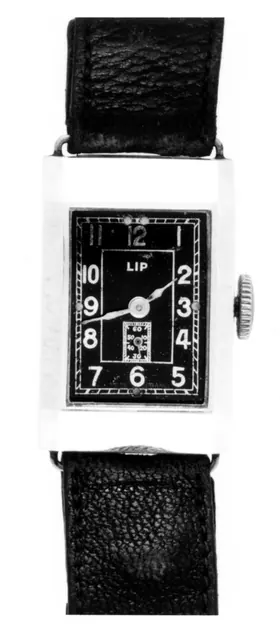
Wristwatches · 1945–1955
Stainless-steel cased club-tooth lever wrist-watch with black dial and black leather wrist-strap
British Museum
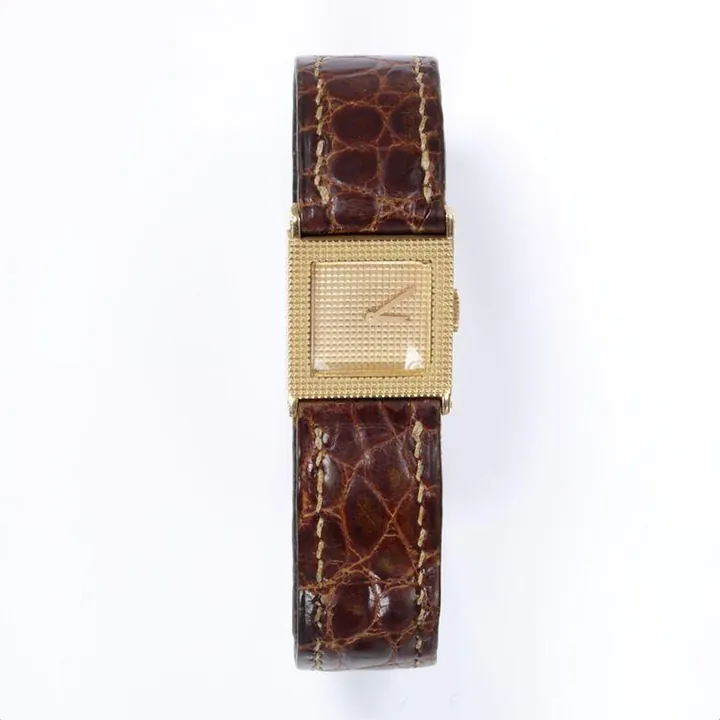
Wristwatches · c. 1963
Wristwatch with gold case and leather strap, Boucheron, Paris, about 1963.
Victoria and Albert Museum, London
Wristwatches · 1960–1965
Wristwatch, France, 1960–1965
Suomen kansallismuseo
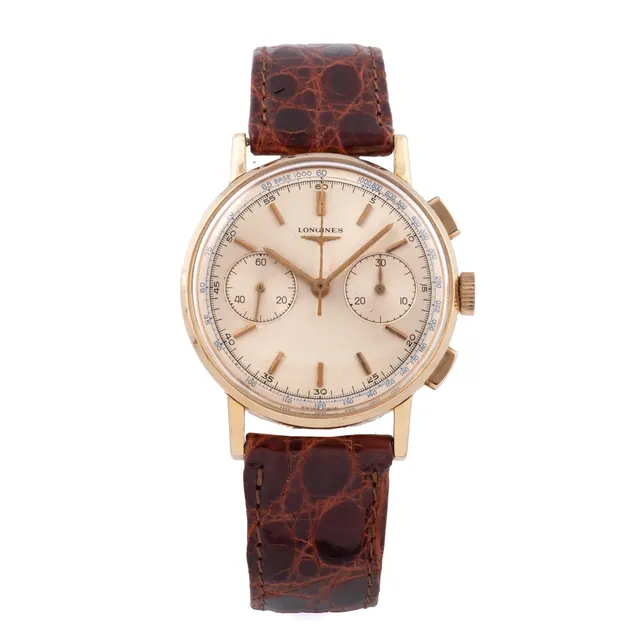
Wristwatches · c. 1960s
Longines wristwatch, 30 Ch French Case, circa 1960's
Antiquorum auction archive, Geneva
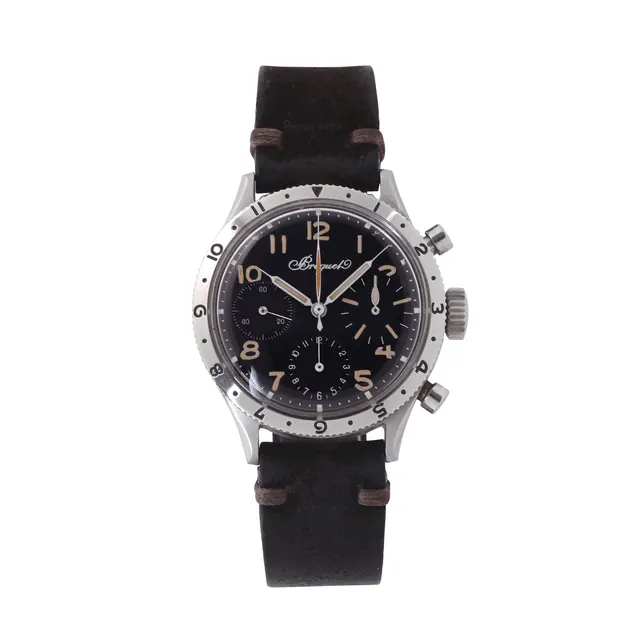
Wristwatches · 1958
Breguet wristwatch, 1958
Antiquorum auction archive, Geneva
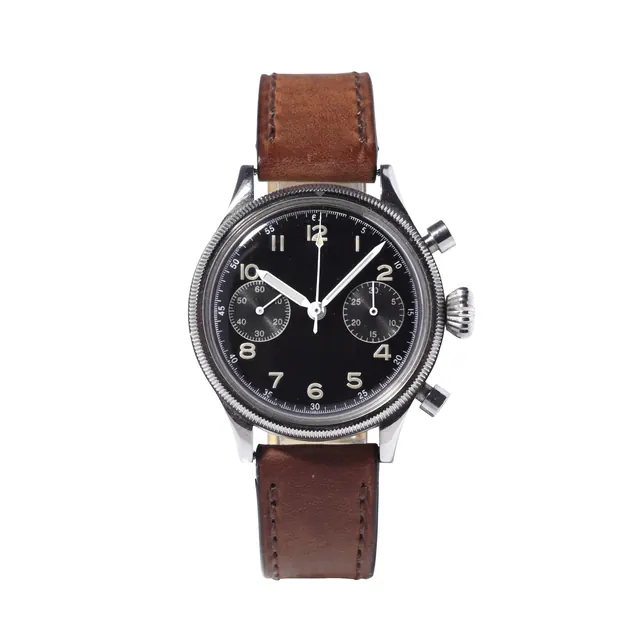
Wristwatches · 1956
Breguet wristwatch, 1956
Antiquorum auction archive, Geneva
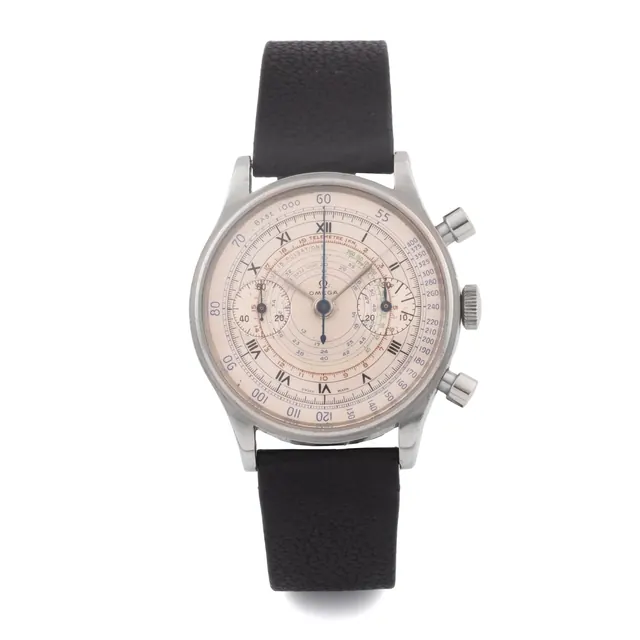
Wristwatches · Sent to French Colonies in March 1949
Omega wristwatch, ref. 2077, 33.3 Chro, Sent to French Colonies in March 1949
Antiquorum auction archive, Geneva
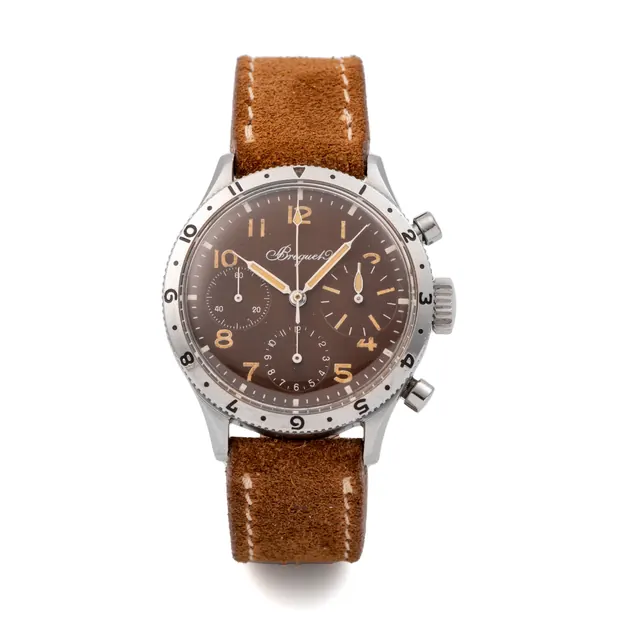
Wristwatches · c. 1959
Breguet wristwatch, Type Xx Tropical Dial, circa 1959
Antiquorum auction archive, Geneva