
Wristwatches · Ladies' wristwatch
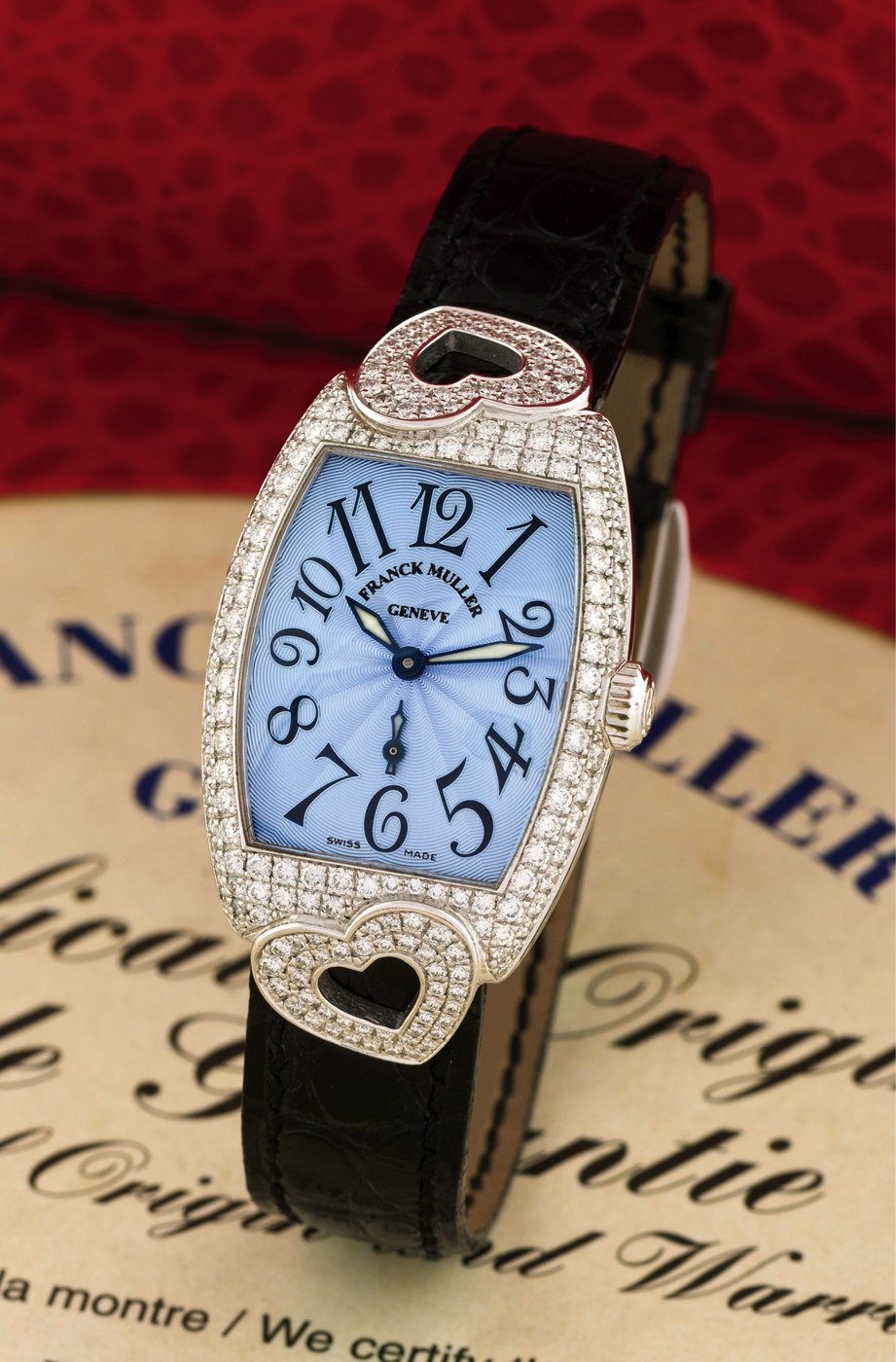
Franck Muller Cintrée Curvex Heart Ref. 1750 S6 HJ
- Maker / attribution
- Franck Muller (source attribution)
- Date
- 2000s
- Historical period
- Mechanical Renaissance (1990 – 2010)
- Country of origin
- Switzerland
- Object type
- Ladies' wristwatch
- Materials / technique
- 18K white gold
- Holding institution
- Antiquorum
- Accession / object no.
- 95
- Credit line
- Antiquorum
- Catalogue title (original)
- FRANCK MULLER, CINTREE CURVEX HEART, \nMECHANICAL, WHITE GOLD AND\nDIAMONDS \nFrank Muller, \"Cintrée Curvex Heart,\" No. 86, Ref. 1750 S6 HJ. Made \nin the 2000's. \nFine, tonneau-shaped, 18K white g (English)
View the source record ↗ (opens another website in a new tab)Suggest a correction
Record summary
Held and catalogued by Antiquorum (object number 95), this is a ladies' wristwatch attributed to Franck Muller, made in Switzerland, dated 2000s. The Atlas places it in the Mechanical Renaissance period (1990 – 2010) of its Wristwatches collection. Materials and techniques recorded by the source: 18K white gold. The record is illustrated with 1 photograph.
Assembled from the source record's structured fields. Dates and attributions are given as the source states them; where a field is missing the Atlas leaves it blank rather than estimating.
Catalogue description
Original object description
Numbered 86, this 2000s Franck Muller Cintrée Curvex Heart ladies' wristwatch (reference 1750 S6 HJ) features an 18K white gold case presenting polished and brushed surfaces, with dimensions of 22 mm by 38 mm and a height of 8 mm. The bezel and distinctive heart-shaped lugs are pavé-set with 168 circular diamonds. Protected by a sapphire crystal, the blue guilloché dial is accented by stylized radial Arabic hour markers and swept by blued steel double spade hands, while a sapphire cabochon is set into the winding crown and four screws secure the case back. Its rhodium-plated mechanical movement integrates 17 jewels, a shock protection system, a straight-line lever escapement, a flat self-compensating balance spring, and a monometallic balance calibrated for isochronism, temperature, and five distinct positions. Accompanied by a certificate, fitted box, and an 18K white gold pin buckle accented with four diamonds, the watch is signed by the manufacturer on its dial, case, and movement. Condition records grade the dial as 1-01 (as new) and the movement as 2* (very good).
Inscriptions & marks
86
Historical context
Mechanical Renaissance (1990 – 2010)
Mechanical watches return as cultural objects; independent watchmaking flourishes.
Mechanical watches returned as cultural and luxury objects. Complications, tourbillons and new materials proliferated; independent watchmakers such as George Daniels, F.P. Journe and Philippe Dufour revived artisanal watchmaking; collecting vintage watches became a major field.
Read the period in the timelineMore wristwatches from this periodEarlier: Quartz Revolution
Atlas type guide
Wristwatches
Bracelet watches were worn by women from the early nineteenth century — Breguet made one for Caroline Murat, Queen of Naples, in 1810–12 — but the wristwatch only became a man's instrument with military use and aviation in the early twentieth century. Between the World Wars it overtook the pocket watch; the 1920s and 1930s brought rectangular Art Deco cases, water-resistant cases and the first automatic winding systems.
After 1945 the wristwatch became a carrier of identity — dress watches, sports and dive watches, chronographs, calendars — produced by Swiss, American, Japanese, German, Soviet and Chinese industries. The quartz revolution after 1969 and the mechanical renaissance since the 1990s, including the rise of independent watchmakers, complete the story.
What to look for
- The reference number (between the lugs or inside the case back) and serial number, the starting point for dating.
- The calibre: its maker and number are often stamped under the dial or on the bridge.
- Originality of dial, hands and crown — refinished ('redial') dials are common.
- Case material marks: 18K/750, 14K/585, stainless steel, gold-filled, plated.
Dating clues
- Wire-lug cases: before c. 1925.
- Water-resistant screw-down cases: from 1926.
- Quartz movements: from 1969; sapphire crystals widespread after c. 1980.
General guidance written by the Atlas editors about this kind of object. It is not a statement about this particular piece; for that, rely on the source record above and on physical examination.
Read next:Identification Centre
Related records
Wristwatches · c. 1996-99
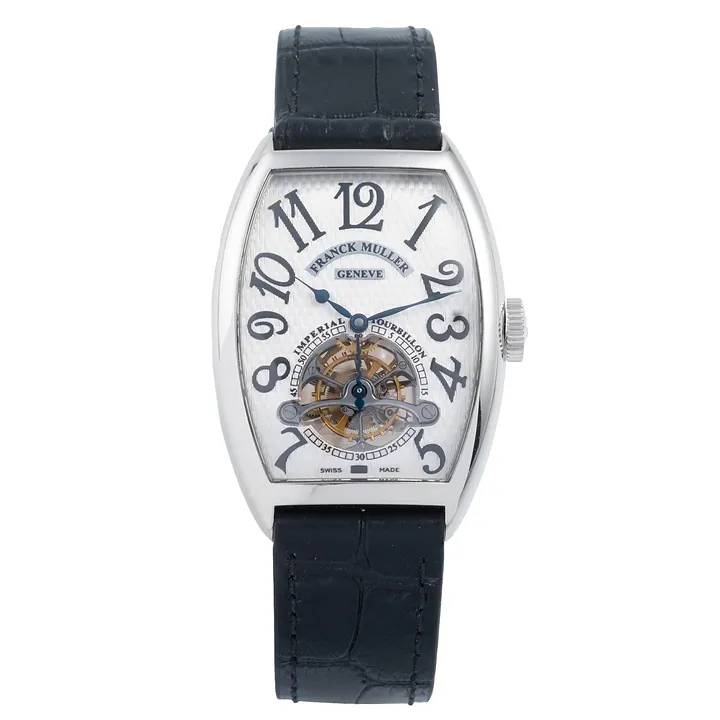
Franck Muller Imperial Tourbillon, ref. 5850T, c. 1996-99
Antiquorum auction archive, Geneva
Wristwatches · c. 2005
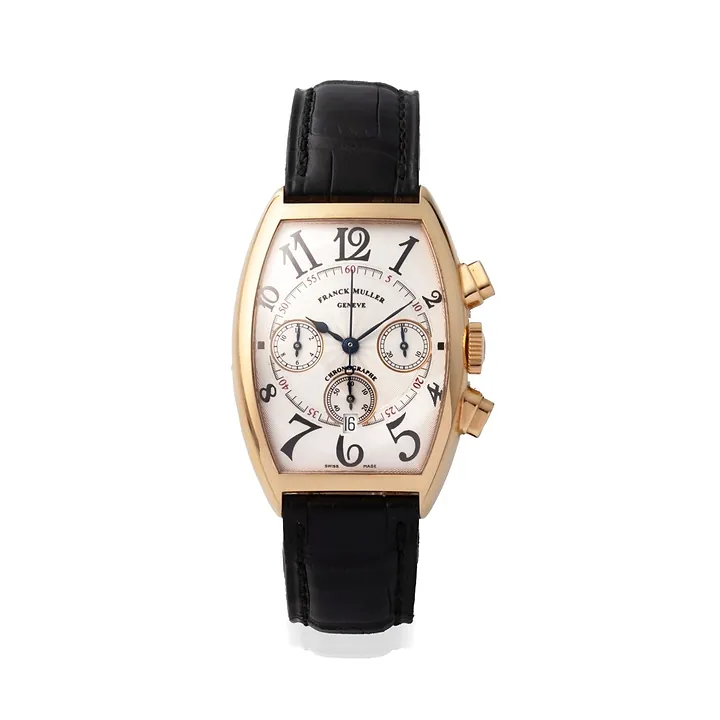
Franck Muller Casablanca Chronograph, ref. 5850 CC AT, c. 2005
Antiquorum auction archive, Geneva
Wristwatches · c. 2010-2020
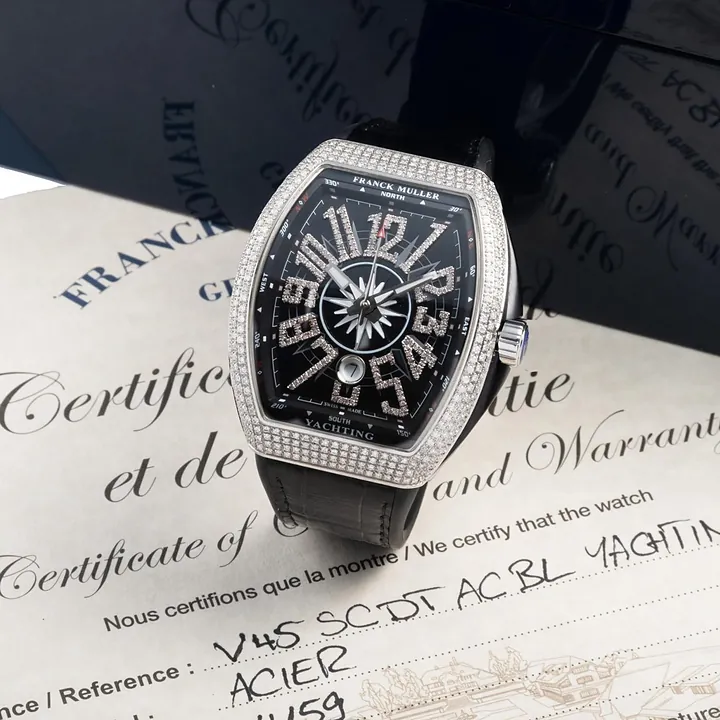
Franck Muller Vanguard Yachting, ref. V45SCDT, c. 2010-2020
Antiquorum auction archive, Geneva
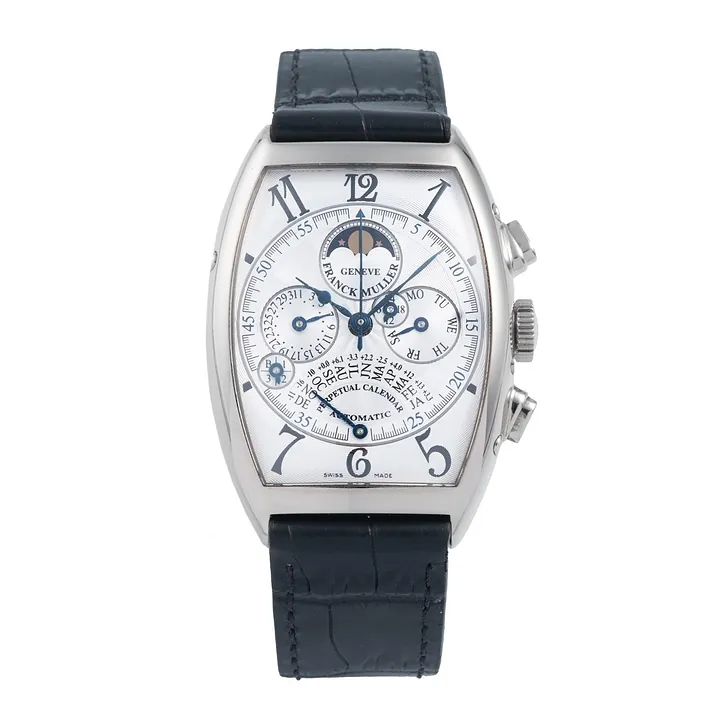
Wristwatches · Sold in August 2016
Franck Muller wristwatch, ref. 6850 QPE, Sold in August 2016
Antiquorum auction archive, Geneva
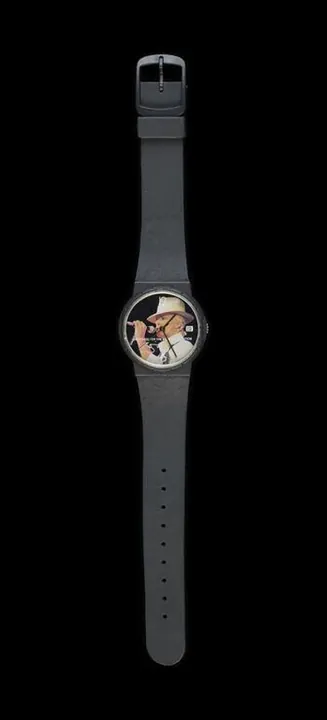
Wristwatches · 1991
Limited edition watch designed by Eta relating to David Bowie's Serious Moonlight live tour, 1991
Victoria and Albert Museum, London

Wristwatches · 2008
Wristwatch by Breitling?, 2008
Museum Rotterdam

Wristwatches · c. 1990s
Audemars Piguet Bamboo, c. 1990s
Antiquorum auction archive, Geneva

Wristwatches · c. 1990
Audemars Piguet Huitieme Perpetual Calendar, ref. 25696PT, c. 1990
Antiquorum auction archive, Geneva