
Wristwatches · Wristwatch
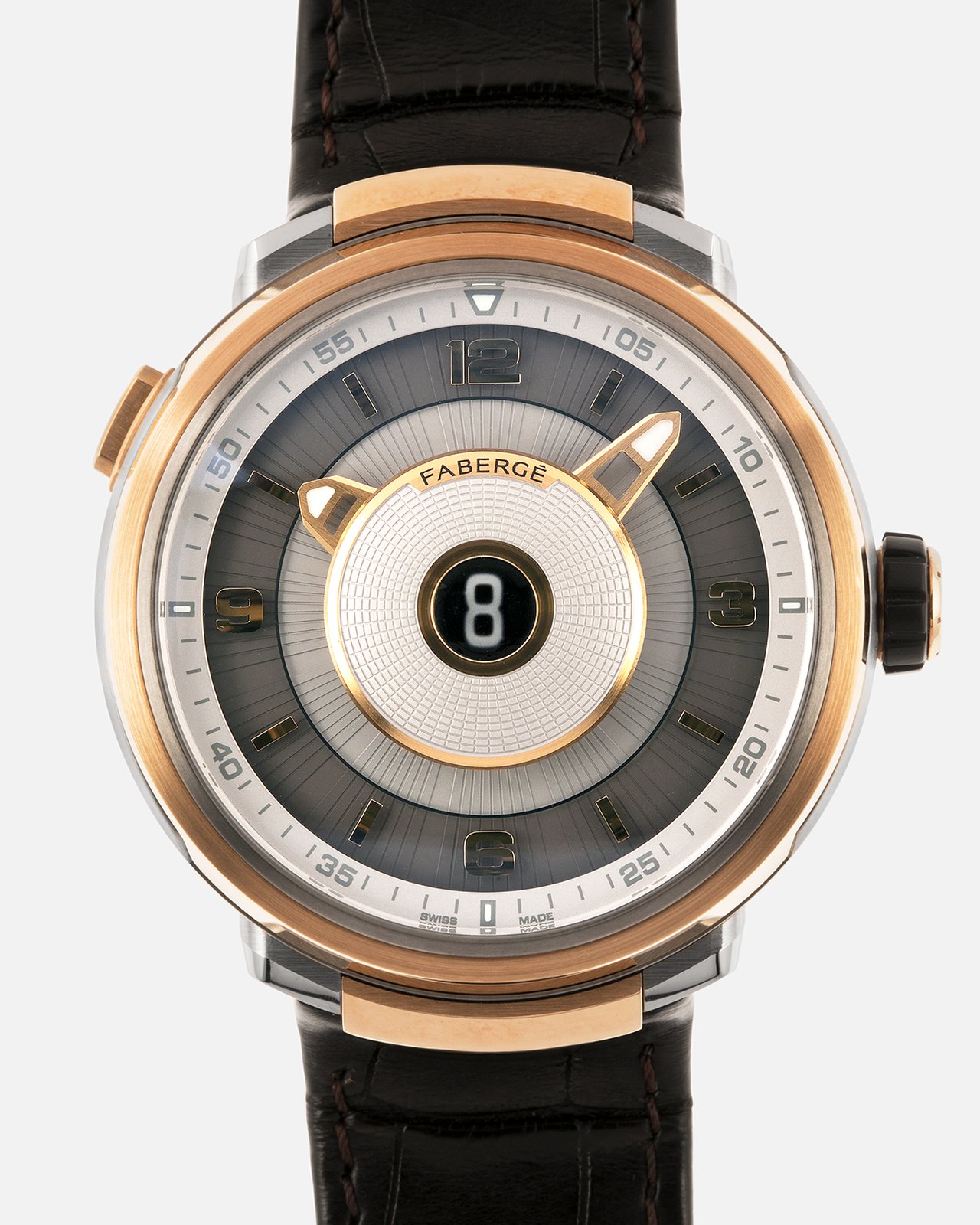
Faberge Visionnaire DTZ Dual Time Zone Agenhor Rose Gold Titanium, 2016
- Maker / attribution
- Fabergé (maker)
- Date
- 2016
- Historical period
- Contemporary Horology (2010 – Present)
- Country of origin
- Russia
- Object type
- Wristwatch
- Materials / technique
- rose gold
- Dimensions
- Case 43 mm
- Stock no.
- Product 7748193189975
- Credit line
- Dealer listing, S.Song Watches (product 7748193189975)
- Catalogue title (original)
- Faberge Visionnaire DTZ Dual Time Zone Agenhor Rose Gold Titanium (English)
View the source record (dealer listing) ↗ (opens another website in a new tab)Suggest a correction
Record summary
Catalogued by S.Song Watches (dealer), Seattle (stock number Product 7748193189975), this is a wristwatch by Fabergé, made in Russia, dated 2016. The Atlas places it in the Contemporary Horology period (2010 – Present) of its Wristwatches collection. Materials and techniques recorded by the source: rose gold. Recorded dimensions: Case 43 mm. The record is illustrated with 6 photographs.
Assembled from the source record's structured fields. Dates and attributions are given as the source states them; where a field is missing the Atlas leaves it blank rather than estimating.
Catalogue description
Dealer description — S.Song Watches
Fabergé is a name most closely associated with the extraordinary objects created by Peter Carl Fabergé for the Russian Imperial family, most famously the legendary Imperial Easter Eggs. Its modern return to serious watchmaking, however, has resulted in some surprisingly interesting watches, particularly when you look beneath the surface. The Visionnaire DTZ is perhaps one of the best examples of this. Introduced in 2016, the DTZ, short for Dual Time Zone, was created as an unusual interpretation of the travel watch, displaying local and home time in two completely different ways. More importantly, it was developed in collaboration with Agenhor and Jean-Marc Wiederrecht, one of the most inventive and important movement constructors in modern independent watchmaking. Rather than simply supplying a module, Agenhor designed and manufactured the entire movement specifically for the watch. The result was the Calibre AGH 6924, an unusual automatic movement built around a ring-shaped architecture that allowed the centre of the watch to be used for its second time zone display. The example you see here today combines a 43mm pink gold and titanium case with an incredibly architectural, multi-layered dial. Local time is displayed through two large central hands extending from underneath the central dome towards the sapphire chapter ring, while home time is displayed digitally through an aperture at the very centre of the watch. Using an instantaneous jumping hour on a 24-hour scale, a '20', for example, immediately tells you it is 8pm at home rather than 8am. The way Agenhor achieved this display is particularly clever. Rather than placing the second time zone disc directly beneath the dial, it is located at the very bottom of the movement. A specially designed magnifying lens sits high above it, enlarging the numeral and creating the illusion that the home-time indication is floating deep within the watch. The second time zone can then be independently advanced in one-hour increments using the pusher at approximately 10 o'clock. Perhaps even more unusual is the automatic winding system. There is no conventional rotor visible through the caseback. Instead, the rotor has been moved to the dial side and effectively disguised as part of the dial itself. The large silver-toned disc beneath the sapphire hour ring is actually the winding rotor, gently oscillating as the watch moves on the wrist. Turning the watch over gives an uninterrupted view of the AGH 6924. The movement is highly architectural and distinctly modern in appearance, with large bridges and exposed wheels rather than an attempt to imitate traditional Geneva movement design. There are also wonderfully unnecessary details hidden within. The lever responsible for activating the jumping second time zone is shaped like a peacock, one of Fabergé's recurring historical motifs, which appears to feed from a snail cam shaped like a bushel of wheat. The automatic AGH 6924 offers approximately 50 hours of power reserve, and the quality and originality of the concept was recognised almost immediately, with the Visionnaire DTZ winning the Travel Time Watch Prize at the 2016 Grand Prix d'Horlogerie de Genève. There is something particularly appealing about watches like this today. The Visionnaire DTZ is far more than an unusual Fabergé travel watch. Underneath is a genuinely interesting movement conceived and manufactured by Jean-Marc Wiederrecht and Agenhor, combining clever engineering with the slightly eccentric approach to complications that has made their work so important to modern independent watchmaking. It is one of those overlooked watches where what lies beneath the surface is arguably far more significant than most people realise.
Historical context
Contemporary Horology (2010 – Present)
Silicon components, connected watches, optical-lattice research clocks and a thriving independent scene.
Smartwatches became the world's best-selling watches, while mechanical watchmaking focuses on craft, innovation (silicon components, new escapements) and independent makers.
Read the period in the timelineMore wristwatches from this periodEarlier: Mechanical Renaissance
Atlas type guide
Military, pilot and travel watches
The wristwatch owes much of its adoption by men to warfare and aviation. Wristlets — small pocket watches soldered with lugs and worn on a strap — were used in colonial campaigns and became standard equipment in the First World War, with protective grilles over the crystal ('shrapnel guards'). Louis Cartier's Santos (1904), designed for the aviator Alberto Santos-Dumont, is often cited as an early purpose-made pilot's watch.
In the Second World War governments specified watches in detail: the German B-Uhr observation watches, the American A-11, and the British 'W.W.W.' (the 'Dirty Dozen' set of 1945). After the war, jet travel brought GMT and world-time watches, which show two or more time zones at once — Louis Cottier's world-time mechanism and the Rolex GMT-Master (1955) are examples.
What to look for
- Military markings on the case back: broad arrow, issue numbers, 'W.W.W.', 'A.T.P.'
- High-legibility black dials with luminous Arabic numerals; oversized crowns for gloved hands.
- 24-hour hands and rotating 24-hour bezels or city rings on GMT/world-time watches.
- Wire lugs on early wristlets converted from pocket watches.
Dating clues
- Wire-lug wristlets: c. 1900–1925.
- Military specifications of the Second World War: 1939–1945.
- GMT and world-time wristwatches: mainly after 1950.
General guidance written by the Atlas editors about this kind of object. It is not a statement about this particular piece; for that, rely on the source record above and on physical examination.
Related records
Clocks · c. 1915
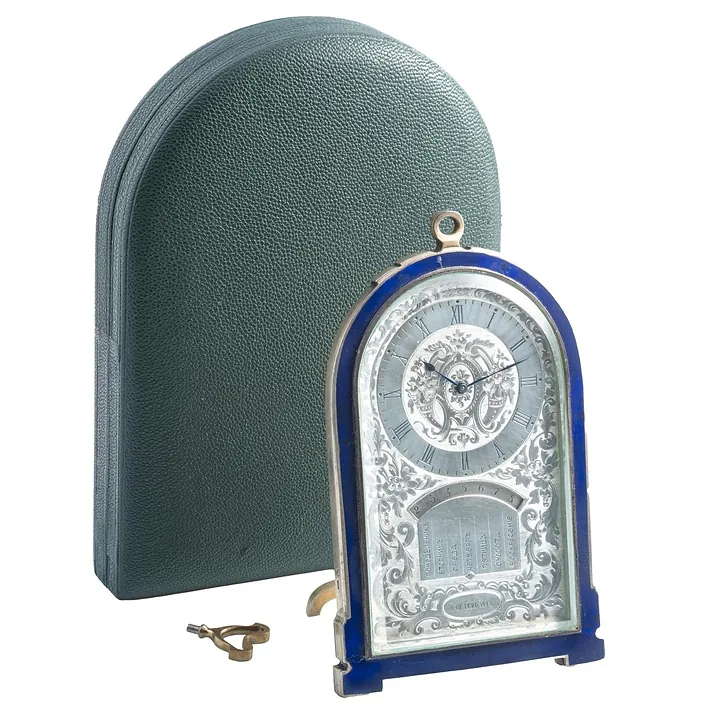
Fabergé clock, c. 1915
Antiquorum auction archive, Geneva
Pocket Watches · c. 1970
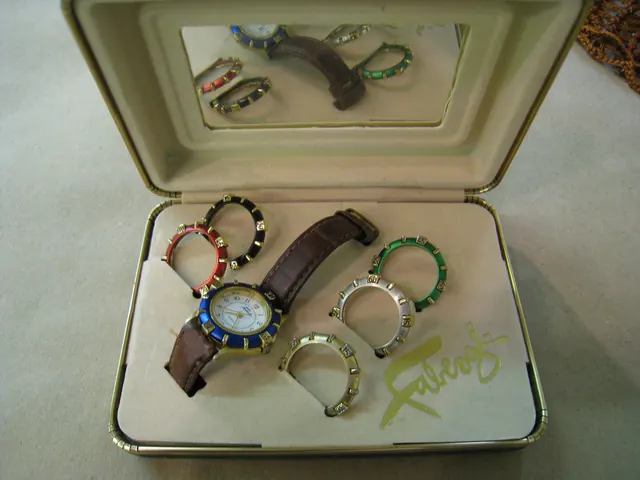
Watch by M.Z. Berger and Co., Inc
Yale University Art Gallery, New Haven
Wristwatches · 2010
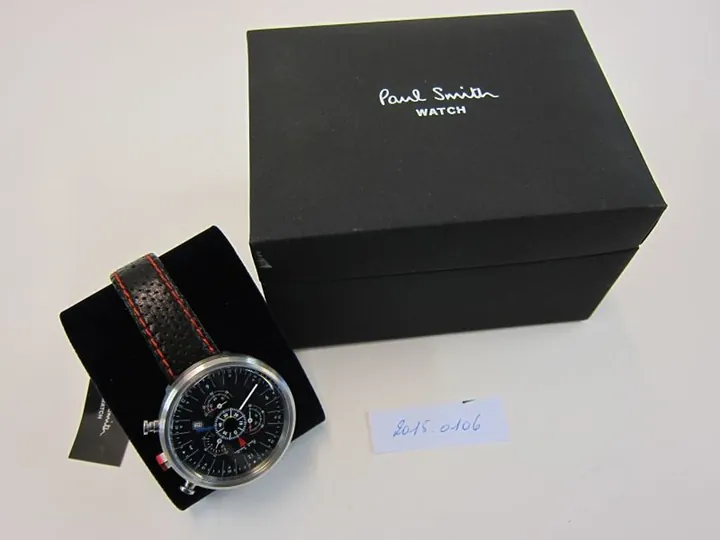
Wristwatch, 2010
Modemuseum Hasselt
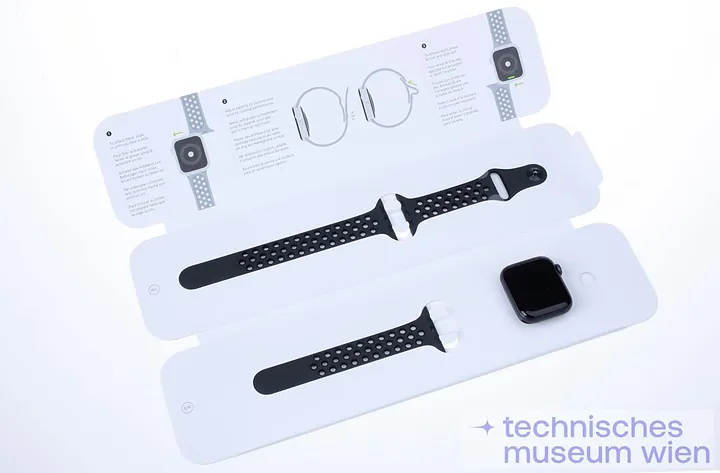
Wristwatches · 2018 (Series 4 released in September 2018; '1977' in the source is the model number A1977)
Apple Watch Series 4 (GPS, 40 mm, model A1977), 2018
Vienna Museum of Science and Technology
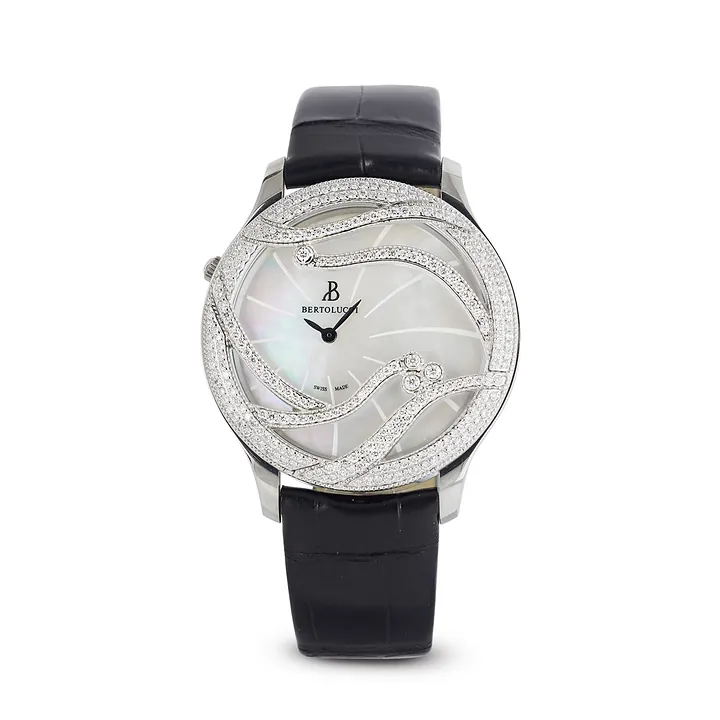
Wristwatches · c. 2010s
Bertolucci Stria III, ref. 11513.50.45.B88.6C1.501, c. 2010s
Antiquorum auction archive, Geneva
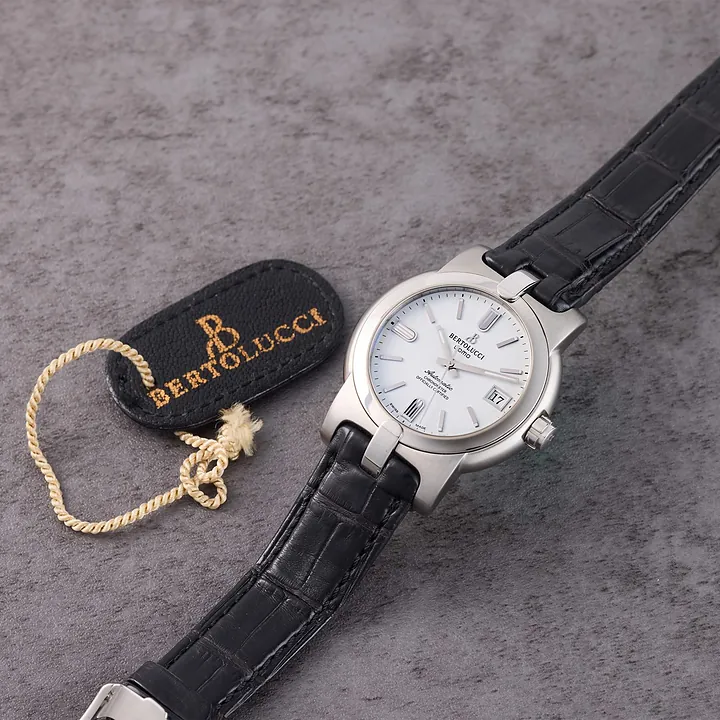
Wristwatches · c. 2010s
Bertolucci Uoma, ref. 824.51.41.10B, c. 2010s
Antiquorum auction archive, Geneva

Wristwatches · c. 2010s
Breguet Type XXI, ref. 3810, c. 2010s (Antiquorum Lot 381-24)
Antiquorum auction archive, Geneva

Wristwatches · c. 2010s
Breguet Type XXI, ref. 3810, c. 2010s (Antiquorum Lot 386-229)
Antiquorum auction archive, Geneva