
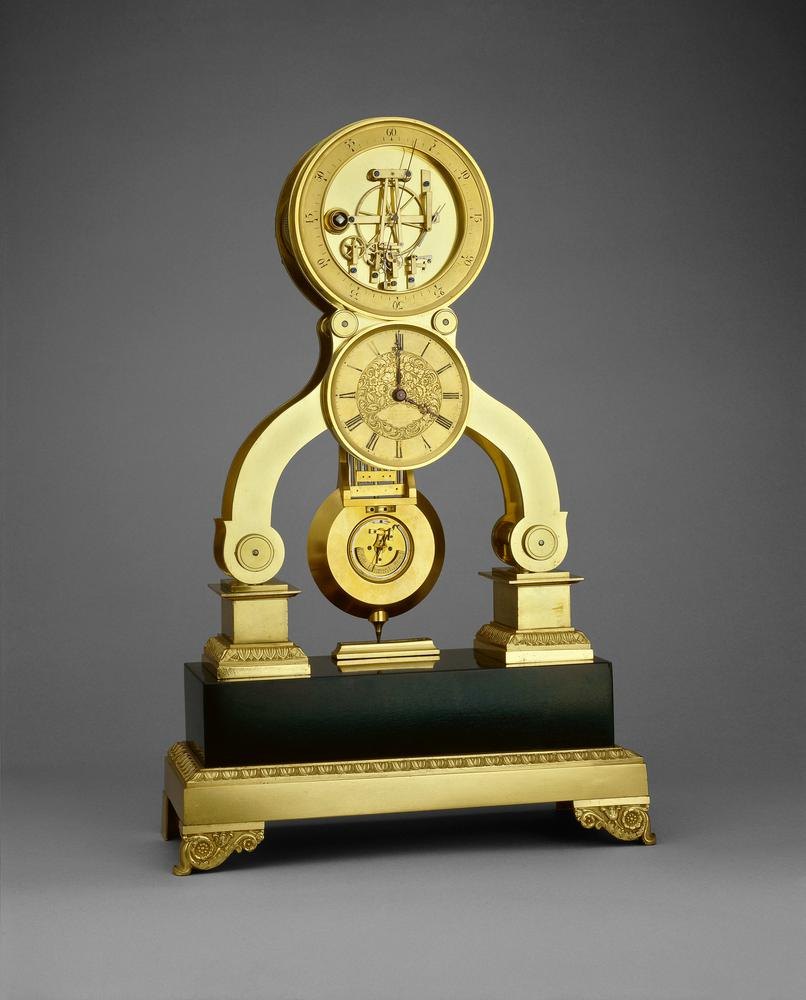
Instruments · Chronometer clock
Eight-day spring driven mantel regulator with remontoire/detent escapement and compensation pendulum
- Maker / attribution
- Edward Funnell (Made by)
- Date
- 1855–1865
- Historical period
- Industrial Revolution (1850 – 1900)
- Country of origin
- British Isles
- Place
- Brighton (East Sussex)
- Object type
- Chronometer clock
- Materials / technique
- metal
- Dimensions
- Height: 48.50 centimetres Width: 31.50 centimetres Depth: 14 centimetres
- Holding institution
- British Museum
- Accession / object no.
- 1958,1006.2133
- Credit line
- British Museum, London
- Catalogue title (original)
- Eight-day spring driven mantel regulator with remontoire/detent escapement and compensation pendulum (English)
View the source record ↗ (opens another website in a new tab)Suggest a correction
Record summary
Held and catalogued by British Museum (object number 1958,1006.2133), this is a chronometer clock by Edward Funnell, made in Brighton (East Sussex), British Isles, dated 1855–1865. The Atlas places it in the Industrial Revolution period (1850 – 1900) of its Instruments collection. Materials and techniques recorded by the source: metal. Recorded dimensions: Height: 48.50 centimetres Width: 31.50 centimetres Depth: 14 centimetres. The record is illustrated with 4 photographs.
Assembled from the source record's structured fields. Dates and attributions are given as the source states them; where a field is missing the Atlas leaves it blank rather than estimating.
Catalogue description
Description — British Museum
Spring-driven eight-day regulator with skeletonised plates separated by large ringed pillars secured by screws. Movement with going barrel and four wheel going train, the fourth wheel mounted in front of the dial and carrying the seconds hand. A form of spring detent escapement with remontoire. The impulse imparted to the pendulum via a steel 10-tooth escape wheel. Gridiron pendulum with a thermometer mounted in the pendulum bob. : Lacquered brass dial for centre seconds. The hours and minutes are indicated on a secondary dial mounted lower down on the skeletonised frame. Blued steel hands. : Rectangular black marble plinth and ormolu base with foliate bracket feet. Plastic cover and wooden stand. Dial with painted legend "Remontoir Chronometer Designed & made by Edward Funnell BRIGHTON". Train-count: [***NB see curator's comment below] Gt wheel 120 2nd wheel 162/12 3rd wheel 150/10 4th wheel 180/10 Fly 6 Co-axial remontoire wind up wheels 60 & 60 Remontoire wheel 60 Escape wheel 30/10 Idle gear driven from 2nd wheel 150 Canon pinions 40/40 Minute wheel 40/7 Hour wheel 71 NB ****** [see curator's comment below].
Curator's comments — British Museum
Text from 'Clocks', by David Thompson, London, 2004, p. 140. Edward Funnell Table regulator Brighton, c. 1860 Height 48.5 cm, width 31.5 cm, depth 14 cm In 'Clockmakers of Sussex', E. J. Tyler tells us that Edward Funnell was born in Brighton and baptised there in April 1822. He was married in 1843 but remarried in 1850. He is described as very short in stature. In 1850 he had a business at 2 Clarence Place, Brighton, but between 1862 and 1878 could be found at 54 East Street. He is known to have exhibited what was described as 'The smallest Watch in the world' which was only seven-sixteenths of an inch in diameter (11.112 mm) and an eighth of an inch thick (3.175 mm), with ten jewelled bearing holes and five other ruby actions. He exhibited the same watch, together with carriage clocks, at the 1855 Paris Exhibition, where he was awarded an 'honourable men¬tion' for it. In complete contrast, he is also known to have installed turret clocks in a number of public buildings and churches, including Newick and Chailey (both in East Sussex) and Winkleigh in Devon. He died in 1889. A measure of Funnell's ability can be seen in this unique mantel regulator which incorporates a sophisticated remontoire spring-detent escapement. In essence the escapement is similar to a normal spring-detent escapement, but here the escape wheel is mounted on a frame together with the spring-detent. Instead of being unlocked by an oscillat¬ing balance, the unlocking is performed by the pendulum. After unlocking, a series of wheels on the front plate are allowed to rotate, and in so doing provide a constant force to the escape wheel, which imparts an impulse to the pendulum to keep it swinging. As the pendulum contin¬ues its swing it resets the escape wheel carriage so that the escape wheel locks again on the locking stone of the detent. On its return swing, the pendulum simply flips the passing spring as the balance does in a normal spring-detent escapement. The sophisticated gridiron pendulum compensates for temperature changes and also has a thermometer mounted in the bob. There is no case as such but the clock was originally protected by a glass dome, allowing all of the mechanism to be seen. The clock of skeleton form, with heavily-gilded plates, is mounted on a black marble base with a gilded plinth and scrolled feet. The double dial consists of an upper chapter ring with centre-seconds hand, which encloses the visible escapement and a lower dial for hours and minutes. The centre of this dial is decorated with an intricate foliate design enclosing a cartouche which was originally inscribed: "Remontoire Chronometer Designed and Made By Edward Funnell BRIGHTON" Ilbert Collection.
Inscriptions & marks
inscription; Remontoir Chronometer Designed & made by Edward Funnell BRIGHTON; [formerly painted on an escutcheon on the dial]
Provenance
Previous owner/ex-collection:, Courtenay Adrian Ilbert; Donated by:, Gilbert Edgar; Acquired 1958
Historical context
Industrial Revolution (1850 – 1900)
American interchangeable-parts manufacture; railroad time standards; Swiss and German factory systems.
Instruments spread into industry, science and sport: stopwatches, chronoscopes, metronomes, watchmen's clocks and time recorders.
Read the period in the timelineMore instruments from this periodEarlier: Precision & Scientific Horology
Atlas type guide
Marine chronometers
A marine chronometer is a precision timekeeper carried at sea to find longitude: the navigator compares local noon, observed with a sextant, with the time at a reference meridian kept by the chronometer. Each hour of difference corresponds to fifteen degrees of longitude. John Harrison proved the method in the 1760s; Pierre Le Roy, Ferdinand Berthoud, John Arnold and Thomas Earnshaw then developed the detent escapement and the compensation balance that made chronometers practical to manufacture.
By the nineteenth century London, Liverpool, Le Locle and Glashütte supplied navies and merchant fleets. A typical box chronometer has a spring-detent escapement, a fusee to equalise mainspring torque, a bimetallic compensation balance with a helical balance spring, and is mounted in gimbals inside a wooden box so that it stays level.
What to look for
- Gimbals and a three-tier wooden box with a glazed inner lid.
- A power-reserve ('up and down') indicator on the dial, usually showing 56 hours on two-day instruments.
- Spring-detent escapement and a cylindrical (helical) balance spring visible through the movement.
- Admiralty or navy marks (broad arrow), and rating certificates from observatories.
- The maker's number on the dial and movement; many makers' registers survive, allowing dating.
Dating clues
- Earnshaw-type spring-detent chronometers became standard after about 1800.
- Auxiliary compensation devices on the balance appear from the mid-nineteenth century.
- Quartz and radio time signals ended routine use of mechanical chronometers in the 1970s and 1980s.
General guidance written by the Atlas editors about this kind of object. It is not a statement about this particular piece; for that, rely on the source record above and on physical examination.
Related records
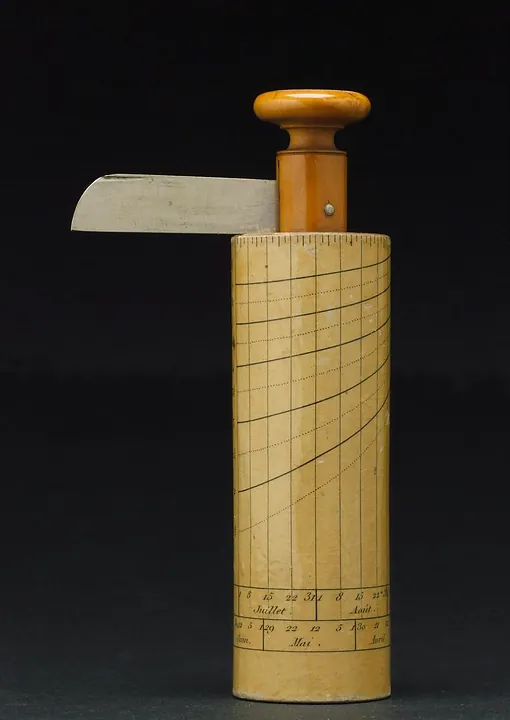
Instruments · 1831–1870
Column dial by Henry Robert, Horloger, au Palais Royal, paper on wood, early 19th century
Science Museum Group, London
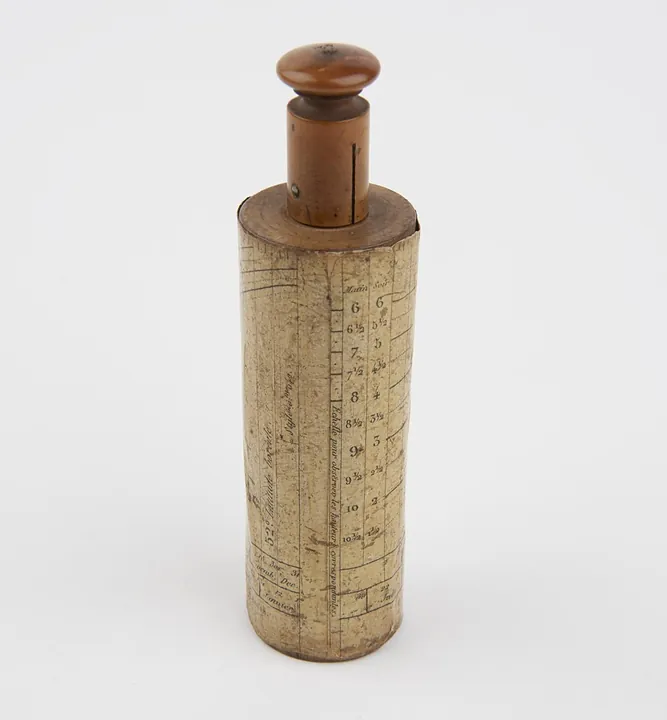
Instruments · 1831–1870
Column sundial for latitude 52 degrees, in boxwood with paper scales by Henry Robert, Horloger, Au Palais Royal, Paris, c.1832
Science Museum Group, London
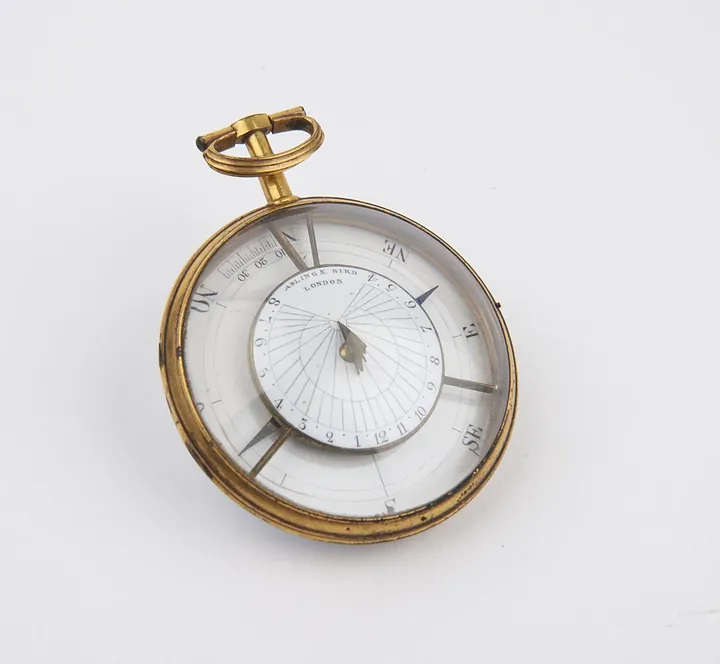
Instruments · 1831–1870
Horizontal compass sundial for latitude for 42 degrees, signed "Asling & Bird, London", in watch type case. English, c.1840.
Science Museum Group, London
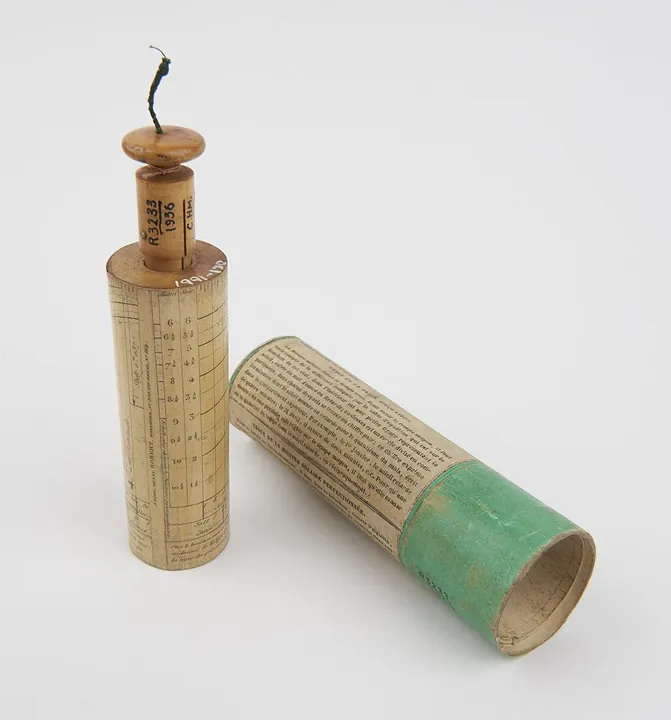
Instruments · 1831–1870
Sundial by Henry Robert, France, 1831–1870
Science Museum Group, London
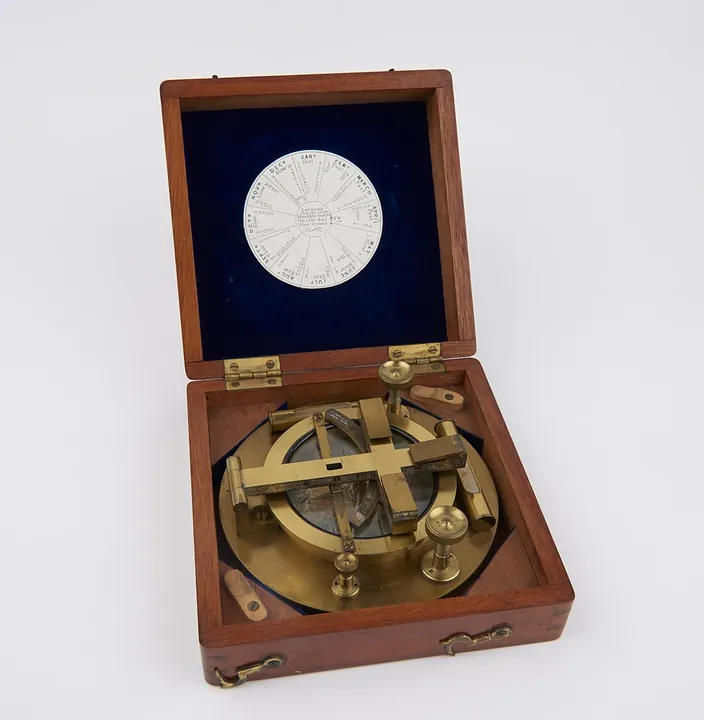
Instruments · 1831–1870
Sundial, in mahogany case
Science Museum Group, London
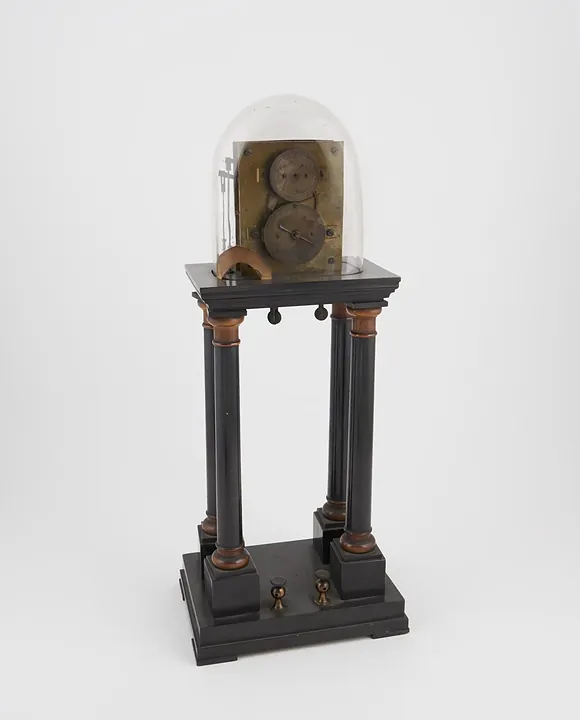
Instruments · 1848–1874
Chronoscope of Hipp type
Science Museum Group, London
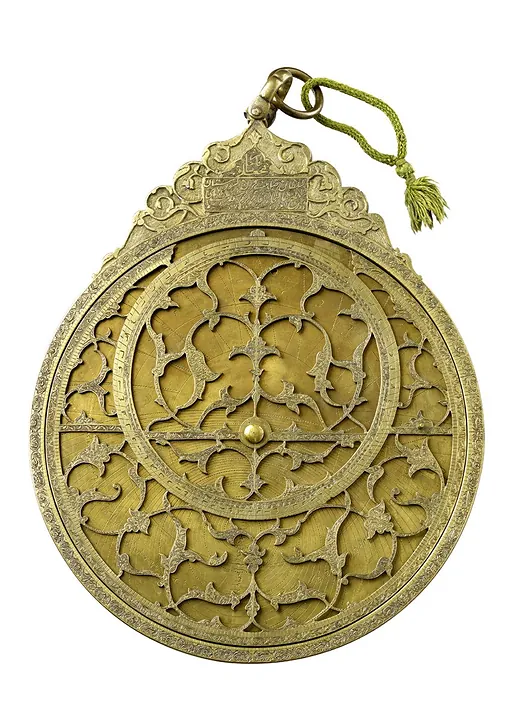
Instruments · 1850–1899
Astrolabe, Islamic world, 1850–1899
Museum of Arts and Crafts, Hamburg
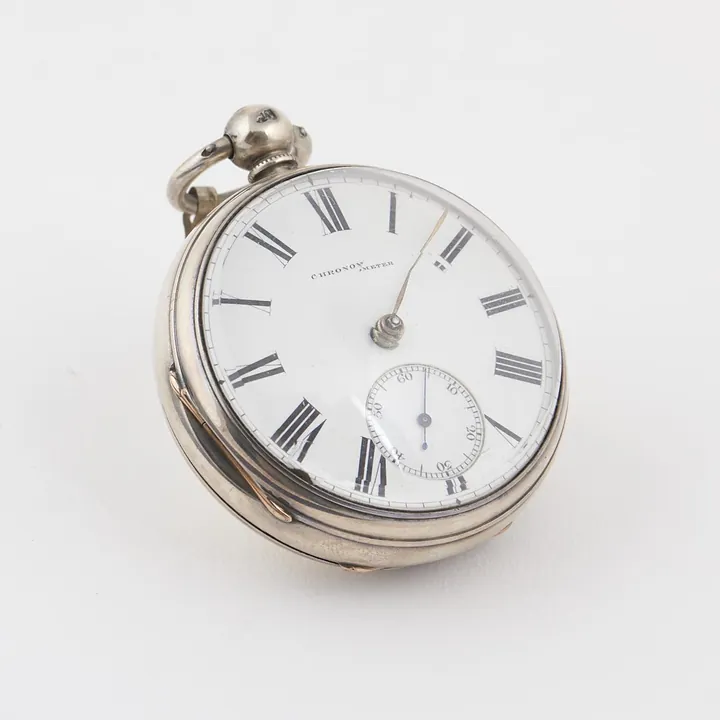
Instruments · 1850–1872
Chronometer watch in silver case by John Arnold and Son, London, no.454/755. Hall marked 1872
Science Museum Group, London