
Clocks · Carriage clock
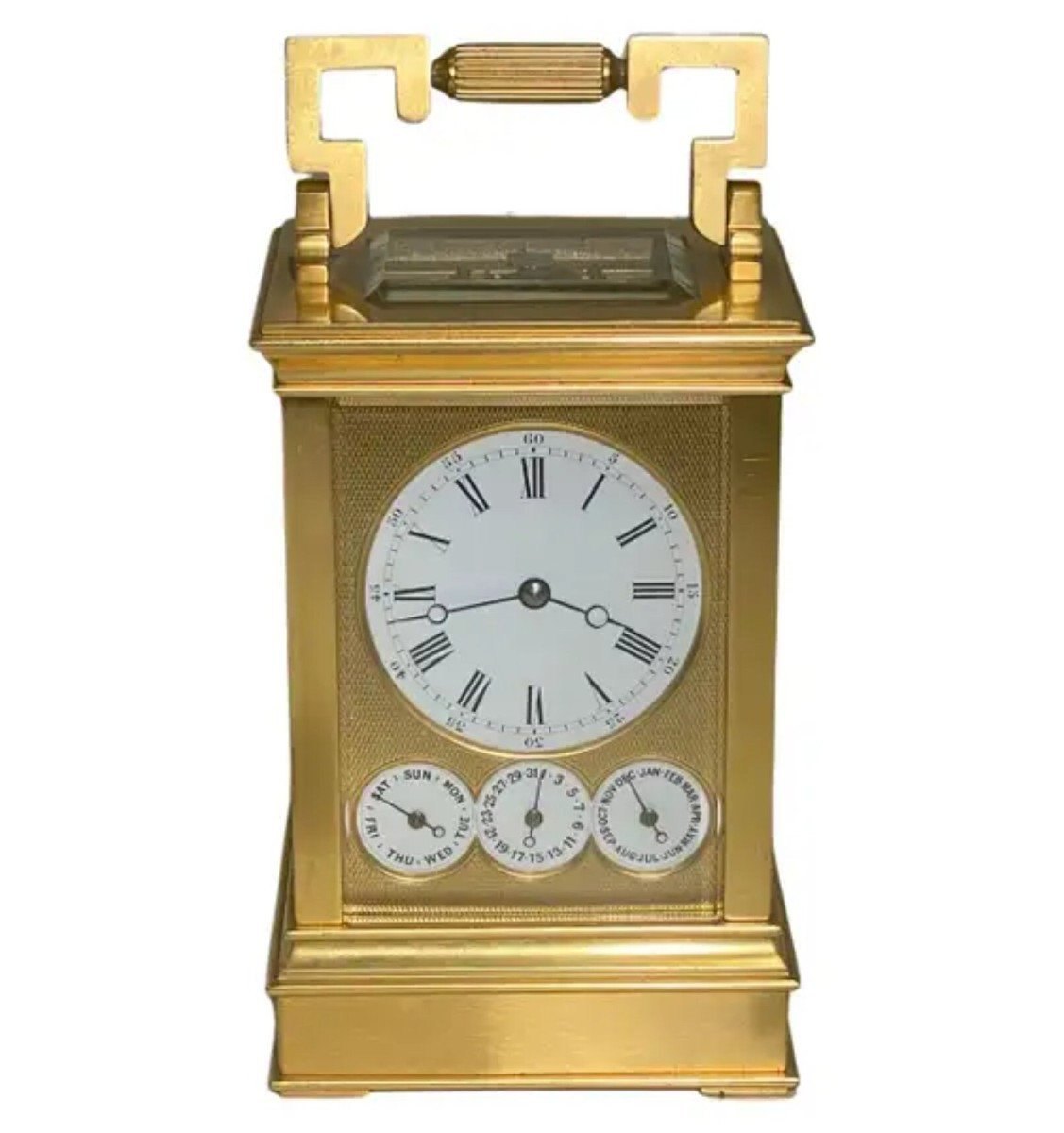
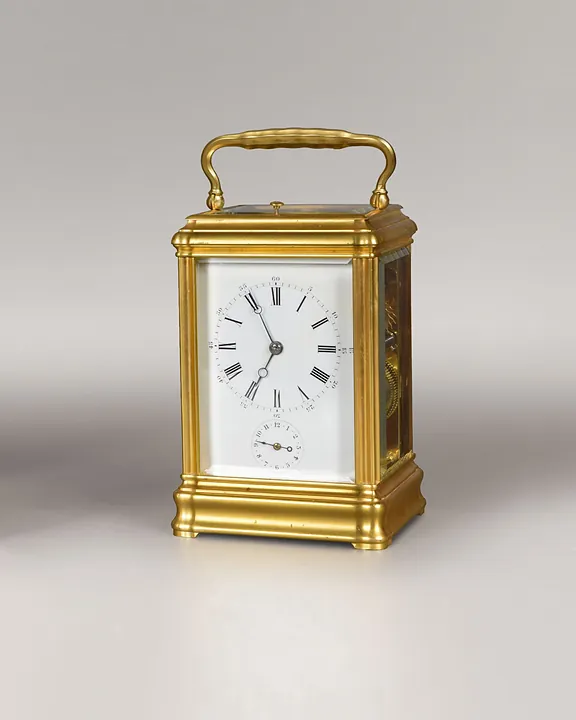
Drocourt No. 14993 Carriage Clock with Calendar
- Maker / attribution
- Drocourt (source attribution)
- Date
- 3rd quarter of the 19th Century
- Historical period
- Precision & Scientific Horology (1750 – 1850)
- Country of origin
- France
- Object type
- Carriage clock
- Dimensions
- 7.5 in (19.05 cm)
- Holding institution
- Bushells Antiques
- Accession / object no.
- drocourt-no-14993-carriage-clock-with-calendar-60bba32d02
- Credit line
- Bushells Antiques
- Catalogue title (original)
- Proantic: A Rare Drocourt No. 14993: Carriage Clock And Calendar Gold (English)
View the source record ↗ (opens another website in a new tab)Suggest a correction
Record summary
Held and catalogued by Bushells Antiques (object number drocourt-no-14993-carriage-clock-with-calendar-60bba32d02), this is a carriage clock attributed to Drocourt, made in France, dated 3rd quarter of the 19th Century. The Atlas places it in the Precision & Scientific Horology period (1750 – 1850) of its Clocks collection. Recorded dimensions: 7.5 in (19.05 cm). The record is illustrated with 1 photograph.
Assembled from the source record's structured fields. Dates and attributions are given as the source states them; where a field is missing the Atlas leaves it blank rather than estimating.
Catalogue description
Original object description
Bearing serial number 14993, this French brass carriage clock is credited to Drocourt and placed by the source in the third quarter of the nineteenth century. It is topped by a folding handle with angular Greek-key fretwork and a fluted central grip. Framed by an engine-turned, textured gilt mask, the primary white porcelain dial exhibits blued moon hands, Roman numerals, and peripheral Arabic five-minute markings, with three secondary dials below indicating the day of the week, the calendar date, and the month. Stamped with the maker's mark, the mechanical movement operates on an eight-day cycle.
Case and Exterior Construction
Constructed from brass, the case is capped by an overhead folding handle styled with a fluted central section and Greek-key angular fretwork. With the handle extended upwards, the piece stands 19.05 cm (7.5 inches) high, spans 10.16 cm (4 inches) in width, and measures 8.39 cm (3.3 inches) in depth.
Dial Configuration
The main circular dial of white porcelain rests within an engine-turned gilt mask and carries blued steel moon hands, Roman numerals for hours, and an exterior Arabic-numeral five-minute register. While catalogued in source documentation as displaying 'alarm, day and date', direct inspection reveals that the three lower subsidiary registers instead track the days of the week, the day of the month from 1 to 31, and the twelve months.
Mechanism and Provenance
Carrying the serial number 14993, the eight-day mechanism is stamped by the French clockmaking firm Drocourt, to whom the clock is attributed, and is dated by the source to the third quarter of the nineteenth century. The seller suggests the clock was possibly manufactured for export to Great Britain.
Inscriptions & marks
14993
Historical context
Precision & Scientific Horology (1750 – 1850)
Harrison solves longitude; Mudge invents the lever; Breguet's Paris workshop defines the modern watch.
The age of the deadbeat escapement, compensated pendulums and observatory regulators. Domestic clocks spread through the middle classes: English longcase and bracket clocks, French gilt-bronze mantel clocks, Viennese Biedermeier wall clocks, Black Forest painted-shield clocks, and the first American shelf clocks.
Read the period in the timelineMore clocks from this periodEarlier: Early Modern Horology
Atlas type guide
Carriage and travel clocks
The carriage clock is a portable spring clock with a balance-wheel escapement and a brass case with glass panels and a carrying handle. Abraham-Louis Breguet made early examples around 1800, and from the 1830s Paul Garnier and other French makers industrialised production, with the small towns of Saint-Nicolas-d'Aliermont and the Franche-Comté supplying movements for retailers worldwide.
Typical features include a platform escapement mounted horizontally on top of the movement (usually a lever, sometimes cylinder or Garnier's chaff-cutter), striking or repeating work, and alarms. English carriage clocks, generally larger and with fusees, were made by firms such as Frodsham and Dent. Travel clocks in folding leather cases became popular in the twentieth century.
What to look for
- A platform escapement visible through the top glass.
- Case styles: corniche, gorge, anglaise, obis or engraved cases.
- Repeat buttons on top and strike/silent levers.
- Stamps of movement makers (e.g. Drocourt, Jacot, Margaine, Richard & Co.) on the backplate.
Dating clues
- Early carriage clocks with Breguet or Garnier features: c. 1800–1850.
- Mass-produced French carriage clocks: c. 1850–1914.
- Folding travel clocks and alarm travel clocks: mostly 1920–1970.
General guidance written by the Atlas editors about this kind of object. It is not a statement about this particular piece; for that, rely on the source record above and on physical examination.
Read next:Detached lever escapement
Related records
Clocks · c. 1880
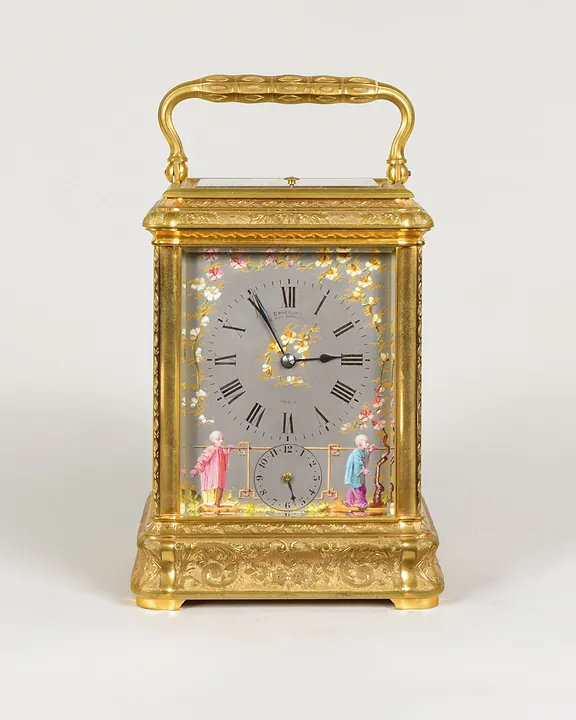
Carriage clock by Drocourt, Paris, c. 1880
Howard Walwyn Fine Antique Clocks (dealer), London
Clocks · c. 1870–1880
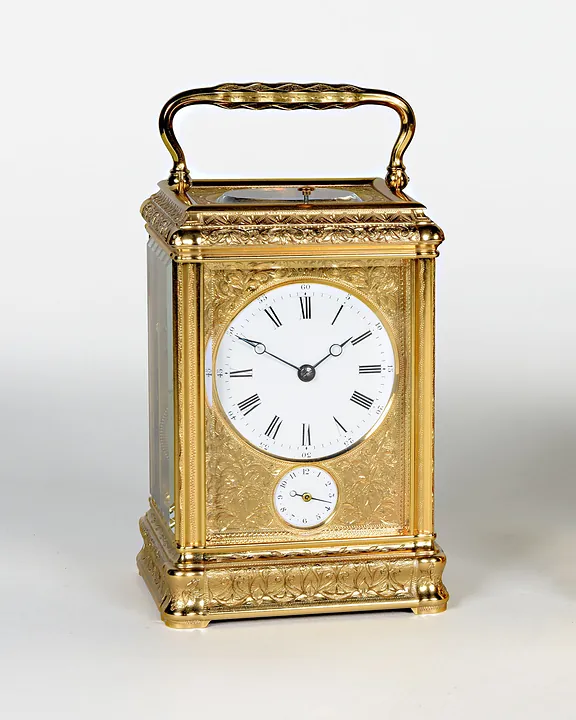
Carriage clock by Drocourt, Paris, c. 1870–1880
Howard Walwyn Fine Antique Clocks (dealer), London
Clocks · c. 1870–1880
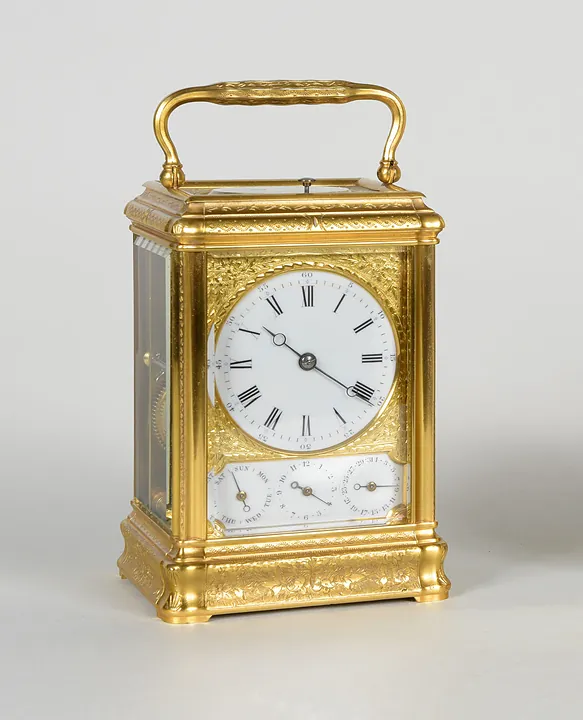
Carriage clock by Drocourt, c. 1870–1880
Howard Walwyn Fine Antique Clocks (dealer), London
Clocks · c. 1880
French carriage clock by Drocourt, c. 1880
Howard Walwyn Fine Antique Clocks (dealer), London
Clocks · 1750–1800
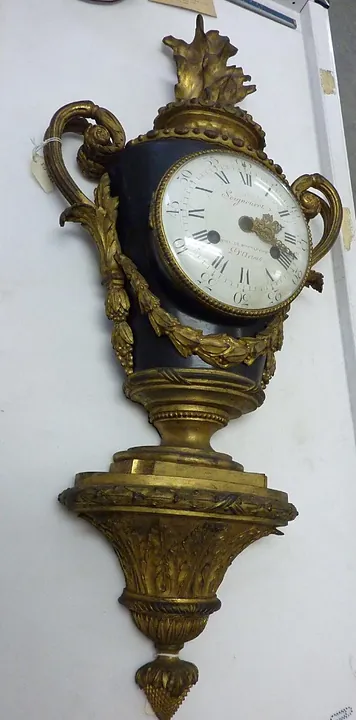
Bracket clock in metal case with scroll handles and flamed-shaped top signed by Pierre Seignoret, Clockmaket to the the Comte d'Artois
Victoria and Albert Museum, London
Clocks · 1756
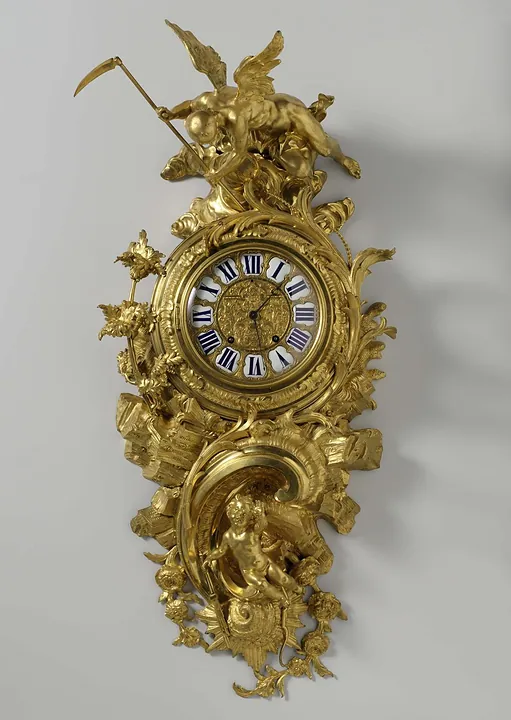
Mantel clock, France, 1756
Rijksmuseum
Clocks · c. 1764–70
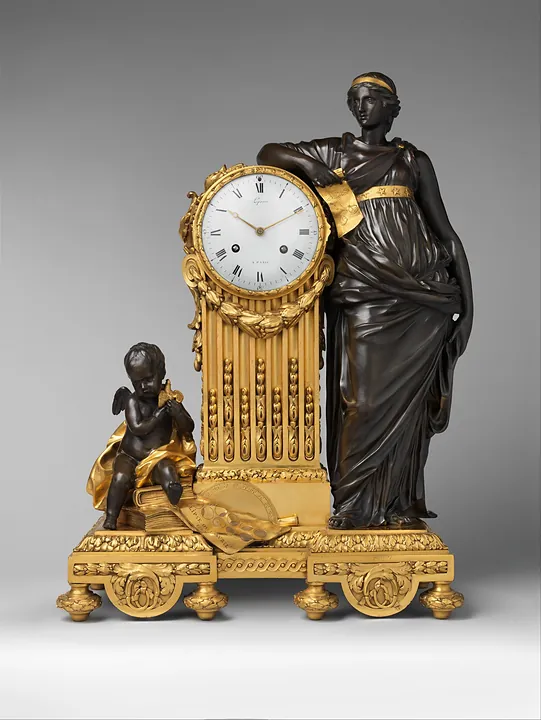
Mantel clock by Jean-André Lepaute, France, c. 1764–70
The Metropolitan Museum of Art, New York
Clocks · 1760–1860
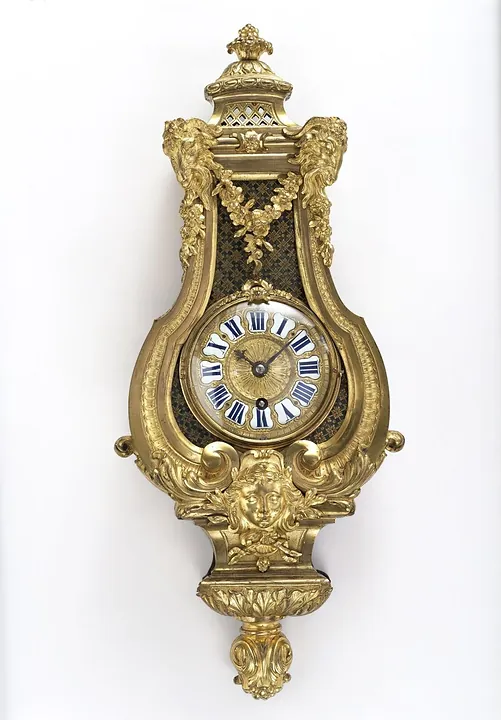
'Pendule d'alcove' wall clock, gilt-bronze and boulle marquetry, Paris, 1760-1860
Victoria and Albert Museum, London