
Clocks · Longcase clock
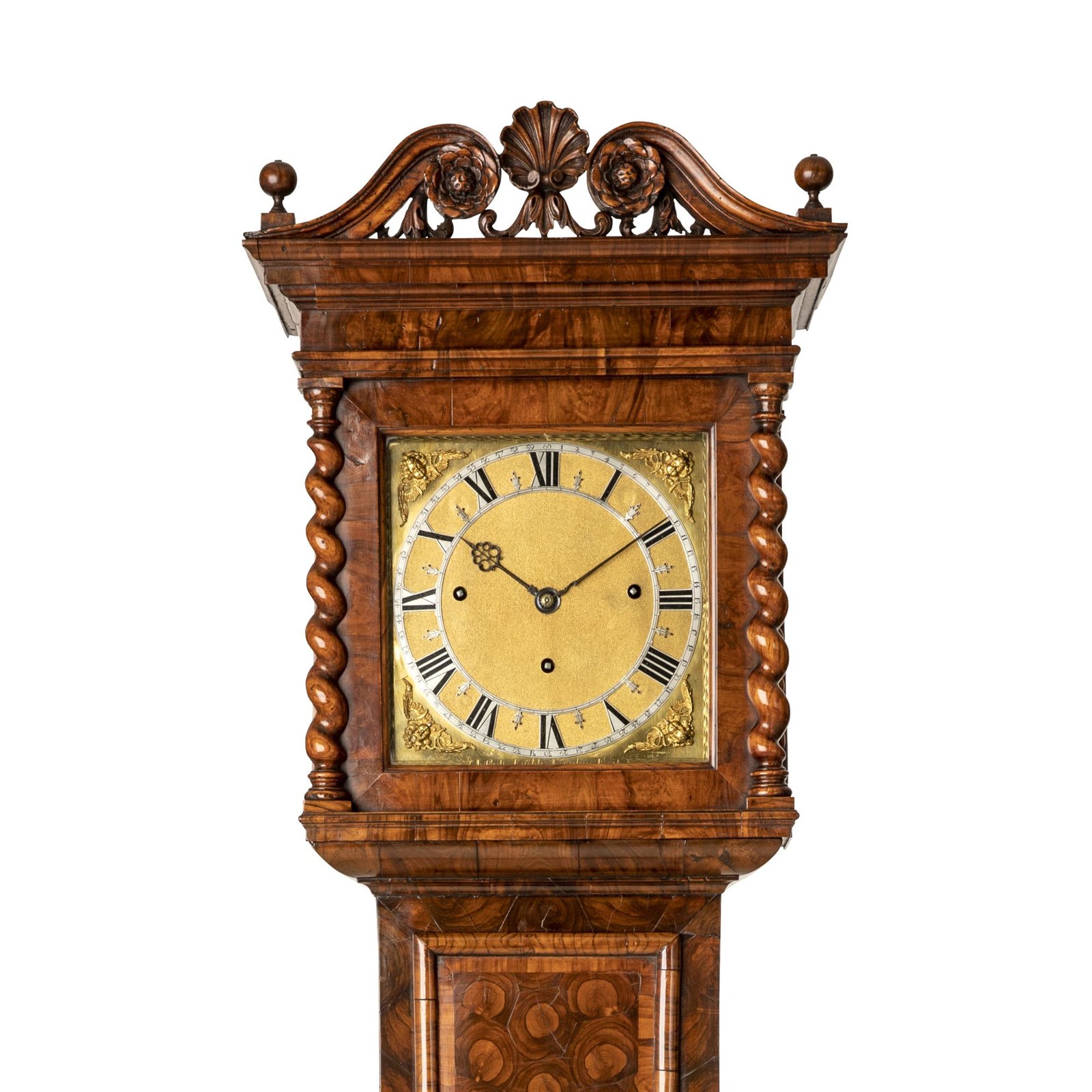
Double six grande sonnerie longcase clock by Joseph Knibb, London
- Maker / attribution
- Joseph Knibb (maker)
- Date
- c. 1675
- Historical period
- Early Modern Horology (1600 – 1750)
- Country of origin
- England
- Place
- London
- Object type
- Longcase clock
- Dimensions
- Height 211 cm
- Stock no.
- Product 3098
- Credit line
- Dealer listing, The Antique Clock Company (product 3098)
- Catalogue title (original)
- A BEAUTIFUL DOUBLE SIX GRANDE SONNERIE LONGCASE CLOCK – JOSEPH KNIBB – LONDON (English)
View the source record (dealer listing) ↗ (opens another website in a new tab)Suggest a correction
Record summary
Catalogued by The Antique Clock Company (dealer), Dorset (stock number Product 3098), this is a longcase clock by Joseph Knibb, made in London, England, dated c. 1675. The Atlas places it in the Early Modern Horology period (1600 – 1750) of its Clocks collection. Recorded dimensions: Height 211 cm. The record is illustrated with 6 photographs.
Assembled from the source record's structured fields. Dates and attributions are given as the source states them; where a field is missing the Atlas leaves it blank rather than estimating.
Catalogue description
Dealer description — The Antique Clock Company
This particular method of Grande Sonnerie striking, which has been used on this clock, is ingenious and probably the most complex employed by Knibb. To reduce the number of blows of the hammer, and thus the power required to a minimum, double six-hour striking is employed – (in this method, normal striking was employed from 1 to 6 and then repeated again from 7 to 12, thus saving 36 strikes in a 12 hour period). This reduces the number of blows powered by one train for the hours at the quarters from 3714 to 2016 over eight days. The other train provides the power for the quarters and the full hour striking, which involves 2400 blows every eight days. Movement: The beautifully conceived movement has ten latched pillars, a front plate split into three for ease of assembly, external count wheels for the hours and quarters and an anchor escapement. A large and a small bell are provided. The pendulum, with a brass rod and threaded bob, has a butterfly nut above the back-cock for regulation. A bracket (re-instated) fixes the movement to the case. Dial: The 10” dial, which is signed along the bottom edge ‘Joseph Knibb Londini Fecit’, has wheatear engraving to its border, cherub spandrels and latched feet. The finely skeletonised chapter ring has quarter and half-hour marks with every minute numbered. Case: The case, the proportions of which are typical of Knibb at this period, is surmounted by a carved cresting with a shell motif to the centre, which is unusually mounted separately, which makes one wonder if originally a crest was fitted there. Spiral twist columns are employed, and there is a convex mould beneath the hood, which lifts up. The trunk door, which is surrounded by a half-round mould, is decorated with olive-wood oyster veneers. To the centre is a cross-banded ring, within which are small pieces of olive wood. Joseph Knibb – B.1640 – D.1711 Joseph Knibb was one of the most celebrated clockmakers of his day and was highly admired by Charles II, for whom he made several fine clocks. Joseph was apprentice to his cousin Samuel Knibb in 1655 at Newport Pagnell, and after his seven-year apprenticeship, he then moved to Oxford in 1662, whilst Samuel moved to London the same year. It was far from an easy move, when he arrived in the city he was thought of as a foreigner by the freeman traders of the city who objected to his presence. It is thought that he traded without permission until, upon payment of a fine in 1668, he was then free to carry out his business without hindrance. It was at this time he was most interested in the development of the anchor escapement and seconds pendulum for timekeeping accuracy – of which this particular clock is a fine example of his efforts. In 1670 he moved to London, this could have been because of his accurate clocks or it could possibly be to do with Samuels death. Either way, immediately after setting up business in the city, he was granted the freedom of the Clockmakers’ Company. He was quick to become established in London with a very distinctive style along with several notable inventions. Apart from producing consistently high-quality work, Joseph was imaginative, inventive and had an excellent eye for proportion. He had many apprentices and was elected as Steward of the Clockmakers’ Company in August 1984 and then Assistant in 1689. By the time he retired in 1697, his business is believed to have made over four hundred clocks, proving that he was an illustrious businessman during his time in London. He retired to Hanslop, where he still made clocks, only not on such a large scale. He died in December 1711. Comparative Literature : The Knibb Family Clockmakers by R. A. Lee Height: 83″ or 211 cm (Including crest) Width: 17 ½” or 44 cm Depth: 10″ or 25 cm The clock was formerly in the collection of Viscount Hereford and was sold by Sotheby’s on 13 th October 1988 and again on 14 th December 2006.
Provenance
Private collection, UK
Historical context
Early Modern Horology (1600 – 1750)
Huygens' pendulum and balance spring transform accuracy; English makers develop the anchor and deadbeat escapements.
Huygens's pendulum (1656–57) improved clock accuracy from about a quarter of an hour to under a minute a day. The anchor escapement (c. 1670) and the long seconds pendulum created the longcase clock; London makers such as Fromanteel, Knibb, Tompion and Quare led European clockmaking, and French makers created the Boulle pendule.
Read the period in the timelineMore clocks from this periodEarlier: Renaissance Horology
Atlas type guide
Longcase (tall-case or grandfather) clocks
The longcase clock was born from two seventeenth-century innovations: Christiaan Huygens's pendulum (1656–57) and the anchor escapement (c. 1670). A long seconds pendulum, nearly a metre long, swings with a small arc, and enclosing it together with the driving weights in a tall wooden case protected the mechanism and created a new piece of furniture. London makers such as Ahasuerus Fromanteel, Thomas Tompion and Joseph Knibb set the pattern.
By the eighteenth century longcase clocks were made throughout Britain, the Netherlands, Scandinavia (the Swedish Mora clock), France (the Comtoise from the Franche-Comté), Germany and colonial America. Eight-day movements with two weights became standard in better clocks; thirty-hour clocks with one weight and a rope or chain were cheaper alternatives.
What to look for
- Winding holes in the dial: two (eight-day, going and striking) or none (thirty-hour, pulled up by a chain).
- Brass dials with applied chapter rings (earlier) versus painted iron 'white' dials (after c. 1770 in Britain).
- Moon-phase arches, date apertures, seconds dials and maker's name on the dial.
- Case woods and style: ebonised, walnut marquetry, lacquer, oak or mahogany; regional styles from London, Lancashire, Scotland or America.
- Whether the movement and dial match the case — 'marriages' are common.
Dating clues
- Square brass dials suggest c. 1670–1720; arched brass dials c. 1715–1790.
- Painted (white) dials were made by Birmingham dial-makers from about 1772.
- Comtoise clocks with repoussé pendulums are mostly nineteenth century.
General guidance written by the Atlas editors about this kind of object. It is not a statement about this particular piece; for that, rely on the source record above and on physical examination.
Read next:Deadbeat escapementAnchor escapement
Related records
Clocks · c. 1680–85
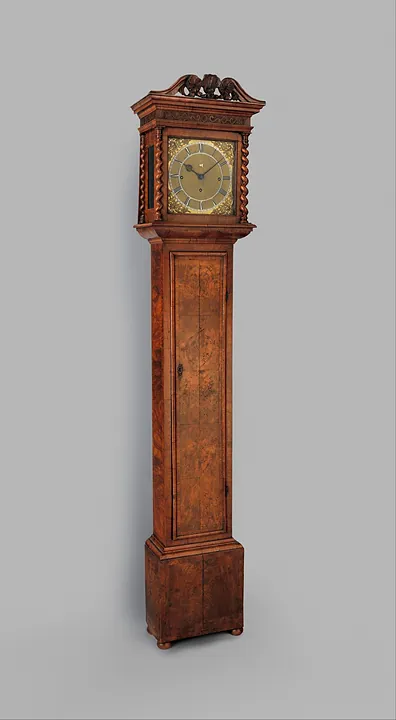
Longcase clock with calendar by Joseph Knibb, England, c. 1680–85
The Metropolitan Museum of Art, New York
Clocks · c.1690
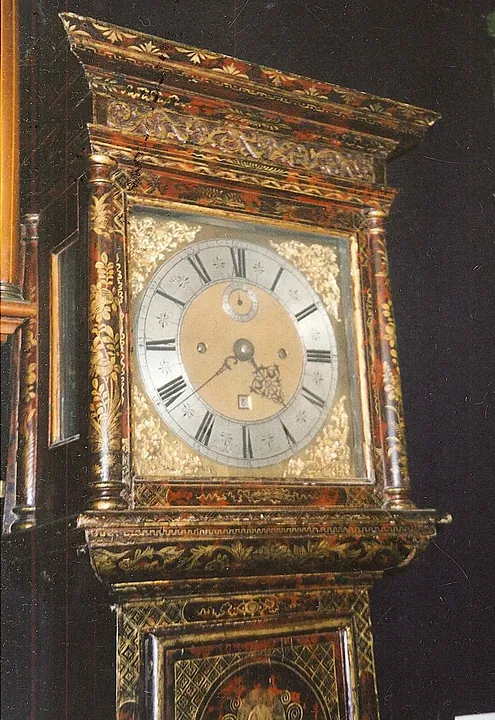
Longcase clock by Joseph Knibb, England, c.1690
Victoria and Albert Museum, London
Pocket Watches · 1670-5
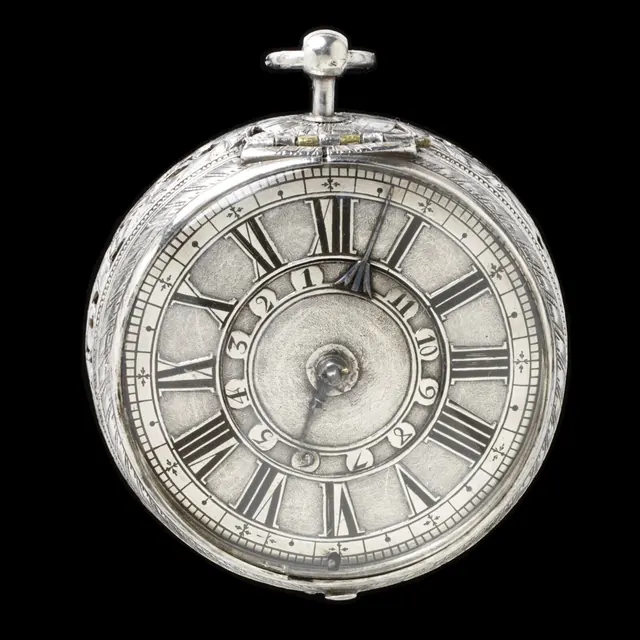
Watch by Joseph Knibb, England, 1670-5
Victoria and Albert Museum, London
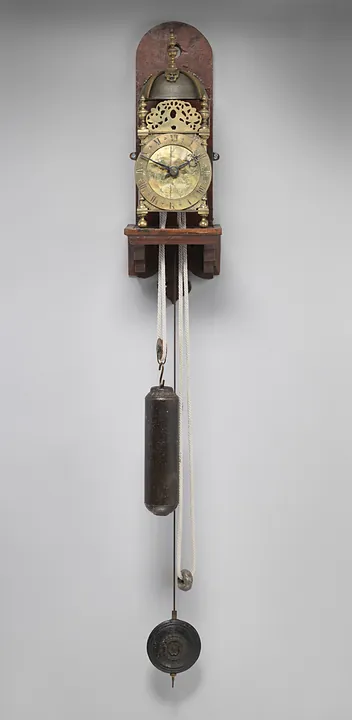
Clocks · c. 1675
Lantern clock
The Metropolitan Museum of Art, New York
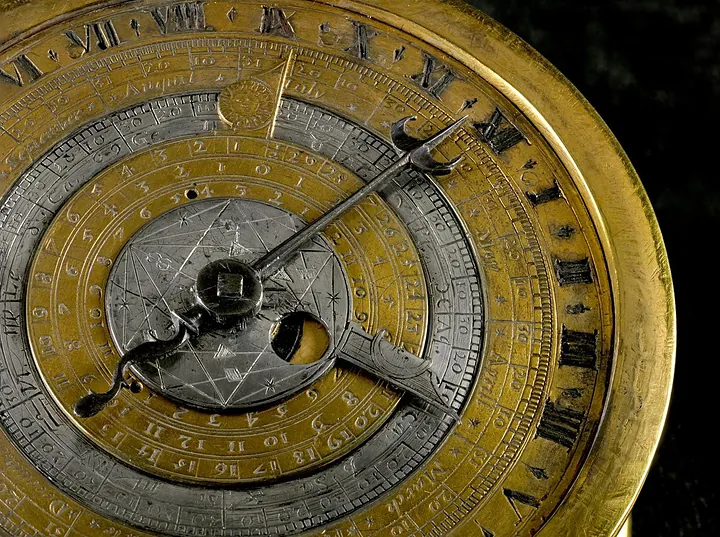
Clocks · 1598–1603
Circular table-clock with calendrical and lunar indications made by Nicholas Vallin in London between 1598 and 1603.
Science Museum Group, London
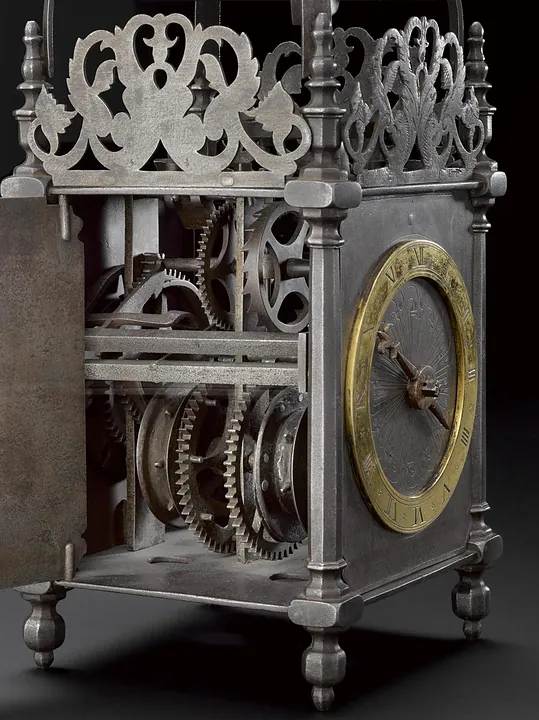
Clocks · 1611
English iron lantern clock, with wheel balance, by John Holloway, Market Lavington, Wiltshire, England, 1611.
Science Museum Group, London
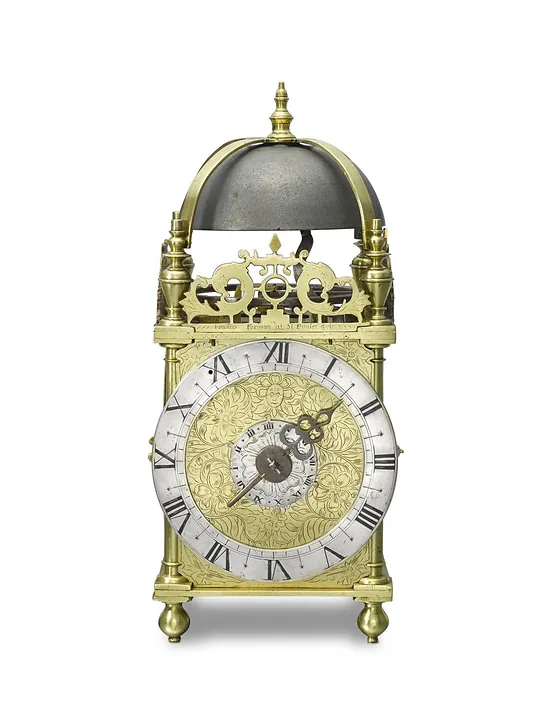
Clocks · 1630
Lantern clock by Francis Forman, England, 1630
Science Museum Group, London
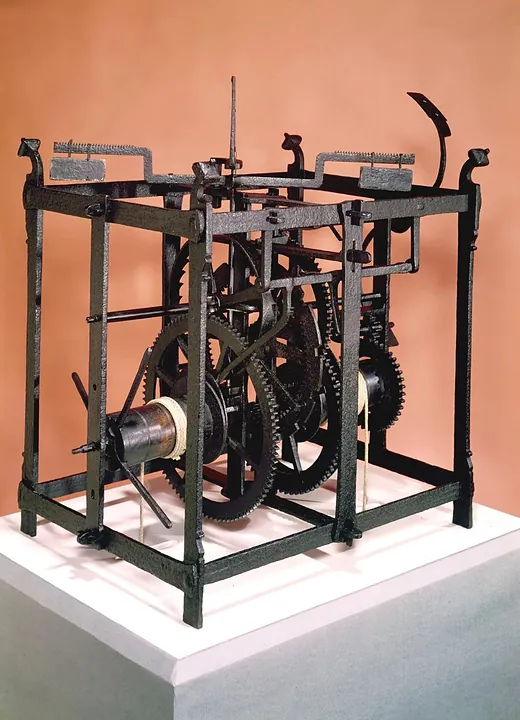
Clocks · 1632–1640
Turret clock, England, 1632–1640
Science Museum Group, London