Clocks · Longcase clock
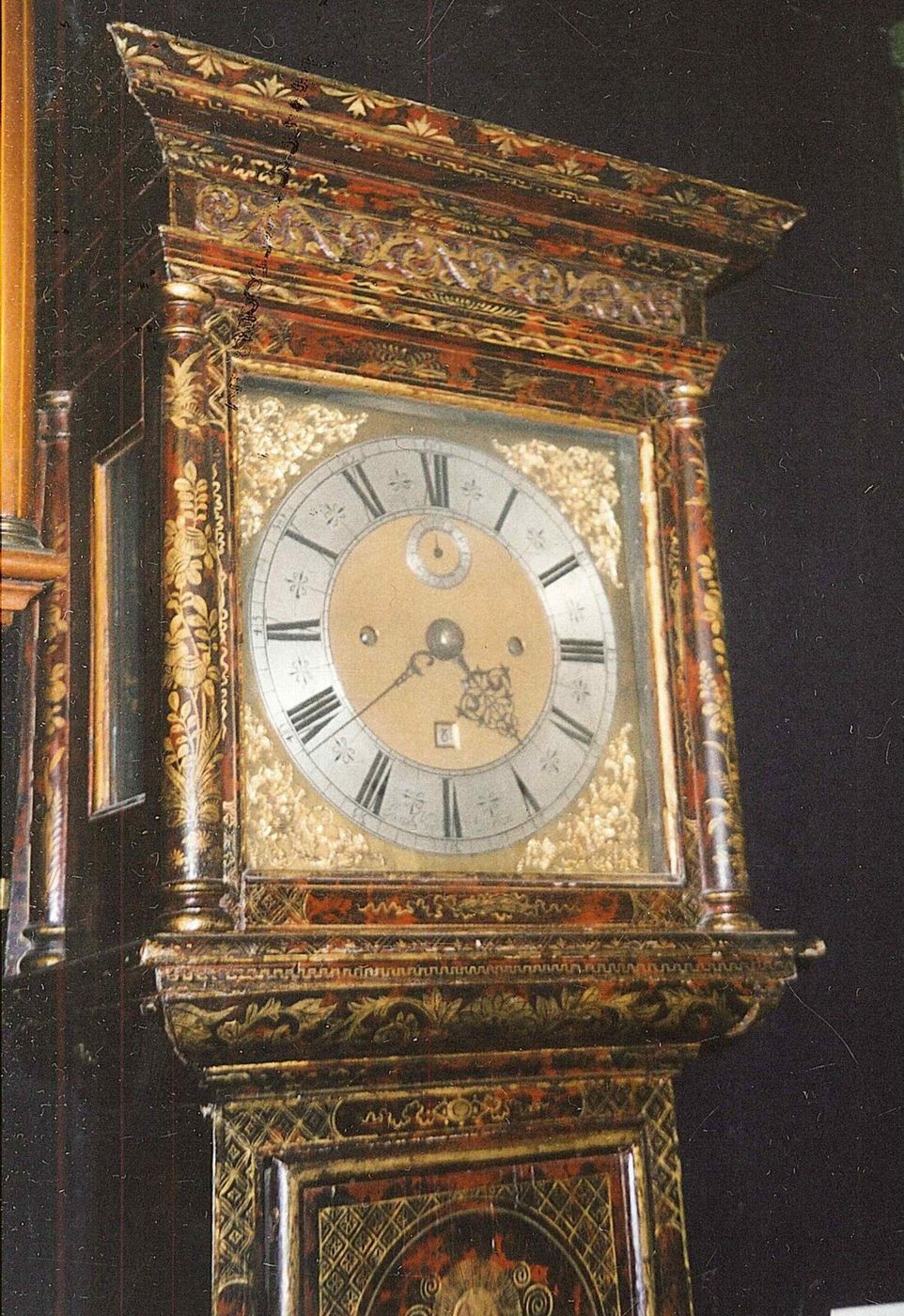
Longcase clock by Joseph Knibb, England, c.1690
- Maker / attribution
- Joseph Knibb (made)
- Date
- c.1690
- Historical period
- Early Modern Horology (1600 – 1750)
- Country of origin
- England
- Place
- London
- Object type
- Longcase clock
- Materials / technique
- Case of softwood, japanned and gilded, the dial of brass with silvered chapter ring.
- Dimensions
- Height: 197.8 cm; Width: 45.2 cm; Depth: 25.7 cm; Weight: 7.75 kg (w.15:5 Brass weight 10/10/2025 NH); Weight: 7.7 kg (w.15:6 Brass weight 10/10/2025 NH)
- Holding institution
- Victoria and Albert Museum, London
- Accession / object no.
- W.15:1 to 3-1970
- Credit line
- Bequeathed by Brigadier W.E.Clark CMG, DSO through the Art Fund
Record summary
Held and catalogued by Victoria and Albert Museum, London (object number W.15:1 to 3-1970), this is a longcase clock by Joseph Knibb, made in London, England, dated c.1690. The Atlas places it in the Early Modern Horology period (1600 – 1750) of its Clocks collection. Materials and techniques recorded by the source: Case of softwood, japanned and gilded, the dial of brass with silvered chapter ring. Recorded dimensions: Height: 197.8 cm; Width: 45.2 cm; Depth: 25.7 cm; Weight: 7.75 kg (w.15:5 Brass weight 10/10/2025 NH); Weight: 7.7 kg (w.15:6 Brass weight 10/10/2025 NH). The record is illustrated with 4 photographs.
Assembled from the source record's structured fields. Dates and attributions are given as the source states them; where a field is missing the Atlas leaves it blank rather than estimating.
Catalogue description
V&A — Summary
Joseph Knibb was one of the finest English clockmakers of the 17th century. He worked in Oxford from 1662, moved to London in 1670/71 and worked in Seargeant’s Inn, near Fleet Street, at the Dyall and later at Charing Cross. In about 1690 he moved out to Hanslope in Buckinghamshire. The earliest surviving English japanned clock case surrounds a bracket clock by Joseph Knibb, dated 1672-4, now in a private collection. Japanned cases became more common in the early 18th century, so this is another early example, although it was redecorated in the early 20”‘ century. The simulated tortoiseshell ground is particularly unusual. The plinth has an added lower base in place of the original bun feet. The movement is correct for a late Joseph Knibb clock - a brass and steel weight-driven two-train movement, with count wheel, striking on two bells. The dial is not typical of Knibb's practice and may have been made after he left London by one of his former workshop assistants. The chapter ring has the hour four engraved as IV instead of IIII which indicates the ‘Roman Striking‘ system. Two bells of different tone are used. The hours one to three are struck on the lighter bell, four is struck as one light bell followed by one deep bell, five is struck as one deep bell, six as one deep bell followed by one light bell (VI). This method is found on longer duration clocks as it reduced the number of strikes made every day.
V&A — Physical description
Longcase clock with 8-day movement, the case of softwood, japanned to imitate tortoiseshell and decorated with gilt-gesso and gilded ornament in the Chinese taste, the dial signed 'Joseph Knibb, London Case: Of softwood, japanned in red and black to imitate tortoiseshell that has been set against a red ground, the whole elaborately decorated with Chinoiserie gilded motifs, added later, probably in the early 20th century. The case is plain in form, with simple mouldings outlining the low plinth (an addition to replace turned feet, for which sockets are visible from the underside) and the top of the base section, the edge of the large door in the trunk and the edges of the frieze of the hood. Detached columns flank the square door of the hood and the back edges of the hood at either side, supporting the entablature with a frieze ornamented with scrolling foliage in raised gesso. The main panel of the door and the front panel of the base are ornamented with raised motifs in gesso, gilded, showing figures on horseback (on the base) and buildings (on the door). Dial: 10-inch square brass dial with silvered chapter ring having Roman hour numerals and arrowhead half-hour divisions. Owing to the presence of Roman striking, four is engraved as “IV”. The minute chapter has divisions for each minute and Arabic numerals in every five, whilst the inner portion of the chapter ring is engraved with hour and half-hour divisions. Around “VI” on the chapter ring is engraved Joseph Knibb London. Separate, silvered subsidiary seconds ring below twelve with Arabic numbers in multiples of fives. Matted dial centre with chamfered, rectangular calendar aperture. The date is indicated by Arabic numerals engraved on a silvered disc carried behind the dial. The dial corners have cast brass, cherub head form spandrels. Three dial feet are attached to the front plate of the movement with pins, the other one, latched. Pierced steel hour and minute hands. Movement: Brass and steel weight driven two-train movement, with count wheel (or locking plate) striking on two bells, the crossed-out count wheel being mounted on the outside of the back plate. Five pillars of finned form are riveted to the back plate; the upper three are latched to the front plate, the lower pinned. Scribe lines for three of the Going train wheels are marked on the outside of the front plate. Striking pin wheel carries pins on both side of the band to operate the Roman hours; double cut out hoop wheel. Where present, wheel collets tend to be half round in profile; arbors are non-parallel in section, tending to fatten towards their centres. Anchor recoil escapement. Two plugged holes and a semi-circular cut-out are now visible on the front plate. The back cock also has a plugged hole. Description and notes by Francis Brodie, c. 2008
V&A — Object history
Given by Brigadier W.E. Clark CMG, DSO and purchased by him from Mallett's, London 24 April 1964 for £1200. No earlier provenance is recorded. Remarks: 'I would refer you to the comments made by P.K.T. and J.H. in the Register description concerning the dial and movement. As they have commented, the dial indeed does not appear to be typical of Knibb's practice — for example the half-hour engraved markings might have expected to be a stylised fleur-de-lys rather than the curved arrow head design; the hour hand does seem a little over elaborate for typical Knibb. The signature in the bottom of the chapter ring was less commonly used except in a few later examples, at about the time when Joseph Knibb was moving to Hanslop, according to Lee (Ronald A. Lee, The Knibb Family Clockmakers, Manor House Press, Surrey, 1964). However, Lee implies in his description of later Knibbs that the dial is an inch or two larger than this example, so it is possible that this could be a very late London production at about the time of Joseph Knibb's retirement. The dial indicates that the clock has so-called Roman Striking. The chapter ring has hour four engraved as “IV" instead of “IIII” and this was used by clockmakers to denote this striking arrangement. Two bells of differing tone are used. The hours one to three are struck on the lighter bell, four is struck as one light bell followed by one deep bell (IV), five is struck one deep bell, six as one deep bell followed by one light bell (VI) and so on. This method of striking tended to be found on longer duration clocks, since Roman striking required fewer blows to be struck per day than ordinary striking. Escape wheel pinion appears large. The plugged holes around the escapement may suggest some repair/replacement. The pallet/crutch at its top has the appearance of an eighteenth century English spring clock. The fly has a rectangular, eighteenth century appearance with the friction spring across the brass. The pinion has its cut extended either side of the main body'. Description and notes by Francis Brodie, c. 2008
V&A gallery label
EIGHT DAY LONG CASE CLOCK Japanned, pine carcase Made by Joseph Knibb, London, about 1690 Bequeathed by Brigadier Clark through the National Art-Collections Fund Museum number W.15-1970 Joseph Knibb (1640-1711) was one of the finest clockmakers of the 17th century. He worked in Oxford from 1662, moved to London in about 1671 and worked at 'The Dyall', in Sergeant's Inn, near Fleet Street. In 1697 he moved to Hanslope in Buckinghamshire. The earliest surviving English japanned clock case surround a bracket clock by Joseph Knibb dated 1672-4, now in a private collection. Japanned cases became more common in the early 18th century, so this is an early example, though it was re-decorated in the early 20th century. The simulated tortoiseshell ground is particularly unusual. The plinth has and added lower base in place of the original bun feet. The movement is corrent for a late Joseph Knibb clock - a brass and steel weight-driven two-train movement, with count wheel, striking on two bells. The dial is not typical of Knibb's practice and may have been made after he left London by one of his former workshop assistants. The chapter ring has four engraved as IV instead of IIII, which indicates the 'Roman Striking ' system. Two bells of different tone are used. The hours one to three are struck on the lighter bell, four is struck as one light bell followed by one deep bell, five is struck as one deep bell, six as one deep bell followed by one light bell (VI). This method is found on longer duration clocks as it reduced the number of strikes made every day but such a form of striking was always unusual.
V&A gallery label
LONG-CASE CLOCK ENGLISH; about 1700 By Joseph Knibb of London. The japanned decoration on the case is not original.
Inscriptions & marks
Joseph Knibb London
Historical context
Early Modern Horology (1600 – 1750)
Huygens' pendulum and balance spring transform accuracy; English makers develop the anchor and deadbeat escapements.
Huygens's pendulum (1656–57) improved clock accuracy from about a quarter of an hour to under a minute a day. The anchor escapement (c. 1670) and the long seconds pendulum created the longcase clock; London makers such as Fromanteel, Knibb, Tompion and Quare led European clockmaking, and French makers created the Boulle pendule.
Read the period in the timelineMore clocks from this periodEarlier: Renaissance Horology
Atlas type guide
Longcase (tall-case or grandfather) clocks
The longcase clock was born from two seventeenth-century innovations: Christiaan Huygens's pendulum (1656–57) and the anchor escapement (c. 1670). A long seconds pendulum, nearly a metre long, swings with a small arc, and enclosing it together with the driving weights in a tall wooden case protected the mechanism and created a new piece of furniture. London makers such as Ahasuerus Fromanteel, Thomas Tompion and Joseph Knibb set the pattern.
By the eighteenth century longcase clocks were made throughout Britain, the Netherlands, Scandinavia (the Swedish Mora clock), France (the Comtoise from the Franche-Comté), Germany and colonial America. Eight-day movements with two weights became standard in better clocks; thirty-hour clocks with one weight and a rope or chain were cheaper alternatives.
What to look for
- Winding holes in the dial: two (eight-day, going and striking) or none (thirty-hour, pulled up by a chain).
- Brass dials with applied chapter rings (earlier) versus painted iron 'white' dials (after c. 1770 in Britain).
- Moon-phase arches, date apertures, seconds dials and maker's name on the dial.
- Case woods and style: ebonised, walnut marquetry, lacquer, oak or mahogany; regional styles from London, Lancashire, Scotland or America.
- Whether the movement and dial match the case — 'marriages' are common.
Dating clues
- Square brass dials suggest c. 1670–1720; arched brass dials c. 1715–1790.
- Painted (white) dials were made by Birmingham dial-makers from about 1772.
- Comtoise clocks with repoussé pendulums are mostly nineteenth century.
General guidance written by the Atlas editors about this kind of object. It is not a statement about this particular piece; for that, rely on the source record above and on physical examination.
Read next:Anchor escapement
Related records
Clocks · ca. 1680–85
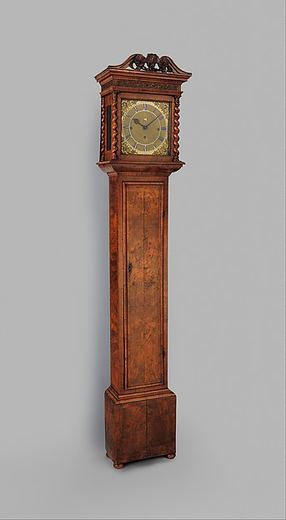
Longcase clock with calendar by Joseph Knibb, United Kingdom, ca. 1680–85
The Metropolitan Museum of Art, New York
Clocks · 1598-1603
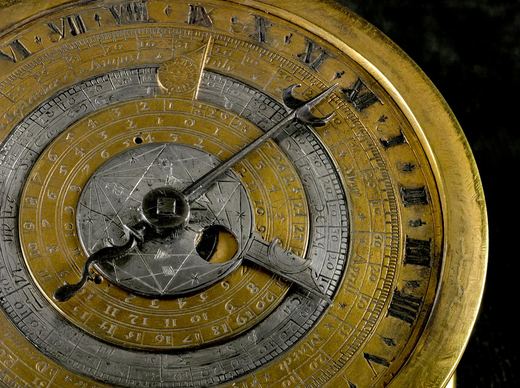
Circular table-clock with calendrical and lunar indications made by Nicholas Vallin in London between 1598 and 1603.
Science Museum Group, London
Clocks · 1611
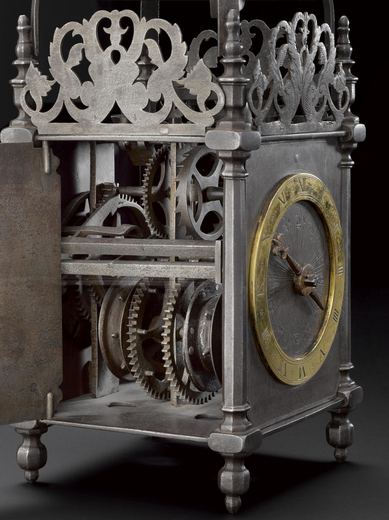
English iron lantern clock, with wheel balance, by John Holloway, Market Lavington, Wiltshire, England, 1611.
Science Museum Group, London
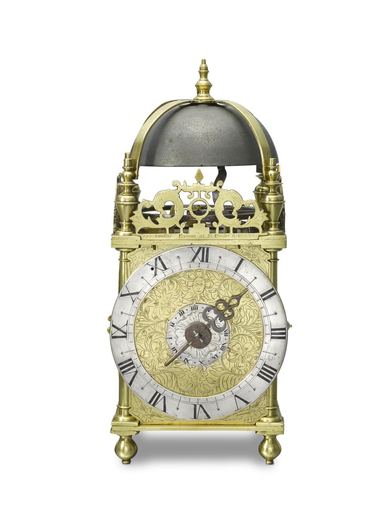
Clocks · 1630
Lantern clock by Forman, Francis, England, 1630
Science Museum Group, London
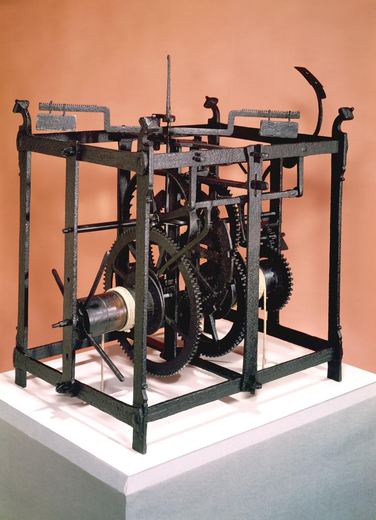
Clocks · 1632-1640
Turret clock, England, 1632-1640
Science Museum Group, London
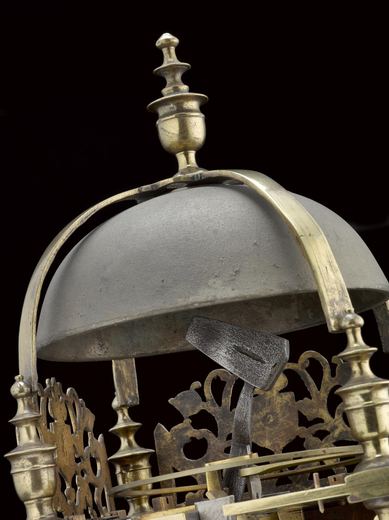
Clocks · 1645-1655
Balance-wheel brass lantern clock, with two driving weights and one counterweight, by Thomas Knifton, Cross Keys, Lothbury, London, England, 1645-1655.
Science Museum Group, London
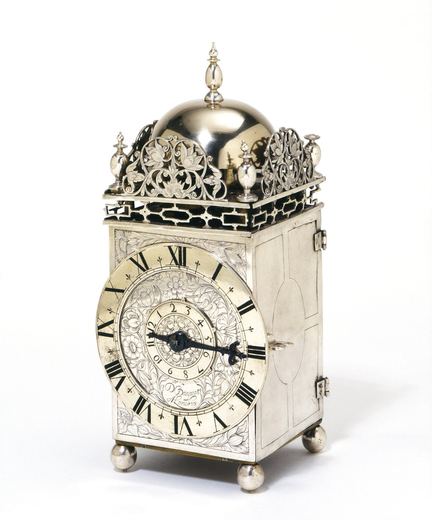
Clocks · ca. 1650
Lantern alarm clock, silver, by David Bouquet, circa 1650
Victoria and Albert Museum, London
Clocks · 1650-1660
Lantern clock by Closon, Peter, England, 1650-1660
Science Museum Group, London