
Wristwatches · Wristwatch
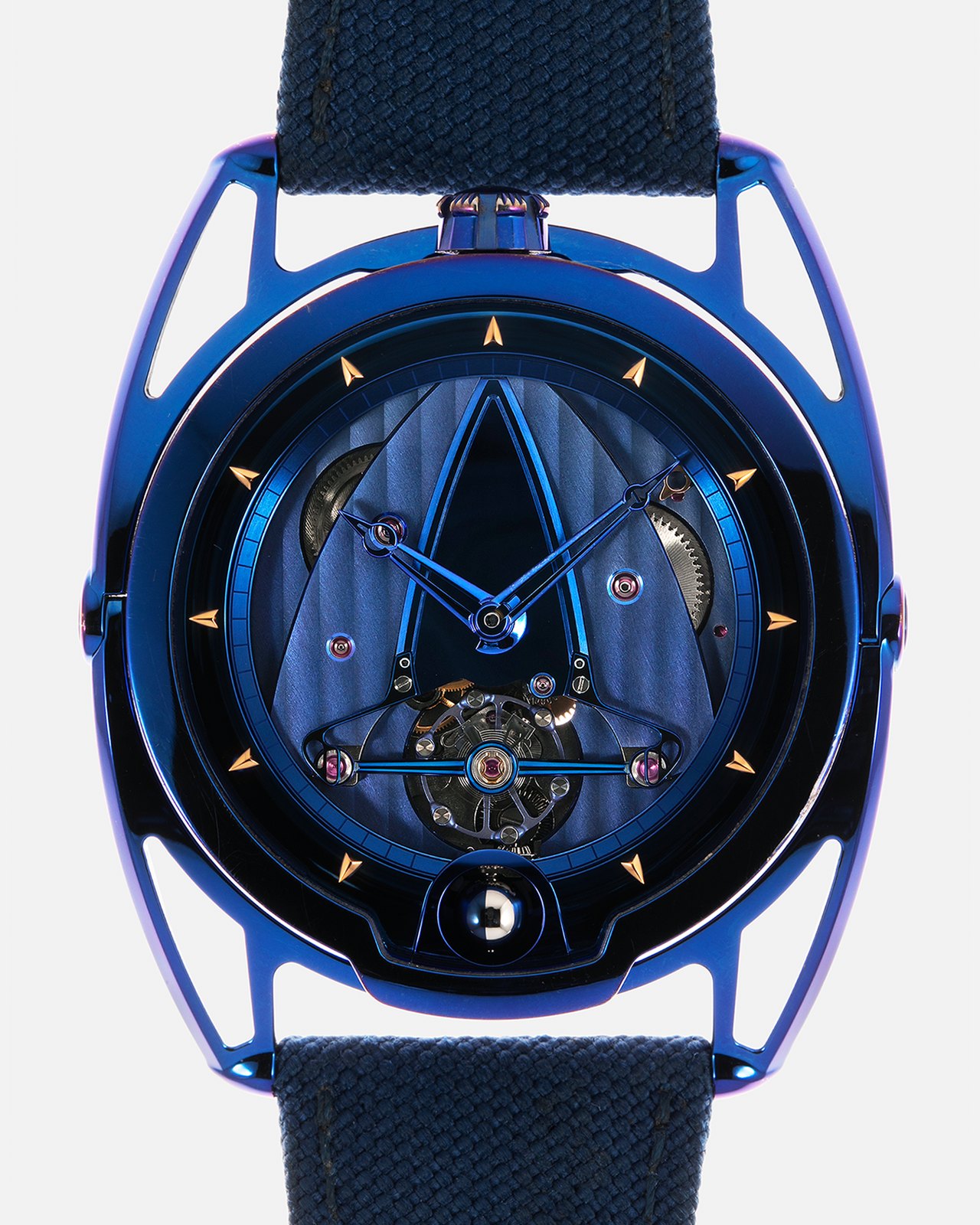
De Bethune DB28 Kind Of Blue, 2019
- Maker / attribution
- De Bethune (maker)
- Date
- 2019
- Historical period
- Contemporary Horology (2010 – Present)
- Country of origin
- Switzerland
- Object type
- Wristwatch
- Dimensions
- Case 43 mm
- Stock no.
- Product 7387521253463
- Credit line
- Dealer listing, S.Song Watches (product 7387521253463)
- Catalogue title (original)
- De Bethune DB28 Kind Of Blue (English)
View the source record (dealer listing) ↗ (opens another website in a new tab)Suggest a correction
Record summary
Catalogued by S.Song Watches (dealer), Seattle (stock number Product 7387521253463), this is a wristwatch by De Bethune, made in Switzerland, dated 2019. The Atlas places it in the Contemporary Horology period (2010 – Present) of its Wristwatches collection. Recorded dimensions: Case 43 mm. The record is illustrated with 6 photographs.
Assembled from the source record's structured fields. Dates and attributions are given as the source states them; where a field is missing the Atlas leaves it blank rather than estimating.
Catalogue description
Dealer description — S.Song Watches
Amongst the litany of independent brands that have popped up in recent years, few of them can compete with the timepieces that De Bethune has been creating. Although the brand has only been around the block for a little over two decades, they are recognized as one of the most exciting and important independent watchmakers today to come out of the Sainte Croix in the Swiss Jura mountains. De Bethune has created a powerful ‘DNA’ as they have unrelentingly developed and stuck with their own unique style. The De Bethune DB28 ‘Kind of Blue’ you see here today is a perfect example of the brand’s innovative spirit and disruptive horological creativity. The DB28 has become a hallmark of De Bethune, serving as a mainstay in their collection and a platform for numerous creative iterations that highlight the brand’s core values and design mastery. First introduced in 2011, the DB28 instantly earned an award at the Grand Prix d’Horlogerie de Genève. To this day, I have yet to encounter another timepiece quite like it. Its breathtaking beauty is difficult to convey in words, but it's effortlessly appreciated when worn on the wrist. The DB28 ‘Kind of Blue’, like other models in the DB28 collection, was meticulously designed with a strong emphasis on ergonomics, finishing, and craftsmanship. This particular DB28 features a breathtaking thermally-blued grade 5 titanium case, measuring 43mm x 9.3mm, and houses an extraordinary dial layout with unique architecture, including a deltoid-like barrel bridge at the very centre. Interestingly, many initially believed this bridge design was inspired by the Starfleet Command insignia from Star Trek , but Denis Flageollet, co-founder of De Bethune, clarified that it was actually inspired by the unique shape of a leaf he encountered on a walk in the Jura mountains of L’Auberson, his home in Switzerland. The dial itself showcases an intricate array of contrasting, meticulously executed finishes, including the signature Côtes de Bethune pattern, symmetrically mirrored from left to right. Polished, faceted arrow-shaped gold hour markers encircle the dial’s periphery, with a discreet railway-style minute scale on the inner section. Additional features include hand-finished bridges, an exposed balance wheel with a polished titanium bridge, a power reserve indicator that mirrors the one on the caseback, and a 360-degree spherical moon phase display at 6:00. Made from palladium, the moon phase is said to be accurate to 1,122 years. Without a doubt, this is an exceptional watch, both technically and aesthetically. There’s more, though—flip the watch over, and you’ll be greeted by the breathtaking 6-day double-barrel manual-winding Cal. DB2115, beating away methodically at 28,800 vph. The movement also showcases an impressive array of cutting-edge technology from its release, including a snail-perlage main plate, hand-polished and chamfered steel components, a temperature-compensating silicon balance spring, a two-armed silicon annular balance with platinum inertia blocks, and a silicon center housed within a platinum ring. Additionally, the titanium balance wheel features white gold mass inserts, which help reduce the parasitic effects of aerodynamic drag and temperature fluctuations on timing. The movement comprises 38 jewels, 299 components, self-regulating twin barrels, and a triple parachute shock absorber system mounted onto the balance bridge, enhancing chronometry and overall durability. While admiring the caseback, you’ll also notice a power reserve indicator with a "POWER" warning strip. Visually, it’s a lot to take in, but it perfectly exemplifies De Bethune’s relentless pursuit of technical innovation in watchmaking. Despite its seemingly intimidating case size and the impressive amount of technology incorporated into its design, the DB28 feels crazy light on the wrist. As mentioned earlier, the choice of materials plays a crucial role here. The case is crafted from thermally blued grade 5 titanium, which has been meticulously mirror-polished to enhance both its strength and aesthetic appeal. Like the rest of the DB28 variants, it deploys De Bethune’s patented floating-lug system, which aids in the fitment and adjustment of the wearer’s wrist size and movements. That being said, this DB28 ‘Kind of Blue’ is the kind of watch that commands the attention of a room the wearer enters. It’s certainly not one to go unnoticed—its striking appearance and technical prowess make it a true conversation starter. Without a doubt, the DB28 is a breathtaking piece of horological art, and it’s easy to see why. The exceptional craftsmanship, impressive movement, intricate dial details, and highly wearable case all come together seamlessly. It’s been an absolute pleasure to experience this masterpiece firsthand, and we’re excited to offer this beautiful piece of wearable mechanical art on the site.
Historical context
Contemporary Horology (2010 – Present)
Silicon components, connected watches, optical-lattice research clocks and a thriving independent scene.
Smartwatches became the world's best-selling watches, while mechanical watchmaking focuses on craft, innovation (silicon components, new escapements) and independent makers.
Read the period in the timelineMore wristwatches from this periodEarlier: Mechanical Renaissance
Atlas type guide
Wristwatches
Bracelet watches were worn by women from the early nineteenth century — Breguet made one for Caroline Murat, Queen of Naples, in 1810–12 — but the wristwatch only became a man's instrument with military use and aviation in the early twentieth century. Between the World Wars it overtook the pocket watch; the 1920s and 1930s brought rectangular Art Deco cases, water-resistant cases and the first automatic winding systems.
After 1945 the wristwatch became a carrier of identity — dress watches, sports and dive watches, chronographs, calendars — produced by Swiss, American, Japanese, German, Soviet and Chinese industries. The quartz revolution after 1969 and the mechanical renaissance since the 1990s, including the rise of independent watchmakers, complete the story.
What to look for
- The reference number (between the lugs or inside the case back) and serial number, the starting point for dating.
- The calibre: its maker and number are often stamped under the dial or on the bridge.
- Originality of dial, hands and crown — refinished ('redial') dials are common.
- Case material marks: 18K/750, 14K/585, stainless steel, gold-filled, plated.
Dating clues
- Wire-lug cases: before c. 1925.
- Water-resistant screw-down cases: from 1926.
- Quartz movements: from 1969; sapphire crystals widespread after c. 1980.
General guidance written by the Atlas editors about this kind of object. It is not a statement about this particular piece; for that, rely on the source record above and on physical examination.
Related records
Wristwatches · c. 2015
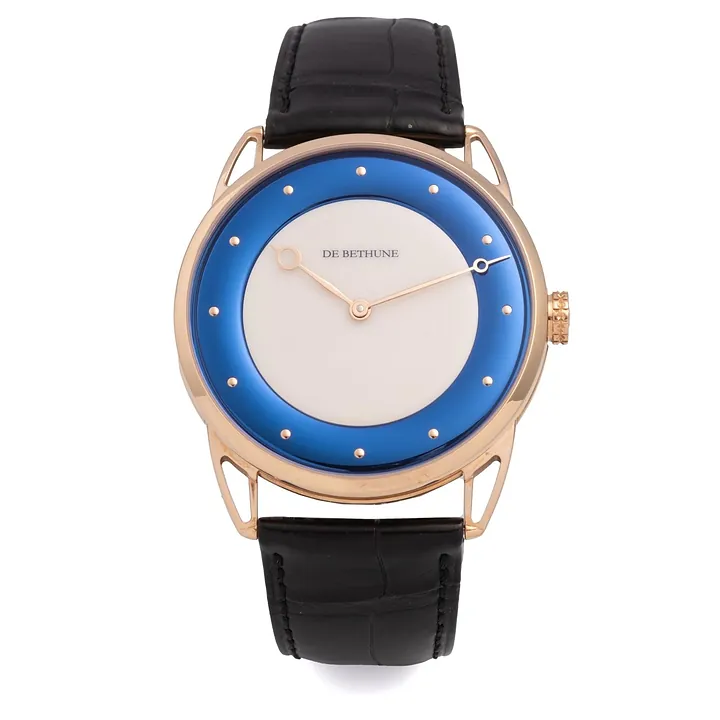
De Bethune White Night, ref. DB 25 XPA Rv3, c. 2015
Antiquorum auction archive, Geneva
Wristwatches · c. 2002
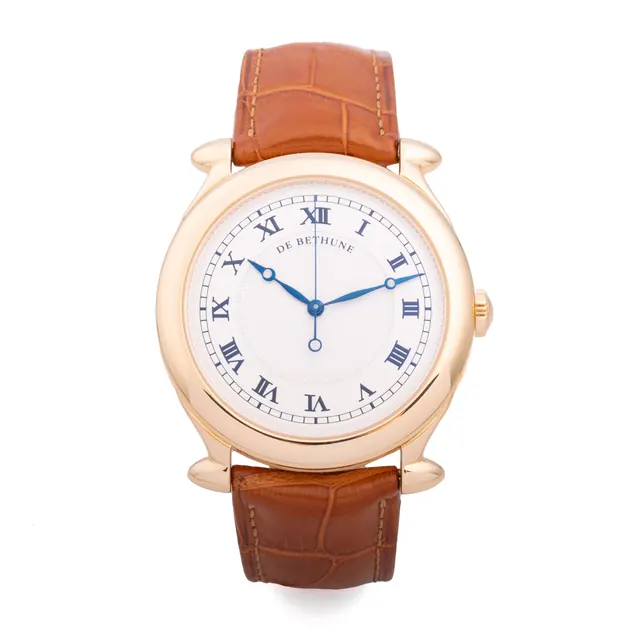
De Bethune wristwatch, ref. DB5RT, No. 007, circa 2002
Antiquorum auction archive, Geneva
Wristwatches · 2008
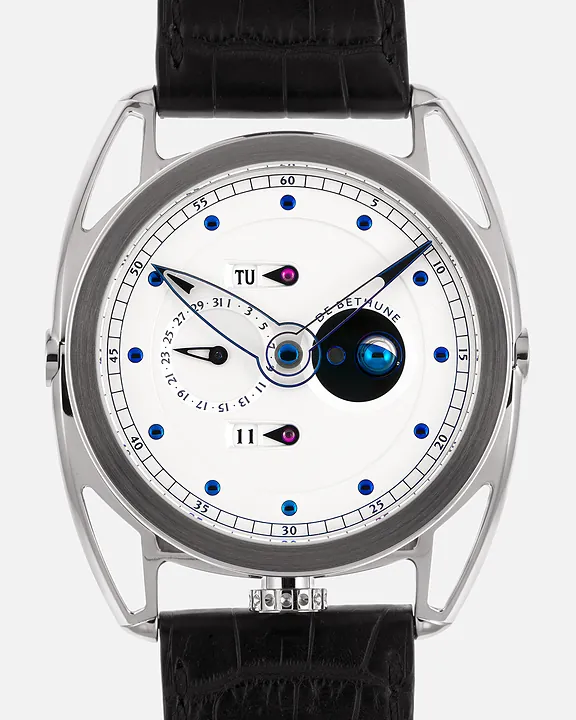
De Bethune DB26 Perpetual Calendar Moonphase DB26WS1, 2008
S.Song Watches (dealer), Seattle
Wristwatches · 2017
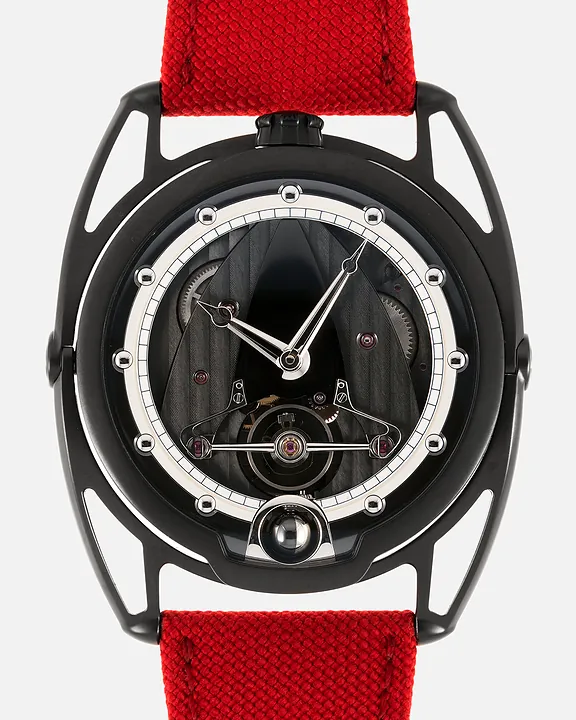
De Bethune DB28 Zirconium, 2017
S.Song Watches (dealer), Seattle

Wristwatches · c. 2010s
Breguet Type XXI, ref. 3810, c. 2010s (Antiquorum Lot 381-24)
Antiquorum auction archive, Geneva

Wristwatches · c. 2010s
Breguet Type XXI, ref. 3810, c. 2010s (Antiquorum Lot 386-229)
Antiquorum auction archive, Geneva

Wristwatches · Sold in September 2010
Breitling Cosmonaute, ref. A 22322, Sold in September 2010
Antiquorum auction archive, Geneva

Wristwatches · c. 2010
Corum Bubble Chrono, ref. 396.150.20, c. 2010
Antiquorum auction archive, Geneva