
Clocks · Clock
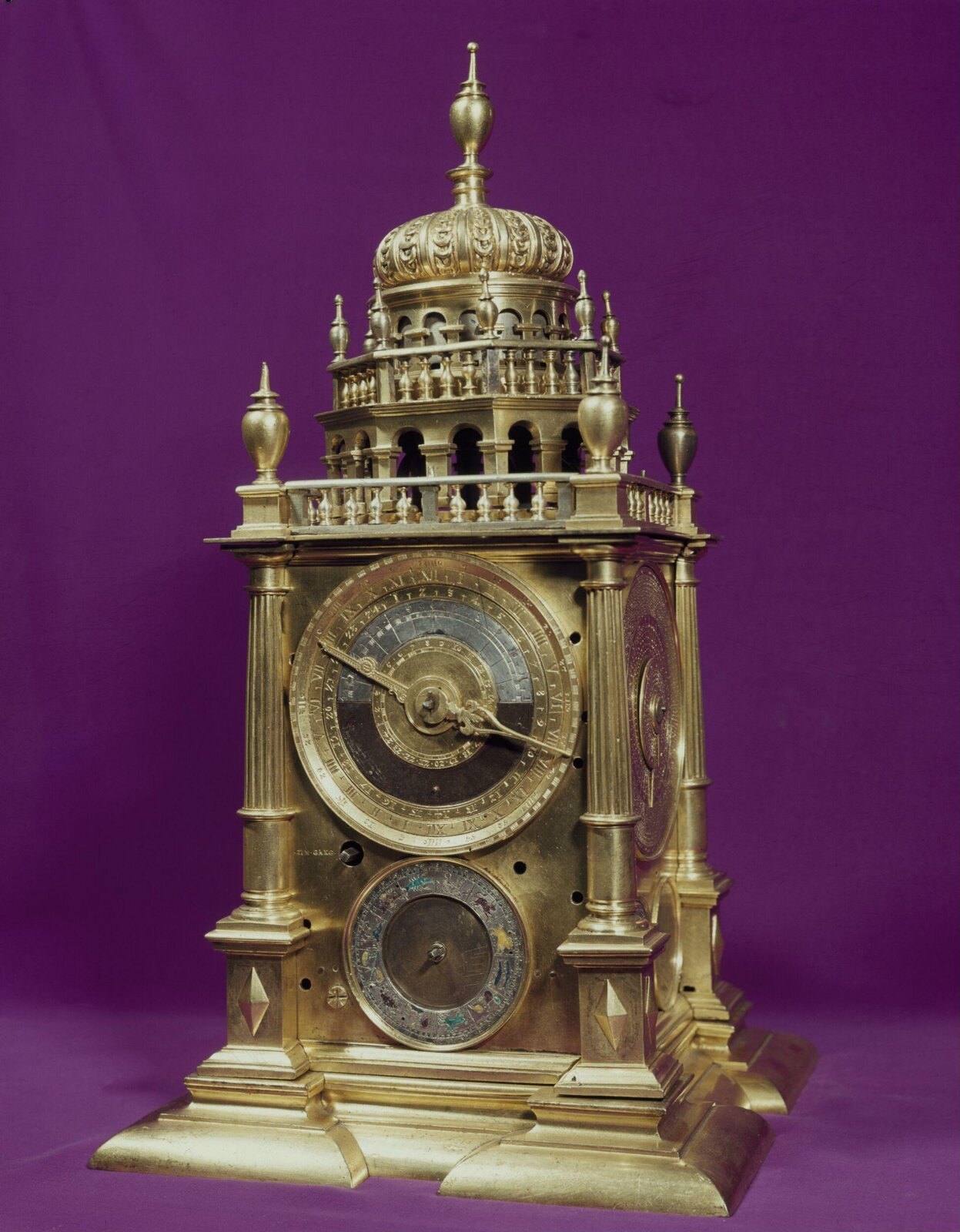
Clock, Germany, 1620
- Maker / attribution
- Unrecorded in source
- Date
- 1620
- Historical period
- Early Modern Horology (1600 – 1750)
- Country of origin
- Germany
- Place
- Southern Germany
- Object type
- Clock
- Materials / technique
- Gilt brass or copper, silvered and enamelled.
- Dimensions
- Height: 41.8 cm; Circumference: 23.5 cm
- Holding institution
- Victoria and Albert Museum, London
- Accession / object no.
- M.52-1952
- Credit line
- Given by Dr W.L. Hildburgh FSA
View the source record ↗ (opens another website in a new tab)Suggest a correction
Record summary
Held and catalogued by Victoria and Albert Museum, London (object number M.52-1952), this is a clock, made in Southern Germany, dated 1620. The Atlas places it in the Early Modern Horology period (1600 – 1750) of its Clocks collection. Materials and techniques recorded by the source: Gilt brass or copper, silvered and enamelled. Recorded dimensions: Height: 41.8 cm; Circumference: 23.5 cm. The record is illustrated with 1 photograph.
Assembled from the source record's structured fields. Dates and attributions are given as the source states them; where a field is missing the Atlas leaves it blank rather than estimating.
Catalogue description
Summary — Victoria and Albert Museum
A South German astronomical and calendar chiming clock with gilt-copper case in the form of a Doric temple with cupola with silver dials decorated with translucent enamel, about 1620. The large dial has a perpetual calendar with a list of saints' days, below two small dials of enamelleded silver include on for setting an alarm. The Astronomical dial is engraved with figures of classical deities representing the seven days of the week.
Physical description — Victoria and Albert Museum
Case: Gilt brass or copper case of architectural form. The large rectangular body rests on a flat projecting moulded base each side of which is recessed at the centre. At each corner of the body a fluted three-quarter Doric column resting on a rectangular plinth, to each outer face of which a flattened pyramidal stud is applied. Above the cornice is a gallery with baluster pillars and an urn-shaped finial at each corner. Within the balustrade, a two-stage cupola, the lower stage formed as an octagonal arcade surmounted by a gallery similar to that above the cornice, with an urn finial at each of the eight angles. The upper stage is formed as a circular arcade cupola, surmounted by an urn-shaped finial. The roof of the cupola is decorated with flat radiating ribs the spaces between filled with down-lapping scales. Dials: A. Main 24-hour dial, on front of clock. Outermost ring, minutes, numbered every 5 in arabic, and quarters I, II, III, IIII. Next ring, 1-24 in arabic. 24 now opposite IX 1/2 but formerly adjustable. Next ring formerly with shutters for sunrise and sunset, but now with top half silvered, 1-12 (but 4 from previous 1-24 sequence showing at zero). Lower half black. Innermost ring 1-24 in arabic. Pierced brass hand (? a renewal) to minute ring. Brass hand with sun pointer to outside of twice I to XII ring. B. Silvered dial ring below A, with signs of the zodiac and numbers of degrees in each sign, some of the signs themselves in translucent coloured enamels. Winding hole in left centre of this front of case marked ZVM GANG. C. On rear of clock, astrolable dial with mater marked 48 GRAD, for latitude 48 degrees. Central rod for hand and 4 sleeves, but not rete or hands. D. Below C, a cast ring of deities for the 7 days of the week, with their Latin names; at centre of this ring, a renewed disc with graduations 5 to 60 in punching of pointilliste type. Centre left, winding hole marked SCHLAG WERK. Centre right, winding hole marked FIRTEL WERCK. E. On the right face of case. Large calendar dial. Outermost ring: daily calendar for the 6 months July to December, every day with its saint or festival, and with its Dominical letter outside. Next ring inwards: Golden Number corresponding to dates spaced by 190 years. Next ring: Indication number, with corresponding years from 1513 to 2188. Below, left, on enamel dial, now mounted upside down, marked SO WECKT: SO WECKT NIT, and renewed pointer (fixed). F. On left of face case. Large calendar dial. Outermost ring: daily calendar for the six months January to June, every day with its Saint or Festival, and with its Dominical letter outside. Next ring: sliding ring of the movable feasts, from Septuagesima to the 6th Sunday after Trinity. Now fixed with Easter Day at June 27th. Within this, a ring 1 to 28, for years of the solar cycle. Within this, the corresponding Dominical letters, anti-clockwise. Within again, a narrow ring giving the above letters for 1583 A, 1700 B, 1800 C, 1900 D, 2100 E, 2200 G. Within again, a ring with the sequence of years, clockwise: 1467, 1496, 1525, 1554, 1583, 220, 1613, 1642, 1671, 1700, 1729, 1758, 1787, 1900, 1817, 1846, 1875, 2100, 1933, 1962, 1991, 2020, 2049, 2078, 2135, 1800, 2165, 2194. The gilt index inscribed on its central disc DOMINICALE CICLVS SOLIS ET LITERA. Below, left, an enamelled dial I to IIII in quarter-chime spacing, with gilt hand. Below right, a similar dial marked 1 to 10 in equal spacing, with gilt hand. Movement: The movement has been somewhat altered from its original state; the main trains are original, but there are anomalies in the the elaborate motion work and the drives to the various dials. The movement is mounted within a posted frame, with square brass corner-posts, 17.2 cm long, including their bases and their capitals and 1.0 cm square. Brass top and bottom plates, 12.0 cm square, and three vertical plates, the front 5.1 cm wide, the middle and rear 7.6 cm wide. Three trains for going, quarter-chiming and hour-striking respectively. Barrels, fusees and strike and chime work arbors are of brass, almost all wheels of iron, except for some renewed motion-work wheels. Going train in front half of movement, with fusee and chain, brass crown-wheel, verge escapement and iron balance-wheel. Fusee of 7 and one half turns. Motion work now operatin two hands: a pierced brass hand rotating once in two hours and coaxial with an 8-T star-wheel which releases the quarter-chime, and a sun-pointer rotating once in 24 hours. Behind the dial, a wheel rotating once a year formerly with a hand indicating on the annual Zodiac ring in front of it . The year-wheel has an eccentric pin which drives a vertical slider mounted on the rear face of the dial, with slots in upper half to operate the sunrise and sunset shutters which are now missing. The fusee arbor is continued through to the rear face of the clock, where it operates a train of gears for the astrolable dial. Quarter-chiming train at upper left of rear compartment, with fusee and chain, and count-wheel with an extra high fourth quarter sector which operates the release of the strike through a rather elaborate lever system. There is now no mechanical linkage between this train and the quarters indicating dial. Striking train at lower right of rear compartment, with fusee and chain and count-wheel, internal, against rear plate. Signs of former alarm train, now missing.
Historical context — Victoria and Albert Museum
The German towns of Augsburg and Nuremberg dominated production in the late 16th and early 17th centuries, although towards the end of the Thirty Years' War (1618-1648) in 1645, there were only seven master clockmakers left in Augsburg. T. Garzoni wrote in La Piazza Universale di tutte le professioni del mondo , Venice, 1595, 'a great number of German craftsmen exel in the art of horology and all the best and the most precise timekeepers actually come from Germany'. In about 1600 Fynes Moryson wrote that 'touching manuall arts, the Dutch are a people more industrious then the Germans and excell them in all arts and trades ..however, I must confess that the Germans of Nurenberg in those parts are esteemed the best workman for clockes and some like things. Fynes Moryson, Itinerary (ed. C.Hughes), London, 1903.
Inscriptions & marks
C. On rear of clock, astrolable dial with mater marked 48 GRAD, for latitude 48 degrees.; ZVM GANG.; SCHLAG WERK. FIRTEL WERCK.; SO WECKT: SO WECKT NIT
Provenance
One of five clocks given by Dr W.L.Hildburgh FSA. Dr Hildburgh had an endearing habit of giving the museum presents at Christmas and on his own birthday. Dr Hildburgh bought boxwood carvings, Spanish silver, the interiors of the Northumberland House Glass Drawing Room; and when he died bequeathed the rest of his collection.
Historical context
Early Modern Horology (1600 – 1750)
Huygens' pendulum and balance spring transform accuracy; English makers develop the anchor and deadbeat escapements.
Huygens's pendulum (1656–57) improved clock accuracy from about a quarter of an hour to under a minute a day. The anchor escapement (c. 1670) and the long seconds pendulum created the longcase clock; London makers such as Fromanteel, Knibb, Tompion and Quare led European clockmaking, and French makers created the Boulle pendule.
Read the period in the timelineMore clocks from this periodEarlier: Renaissance Horology
Atlas type guide
Domestic clocks
A clock combines four systems: a source of power (falling weight, coiled spring, or later electricity), a gear train that divides time, an escapement and oscillator that regulate it (foliot, pendulum or balance), and an indicating system of dial and hands or a bell. Its history runs from the large iron weight-driven clocks of the late thirteenth century to Renaissance spring-driven table clocks, the pendulum revolution of 1656, the factory clocks of the nineteenth century and electric and quartz clocks of the twentieth.
Domestic clocks also reflect regional furniture and decorative traditions — English longcase and bracket clocks, French pendules, Viennese regulators, Black Forest and American shelf clocks — and therefore record changing tastes as much as technical progress.
What to look for
- How the clock is powered: weights, spring barrel, fusee, electric coil.
- The oscillator: foliot, short pendulum, long seconds pendulum or balance.
- Whether it strikes: hour only (count wheel) or hours and quarters (rack striking).
- The maker or retailer's name on dial and movement, and any factory trademarks.
- Signs of alteration — replaced dials, converted escapements, 'married' cases.
Dating clues
- Before 1656 clocks used foliots or balances; after, most domestic clocks have pendulums.
- Anchor escapements spread after c. 1670; minute hands became common at the same time.
- Factory production in America and Germany transformed prices after c. 1840.
General guidance written by the Atlas editors about this kind of object. It is not a statement about this particular piece; for that, rely on the source record above and on physical examination.
Read next:Anchor (recoil) escapementFoliot
Related records
Clocks · 1600–1700
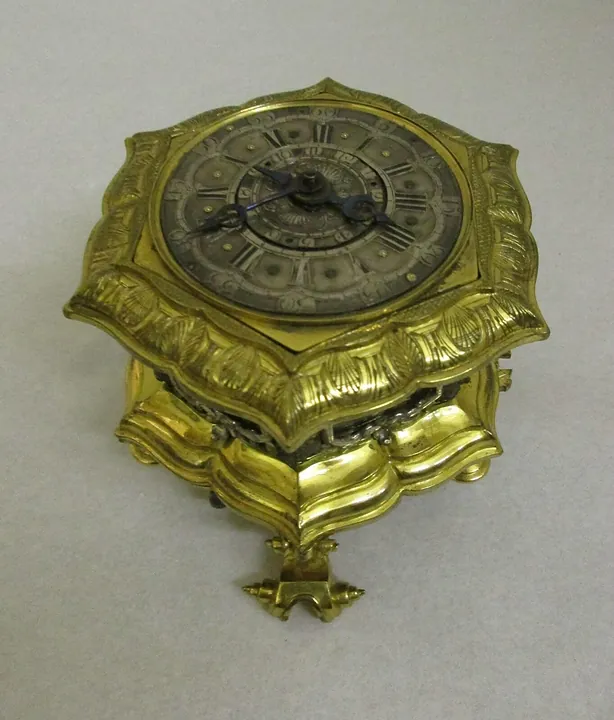
Clock, Germany, 1600–1700
Victoria and Albert Museum, London
Clocks · 1600–1699
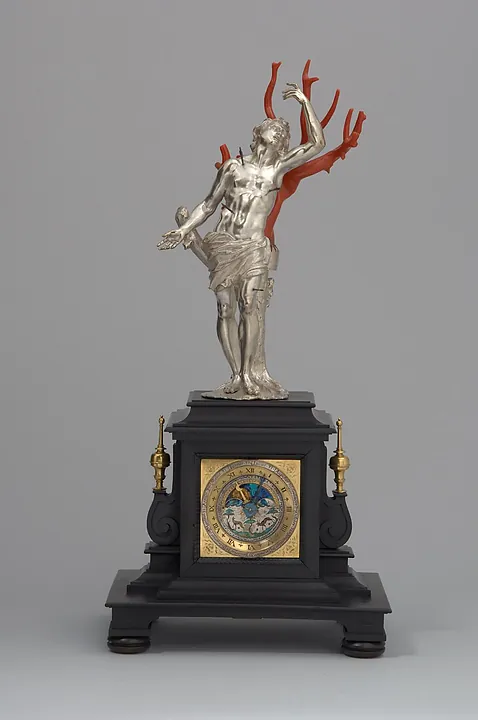
Table clock by Hans Christoph II. Fesenmair, Germany, 1600–1699
Fine Arts Museum Vienna
Clocks · 1600–1699
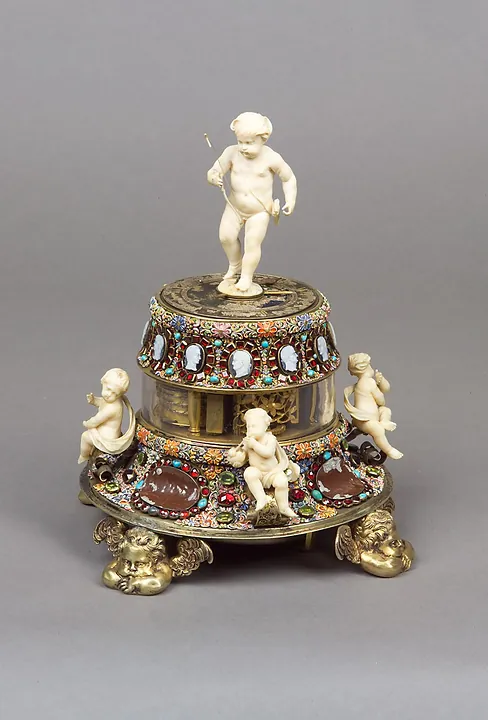
Table clock by Hans Jakob Mair, Germany, 1600–1699
Fine Arts Museum Vienna
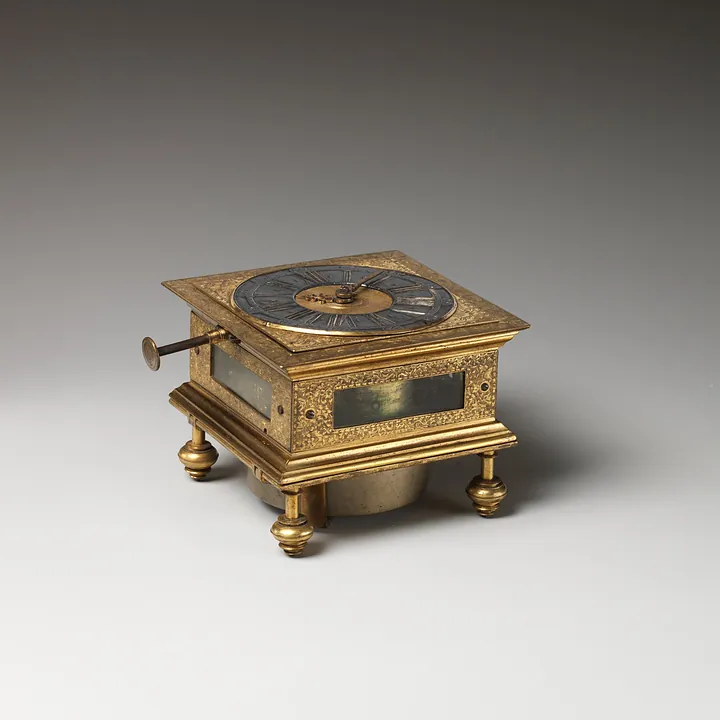
Clocks · 17th century
Table clock by Johann Heinrich Kleinschmidt, Germany, 17th century
The Metropolitan Museum of Art, New York
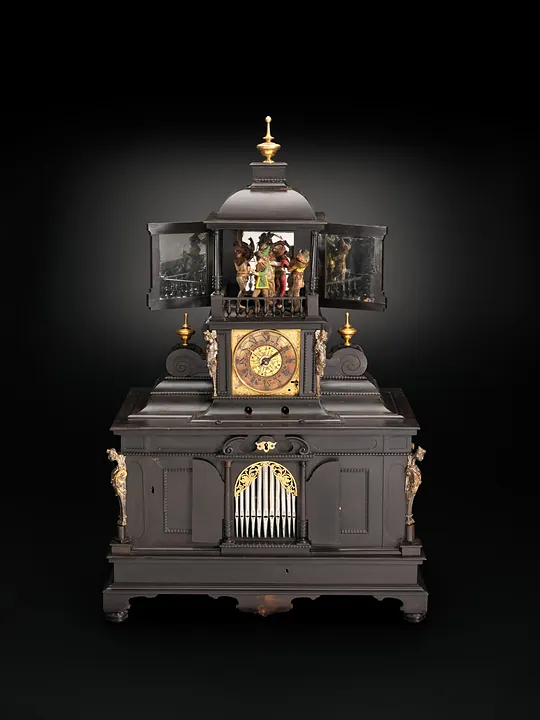
Clocks · c. 1625
Musical clock with spinet and organ by Veit Langenbucher, Germany, c. 1625
The Metropolitan Museum of Art, New York
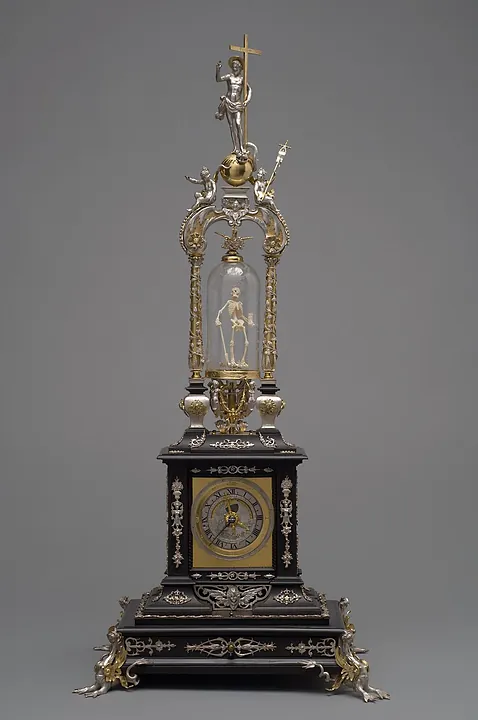
Clocks · 1624–1630
Table clock by Christoph Angermair, Germany, 1624–1630
Fine Arts Museum Vienna
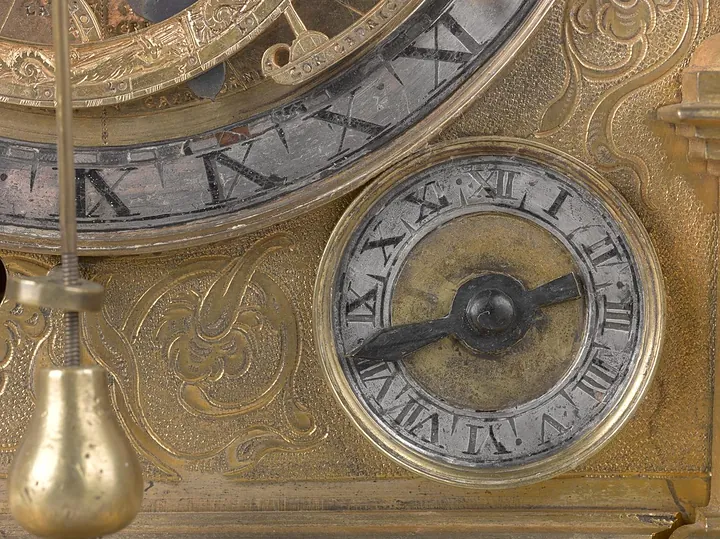
Clocks · 1625–1635
Upright table clock with winding key, by unknown maker, made in Augsburg, Germany, 1625–1635
Science Museum Group, London
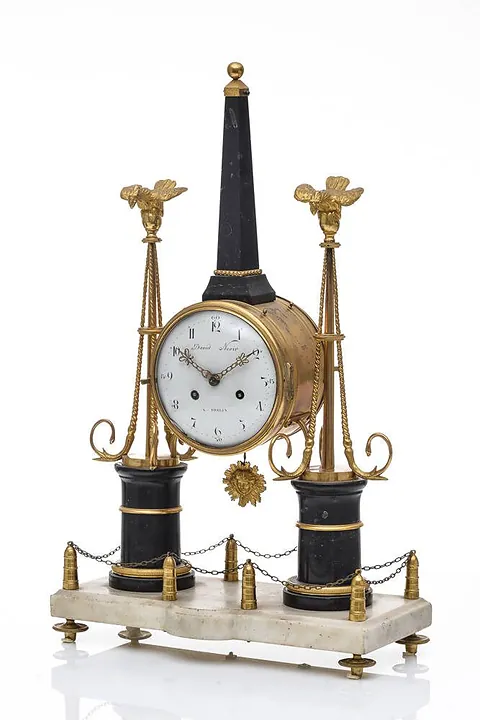
Clocks · 1700–1799
Mantel clock by David Nevir, Germany, 1700–1799
City Museum Berlin