
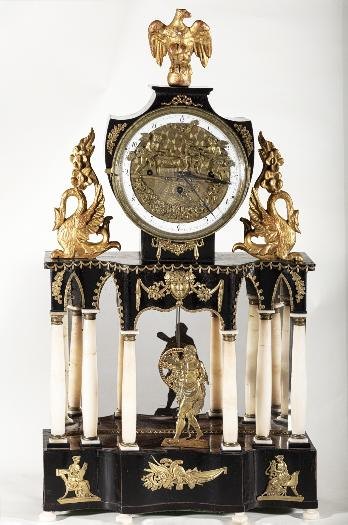
Clocks · Clock
Clock by Atribuido, c. 1820–1840
- Date
- c. 1820–1840
- Historical period
- Precision & Scientific Horology (1750 – 1850)
- Country of origin
- Unrecorded in source
- Object type
- Clock
- Materials / technique
- Madera Alabastro Metal Madera Porcelana Vidrio
- Dimensions
- Altura = 71,50 cm Anchura = 39 cm Profundidad = 14 cm
- Holding institution
- National Museum of Romanticism
- Accession / object no.
- pages_Main_idt_33584_inventary_CE10588_table_FMUS_museum_MNR
- Credit line
- National Museum of Romanticism
- Catalogue title (original)
- Reloj (Spanish)
View the source record ↗ (opens another website in a new tab)Suggest a correction
Record summary
Held and catalogued by National Museum of Romanticism (object number pages_Main_idt_33584_inventary_CE10588_table_FMUS_museum_MNR), this is a clock by Atribuido, dated c. 1820–1840. The Atlas places it in the Precision & Scientific Horology period (1750 – 1850) of its Clocks collection. Materials and techniques recorded by the source: Madera Alabastro Metal Madera Porcelana Vidrio. Recorded dimensions: Altura = 71,50 cm Anchura = 39 cm Profundidad = 14 cm. The record is illustrated with 1 photograph.
Assembled from the source record's structured fields. Dates and attributions are given as the source states them; where a field is missing the Atlas leaves it blank rather than estimating.
Catalogue description
Catalogue description from National Museum of Romanticism
Reloj de sobremesa austriaco de tipo pórtico, en madera ebonizada. Sobre zócalo de perfil mixtilíneo, seis columnas de alabastro sostienen una arquería compuesta por un arco carpanel, en el centro, flanqueado por arcos apuntados y fondo de espejo. Con patas de bola aplastada en alabastro. Presenta aplicaciones metálicas en dorado. En el friso del zócalo trofeos militares en el centro, y a los lados, dos damas sedentes con instrumentos musicales. En el entablamento, mascarón entre guirnaldas. Base de marquetería de diseño geométrico sobre la que se erige una figura en altorrelieve de Hércules portando la piel de león y la clava. Péndulo de bronce visto, en forma de disco con radios. Sobre el entablamento, la caja del reloj con esfera de metal, de fondo rallado en retícula. Máquina original de tracción a muelles y péndulo (de 24 horas), con gran sonería de horas y cuartos (cada cuarto). La esfera se acompaña de dos autómatas, dos angelotes alados que representan la escena de una fragua. El de la izquierda con un martillo y unas tenazas sobre un yunque mientras el de la derecha afila la punta de una flecha con un torno. Debajo, un delfín con un tridente y guirnalda de flores. Disco exterior de porcelana blanca con horarias y calendario, en números arábigos y tres bocallaves. La esfera se protege con ventana de cristal biselado, en marco de bronce dorado. La maquinaria del reloj se oculta tras la esfera. La caja, flanqueada por dragones alados, se remata con un águila, en madera tallada y dorada. Este reloj vienés pertenece a una tipología característica de la época y por la similitud con otros ejemplares se atribuye a Carl Pohl. La iconografía que presenta este reloj está asociada a los valores de la virtud y la fortaleza propugnados por el Imperio austrohúngaro. La figura de Hércules, la fragua en la que se fabrica el armamento, los trofeos militares y el águila imperial, constituyen una alegoría de trasfondo político que alude al poder imperial sostenido por las victorias militares. Tras la victoria de Napoleón, Viena y otros grandes centros del Imperio austrohúngaro adoptaron a su gusto y con medios más modestos los modelos del neoclasicismo francés, desempeñando un papel importante en la fabricación de relojes. Este reloj de pórtico se contextualiza en el estilo Biedermeier, que se desarrolló en el Imperio austriaco y en el resto de la Europa central en el periodo que abarca desde el Congreso de Viena de 1814-1815 a 1848, contemporáneo al estilo Restauración en Francia. (Catalogación: Laura González Vidales, 2023)
Shown in the original language of the source catalogue. An editor-reviewed English translation has not yet been published; we do not publish machine translations as authoritative text.
Historical context
Precision & Scientific Horology (1750 – 1850)
Harrison solves longitude; Mudge invents the lever; Breguet's Paris workshop defines the modern watch.
The age of the deadbeat escapement, compensated pendulums and observatory regulators. Domestic clocks spread through the middle classes: English longcase and bracket clocks, French gilt-bronze mantel clocks, Viennese Biedermeier wall clocks, Black Forest painted-shield clocks, and the first American shelf clocks.
Read the period in the timelineMore clocks from this periodEarlier: Early Modern Horology
Atlas type guide
Domestic clocks
A clock combines four systems: a source of power (falling weight, coiled spring, or later electricity), a gear train that divides time, an escapement and oscillator that regulate it (foliot, pendulum or balance), and an indicating system of dial and hands or a bell. Its history runs from the large iron weight-driven clocks of the late thirteenth century to Renaissance spring-driven table clocks, the pendulum revolution of 1656, the factory clocks of the nineteenth century and electric and quartz clocks of the twentieth.
Domestic clocks also reflect regional furniture and decorative traditions — English longcase and bracket clocks, French pendules, Viennese regulators, Black Forest and American shelf clocks — and therefore record changing tastes as much as technical progress.
What to look for
- How the clock is powered: weights, spring barrel, fusee, electric coil.
- The oscillator: foliot, short pendulum, long seconds pendulum or balance.
- Whether it strikes: hour only (count wheel) or hours and quarters (rack striking).
- The maker or retailer's name on dial and movement, and any factory trademarks.
- Signs of alteration — replaced dials, converted escapements, 'married' cases.
Dating clues
- Before 1656 clocks used foliots or balances; after, most domestic clocks have pendulums.
- Anchor escapements spread after c. 1670; minute hands became common at the same time.
- Factory production in America and Germany transformed prices after c. 1840.
General guidance written by the Atlas editors about this kind of object. It is not a statement about this particular piece; for that, rely on the source record above and on physical examination.
Related records
Clocks · c. 1780
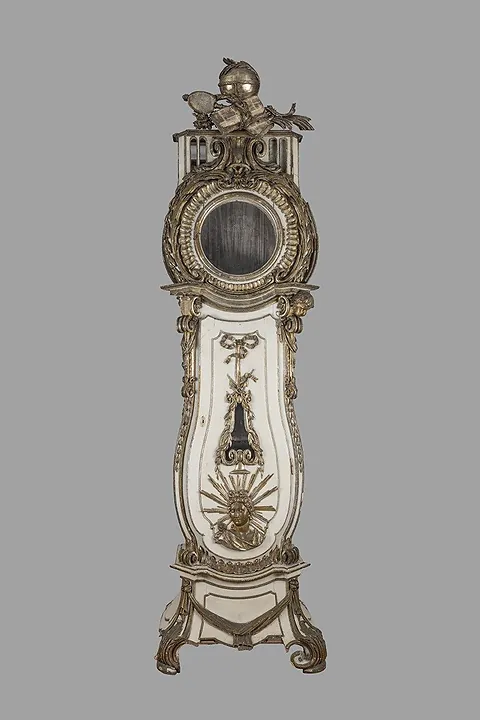
Longcase clock by Louis George, Eberswalde, c. 1780
Museum Eberswalde
Clocks · 1780s (inferred: the museum dates the style to the 1780s and the music includes Gluck's Iphigénie en Tauride of 1779)
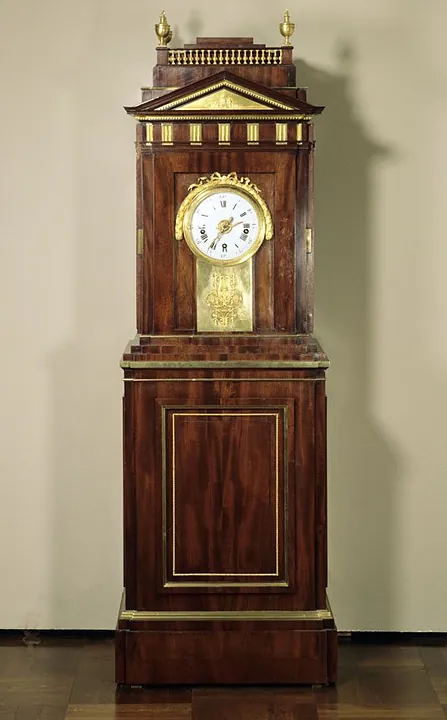
Musical longcase clock, Roentgen workshop, Neuwied, 1780s
Badisches Landesmuseum Karlsruhe
Clocks · 1740–1760
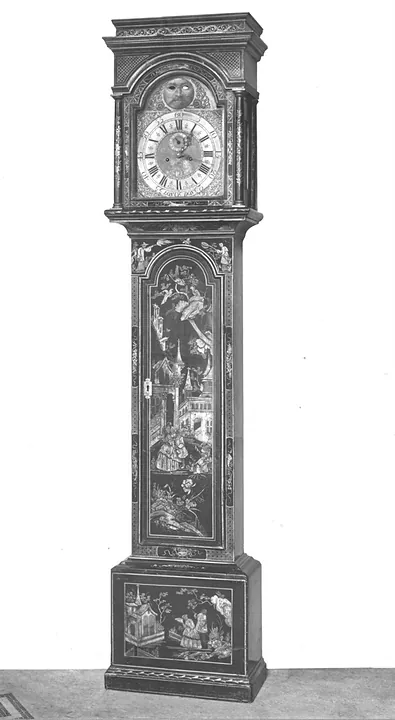
Longcase clock, English, 1740–1760, japanned wood, John Ellicott
Victoria and Albert Museum, London
Clocks · 1740–60
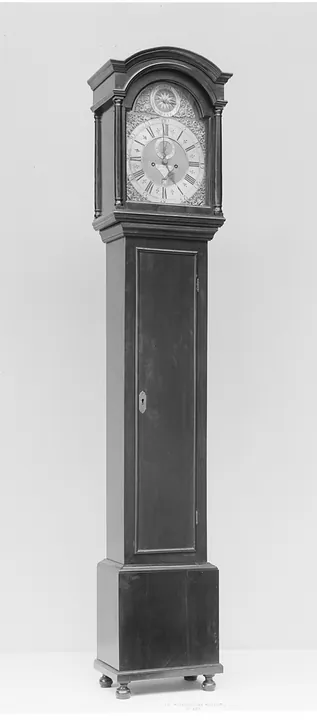
Tall clock by Samuel Bagnall, United States, 1740–60
The Metropolitan Museum of Art, New York
Clocks · c.1750
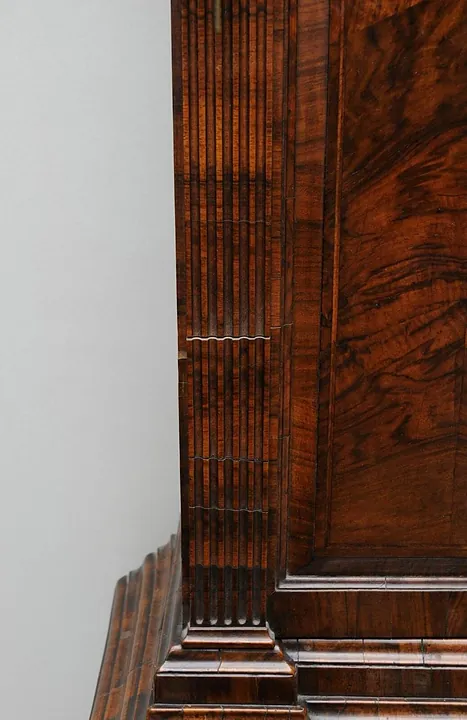
Long-case clock, English, ca. 1750, by Richard Peyton of Gloucester
Victoria and Albert Museum, London
Clocks · 1750–1800
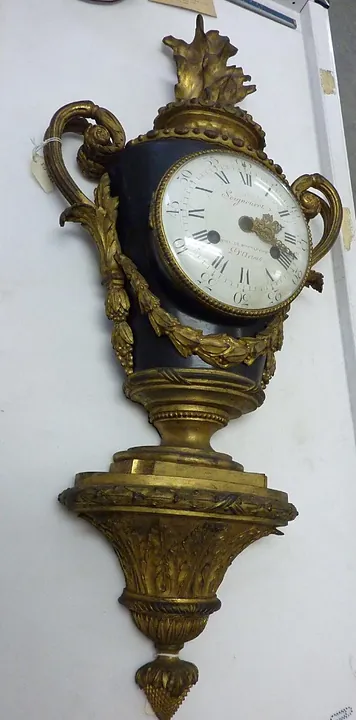
Bracket clock in metal case with scroll handles and flamed-shaped top signed by Pierre Seignoret, Clockmaket to the the Comte d'Artois
Victoria and Albert Museum, London
Clocks · c. 1750
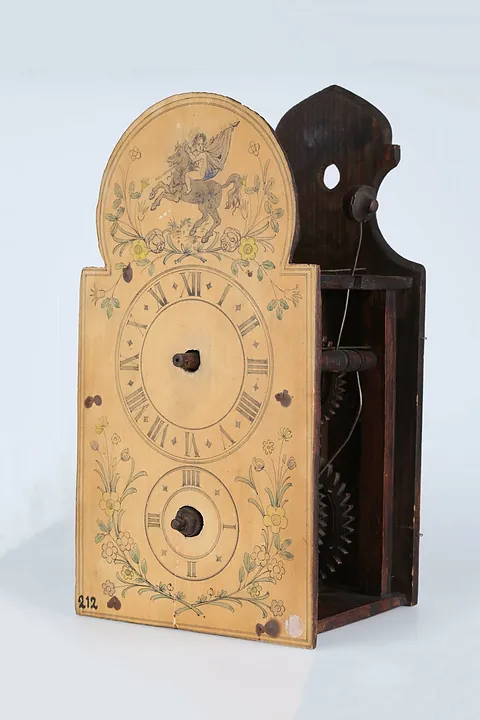
Clock by Georg Gfell, Germany, c. 1750
German Clock Museum
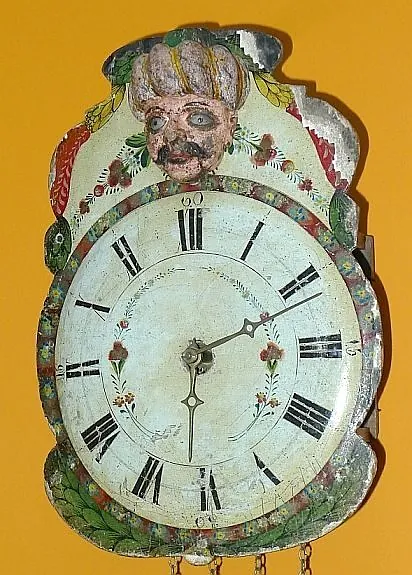
Clocks · 1750–1799
Cuckoo / black forest clock, Germany, 1750–1799
Badisches Landesmuseum Karlsruhe