
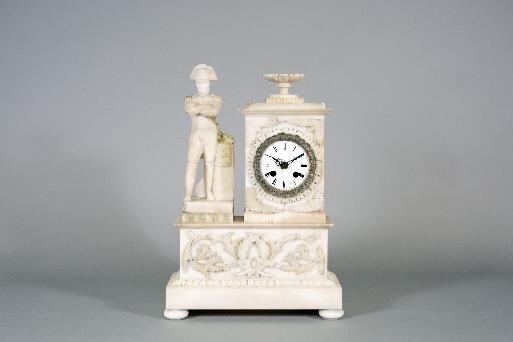
Clocks · Clock
Clock, 1801–1833 (Primer tercio del siglo XIX)
- Maker / attribution
- Unrecorded in source
- Date
- 1801–1833 (Primer tercio del siglo XIX)
- Historical period
- Precision & Scientific Horology (1750 – 1850)
- Country of origin
- Unrecorded in source
- Place
- Francia
- Object type
- Clock
- Materials / technique
- Alabastro Metal Porcelana Pigmento
- Dimensions
- Altura = 41,50 cm Anchura = 28 cm Profundidad = 11,50 cm
- Holding institution
- National Museum of Romanticism
- Accession / object no.
- pages_Main_idt_7149_inventary_CE0860_table_FMUS_museum_MNR
- Credit line
- National Museum of Romanticism
- Catalogue title (original)
- Reloj (Spanish)
View the source record ↗ (opens another website in a new tab)Suggest a correction
Record summary
Held and catalogued by National Museum of Romanticism (object number pages_Main_idt_7149_inventary_CE0860_table_FMUS_museum_MNR), this is a clock, made in Francia, dated 1801–1833 (Primer tercio del siglo XIX). The Atlas places it in the Precision & Scientific Horology period (1750 – 1850) of its Clocks collection. Materials and techniques recorded by the source: Alabastro Metal Porcelana Pigmento. Recorded dimensions: Altura = 41,50 cm Anchura = 28 cm Profundidad = 11,50 cm. The record is illustrated with 1 photograph.
Assembled from the source record's structured fields. Dates and attributions are given as the source states them; where a field is missing the Atlas leaves it blank rather than estimating.
Catalogue description
Catalogue description from National Museum of Romanticism
Reloj de sobremesa en alabastro blanco. Sobre zócalo rectangular apoyado en patas de bola aplastada, con el frente decorado con motivos vegetales, plinto que aloja la esfera del reloj, de porcelana blanca. Horarias en cifras romanas, pintadas en negro. Dos bocallaves bajo el cañón de agujas. Cerco en bronce dorado con motivos de palmetas cincelados. En las enjutas, trifolios en altorrelieve. Remate en forma de copa. A la izquierda, figura de Napoleón, estante, en posición frontal, con los brazos cruzados y las piernas separadas, en ligero contraposto. Ataviado con levita, chaleco y pantalón. Lleva bicornio. Es un prototipo de reloj de despacho o sobremesa, que alcanzó gran popularidad durante el estilo Imperio (1800-1830), caracterizado por las esculturas que aparecen sobre la base. En este caso refleja los motivos decorativos impuestos por el emperador: elementos vegetales, mitológicos, animales o figurativos relacionados con sus conquistas. La combinación del alabastro con el dorado, que actualmente no se conserva, al igual que los realizados en mármol con bronce dorado, es la preferida por el gusto neoclásico y el Imperio. Los adelantos obtenidos en la fabricación de relojes durante el XVIII hicieron que éstos alcanzasen categoría artística por su exquisitez decorativa. La moda exigía que en todo gabinete, despacho, salón o dormitorio uno o más relojes completaran el mobiliario, contribuyendo así al esplendor y lujo de las estancias. En Francia se hicieron los mejores relojes, en los que a la perfección de la maquinaria se une la esmerada construcción de las cajas, que se convierten en el exponente del estilo artístico imperante. Tipologías similares de relojes se encuentran, por ejemplo, en bronce dorado y pavonado (Palacio Real del Pardo, Inv. 10073009, 10072445; Museo de Artes Decorativas de París, Inv. 23735) y en alabastro (Museo Cerralbo de Madrid, Inv. VH 893 a 895).
Shown in the original language of the source catalogue. An editor-reviewed English translation has not yet been published; we do not publish machine translations as authoritative text.
Historical context
Precision & Scientific Horology (1750 – 1850)
Harrison solves longitude; Mudge invents the lever; Breguet's Paris workshop defines the modern watch.
The age of the deadbeat escapement, compensated pendulums and observatory regulators. Domestic clocks spread through the middle classes: English longcase and bracket clocks, French gilt-bronze mantel clocks, Viennese Biedermeier wall clocks, Black Forest painted-shield clocks, and the first American shelf clocks.
Read the period in the timelineMore clocks from this periodEarlier: Early Modern Horology
Atlas type guide
Domestic clocks
A clock combines four systems: a source of power (falling weight, coiled spring, or later electricity), a gear train that divides time, an escapement and oscillator that regulate it (foliot, pendulum or balance), and an indicating system of dial and hands or a bell. Its history runs from the large iron weight-driven clocks of the late thirteenth century to Renaissance spring-driven table clocks, the pendulum revolution of 1656, the factory clocks of the nineteenth century and electric and quartz clocks of the twentieth.
Domestic clocks also reflect regional furniture and decorative traditions — English longcase and bracket clocks, French pendules, Viennese regulators, Black Forest and American shelf clocks — and therefore record changing tastes as much as technical progress.
What to look for
- How the clock is powered: weights, spring barrel, fusee, electric coil.
- The oscillator: foliot, short pendulum, long seconds pendulum or balance.
- Whether it strikes: hour only (count wheel) or hours and quarters (rack striking).
- The maker or retailer's name on dial and movement, and any factory trademarks.
- Signs of alteration — replaced dials, converted escapements, 'married' cases.
Dating clues
- Before 1656 clocks used foliots or balances; after, most domestic clocks have pendulums.
- Anchor escapements spread after c. 1670; minute hands became common at the same time.
- Factory production in America and Germany transformed prices after c. 1840.
General guidance written by the Atlas editors about this kind of object. It is not a statement about this particular piece; for that, rely on the source record above and on physical examination.
Related records
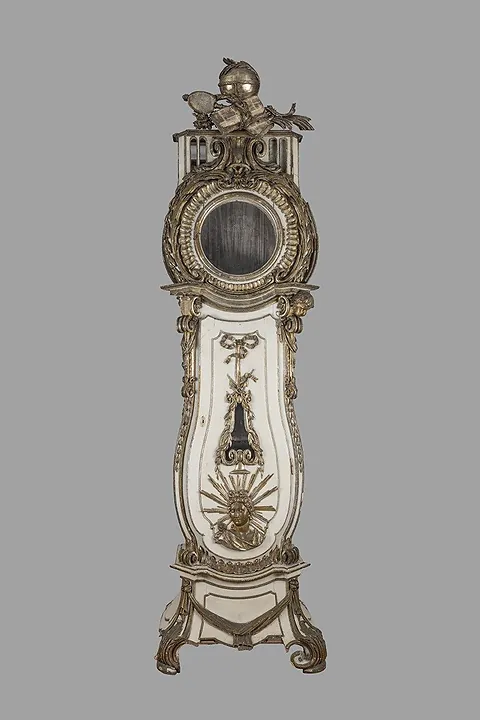
Clocks · c. 1780
Longcase clock by Louis George, Eberswalde, c. 1780
Museum Eberswalde
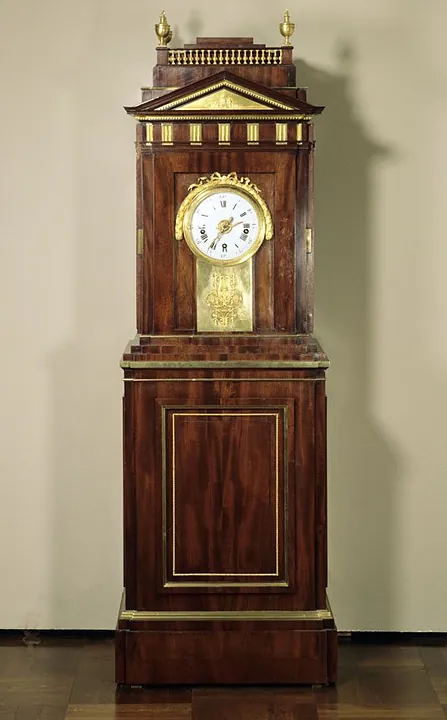
Clocks · 1780s (inferred: the museum dates the style to the 1780s and the music includes Gluck's Iphigénie en Tauride of 1779)
Musical longcase clock, Roentgen workshop, Neuwied, 1780s
Badisches Landesmuseum Karlsruhe
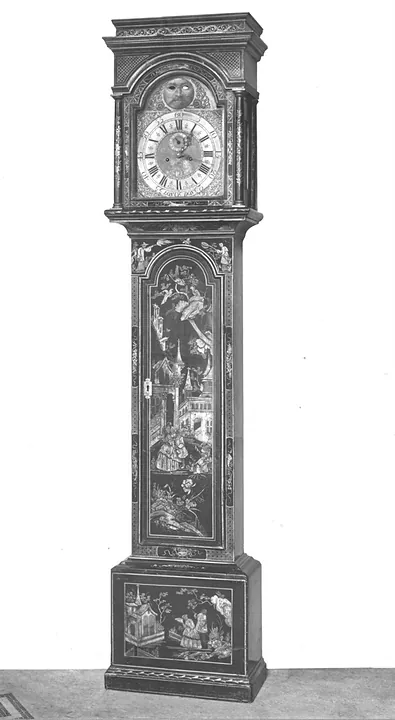
Clocks · 1740–1760
Longcase clock, English, 1740–1760, japanned wood, John Ellicott
Victoria and Albert Museum, London
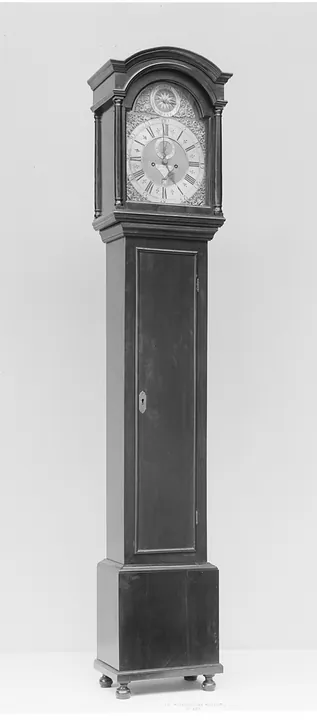
Clocks · 1740–60
Tall clock by Samuel Bagnall, United States, 1740–60
The Metropolitan Museum of Art, New York
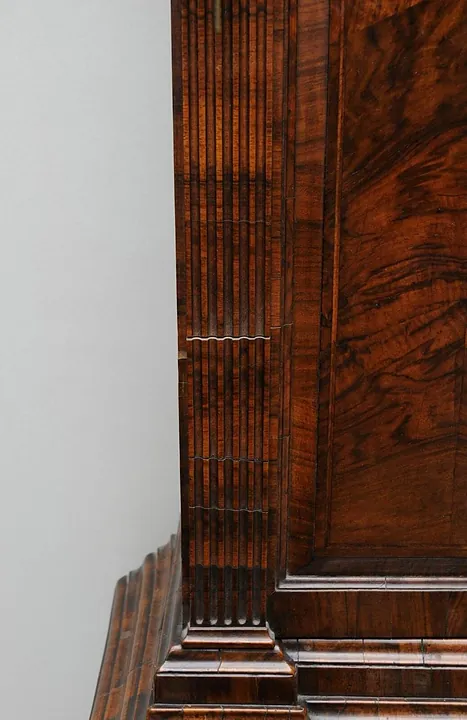
Clocks · c.1750
Long-case clock, English, ca. 1750, by Richard Peyton of Gloucester
Victoria and Albert Museum, London
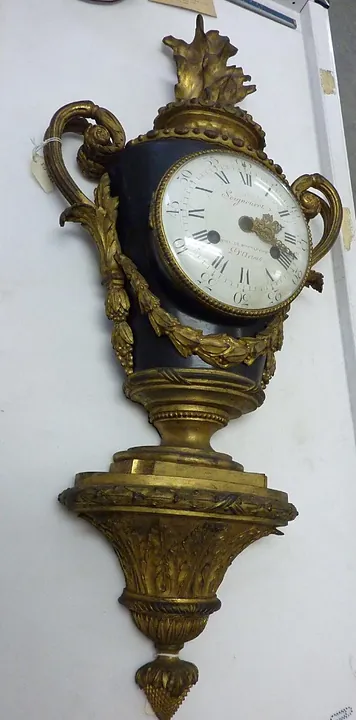
Clocks · 1750–1800
Bracket clock in metal case with scroll handles and flamed-shaped top signed by Pierre Seignoret, Clockmaket to the the Comte d'Artois
Victoria and Albert Museum, London
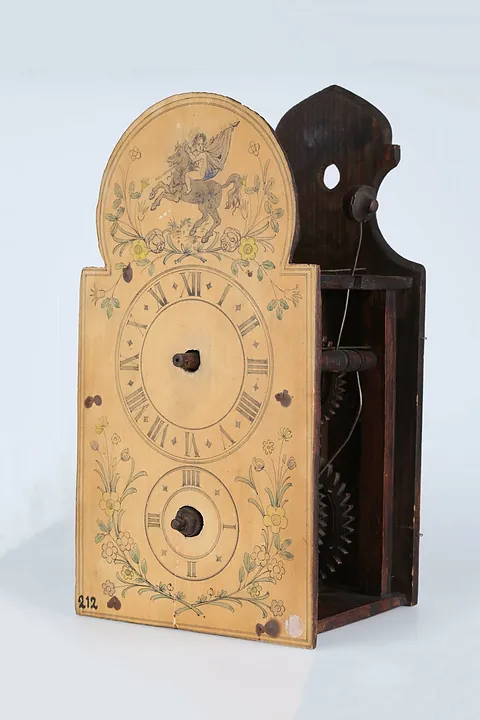
Clocks · c. 1750
Clock by Georg Gfell, Germany, c. 1750
German Clock Museum
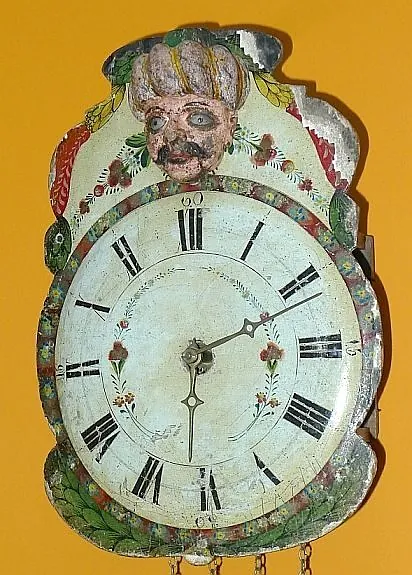
Clocks · 1750–1799
Cuckoo / black forest clock, Germany, 1750–1799
Badisches Landesmuseum Karlsruhe