
Clocks · Longcase clock
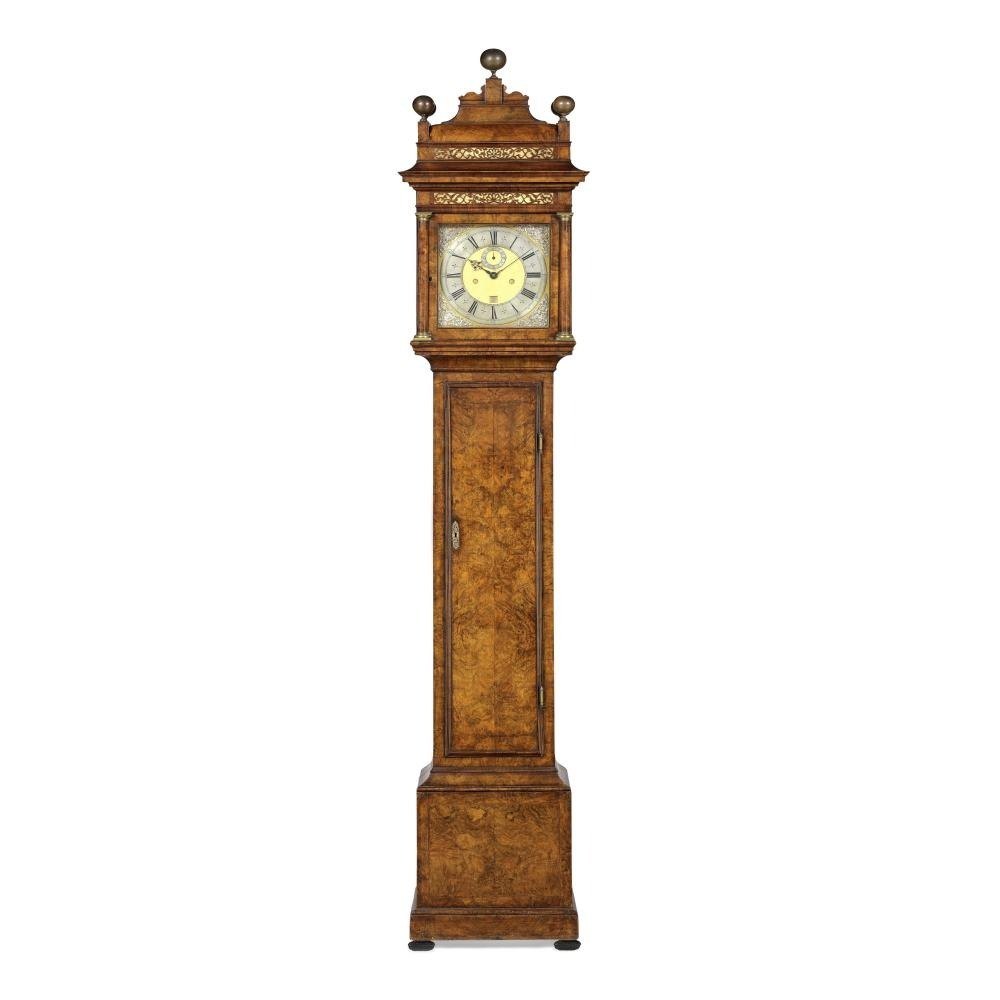
Burr walnut month-going longcase clock
- Maker / attribution
- Thomas Tompion (source attribution)
- Date
- early 18th century
- Historical period
- Early Modern Horology (1600 – 1750)
- Country of origin
- London
- Object type
- Longcase clock
- Dimensions
- 2.52m
- Holding institution
- Bonhams / Invaluable
- Accession / object no.
- 204825900
- Credit line
- Bonhams / Invaluable
- Catalogue title (original)
- Burr walnut month-going longcase clock (English)
View the source record ↗ (opens another website in a new tab)Suggest a correction
Record summary
Held and catalogued by Bonhams / Invaluable (object number 204825900), this is a longcase clock attributed to Thomas Tompion, made in London, dated early 18th century. The Atlas places it in the Early Modern Horology period (1600 – 1750) of its Clocks collection. Recorded dimensions: 2.52m. The record is illustrated with 1 photograph.
Assembled from the source record's structured fields. Dates and attributions are given as the source states them; where a field is missing the Atlas leaves it blank rather than estimating.
Catalogue description
Original object description
Dating from the early 18th century and originating in London, this burr walnut month-going longcase clock measures 2.52 meters in height. The movement is attributed to Thomas Tompion and carries the number 385 on its backplate, though final attribution remains contingent upon standard verification. Encased in burr walnut, the trunk door is decorated with six book-matched veneer panels accented by feather banding, set over an ebonised base fitted with block feet marked respectively "R" and "L". Surmounting the hood is a substantial lacquered brass spherical finial in the center, accompanied by four lesser pedestal finials and framed with fretwork backed in silk. The square 12-inch dial of gilt brass bears the maker's signature "THO: TOMPION LONDINI FECIT" alongside engraving ascribed to "graver 195". Features across the dial plate include blued steel hands, a matted center field, a subsidiary seconds ring, a date aperture operated by pin-hole adjustment, and silvered spandrels cast with foliate motifs and Indian masks. Powered by brass-cased weights, the month-duration mechanism is stabilized by an L-bracket secured at the upper right to the case, and it operates with reversed gear trains, an anchor escapement fitted with an extended crutch, and an external countwheel sounding on a bell. The movement architecture incorporates six knopped, latched pillars and incorporates bolt-and-shutter maintaining power. A period-original pendulum featuring an engraved rating nut is preserved alongside the weight assemblies.
Inscriptions & marks
385
Historical context
Early Modern Horology (1600 – 1750)
Huygens' pendulum and balance spring transform accuracy; English makers develop the anchor and deadbeat escapements.
Huygens's pendulum (1656–57) improved clock accuracy from about a quarter of an hour to under a minute a day. The anchor escapement (c. 1670) and the long seconds pendulum created the longcase clock; London makers such as Fromanteel, Knibb, Tompion and Quare led European clockmaking, and French makers created the Boulle pendule.
Read the period in the timelineMore clocks from this periodEarlier: Renaissance Horology
Atlas type guide
Longcase (tall-case or grandfather) clocks
The longcase clock was born from two seventeenth-century innovations: Christiaan Huygens's pendulum (1656–57) and the anchor escapement (c. 1670). A long seconds pendulum, nearly a metre long, swings with a small arc, and enclosing it together with the driving weights in a tall wooden case protected the mechanism and created a new piece of furniture. London makers such as Ahasuerus Fromanteel, Thomas Tompion and Joseph Knibb set the pattern.
By the eighteenth century longcase clocks were made throughout Britain, the Netherlands, Scandinavia (the Swedish Mora clock), France (the Comtoise from the Franche-Comté), Germany and colonial America. Eight-day movements with two weights became standard in better clocks; thirty-hour clocks with one weight and a rope or chain were cheaper alternatives.
What to look for
- Winding holes in the dial: two (eight-day, going and striking) or none (thirty-hour, pulled up by a chain).
- Brass dials with applied chapter rings (earlier) versus painted iron 'white' dials (after c. 1770 in Britain).
- Moon-phase arches, date apertures, seconds dials and maker's name on the dial.
- Case woods and style: ebonised, walnut marquetry, lacquer, oak or mahogany; regional styles from London, Lancashire, Scotland or America.
- Whether the movement and dial match the case — 'marriages' are common.
Dating clues
- Square brass dials suggest c. 1670–1720; arched brass dials c. 1715–1790.
- Painted (white) dials were made by Birmingham dial-makers from about 1772.
- Comtoise clocks with repoussé pendulums are mostly nineteenth century.
General guidance written by the Atlas editors about this kind of object. It is not a statement about this particular piece; for that, rely on the source record above and on physical examination.
Read next:Deadbeat escapementAnchor escapement
Related records
Clocks · c. 1690
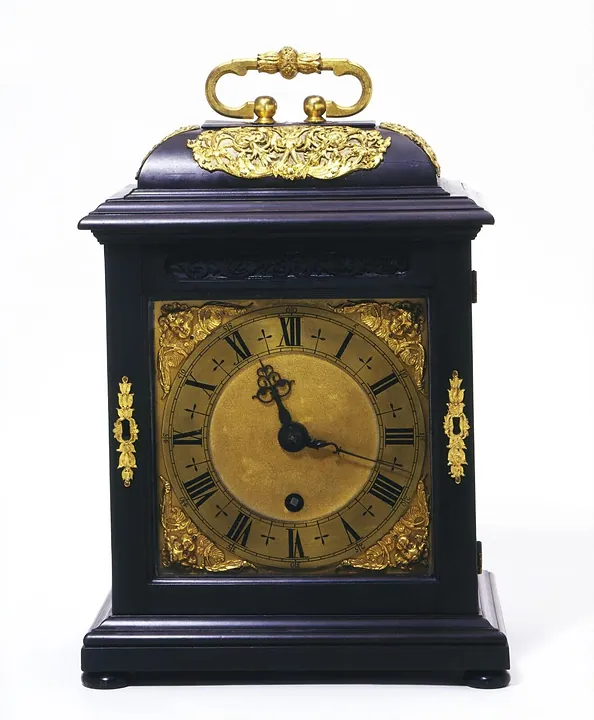
Bracket clock by Thomas Tompion, England, c. 1690
Victoria and Albert Museum, London
Clocks · c. 1696
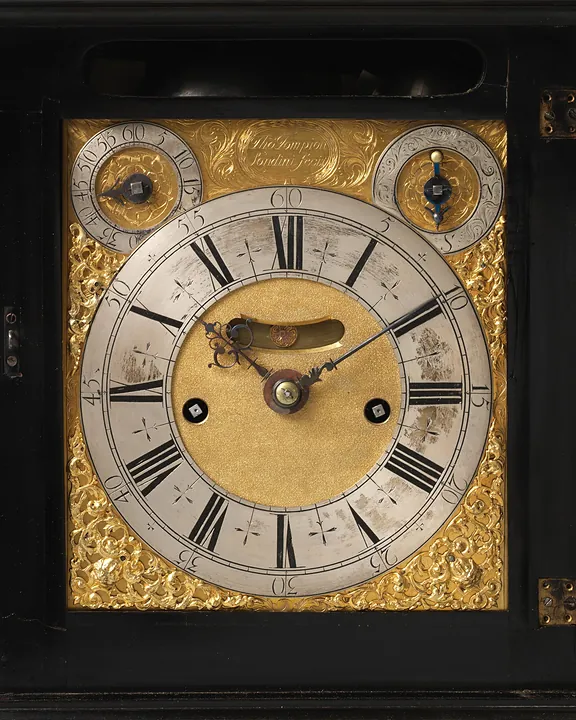
Table or bracket clock by Thomas Tompion, England, c. 1696
The Metropolitan Museum of Art, New York
Clocks · c.1705
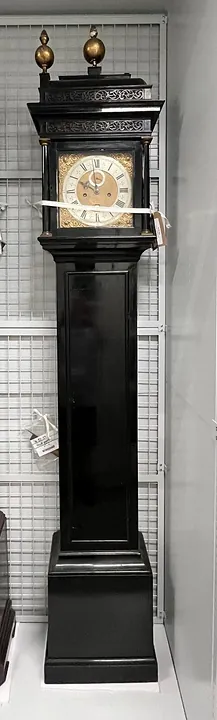
Eight day long case clock, ebonised pearwood veneer on oak carcase, inscribed 'Tho Tompion and Edw Banger London', made in about 1705
Victoria and Albert Museum, London
Movements & Components · 1690
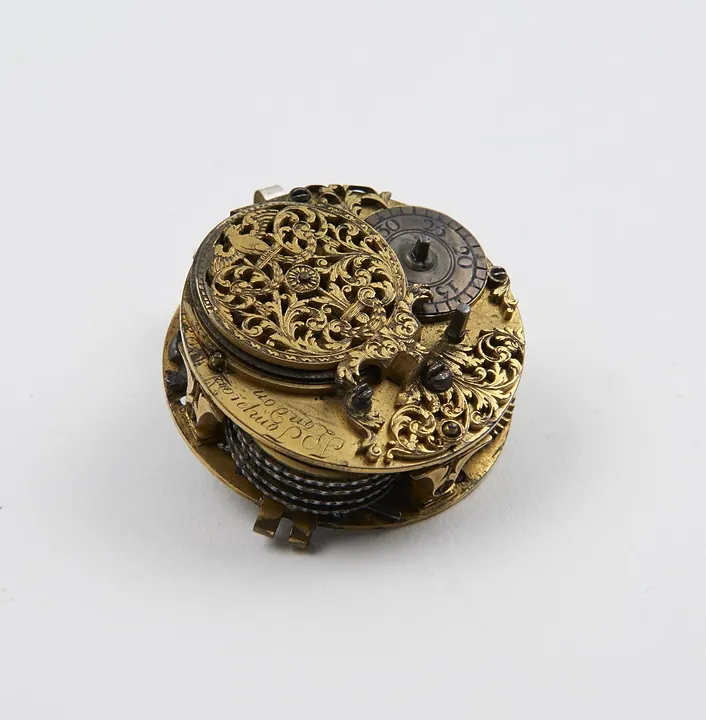
Pocket watch verge escapement movement by Thomas. Tompion, London, England,1690
Science Museum Group, London
Clocks · c. 1700
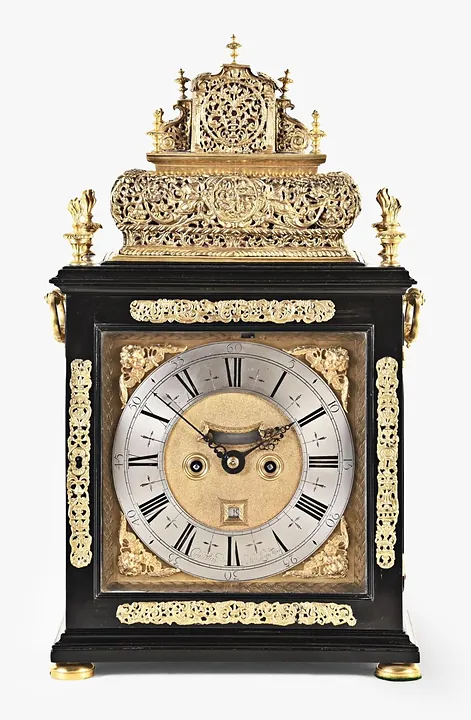
Claudius DuChesne Queen Anne basket top table clock
Schmitt Horan & Co. (via Invaluable)
Clocks · Early 17th century
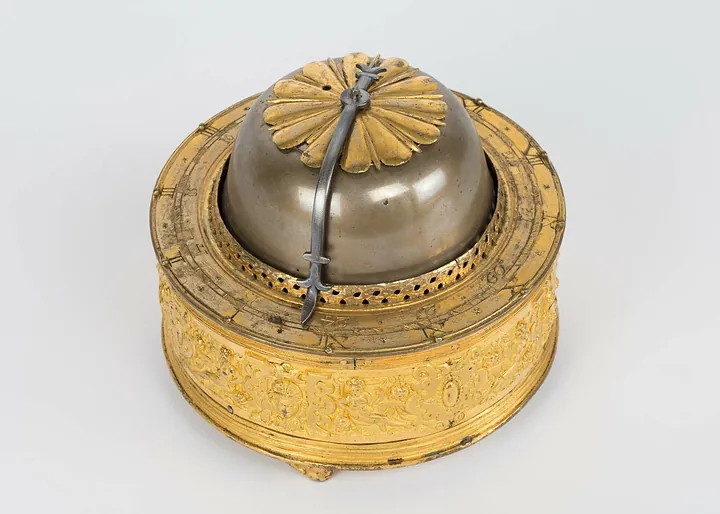
Table clock, probably Denmark, early 17th century
German Clock Museum
Clocks · 1590–1610
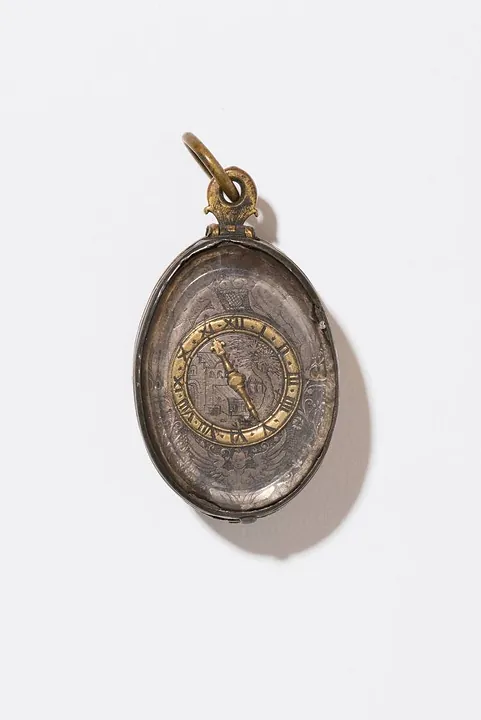
Clock, France, 1590–1610
MAK – Museum of Applied Arts
Clocks · c. 1600
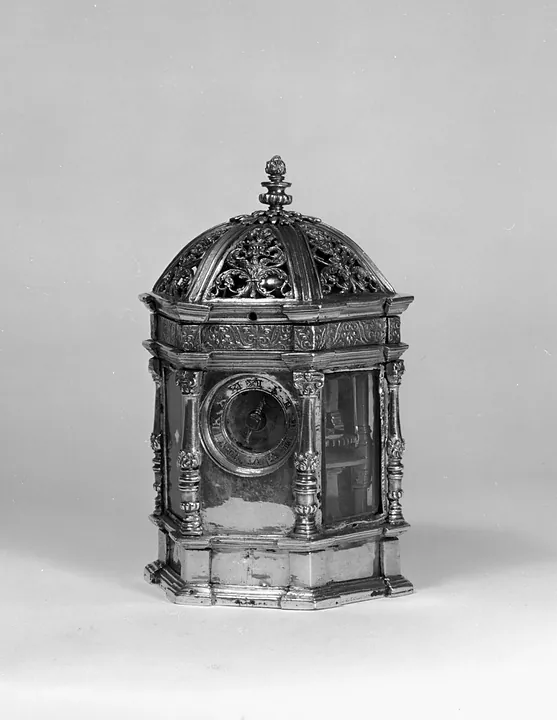
Table Clock, sheet brass, engraved, pierced and gilt, Paris, ca.1600, signed 'B(?) Pichard, à Paris'
Victoria and Albert Museum, London