
Clocks · Table clock
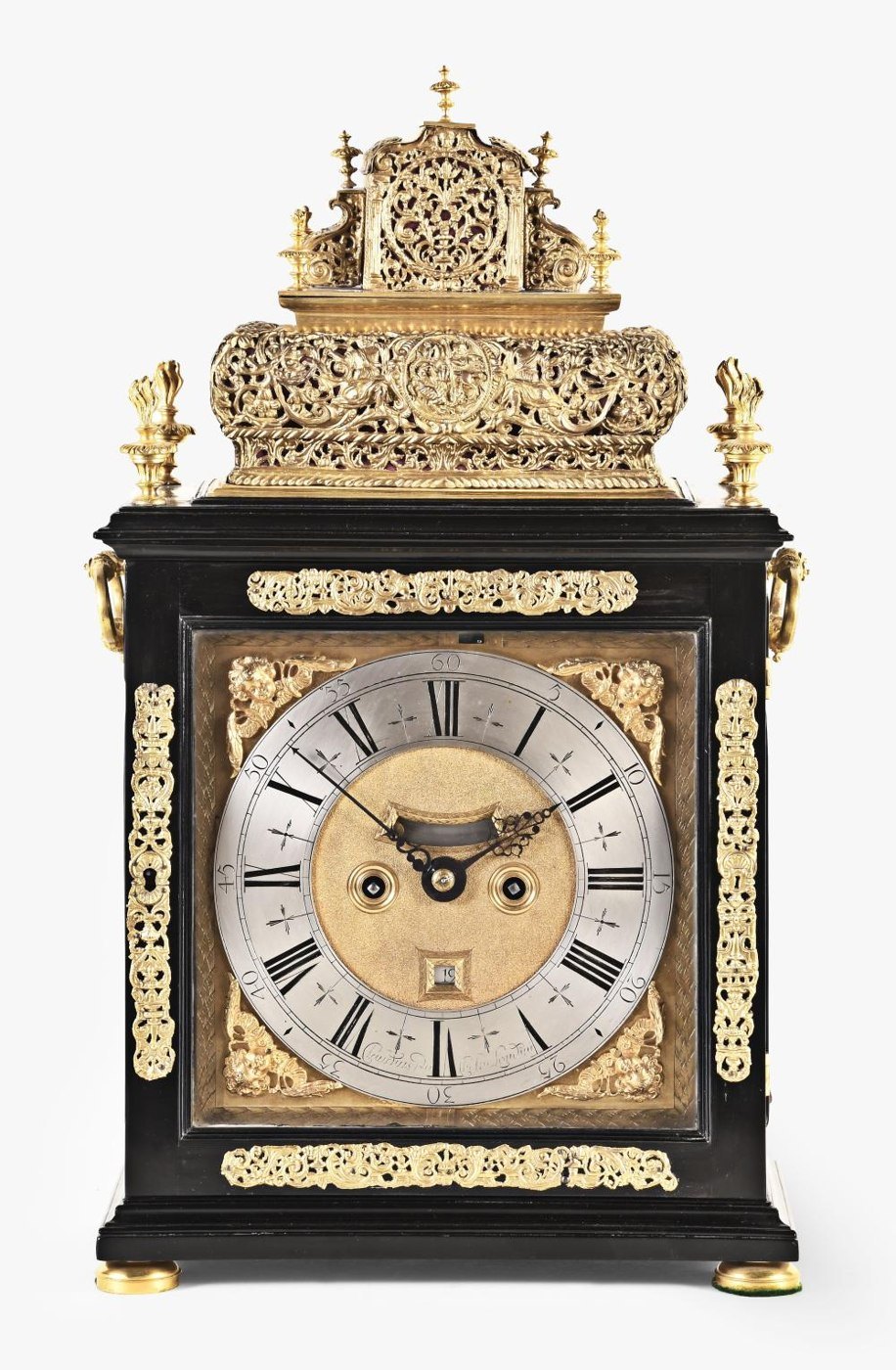
Claudius DuChesne Queen Anne basket top table clock
- Maker / attribution
- Claudius DuChesne (source attribution)
- Date
- c. 1700
- Historical period
- Early Modern Horology (1600 – 1750)
- Country of origin
- London
- Object type
- Table clock
- Materials / technique
- Ebony veneered oak
- Dimensions
- 21.5in x 12.25in x 6.5in
- Auction house
- Schmitt Horan & Co. (via Invaluable)
- Lot
- 447
- Credit line
- Schmitt Horan & Co. (via Invaluable)
- Catalogue title (original)
- A fine Queen Anne basket top table clock with pull quarter repeating by Claudius DuChesne (English)
View the source record (auction lot) ↗ (opens another website in a new tab)Suggest a correction
Record summary
Catalogued by Schmitt Horan & Co. (via Invaluable) (lot 447), this is a table clock attributed to Claudius DuChesne, made in London, dated c. 1700. The Atlas places it in the Early Modern Horology period (1600 – 1750) of its Clocks collection. Materials and techniques recorded by the source: Ebony veneered oak. Recorded dimensions: 21.5in x 12.25in x 6.5in. The record is illustrated with 1 photograph.
Assembled from the source record's structured fields. Dates and attributions are given as the source states them; where a field is missing the Atlas leaves it blank rather than estimating.
Catalogue description
Original object description
This Queen Anne table clock, attributed to London horologist Claudius DuChesne and dating to circa 1700, features an ebony-veneered oak case set upon low circular gilt feet with molded cornice and base profiles. The exterior is crowned by a repoussé basket top bearing four corner urn-and-flame finials and seven smaller urns, along with cast side handles and repoussé strapwork frets displaying Queen Anne effigies on the flanks and St. George slaying the dragon on the front and rear reserves. Its nine-inch square brass dial displays a matted interior, gilt cherub corner spandrels, an outer wheatear edge, a silvered chapter ring with Roman numerals, a false pendulum aperture below 12, and a date aperture above 6. Held by five knopped pillars, the three-train, eight-day fusee movement incorporates a knife-edge verge escapement, a bob pendulum, and a pull-wind quarter repeater chiming on five bells; its backplate is engraved with scrolling foliage, a wheatear frame, a grotesque mask, and an avian motif. Auction assessments indicate that the movement runs and chimes, though quarter strikes function irregularly; the case displays polish, minor warps, splits, rubbing to the gilding, and a small loss at the back left; the minute hand, door glass, back cock, and guard are replacements; the pillar pin ends are filed, and a single case screw is missing.
Historical context
Early Modern Horology (1600 – 1750)
Huygens' pendulum and balance spring transform accuracy; English makers develop the anchor and deadbeat escapements.
Huygens's pendulum (1656–57) improved clock accuracy from about a quarter of an hour to under a minute a day. The anchor escapement (c. 1670) and the long seconds pendulum created the longcase clock; London makers such as Fromanteel, Knibb, Tompion and Quare led European clockmaking, and French makers created the Boulle pendule.
Read the period in the timelineMore clocks from this periodEarlier: Renaissance Horology
Atlas type guide
Bracket, table and spring-driven clocks
Spring-driven clocks freed timekeeping from the hanging weight. The coiled mainspring, documented from the fifteenth century, made portable table clocks possible; to even out its declining force, makers used the fusee, a conical pulley connected to the barrel by a gut line or chain. Renaissance table clocks from Augsburg and Nuremberg — drum-shaped, square or tower-shaped in gilt brass — were luxury scientific objects, often with astronomical dials and alarms.
After the pendulum, English makers developed the bracket clock: a wooden case with a carrying handle, a short pendulum with a verge escapement, and often repeating work to sound the hours on demand at night. Later examples use the anchor escapement. In the nineteenth century, 'table clock' became a broad term for spring clocks of every nationality.
What to look for
- A fusee in the movement (cone-shaped pulley) and the type of line — gut or chain.
- Verge escapement with a short bob pendulum, often with a decoratively engraved backplate.
- Repeat cords or buttons that make the clock strike again on demand.
- Gilt-brass engraved cases and horizontal dials on Renaissance pieces.
- Case shapes: inverted bell, bell top, break-arch, lancet or balloon.
Dating clues
- Drum and tower table clocks: c. 1520–1650.
- Ebony veneered English bracket clocks with verge escapements: c. 1670–1800.
- Engraved backplates were usual on English clocks until c. 1800, then generally plain.
General guidance written by the Atlas editors about this kind of object. It is not a statement about this particular piece; for that, rely on the source record above and on physical examination.
Read next:Anchor (recoil) escapement
Related records
Clocks · early 18th century
Burr walnut month-going longcase clock
Bonhams / Invaluable
Clocks · Early 17th century
Table clock, probably Denmark, early 17th century
German Clock Museum
Clocks · 1590–1610
Clock, France, 1590–1610
MAK – Museum of Applied Arts
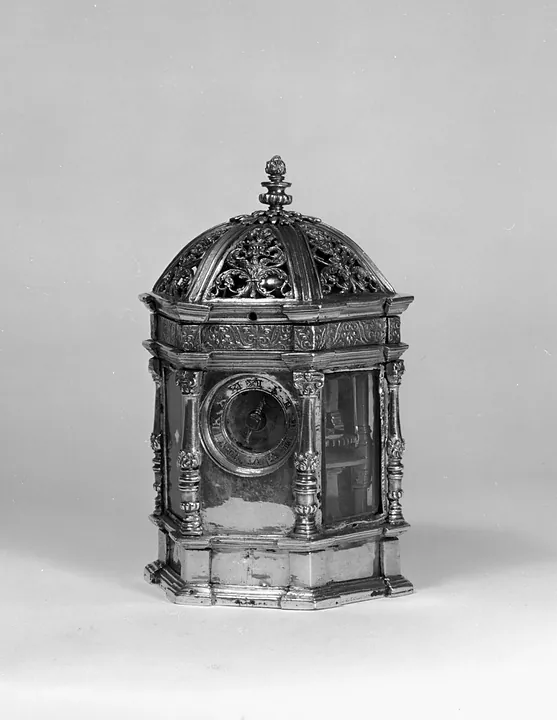
Clocks · c. 1600
Table Clock, sheet brass, engraved, pierced and gilt, Paris, ca.1600, signed 'B(?) Pichard, à Paris'
Victoria and Albert Museum, London
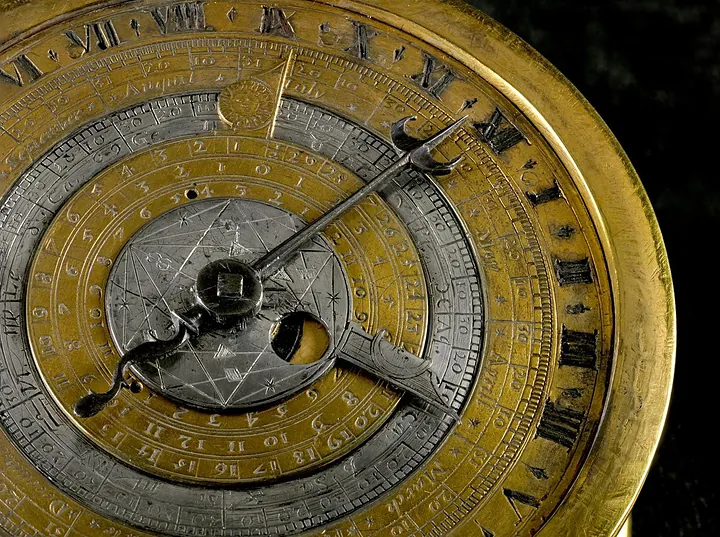
Clocks · 1598–1603
Circular table-clock with calendrical and lunar indications made by Nicholas Vallin in London between 1598 and 1603.
Science Museum Group, London
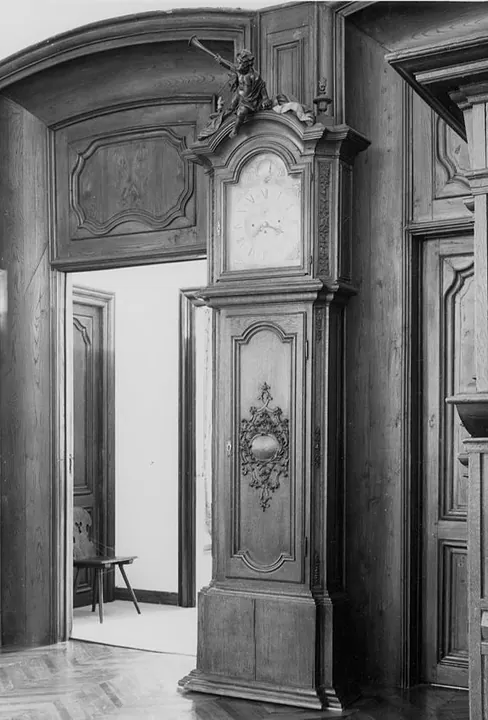
Clocks · 1660
Clock by Joannes Volcker, Belgium, 1660 (no. AP_10156031)
Royal Institute for Cultural Heritage
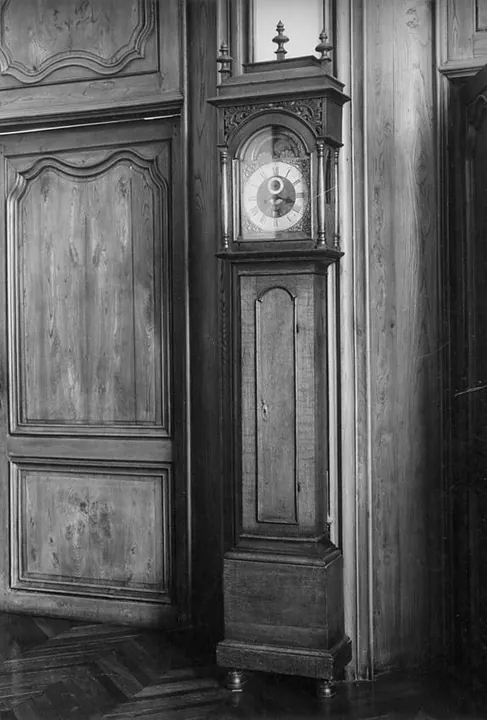
Clocks · 1641–1660
Clock by Joannes Volcker, Belgium, 1641–1660 (no. AP_10156032)
Royal Institute for Cultural Heritage
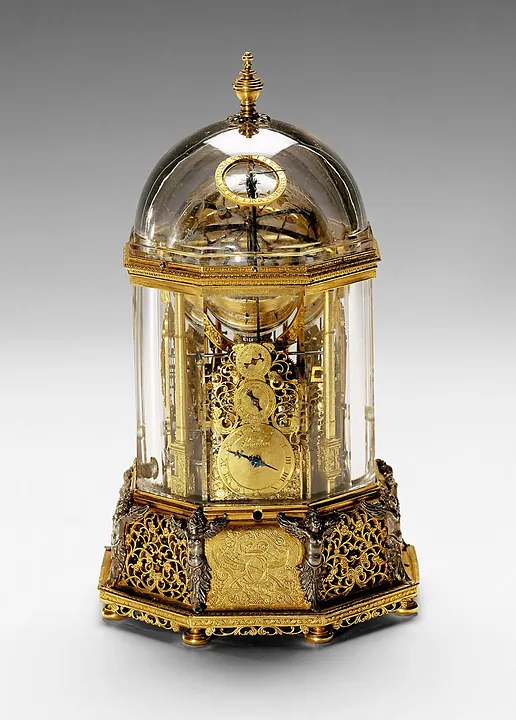
Clocks · 1600–1699
Clock attributed to Jobst Bürgi, Czech Republic, 1600–1699
Fine Arts Museum Vienna