
Wristwatches · Wristwatch
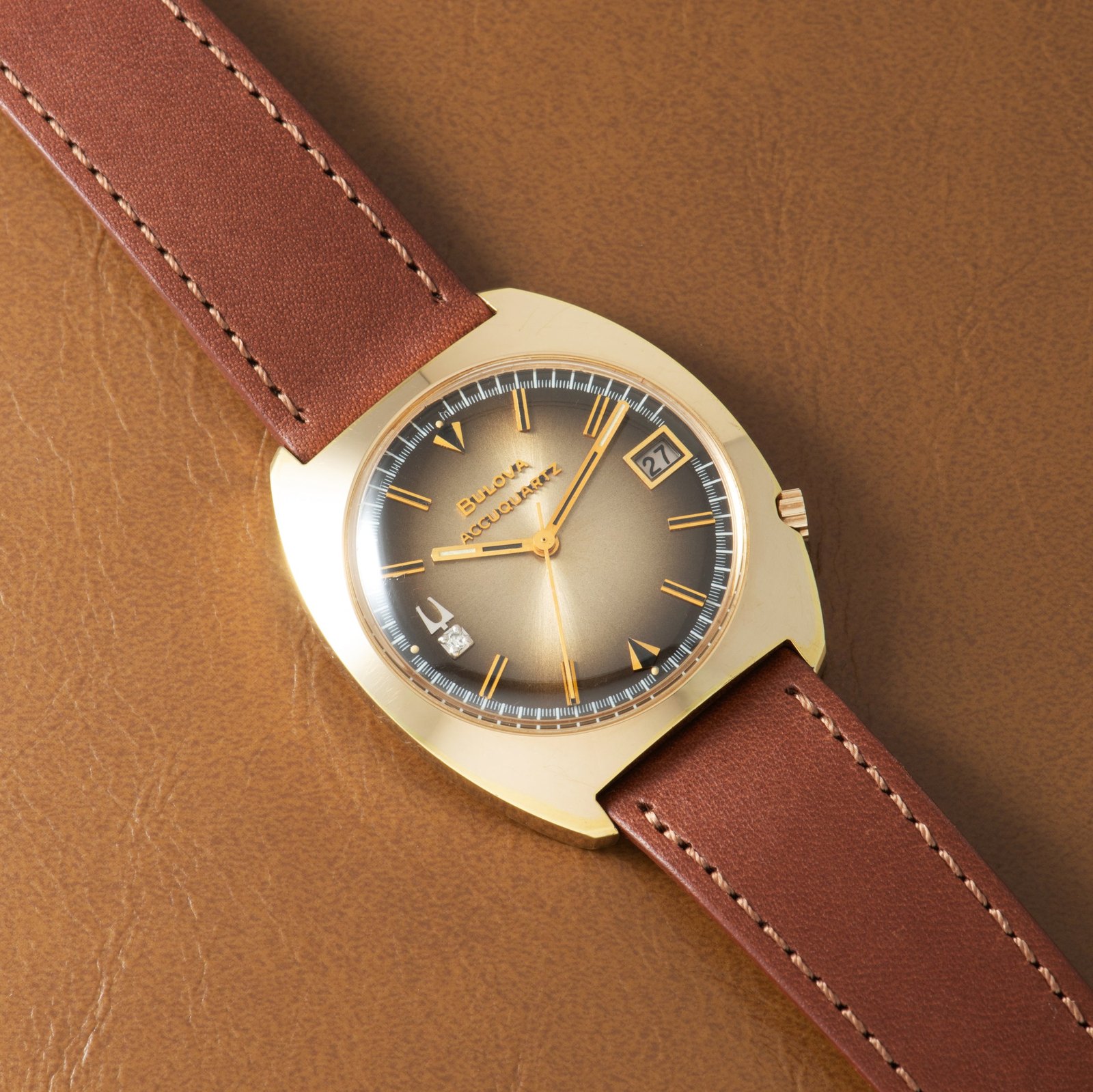
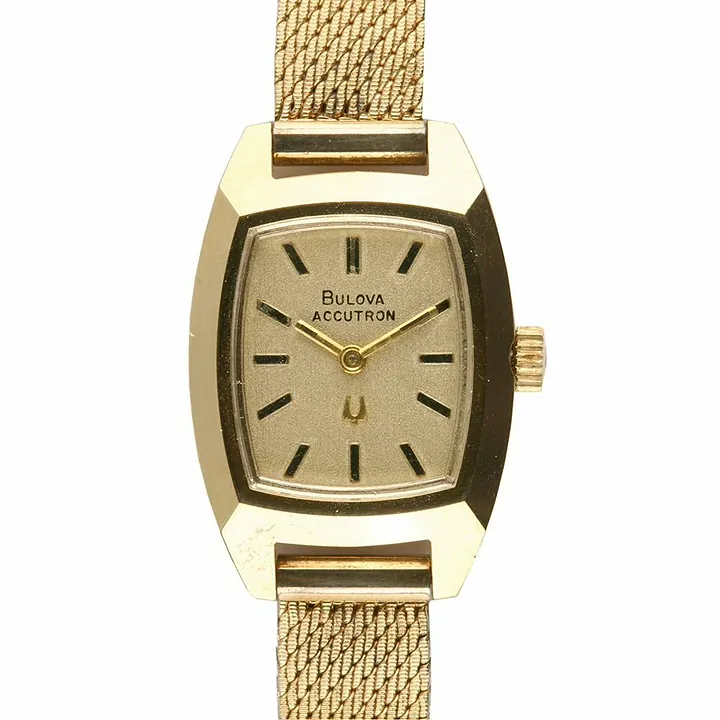
Bulova Accutron Accuquartz 'Gold Fumé', 1973
- Maker / attribution
- Bulova (maker)
- Date
- 1973
- Historical period
- Quartz Revolution (1969 – 1990)
- Country of origin
- United States
- Object type
- Wristwatch
- Materials / technique
- gold
- Stock no.
- 40993130
- Credit line
- Dealer listing, Analog/Shift (40993130)
- Catalogue title (original)
- Bulova Accutron Accuquartz 'Gold Fumé' (English)
View the source record (dealer listing) ↗ (opens another website in a new tab)Suggest a correction
Record summary
Catalogued by Analog/Shift (dealer), New York (stock number 40993130), this is a wristwatch by Bulova, made in United States, dated 1973. The Atlas places it in the Quartz Revolution period (1969 – 1990) of its Wristwatches collection. Materials and techniques recorded by the source: gold. The record is illustrated with 6 photographs.
Assembled from the source record's structured fields. Dates and attributions are given as the source states them; where a field is missing the Atlas leaves it blank rather than estimating.
Catalogue description
Dealer description — Analog/Shift
In 1960, Bulova had a vision of the future — and in that future, there was humming. About a decade before the infamous Quartz Crisis, Bulova put into production a timepiece that did away with the traditional balance wheel, favoring instead a steel tuning fork powered by electromagnets attached to a battery-powered transistor oscillator circuit. Designed by Max Hetzel, the Accutron made waves, becoming the first wristwatch precise enough to be qualified for U.S. Railroad certification, and guaranteed to be accurate to roughly one minute per month, or about 2 seconds per day. While Bulova had grand plans for their watch of the future, the quartz movement quickly captured the broader market. To keep on pace with the Japanese, Bulova Accutron worked in the development of the first quartz Swiss quartz movement, the Calibre Beta 21. In 1970, Accutron presented the Accuquartz with the Beta 21 movement. This specific watch, is one such example. It dates to 1973, given its N3 caseback engraving. "N" representing production in the 1970s, and "3" being the specific year within that decade. Housed in a swollen gold plated case, it features a dark sunburst dial with an outer minute track, applique stick indexes, and a baton handset. This piece also includes a date window for added functionality. No matter your mechanical-movement inclinations, there is no denying that this watch is an important piece of horological history. Accutron Factory Certified Pre-Owned Analog:Shift is proud to be partnered with Accutron as the exclusive retailer for Factory Certified Pre-Owned timepieces. Our longstanding relationship and shared passion for horological history and design have culminated in this unique offering. Each Accutron timepiece undergoes rigorous inspection and certification by expert watchmakers and is backed by the manufacture, ensuring unparalleled authenticity and quality.
Historical context
Quartz Revolution (1969 – 1990)
Seiko's Astron begins mass quartz timekeeping; traditional industries contract sharply.
Quartz and digital watches transformed the market after 1969. Swiss employment collapsed, Japanese and Hong Kong production soared, and the Swatch (1983) helped the Swiss industry recover; mechanical watches survived as luxury goods.
Read the period in the timelineMore wristwatches from this periodEarlier: Modern Mechanical Horology
Atlas type guide
Quartz, digital and electronic watches
Electronic watches arrived in three steps. The Hamilton Electric 500 (1957) was the first battery-powered wristwatch, still with a balance; Bulova's Accutron (1960) used a tuning fork. On 25 December 1969 Seiko released the Astron 35SQ, the first quartz wristwatch, closely followed by the Swiss Beta 21 group. In 1972 Hamilton's Pulsar introduced the LED digital watch, and LCD displays soon made digital watches cheap.
The 'Quartz Crisis' that followed devastated the Swiss mechanical industry, which lost two-thirds of its workforce between 1970 and 1984 before recovering with the Swatch (1983) and the luxury mechanical revival. Solar, radio-controlled, kinetic and connected smartwatches continue the electronic line.
What to look for
- Battery hatch in the case back and calibre markings with 'Quartz' or a crystal frequency.
- Display technology: LED (red, push-button) versus LCD (always-on).
- Tuning-fork hum and a smoothly sweeping seconds hand on Accutrons.
- Model and reference numbers, often printed on the back.
Dating clues
- Electric balance watches: from 1957.
- Tuning-fork watches: 1960–c. 1977.
- Quartz analogue: from December 1969; LED digital: 1972–c. 1978; LCD from 1973.
General guidance written by the Atlas editors about this kind of object. It is not a statement about this particular piece; for that, rely on the source record above and on physical examination.
Read next:Seiko calibre 35A (Astron)
Related records
Wristwatches · c. 1969
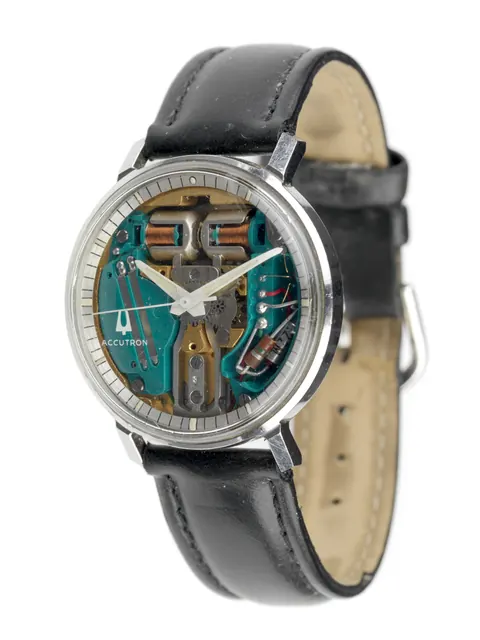
Bulova 'Accutron' tuning-fork wristwatch by Bulova
Royal Museums Greenwich
Wristwatches · c. 1965
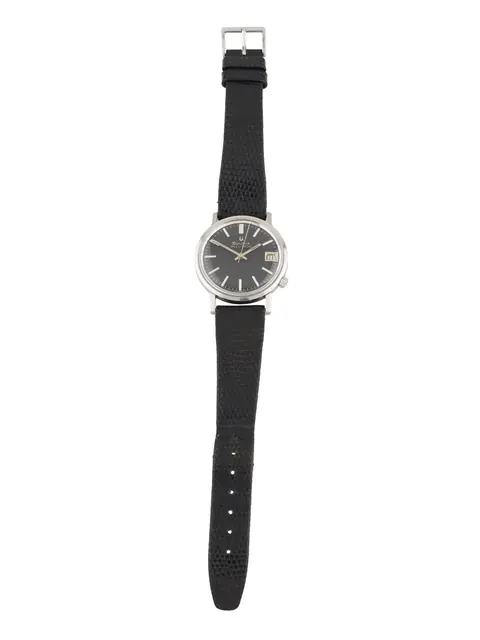
Wristwatch Accutron by Knud Geelmuyden Bull
Royal Museums Greenwich
Clocks · c. 1960s
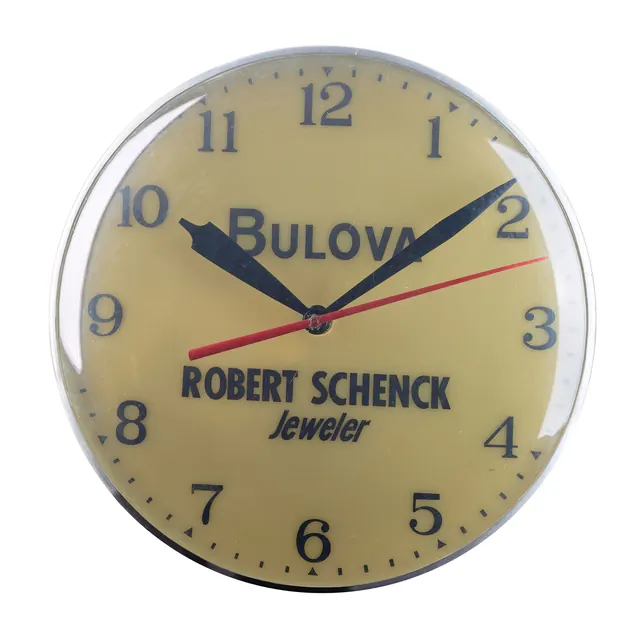
Bulova wall clock, Lighted Advertising Wall Clock for Robert Schenck Jeweler, circa 1960s
Antiquorum auction archive, Geneva
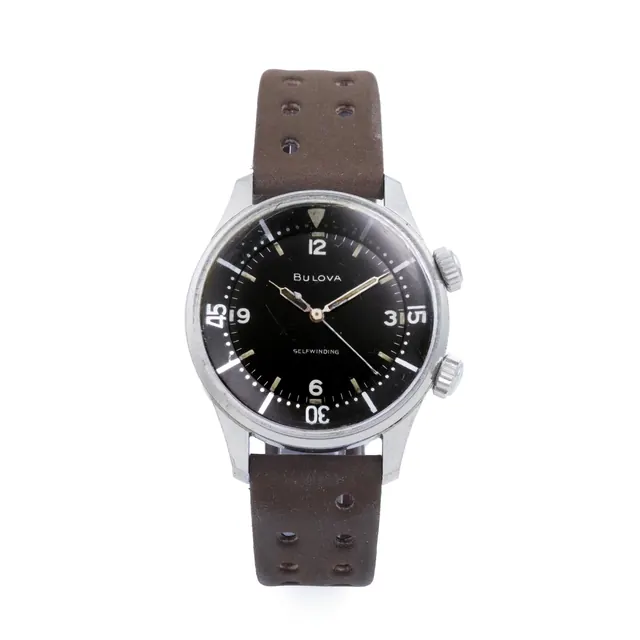
Wristwatches · 1963
Bulova wristwatch, ref. 314, Diver Super Compressor, 1963
Antiquorum auction archive, Geneva
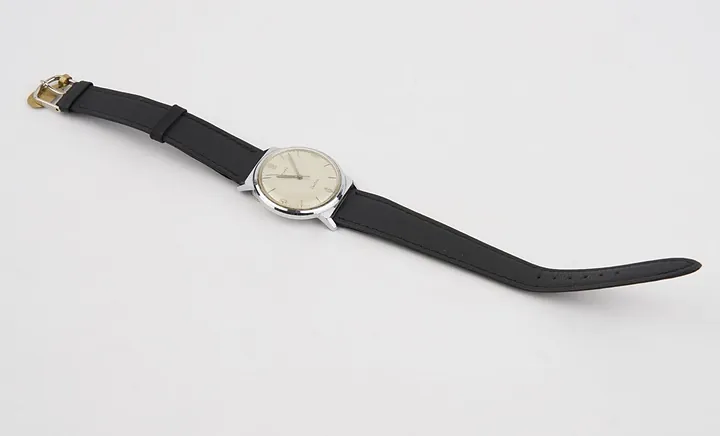
Wristwatches · 1949–1992
Timex `Electric' wristwatch, with electrically operated balance wheel mechanism, United States, 1949–1992
Science Museum Group, London
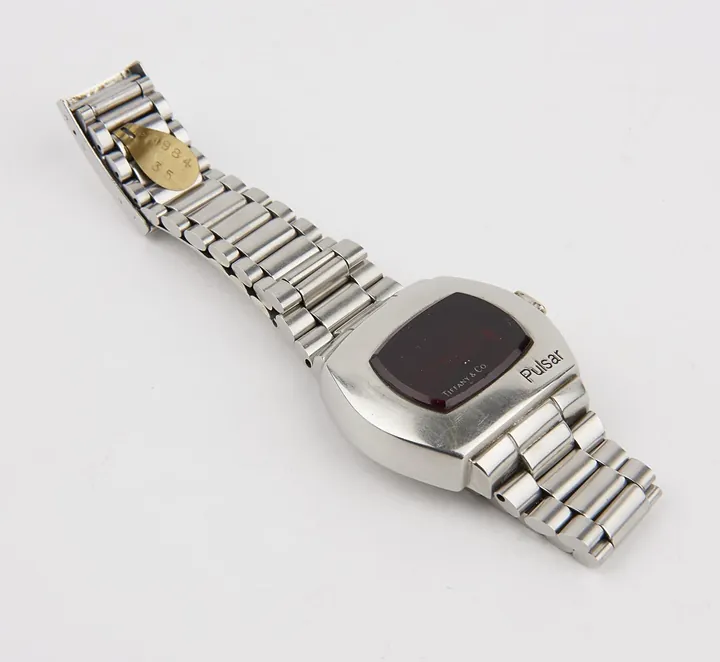
Wristwatches · 1972
Wristwatch by Hamilton Watch Company and Electro-Data Inc, United States, 1972
Science Museum Group, London
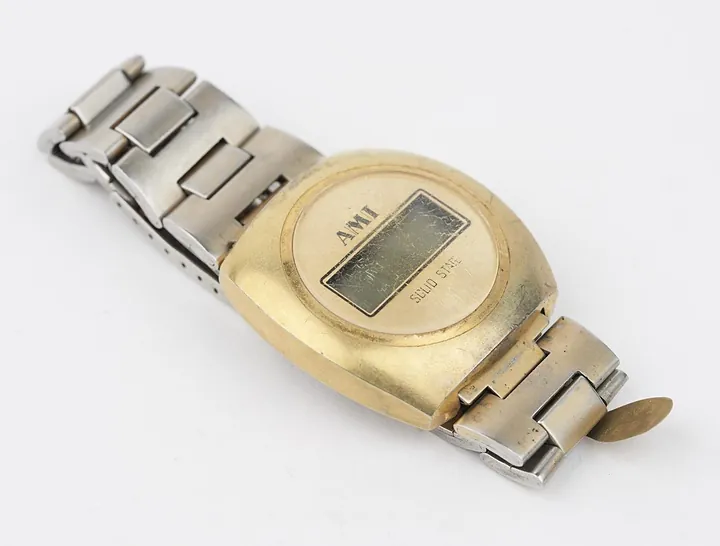
Wristwatches · 1973–1974
Quartz watch with liquid crystal digital display, made by American Microsystems Inc. (AMI) . 1973/74
Science Museum Group, London
Wristwatches · c. 1973
Wristwatch by Josef Bulova, United States, c. 1973
German Clock Museum