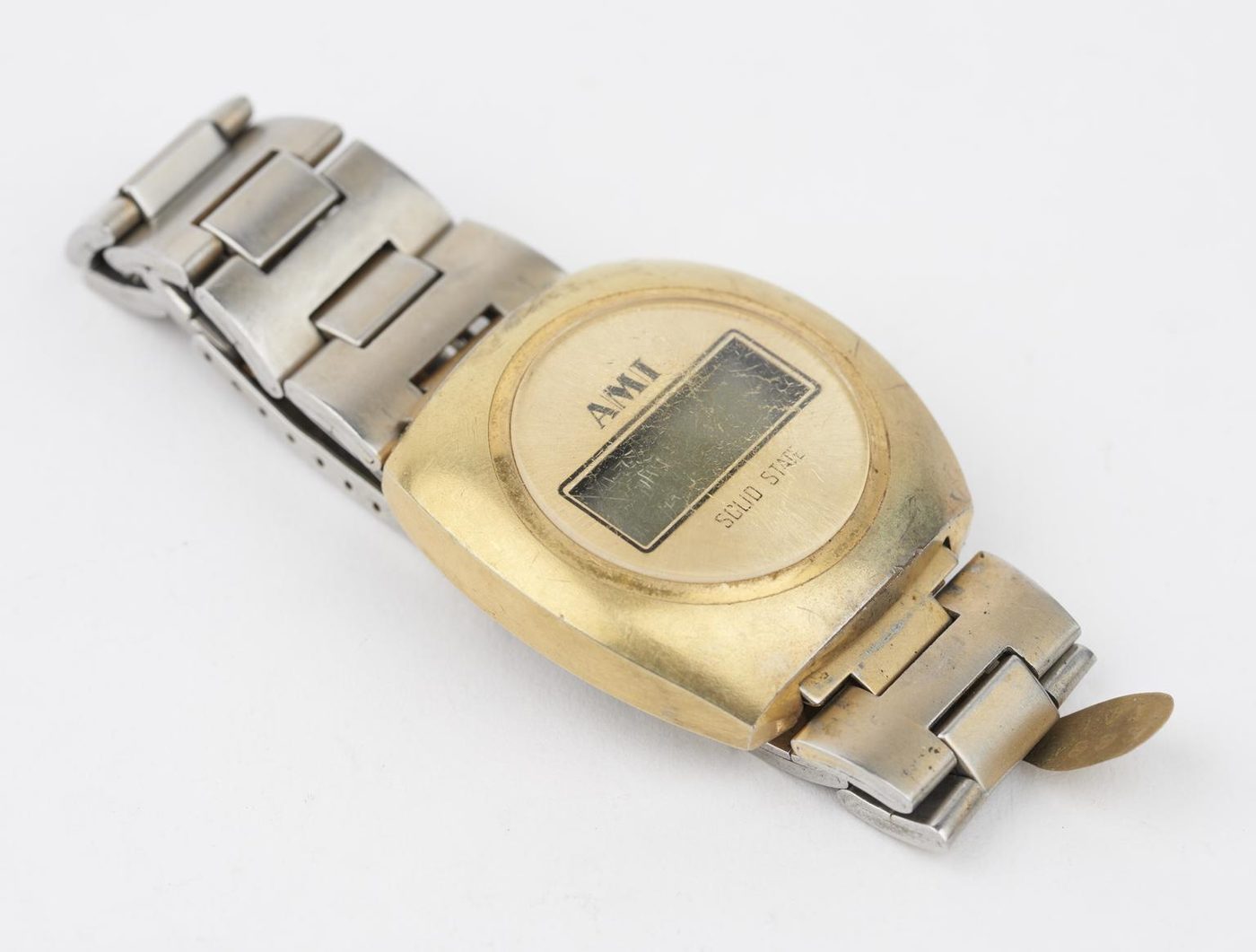
Wristwatches · Wrist-watch
Quartz watch with liquid crystal digital display, made by American Microsystems Inc. (AMI) . 1973/74
- Maker / attribution
- American Microsystems Inc. (maker)
- Date
- 1973-1974
- Historical period
- Quartz Revolution (1969 – 1990)
- Country of origin
- United States
- Object type
- Wrist-watch
- Holding institution
- Science Museum Group, London
- Accession / object no.
- 1982-47
- Credit line
- Slavin, M.W.
- Catalogue title (original)
- Quartz watch with liquid crystal digital display
Record summary
Held and catalogued by Science Museum Group, London (object number 1982-47), this is a wrist-watch by American Microsystems Inc., made in United States, dated 1973-1974. The Atlas places it in the Quartz Revolution period (1969 – 1990) of its Wristwatches collection. The record is illustrated with 1 photograph.
Assembled from the source record's structured fields. Dates and attributions are given as the source states them; where a field is missing the Atlas leaves it blank rather than estimating.
Catalogue description
The source record does not include a narrative description. The structured fields above are reproduced from it.
Historical context
Quartz Revolution (1969 – 1990)
Seiko's Astron begins mass quartz timekeeping; traditional industries contract sharply.
Quartz and digital watches transformed the market after 1969. Swiss employment collapsed, Japanese and Hong Kong production soared, and the Swatch (1983) helped the Swiss industry recover; mechanical watches survived as luxury goods.
Read the period in the timelineMore wristwatches from this periodEarlier: Modern Mechanical Horology
Atlas type guide
Quartz, digital and electronic watches
Electronic watches arrived in three steps. The Hamilton Electric 500 (1957) was the first battery-powered wristwatch, still with a balance; Bulova's Accutron (1960) used a tuning fork. On 25 December 1969 Seiko released the Astron 35SQ, the first quartz wristwatch, closely followed by the Swiss Beta 21 group. In 1972 Hamilton's Pulsar introduced the LED digital watch, and LCD displays soon made digital watches cheap.
The 'Quartz Crisis' that followed devastated the Swiss mechanical industry, which lost two-thirds of its workforce between 1970 and 1984 before recovering with the Swatch (1983) and the luxury mechanical revival. Solar, radio-controlled, kinetic and connected smartwatches continue the electronic line.
What to look for
- Battery hatch in the case back and calibre markings with 'Quartz' or a crystal frequency.
- Display technology: LED (red, push-button) versus LCD (always-on).
- Tuning-fork hum and a smoothly sweeping seconds hand on Accutrons.
- Model and reference numbers, often printed on the back.
Dating clues
- Electric balance watches: from 1957.
- Tuning-fork watches: 1960–c. 1977.
- Quartz analogue: from December 1969; LED digital: 1972–c. 1978; LCD from 1973.
General guidance written by the Atlas editors about this kind of object. It is not a statement about this particular piece; for that, rely on the source record above and on physical examination.
Read next:Seiko calibre 35A (Astron)
Related records
Wristwatches · 1949-1992
Timex `Electric' wristwatch, with electrically operated balance wheel mechanism, United States, 1949-1992
Science Museum Group, London
Wristwatches · 1972
Wristwatch by Hamilton Watch Company; Electro-Data Inc, United States, 1972
Science Museum Group, London
Wristwatches · 1973
Wristwatch by Josef Bulova, United States, 1973
German Clock Museum
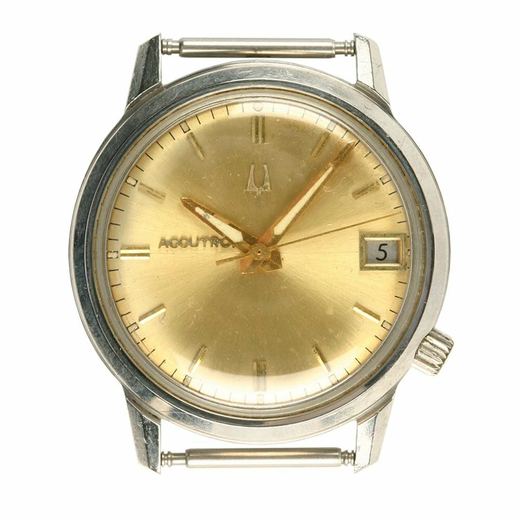
Wristwatches · 1975
Wristwatch by Josef Bulova, United States, 1975
German Clock Museum
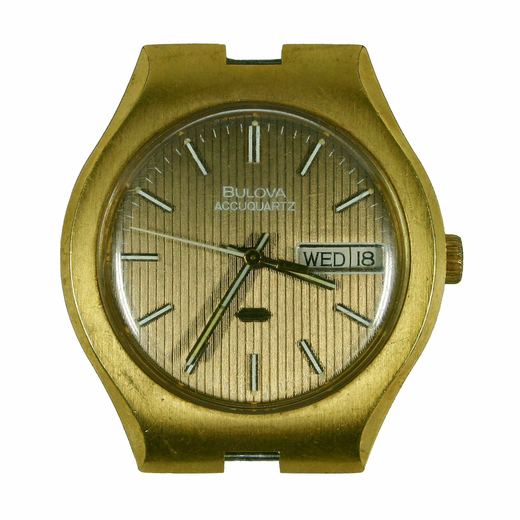
Wristwatches · 1976
Wristwatch by Josef Bulova, United States, 1976
German Clock Museum
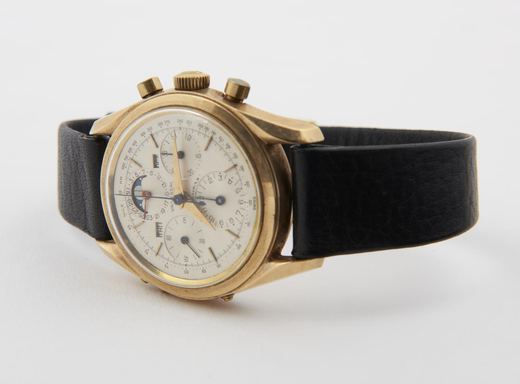
Wristwatches · 1960-1986
'Tri-Compax' calendar chronograph wristwatch in gold case, by Universal, Geneva, Switzerland, 1960-1986.
Science Museum Group, London
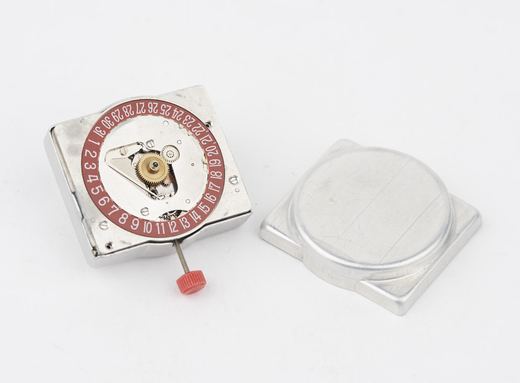
Wristwatches · 1969-1970
Beta 21 Quartz wristwatch movement, made in Switzerland, 1970.
Science Museum Group, London
Wristwatches · circa 1969
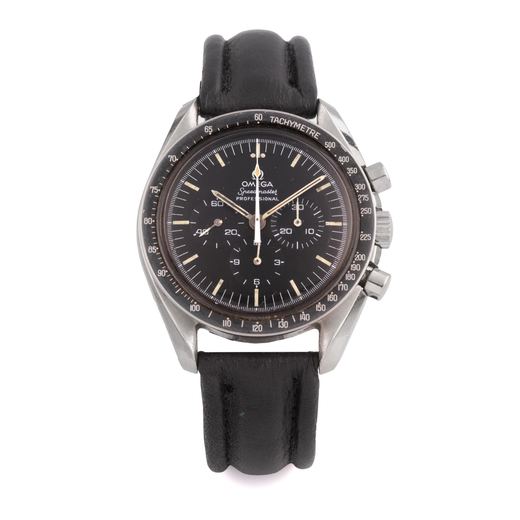
Omega Speedmaster Moonwatch, ref. 145022-69st, circa 1969
Antiquorum auction archive, Geneva