
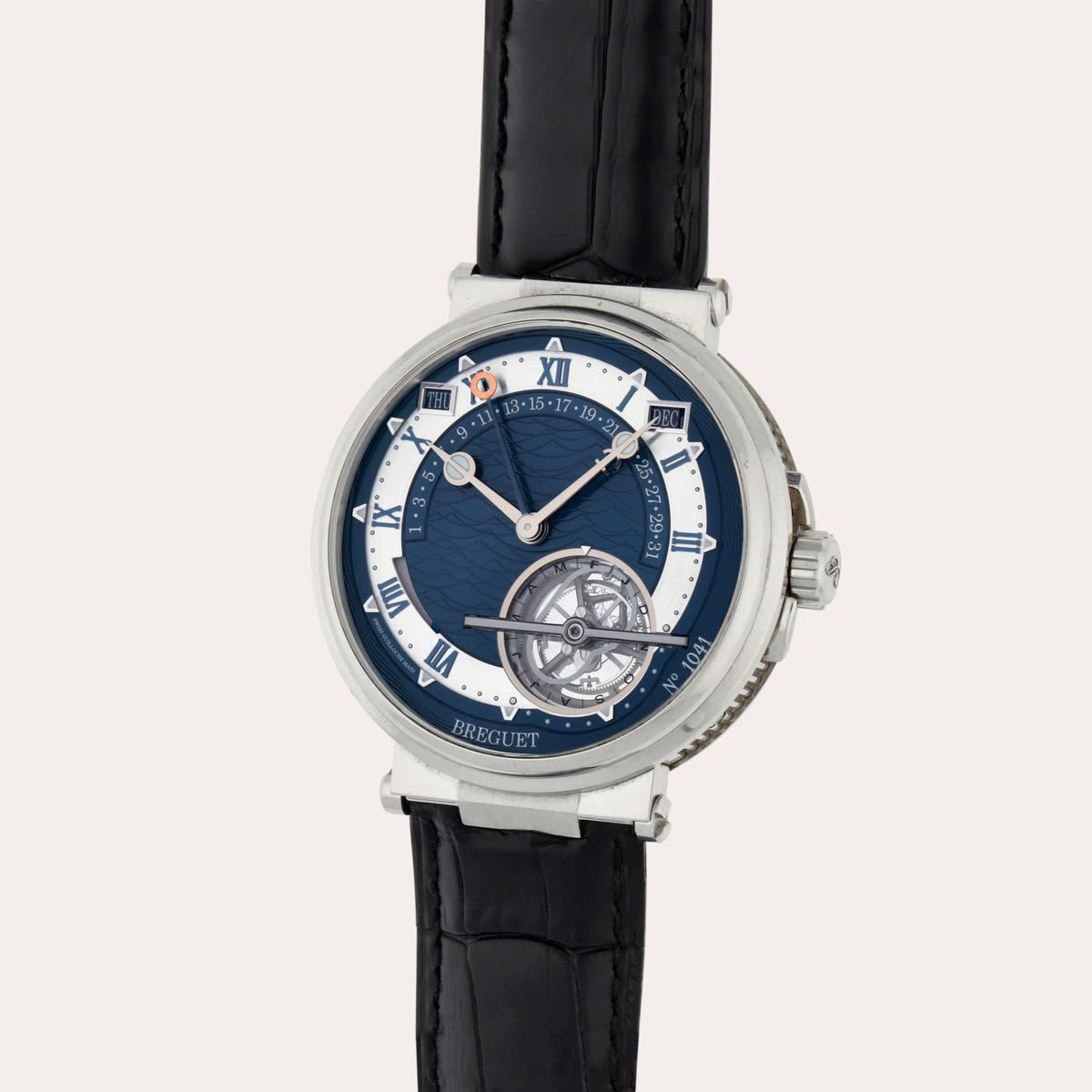
Wristwatches · Perpetual calendar tourbillon wristwatch
Breguet Marine Tourbillon Équation Marchante, Reference 5887PT/Y2/9WV
- Maker / attribution
- Breguet (source attribution)
- Date
- c. 2022
- Historical period
- Contemporary Horology (2010 – Present)
- Country of origin
- Switzerland
- Object type
- Perpetual calendar tourbillon wristwatch
- Materials / technique
- Platinum
- Auction house
- Sotheby's
- Lot
- 204
- Credit line
- Sotheby's
- Catalogue title (original)
- Breguet | Marine Tourbillon Equation Marchante, Reference (English)
View the source record (auction lot) ↗ (opens another website in a new tab)Suggest a correction
Record summary
Catalogued by Sotheby's (lot 204), this is a perpetual calendar tourbillon wristwatch attributed to Breguet, made in Switzerland, dated c. 2022. The Atlas places it in the Contemporary Horology period (2010 – Present) of its Wristwatches collection. Materials and techniques recorded by the source: Platinum. The record is illustrated with 1 photograph.
Assembled from the source record's structured fields. Dates and attributions are given as the source states them; where a field is missing the Atlas leaves it blank rather than estimating.
Catalogue description
Original object description
Assigned reference number 5887PT/Y2/9WV and dating to circa 2022, this platinum Breguet Marine Tourbillon Équation Marchante is registered with movement number 31'120 and dial number N° 1041. The wave-guilloché blue dial includes silvered chapter rings, faceted Breguet-style hands, day and month apertures, a retrograde date indicator, an equation of time complication, a power reserve sector, and a full perpetual calendar, alongside an opening between 4 and 6 o'clock exposing the one-minute tourbillon. A differential gear train driven by an analemma cam advances a separate running equation of time minute hand tipped with a gilt sun motif. The self-winding calibre 581 DPE is built with 57 jewels and an outer peripheral winding mass. Configured with a fluted caseband, stepped lugs, a black leather strap, a platinum double-deployant buckle, and a seven-screw sapphire crystal display back, the case diameter is noted as 44 mm in descriptive documentation but listed as 45 mm in technical specifications. The watch is accompanied by its inner presentation box and outer carton, lacking paperwork.
Inscriptions & marks
1'041 BU
Historical context
Contemporary Horology (2010 – Present)
Silicon components, connected watches, optical-lattice research clocks and a thriving independent scene.
Smartwatches became the world's best-selling watches, while mechanical watchmaking focuses on craft, innovation (silicon components, new escapements) and independent makers.
Read the period in the timelineMore wristwatches from this periodEarlier: Mechanical Renaissance
Atlas type guide
Calendar, moon-phase and perpetual calendar watches
Calendar complications range from a simple date to the perpetual calendar, which automatically allows for months of different lengths and leap years until 2100. Pocket watches with perpetual calendars were made in the eighteenth and nineteenth centuries; Patek Philippe made the first perpetual calendar wristwatch in 1925, and series production followed in 1941. The annual calendar (Patek Philippe, 1996) needs correction only once a year.
Moon-phase displays use a disc with two moons and 59 teeth advanced daily, approximating the 29.5-day lunation; more precise trains reduce the error to one day in over a century.
What to look for
- Apertures or subsidiary dials for day, date, month and leap year.
- Moon disc under a 'bosom' shaped aperture.
- Recessed correctors on the case band for setting the calendar.
Dating clues
- Triple-date wristwatches: popular c. 1940–1955.
- Perpetual calendar wristwatches: from 1925 (unique) and 1941 (series).
General guidance written by the Atlas editors about this kind of object. It is not a statement about this particular piece; for that, rely on the source record above and on physical examination.
Related records
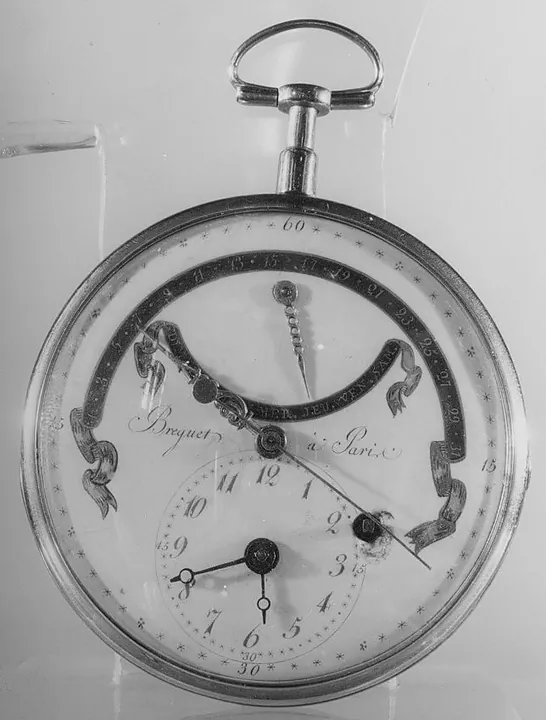
Pocket Watches · 1700–1799
Pocket watch by Breguet, Belgium, 1700–1799
Royal Institute for Cultural Heritage
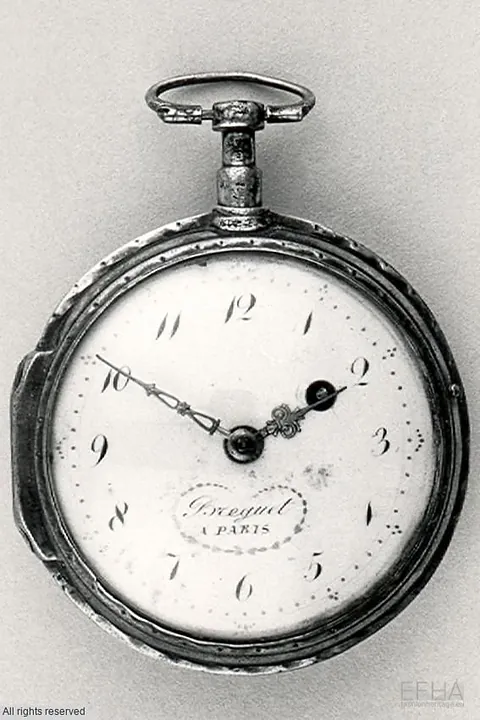
Pocket Watches · 1700–1799
Pocket watch by Breguet, France, 1700–1799
Fashion Museum of Antwerp
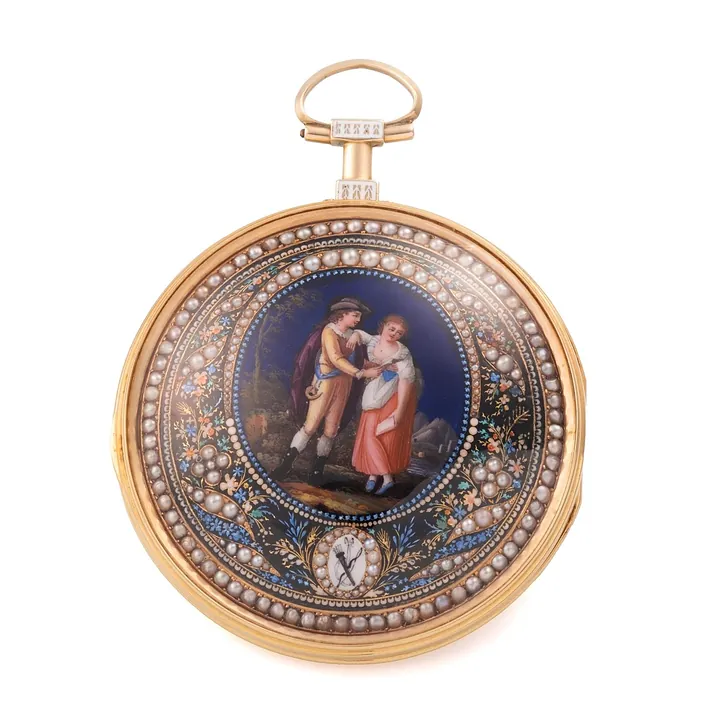
Pocket Watches · c. 1790
Breguet Love Letter, c. 1790
Antiquorum auction archive, Geneva
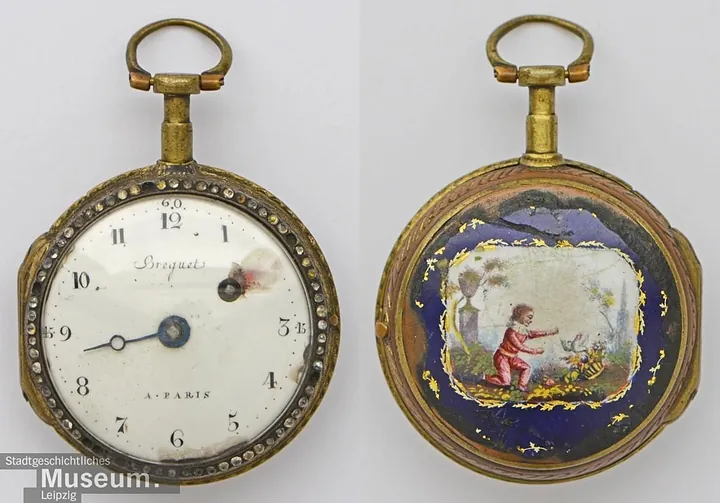
Pocket Watches · 1790
Pocket watch possibly by Breguet, France, 1790
Museum of City History Leipzig

Wristwatches · c. 2010s
Breguet Type XXI, ref. 3810, c. 2010s (Antiquorum Lot 381-24)
Antiquorum auction archive, Geneva

Wristwatches · c. 2010s
Breguet Type XXI, ref. 3810, c. 2010s (Antiquorum Lot 386-229)
Antiquorum auction archive, Geneva

Wristwatches · Sold in September 2010
Breitling Cosmonaute, ref. A 22322, Sold in September 2010
Antiquorum auction archive, Geneva

Wristwatches · c. 2010
Corum Bubble Chrono, ref. 396.150.20, c. 2010
Antiquorum auction archive, Geneva