
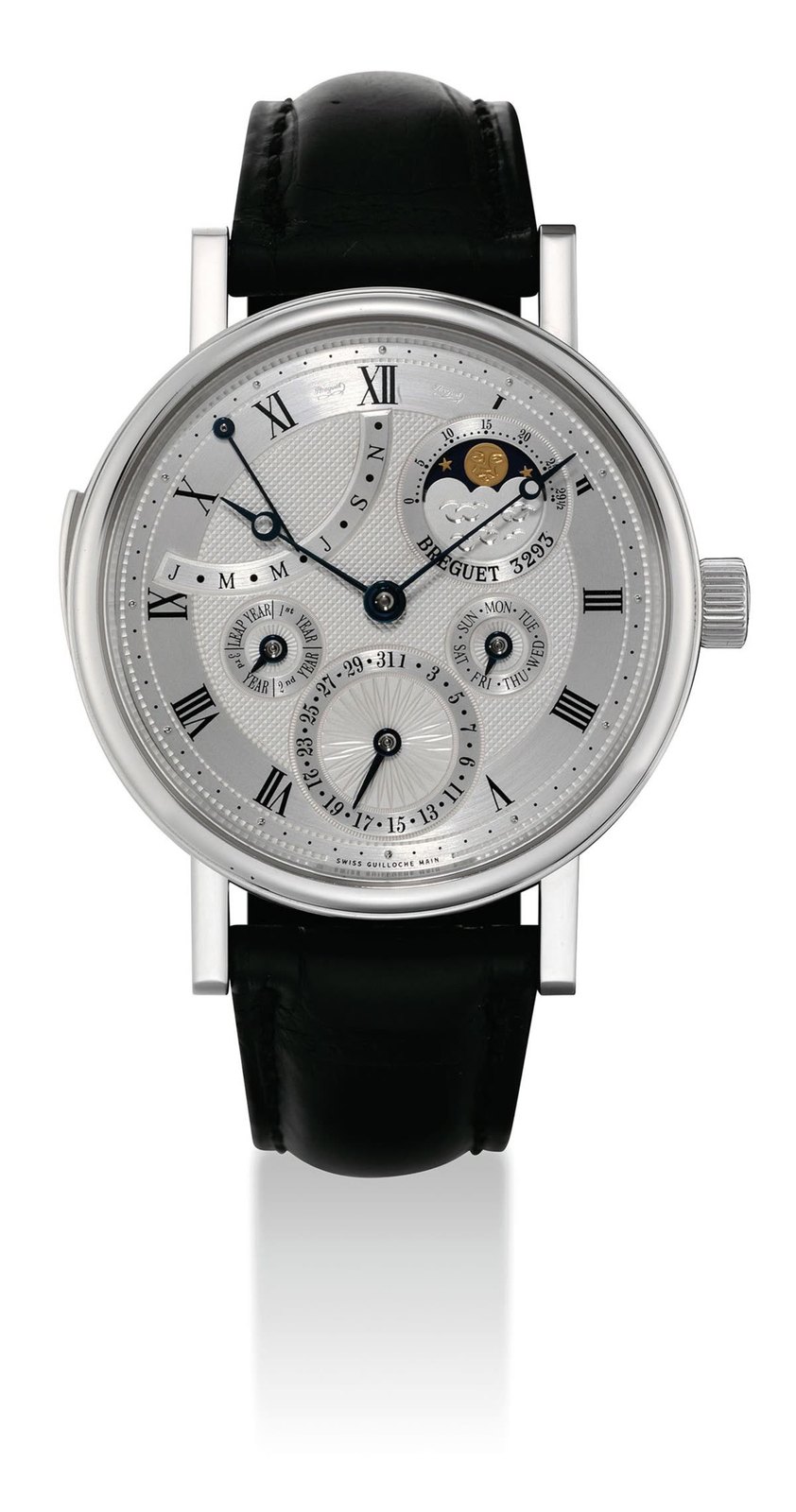
Wristwatches · Minute repeating perpetual calendar wristwatch
Breguet Classique Complications Ref. 5447 Platinum Minute Repeating Perpetual Calendar Wristwatch
- Maker / attribution
- Breguet (source attribution)
- Date
- c. 2007
- Historical period
- Mechanical Renaissance (1990 – 2010)
- Country of origin
- Switzerland
- Object type
- Minute repeating perpetual calendar wristwatch
- Materials / technique
- Platinum
- Dimensions
- 41 mm
- Auction house
- Christie's
- Lot
- 2467
- Credit line
- Christie's
- Catalogue title (original)
- BREGUET. A VERY FINE AND RARE PLATINUM MINUTE REPEATING PERPETUAL CALENDAR WRISTWATCH WITH RETROGRADE MONTH, LEAP YEAR INDICATION AND MOON PHASES, SIGNED BREGUET, CLASSIQUE COMPLICATIONS MODEL, REF. 5 (English)
View the source record (auction lot) ↗ (opens another website in a new tab)Suggest a correction
Record summary
Catalogued by Christie's (lot 2467), this is a minute repeating perpetual calendar wristwatch attributed to Breguet, made in Switzerland, dated c. 2007. The Atlas places it in the Mechanical Renaissance period (1990 – 2010) of its Wristwatches collection. Materials and techniques recorded by the source: Platinum. Recorded dimensions: 41 mm. The record is illustrated with 1 photograph.
Assembled from the source record's structured fields. Dates and attributions are given as the source states them; where a field is missing the Atlas leaves it blank rather than estimating.
Catalogue description
Original object description
Dating from circa 2007, this Breguet Classique Complications reference 5447 is housed in a 41 mm platinum case with a coin-edge caseband, a glazed snap-on display back, and a repeating slide placed on the left flank. Its engine-turned silvered dial exhibits various guilloché textures, blued open-tipped hands, an outer Roman numeral ring, an arched retrograde month scale, and four subsidiary registers tracking the day, date, leap-year sequence, and moon phase with a golden moon visage below 12 o'clock. The repeating mechanism relies on two hammers and two gongs driven by the signed 31-jewel calibre 567RMP lever movement, numbered 6193. Completed by a black strap with a platinum folding buckle, the timepiece is documented alongside fitted presentation boxes, a polishing cloth, promotional material, an instruction booklet, an adjustment stylus, and a Certificate of Origin dated 22 December 2007.
Inscriptions & marks
Movement no. 6193, Case no. 3293X
Historical context
Mechanical Renaissance (1990 – 2010)
Mechanical watches return as cultural objects; independent watchmaking flourishes.
Mechanical watches returned as cultural and luxury objects. Complications, tourbillons and new materials proliferated; independent watchmakers such as George Daniels, F.P. Journe and Philippe Dufour revived artisanal watchmaking; collecting vintage watches became a major field.
Read the period in the timelineMore wristwatches from this periodEarlier: Quartz Revolution
Atlas type guide
Repeating watches
Before electric light, telling the time in the dark was a real problem. Repeating watches strike the time on demand when a slide or push-piece is operated: quarter repeaters sound hours and quarters, minute repeaters hours, quarters and minutes. Edward Barlow and Daniel Quare disputed the invention in London in the 1680s. Early repeaters struck on a bell inside the case; Abraham-Louis Breguet introduced the gong (a coiled steel wire) around 1780, allowing thinner watches.
Repeaters require a separate train with racks, snails and a governor to control the striking speed, and are among the most demanding complications to make and adjust. Swiss makers of the Vallée de Joux specialised in repeating ébauches in the nineteenth century.
What to look for
- A slide on the case band or a push-piece through the pendant.
- Gongs encircling the movement (after c. 1780) or a bell in the case (earlier); pierced case for sound.
- The racks, snails and governor visible under the dial or on the movement.
- Terms such as 'Minutes', 'Quarts' or 'Répétition' on the dial or cuvette.
Dating clues
- Bell-striking quarter repeaters: c. 1690–1800.
- Gong repeaters and dumb repeaters (striking on the case): after c. 1780.
- Minute repeaters became more common after c. 1830 with Vallée de Joux ébauches.
General guidance written by the Atlas editors about this kind of object. It is not a statement about this particular piece; for that, rely on the source record above and on physical examination.
Read next:Minute repeater
Related records
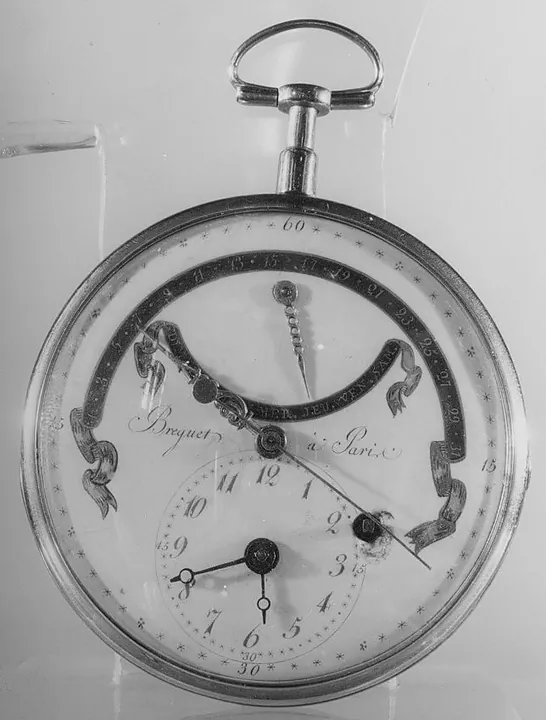
Pocket Watches · 1700–1799
Pocket watch by Breguet, Belgium, 1700–1799
Royal Institute for Cultural Heritage
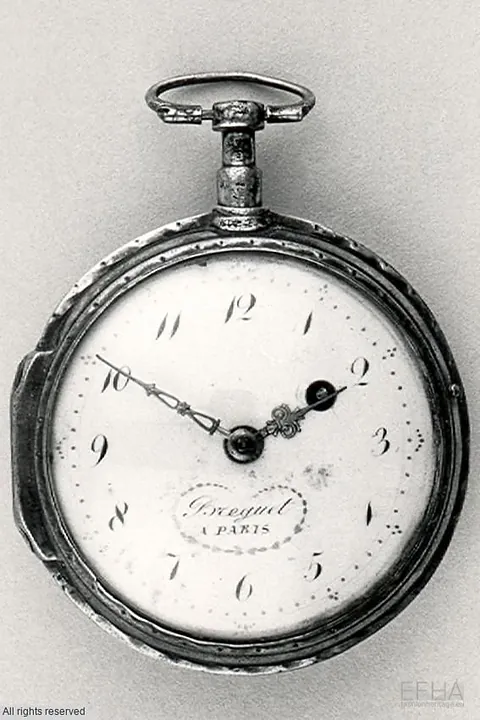
Pocket Watches · 1700–1799
Pocket watch by Breguet, France, 1700–1799
Fashion Museum of Antwerp
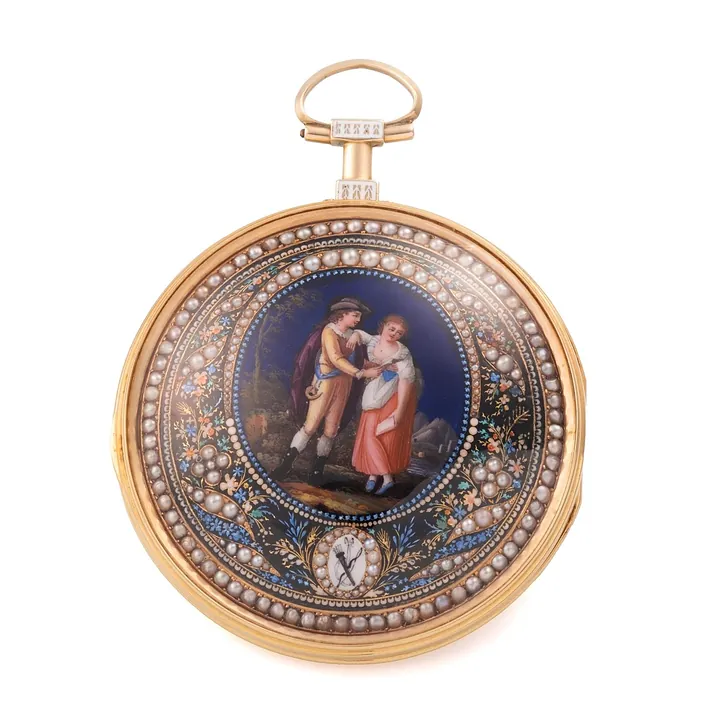
Pocket Watches · c. 1790
Breguet Love Letter, c. 1790
Antiquorum auction archive, Geneva
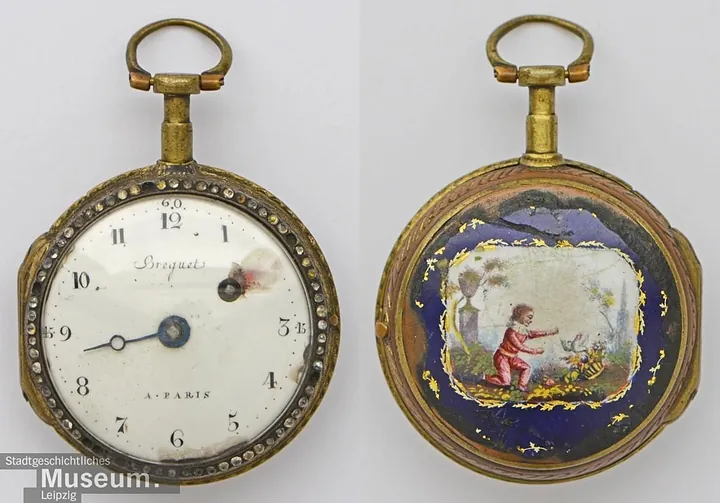
Pocket Watches · 1790
Pocket watch possibly by Breguet, France, 1790
Museum of City History Leipzig
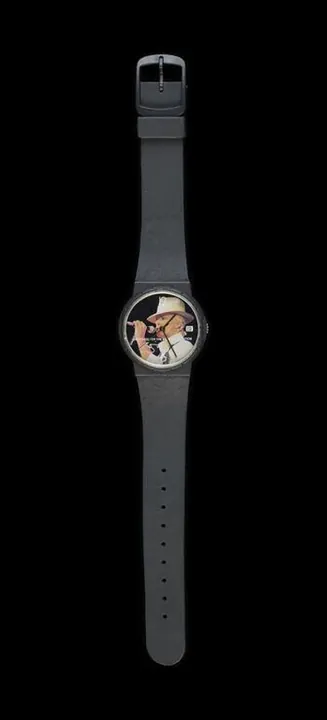
Wristwatches · 1991
Limited edition watch designed by Eta relating to David Bowie's Serious Moonlight live tour, 1991
Victoria and Albert Museum, London

Wristwatches · 2008
Wristwatch by Breitling?, 2008
Museum Rotterdam

Wristwatches · c. 1990s
Audemars Piguet Bamboo, c. 1990s
Antiquorum auction archive, Geneva

Wristwatches · c. 1990
Audemars Piguet Huitieme Perpetual Calendar, ref. 25696PT, c. 1990
Antiquorum auction archive, Geneva