
Clocks · Alarm clock
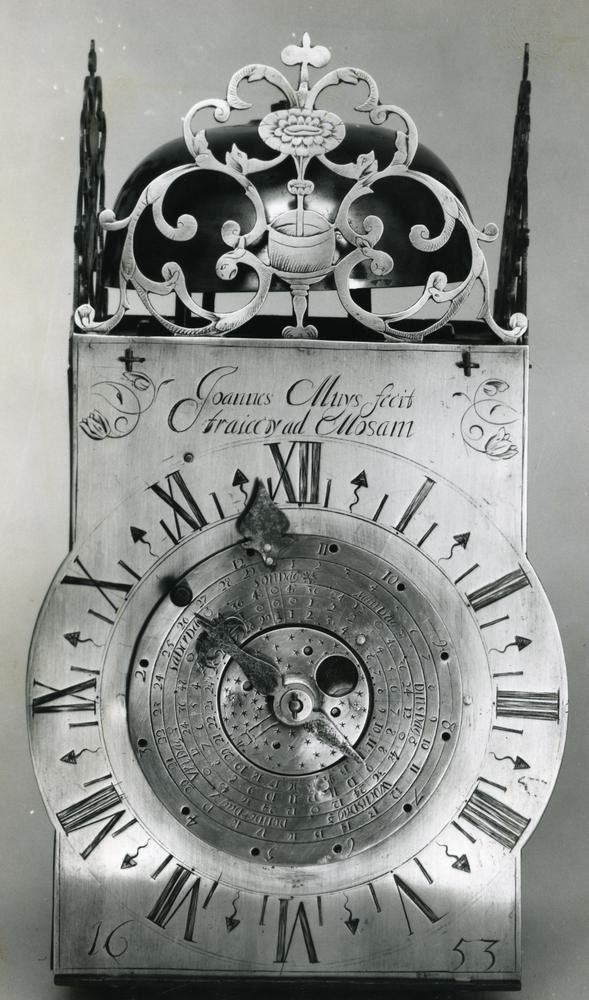
Brass wall lantern clock
- Maker / attribution
- Joannes Muijs (Made by)
- Date
- 1653
- Historical period
- Early Modern Horology (1600 – 1750)
- Country of origin
- Netherlands
- Place
- Maastricht
- Object type
- Alarm clock
- Materials / technique
- brass, steel
- Dimensions
- Height: 14 inches
- Holding institution
- British Museum
- Accession / object no.
- 1958,1006.2102
- Credit line
- British Museum, London
- Catalogue title (original)
- Brass wall lantern clock (English)
View the source record ↗ (opens another website in a new tab)Suggest a correction
Record summary
Held and catalogued by British Museum (object number 1958,1006.2102), this is an alarm clock by Joannes Muijs, made in Maastricht, Netherlands, dated 1653. The Atlas places it in the Early Modern Horology period (1600 – 1750) of its Clocks collection. Materials and techniques recorded by the source: brass, steel. Recorded dimensions: Height: 14 inches. The record is illustrated with 4 photographs.
Assembled from the source record's structured fields. Dates and attributions are given as the source states them; where a field is missing the Atlas leaves it blank rather than estimating.
Catalogue description
Description — British Museum
Brass wall lantern clock; verge escapement with balance; weight-driven; alarum; striking-train (hours only); dial-plate with outer revolving disc with fixed pointer (for the hours) and moveable pin (for releasing the alarum at the selected hour) and with divisions for the days of the week and age of the moon and the time when the moon crosses the meridian (read against the engraved pointer on the inner revolving disc); phase of moon shown in the aperture and the day of the week is indicated by the small steel hand. Train-counts: Going. Gt wheel 80 2nd wheel 60/8 Crown wheel 20/6* *very unusual but correct count. Going great wheel arbor has pinion of 10 to wheel of 60, mounted on reverse of which is a pinion of 6. This pinion of 6 drives pinion of 14 which carries day-of-week hand. Mounted on pinion of 6 is a pin which indexes a wheel of 10 once in 3 days, and therefore makes one complete revolution in 30 days. This wheel carries moon phase disc etc. Striking. Gt wheel 60 (with extended pinion of 6 to count-wheel of 45. 2nd wheel 60/10 3rd wheel 60/6 Fly 6.
Curator's comments — British Museum
The following text is the entry for this object from the unpublished catalogue of pre-pendulum clocks by John Leopold, former Assistant Keeper of Horology at the Museum. This information is unedited and should be used accordingly. xxxxxxxxxxxxxxxxxxxxxxxxxxxxxxxxxxxxxxxxxxxxxxxxxxxxxxxxxxx WALL CLOCK (STOOLCLOCK) BY JOANNES MUYS, MAASTRICHT,… 1653. Ilbert No. 57 A: no provenance. Bibliography. Baillie 2 (1947) 229. Cat.Ilbert (1958) no.273. Dawson etc. (1958) 163. Garner (1958) 197. Morpurgo (1970) 90. Mestrom (1977) 51. Edwardes (1996) 38-42. Signature. The dial is engraved: "Joannes Muys fecit traiecty ad Mosam 16 53" Case and dial. The case consists of the dial, the back plate, two doors, and ornamental frets on three sides. The back consists of an iron plate, having two lugs at the bottom to fit into slots in the bottom plate of the movement, and two slots at the top to accomodate lugs on the top plate of the movement; the back is secured by pins throught these lugs. The present back has no trace of an aperture for the pendulum which this clock undoubtedly had at one time (see Conversions), and is a modern replacement. The present brass doors are also modern replacements. They are hinged in brass hoops riveted to the back; this may well have been the way the original doors were hinged, since there are no holes in the corners of the movement plates for the conventional hinging. The brass dial plate is attached to the movement in the same way that the back is. The dial is engraved at the top with the signature between two floral sprigs, and at the bottom with the date. In the centre is a large aperture surrounded by the chapter ring (see below). All this engraving has traces of black wax filling. The back of the dial plate has scribe lines. There are three brass frets: two at the sides, screwed to the top plate of the movement, and one riveted to the top of the dial plate. All three are pierced in the same patern, but there are differences in the engraving between the front and the sides: the ornament of the side frets is centred around a mask, while that of the front has a vase in the centre. The top of the right-hand fret, which had broken off, has been neatly repaired and the added part engraved: this repair may already have taken place during manufacture of the clock. The top of the front fret has also broken off and has been replaced, with lighter engraving on the replaced part. The dial consists of the chapterring and its mobile centre. The chapterring is engraved I - XII with wavy arrows as half-hour marks and plain bars for the quarters. The aperture inside the chapterring accomodates the mobile dial-centre, which revolves once in 12 hours and carries, riveted to the edge, the iron hourhand. Four filled holes in the dial plate around the aperture seem to indicate that there originally was a ring riveted to the back of the plate, to form a shoulder for the mobile centre. The centre itself is composed of a wide ring riveted to a disc behind it; this disc is screwed to the pipe of the hourhand wheel, and is covered by a further mobile disc. The recessed disc is engraved with four representations of the moon, in its four quarters; these portions are silvered. Over this part revolves the mobile disc of the moon; it has an aperture to show the phases of the moon (and four smaller ones for adjusting), and is otherwise engraved with stars and a human arm with hand. The hand points to the inner ring of the mobile centre, marked 1 - 29½ for the lunar date. The same hand additionally refers to the next two rings, which are marked 0 - 12 - 0 and 48, 36, 24, 12, 0 (repeated six times). Together these rings indicate the period of moonshine after sunset or before sunrise for each lunar day, thus: lunar day 1 - 0 hour 48 min; l.d.2 - 1 h.36 min.; l.d.3 - 2 h. 24 min.; etc. At lunar day 4 the hour, which should be 3, is wrongly marked 2. Around these lunar rings is one marked "sondag mandag dinsdag woensdag donderdag vridag saderdag", the weekdays in Dutch, each marked with the symbol of the appropriate planet; the day is indicated by the steel hand. Around the ring of the weekdays is another one marked 1 - 29½ for the lunar date, and also read from the engraved arm. The outer ring, finally, is marked counter-clockwise 1 - 12; it has twelve apertures for inserting a peg to release the alarm, and the figures indicate the number of hours of sleep provided for when the alarm is set. The pipes at the centre of the discs, as well as the week-day hand, have been replaced (see conversions). Movement. Posted frame movement; three iron plates (two at the top) connected at the corners by massive profiled round brass pillars with square pediments. The pillars are screwed to the plates by steel nuts, with brass pipes as spacers between the top plates. Movement largely made of brass, with the exception of the plates, the disc of the countwheel and the (later) scape wheel, which are of iron. Unusually thick wheels; all have four crossings except the scape wheel and the third wheel striking, which have three, and the alarm wheel which is solid. Going train. Traincount: 10 ║ 80 60 ── ║ ── ── 20 (x 2) 12-hours 60 ║ 8 6 Greatwheel: mounted friction-tight on the arbor, to which the unlocking-star for the striking is pinned and which carries the pinion of report. Friction-plate of brass with riveted steel centre. Face-click which has worn deeply into the crossings of the wheel. Cordwheel with brass discs. Scape wheel: steel wheel of unconventional count; the pinion is too narrow to engage the entire width of the 2nd wheel. Wheel and pinion are a restoration. Wheel balance, potence, cock and gallows all restored. The pinion-of-report has an arbor with a square hole, which slides onto the square of the great-wheel arbor. This square has a pinhole, but the pinion-arbor has been altered and can no longer be pinned. The wheels for the dial are all mounted on pipes, running on a steel arbor riveted solid with the fron
Inscriptions & marks
signature; Joannes Muys, Mosam [movement]
Provenance
Previous owner/ex-collection:, Courtenay Adrian Ilbert; Donated by:, Gilbert Edgar
Historical context
Early Modern Horology (1600 – 1750)
Huygens' pendulum and balance spring transform accuracy; English makers develop the anchor and deadbeat escapements.
Huygens's pendulum (1656–57) improved clock accuracy from about a quarter of an hour to under a minute a day. The anchor escapement (c. 1670) and the long seconds pendulum created the longcase clock; London makers such as Fromanteel, Knibb, Tompion and Quare led European clockmaking, and French makers created the Boulle pendule.
Read the period in the timelineMore clocks from this periodEarlier: Renaissance Horology
Atlas type guide
Alarm clocks
Alarm work is among the oldest clock functions: monastic clocks woke monks for night prayers, and Renaissance table clocks often carried an alarm disc set by a pin. A separate spring or weight is released at the set time and drives a hammer against a bell. Some early alarms also lit a candle by striking a flint — the 'tinder pistol' alarm.
The cheap, mass-produced alarm clock arrived in the second half of the nineteenth century. American firms such as Seth Thomas and Westclox (the 'Big Ben' of 1910) and German makers such as Junghans and Kienzle made millions of drum-shaped alarms with pin-pallet escapements. Electric, quartz and digital alarm clocks followed in the twentieth century.
What to look for
- A separate alarm-setting dial or disc and an extra winding key.
- Twin bells on top (common after c. 1920) or a bell enclosed in the base.
- Pin-pallet escapements in inexpensive factory alarms.
- Trademarks and patent dates on dial or back.
Dating clues
- Renaissance alarm table clocks: sixteenth to seventeenth centuries.
- Drum alarm clocks: from the 1870s.
- Luminous dials with radium paint: c. 1910–1960.
General guidance written by the Atlas editors about this kind of object. It is not a statement about this particular piece; for that, rely on the source record above and on physical examination.
Read next:Anchor (recoil) escapement
Related records
Clocks · 1650
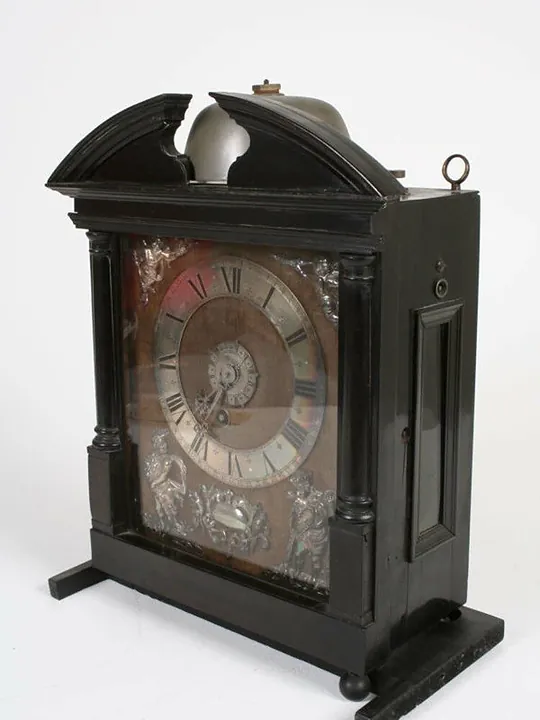
Clock by J.J. van Leeuwaarden, Netherlands, 1650
City Museum Zutphen
Clocks · 1680
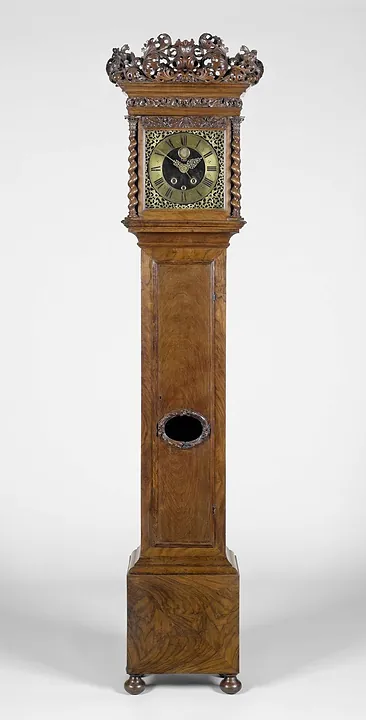
Longcase clock, Netherlands, 1680
Rijksmuseum
Clocks · c. 1690–94
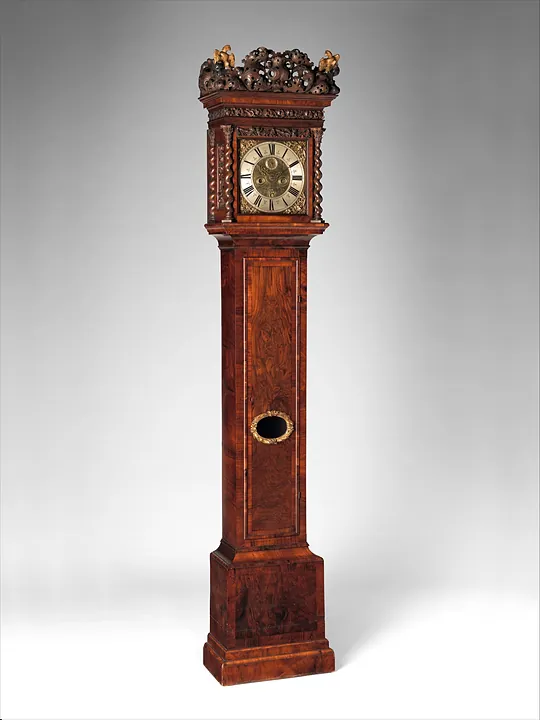
Longcase clock, movement by Ahasuerus II Fromanteel, Netherlands, c. 1690–94
The Metropolitan Museum of Art, New York
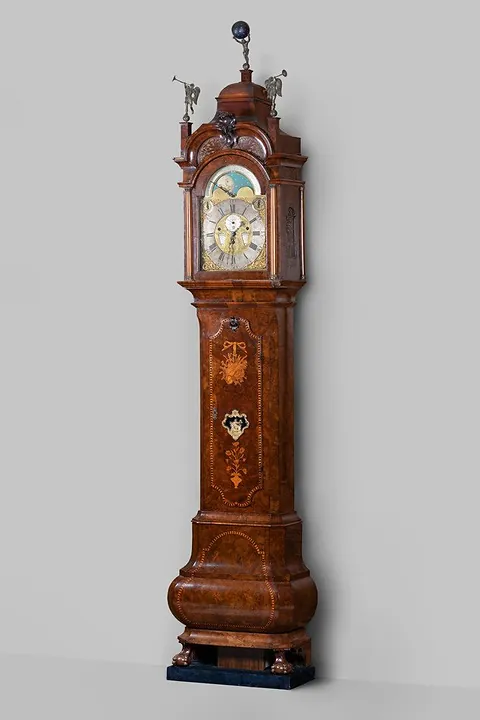
Clocks · 1715
Longcase clock by Paulus Bramer, Netherlands, 1715
Geldersch Landschap & Kasteelen
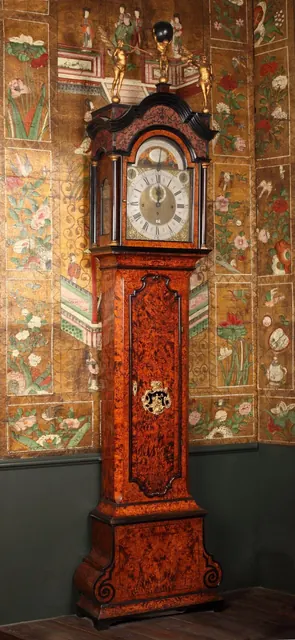
Clocks · 1715–1725
Longcase clock by Roger Dunster, Netherlands, 1715–1725
Victoria and Albert Museum, London
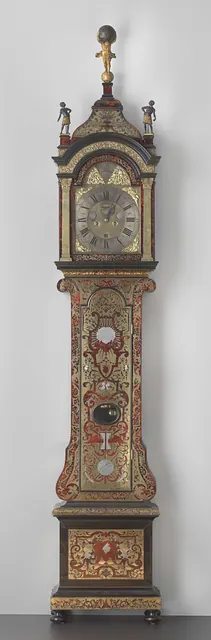
Clocks · c.1715 - c.1725
Longcase clock
Rijksmuseum
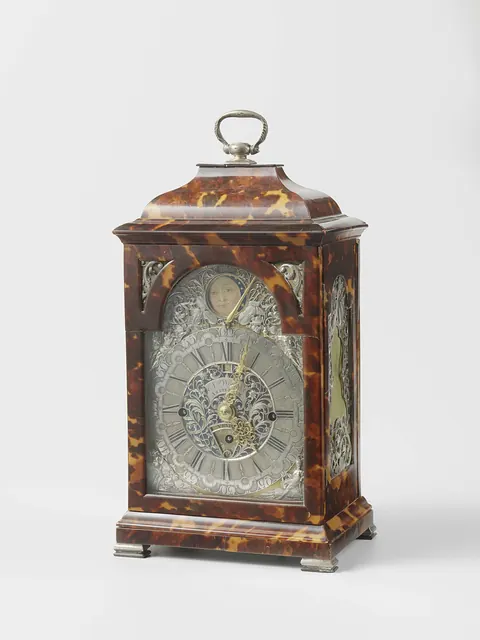
Clocks · c.1730 - c.1750
Mechanical clock, Netherlands, c.1730 - c.1750
Rijksmuseum
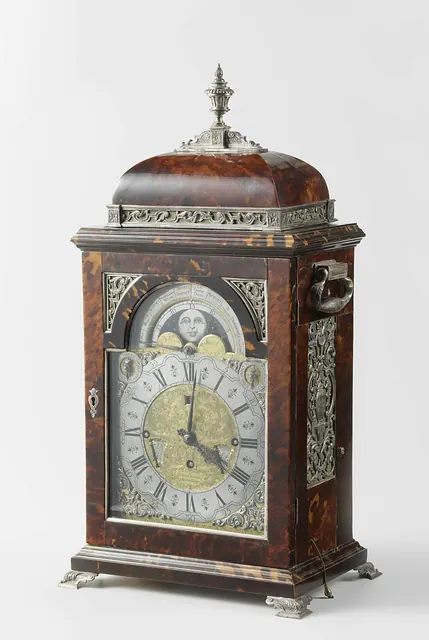
Clocks · c.1700 - c.1725
Furniture, Netherlands, c.1700 - c.1725
Rijksmuseum