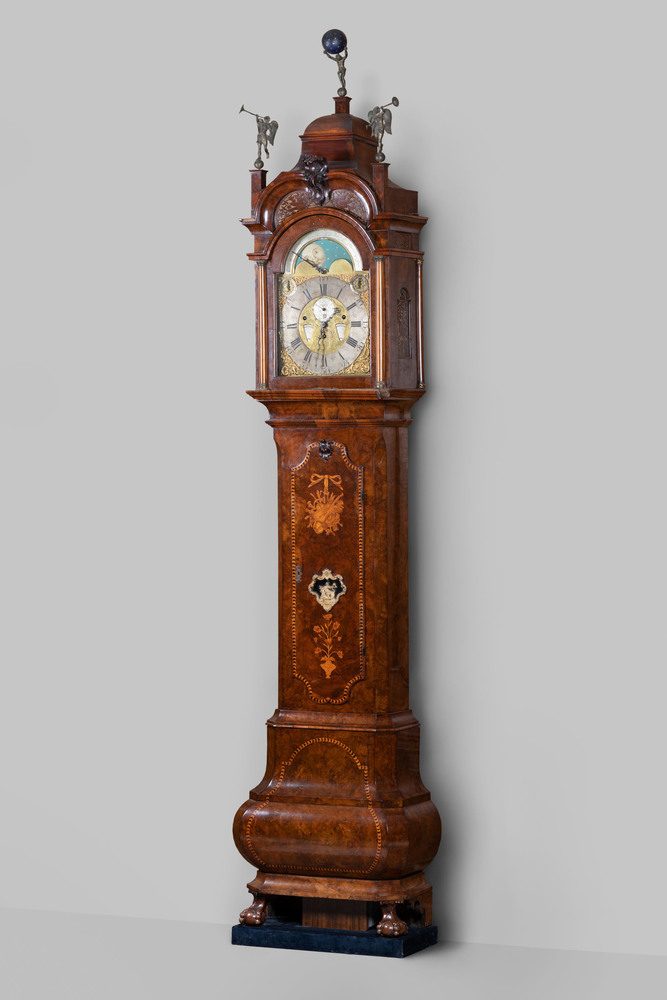
Clocks · Longcase clock
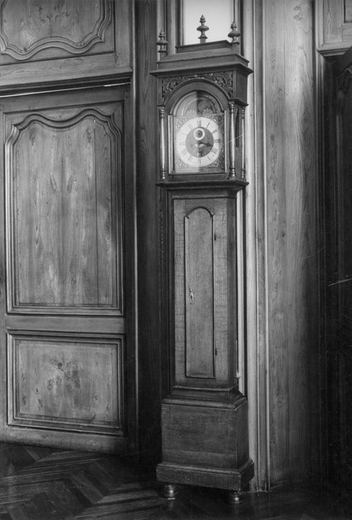
Longcase clock by Paulus Bramer, Netherlands, 1715
- Maker / attribution
- Paulus Bramer (creator)
- Date
- 1715
- Historical period
- Early Modern Horology (1600 – 1750)
- Country of origin
- Netherlands
- Object type
- Longcase clock
- Holding institution
- Geldersch Landschap & Kasteelen
- Accession / object no.
- resource_document_collectiegelderland_35K7T4JFPQJKXSG2BRQRNXBZTLL6XVTQZ3VR2YNOT4LHCXWP7N6A
- Catalogue title (original)
- Staande klok (Dutch)
Record summary
Held and catalogued by Geldersch Landschap & Kasteelen (object number resource_document_collectiegelderland_35K7T4JFPQJKXSG2BRQRNXBZTLL6XVTQZ3VR2YNOT4LHCXWP7N6A), this is a longcase clock by Paulus Bramer, made in Netherlands, dated 1715. The Atlas places it in the Early Modern Horology period (1600 – 1750) of its Clocks collection. The record is illustrated with 1 photograph.
Assembled from the source record's structured fields. Dates and attributions are given as the source states them; where a field is missing the Atlas leaves it blank rather than estimating.
Catalogue description
Catalogue description from Geldersch Landschap & Kasteelen (Dutch)
Staande klok in een kast van wortelnotenhout. Het voetstuk heeft schuin geplaatste hoekstijlen en rust op vier poten. De kastdeur is aan de boven- en onderkant geschulpt met aan de bovenkant een kuifstuk en in het midden een verguld koperen beslagstuk met een allegorische voorstelling van Europa op een stier. De kap wordt geflankeerd door vier Dorische zuilen en heeft een geschulpte kaplijst met kuifstuk en opengewerkt fries. Bovenop staan op drie bollen drie goudkleurige figuren. In het midden Atlas en rechts en links de Faam en de Tijd. De bovenste wijzerplaat toont de maandstand en datum, de onderste de tijd. Rondom de wijsplaten zijn vergulde versieringen met bladeren en krulwerk aangebracht. Op de onderste wijzerplaat is de naam van de maker 'Paulus Bramer / Amsterdam' te lezen.
Shown in the original language of the source catalogue. An editor-reviewed English translation has not yet been published; we do not publish machine translations as authoritative text.
Historical context
Early Modern Horology (1600 – 1750)
Huygens' pendulum and balance spring transform accuracy; English makers develop the anchor and deadbeat escapements.
Huygens's pendulum (1656–57) improved clock accuracy from about a quarter of an hour to under a minute a day. The anchor escapement (c. 1670) and the long seconds pendulum created the longcase clock; London makers such as Fromanteel, Knibb, Tompion and Quare led European clockmaking, and French makers created the Boulle pendule.
Read the period in the timelineMore clocks from this periodEarlier: Renaissance Horology
Atlas type guide
Longcase (tall-case or grandfather) clocks
The longcase clock was born from two seventeenth-century innovations: Christiaan Huygens's pendulum (1656–57) and the anchor escapement (c. 1670). A long seconds pendulum, nearly a metre long, swings with a small arc, and enclosing it together with the driving weights in a tall wooden case protected the mechanism and created a new piece of furniture. London makers such as Ahasuerus Fromanteel, Thomas Tompion and Joseph Knibb set the pattern.
By the eighteenth century longcase clocks were made throughout Britain, the Netherlands, Scandinavia (the Swedish Mora clock), France (the Comtoise from the Franche-Comté), Germany and colonial America. Eight-day movements with two weights became standard in better clocks; thirty-hour clocks with one weight and a rope or chain were cheaper alternatives.
What to look for
- Winding holes in the dial: two (eight-day, going and striking) or none (thirty-hour, pulled up by a chain).
- Brass dials with applied chapter rings (earlier) versus painted iron 'white' dials (after c. 1770 in Britain).
- Moon-phase arches, date apertures, seconds dials and maker's name on the dial.
- Case woods and style: ebonised, walnut marquetry, lacquer, oak or mahogany; regional styles from London, Lancashire, Scotland or America.
- Whether the movement and dial match the case — 'marriages' are common.
Dating clues
- Square brass dials suggest c. 1670–1720; arched brass dials c. 1715–1790.
- Painted (white) dials were made by Birmingham dial-makers from about 1772.
- Comtoise clocks with repoussé pendulums are mostly nineteenth century.
General guidance written by the Atlas editors about this kind of object. It is not a statement about this particular piece; for that, rely on the source record above and on physical examination.
Related records
Clocks · 1550–1650
Turret clock, Netherlands, 1550–1650
Museum Klok & Peel
Clocks · 1650
Clock by J.J. van Leeuwaarden, Netherlands, 1650
City Museum Zutphen
Clocks · 1680
Longcase clock, Netherlands, 1680
Rijksmuseum
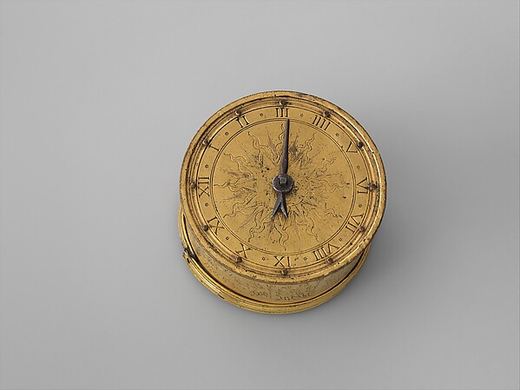
Clocks · case 1554, movement ca. 1680
Table clock by Caspar Behaim (Chasparus Bohemus), Austria, case 1554, movement ca. 1680
The Metropolitan Museum of Art, New York
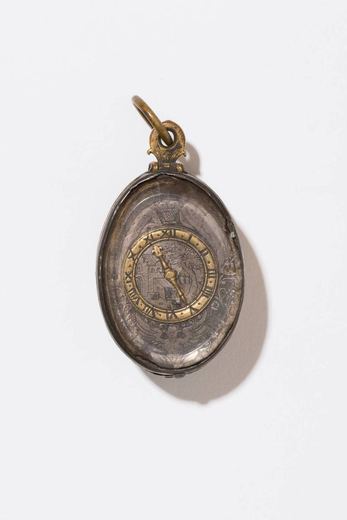
Clocks · 1590–1610
Clock, France, 1590–1610
MAK – Museum of Applied Arts
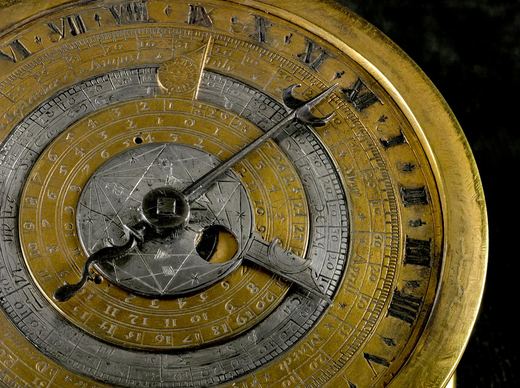
Clocks · 1598-1603
Circular table-clock with calendrical and lunar indications made by Nicholas Vallin in London between 1598 and 1603.
Science Museum Group, London
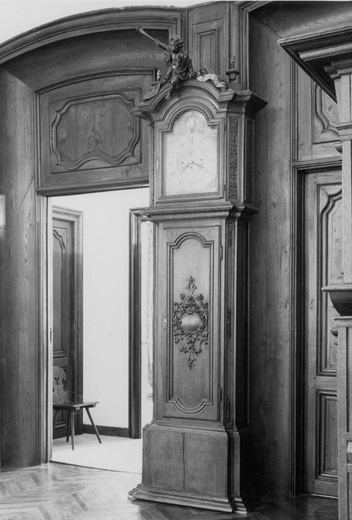
Clocks · 1600–1699
Clock by Joannes Volcker, Belgium, 1600–1699 (Royal Institute for Cultural Heritage AP_10156031)
Royal Institute for Cultural Heritage
Clocks · 1600–1699
Clock by Joannes Volcker, Belgium, 1600–1699 (Royal Institute for Cultural Heritage AP_10156032)
Royal Institute for Cultural Heritage