
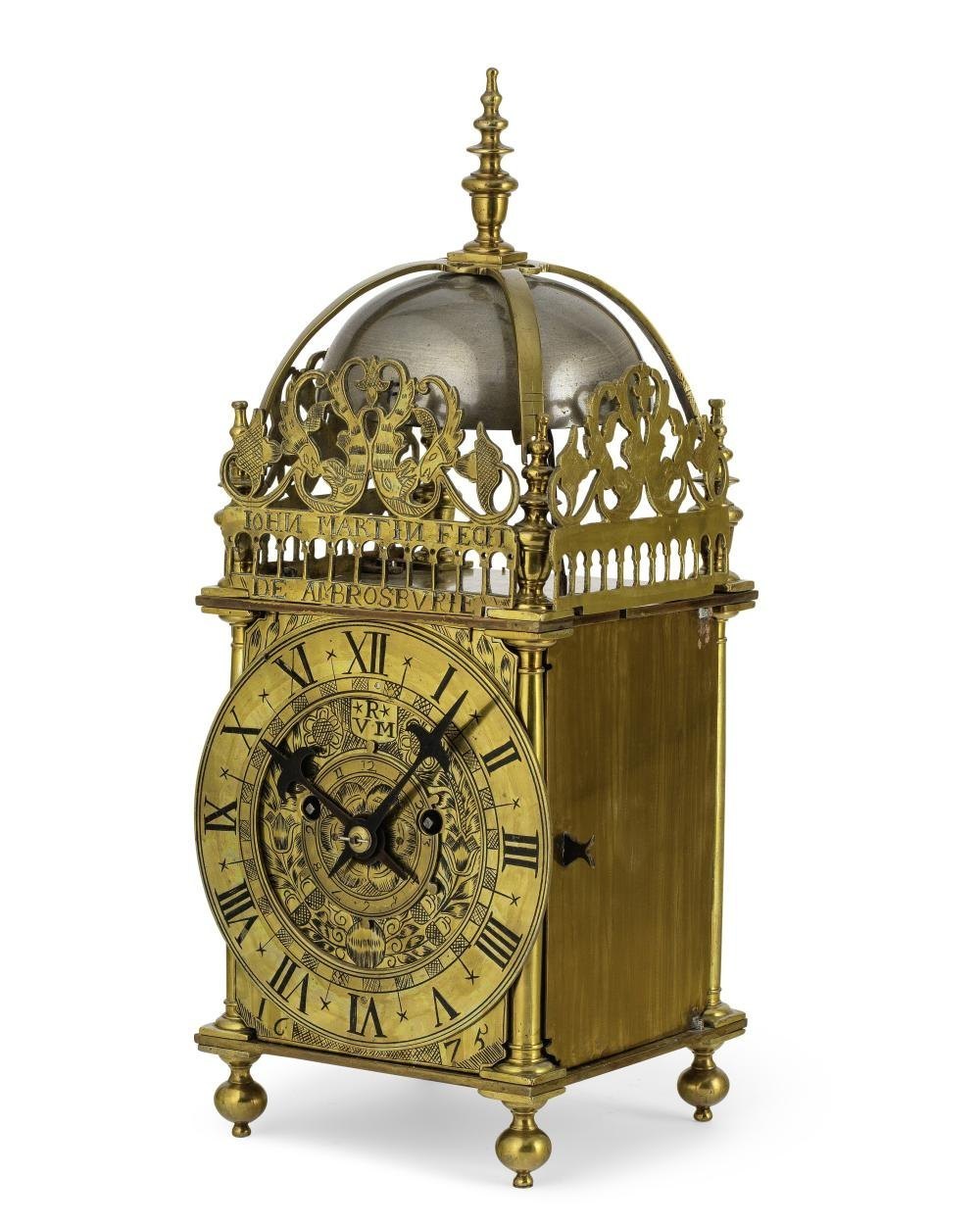
Clocks · Lantern clock
Brass lantern clock
- Maker / attribution
- John Martin (source attribution)
- Date
- 19th century
- Historical period
- Precision & Scientific Horology (1750 – 1850)
- Country of origin
- Unrecorded in source
- Object type
- Lantern clock
- Dimensions
- 40 cm
- Holding institution
- Bonhams, via Invaluable
- Accession / object no.
- brass-lantern-clock-1a59b41d27
- Credit line
- Bonhams, via Invaluable
- Catalogue title (original)
- Brass lantern clock with late 19th century twin fusee movement (English)
View the source record ↗ (opens another website in a new tab)Suggest a correction
Record summary
Held and catalogued by Bonhams, via Invaluable (object number brass-lantern-clock-1a59b41d27), this is a lantern clock attributed to John Martin, dated 19th century. The Atlas places it in the Precision & Scientific Horology period (1750 – 1850) of its Clocks collection. Recorded dimensions: 40 cm. The record is illustrated with 1 photograph.
Assembled from the source record's structured fields. Dates and attributions are given as the source states them; where a field is missing the Atlas leaves it blank rather than estimating.
Catalogue description
Original object description
Standing roughly 40 cm high on ball feet with turned corner pillars, this brass lantern clock is an assembled composite pairing a 19th-century movement with seventeenth-century style casing. Surmounting the body are corner finials, a bell framework holding an hour-striking bell, and a non-original top finial. The 6.5-inch brass dial is dated 1675 and features a cartouche marked 'RVM', Roman numerals punctuated by star-shaped half-hour indications, and an inner floral alarm disk with Arabic numbering enclosing a Tudor rose motif. An anchor escapement governs the double chain fusee strike movement, and an engraved fret carries the inscription 'John Martin Fecit De Ambroseburie'. Auction specialists observed modern replacements throughout the clock—including the hands, side doors, brass plates, frets, and the rear cover—and underscored the fundamental date divergence between the 1675 dial marking and the late-nineteenth-century mechanism.
Historical context
Precision & Scientific Horology (1750 – 1850)
Harrison solves longitude; Mudge invents the lever; Breguet's Paris workshop defines the modern watch.
The age of the deadbeat escapement, compensated pendulums and observatory regulators. Domestic clocks spread through the middle classes: English longcase and bracket clocks, French gilt-bronze mantel clocks, Viennese Biedermeier wall clocks, Black Forest painted-shield clocks, and the first American shelf clocks.
Read the period in the timelineMore clocks from this periodEarlier: Early Modern Horology
Atlas type guide
Lantern, chamber and Gothic clocks
Domestic weight-driven clocks were made in southern Germany, Switzerland, Italy and Flanders from the fifteenth century. These 'Gothic' or chamber clocks have an open iron frame with corner posts, a verge escapement controlled by a foliot or balance wheel, and often an alarm or hour striking on a bell mounted above.
In England the lantern clock appeared around 1600: a brass posted-frame clock with a bell on top under decorative frets, hung on a hook or set on a wall bracket. After about 1658 many were converted to pendulum control, so originality of the escapement is a key question for any surviving example.
What to look for
- Iron (continental) or brass (English) posted frames with turned corner pillars and finials.
- A single hour hand — minute hands are rare before the pendulum era.
- Evidence of conversion: plugged holes, replaced escapement wheels or later pendulums.
- Fret designs and engraving on the dial centre, which help date English lantern clocks.
Dating clues
- Continental Gothic chamber clocks: c. 1450–1650.
- English lantern clocks: c. 1600–1720, with provincial examples later.
- Short 'bob' pendulum conversions after 1658; long pendulums with anchor escapement after c. 1670.
General guidance written by the Atlas editors about this kind of object. It is not a statement about this particular piece; for that, rely on the source record above and on physical examination.
Read next:FoliotVerge escapement
Related records
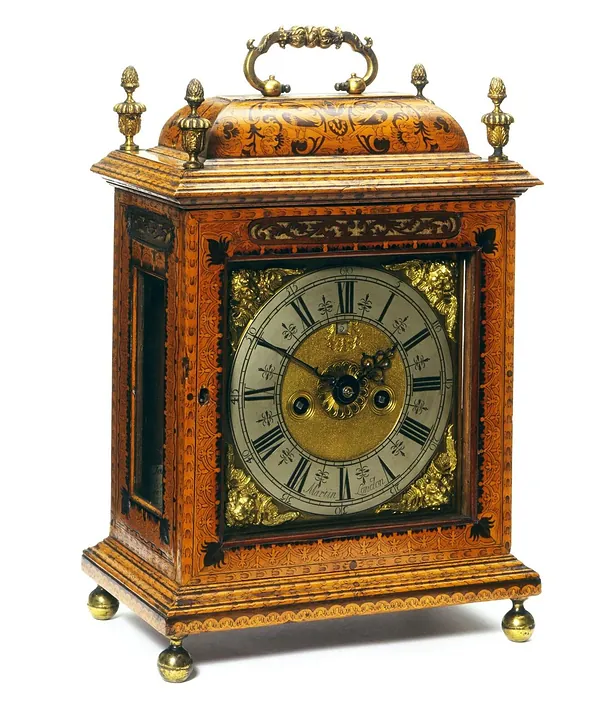
Clocks · c. 1695
Bracket clock, English; London, 1690-1700, by John Martin
Victoria and Albert Museum, London
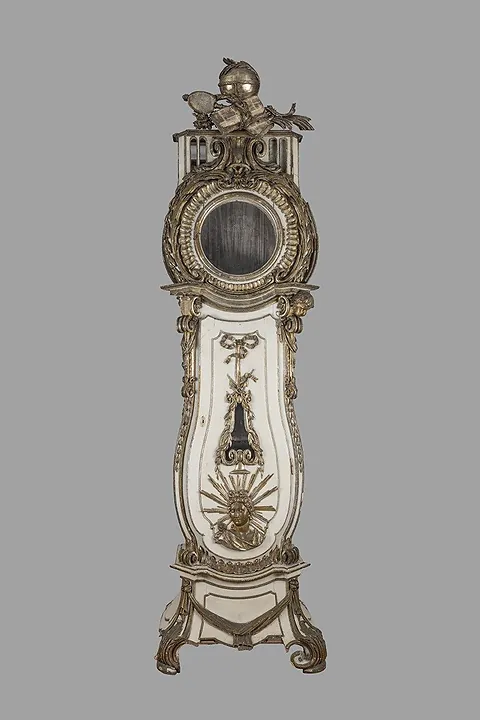
Clocks · c. 1780
Longcase clock by Louis George, Eberswalde, c. 1780
Museum Eberswalde
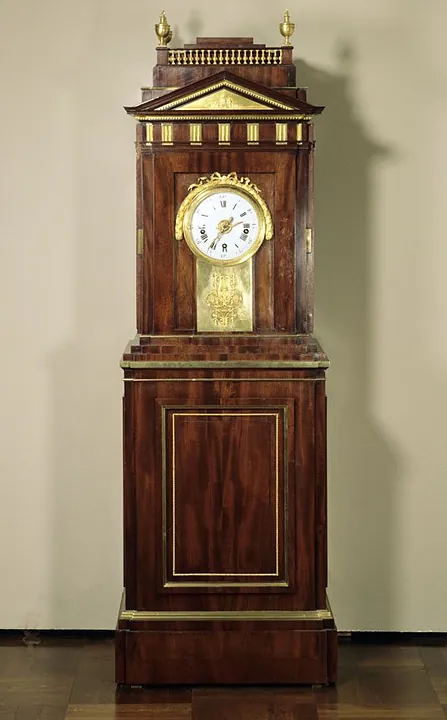
Clocks · 1780s (inferred: the museum dates the style to the 1780s and the music includes Gluck's Iphigénie en Tauride of 1779)
Musical longcase clock, Roentgen workshop, Neuwied, 1780s
Badisches Landesmuseum Karlsruhe
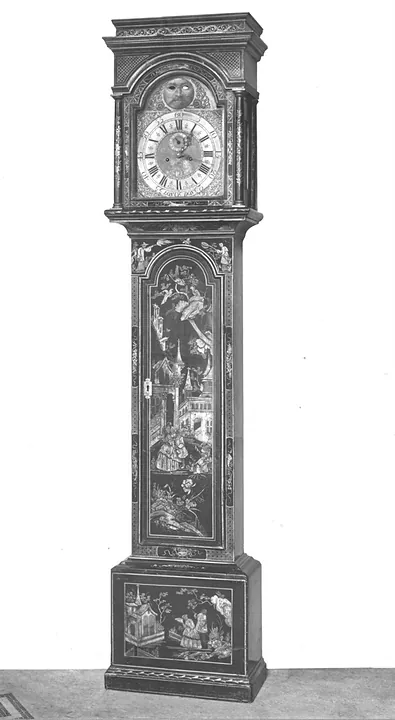
Clocks · 1740–1760
Longcase clock, English, 1740–1760, japanned wood, John Ellicott
Victoria and Albert Museum, London
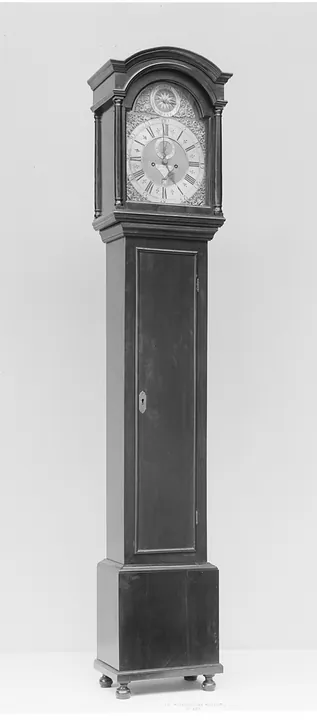
Clocks · 1740–60
Tall clock by Samuel Bagnall, United States, 1740–60
The Metropolitan Museum of Art, New York
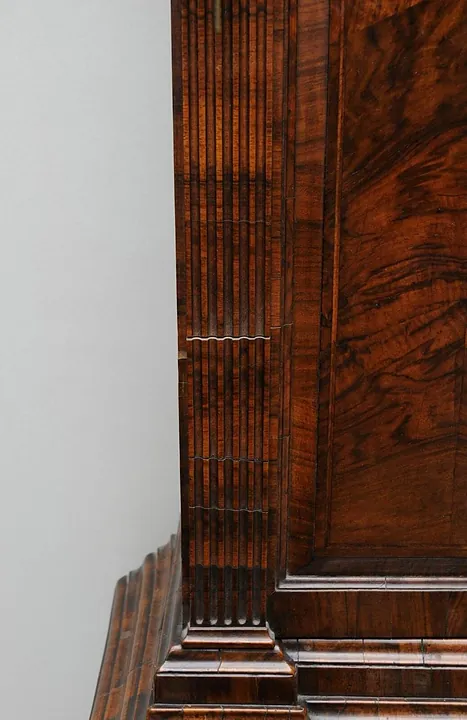
Clocks · c.1750
Long-case clock, English, ca. 1750, by Richard Peyton of Gloucester
Victoria and Albert Museum, London
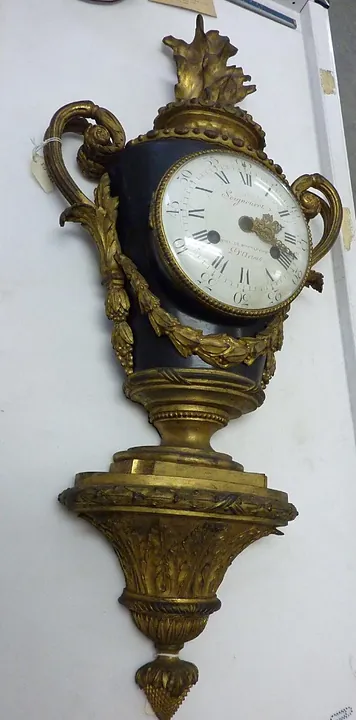
Clocks · 1750–1800
Bracket clock in metal case with scroll handles and flamed-shaped top signed by Pierre Seignoret, Clockmaket to the the Comte d'Artois
Victoria and Albert Museum, London
Clocks · c. 1750
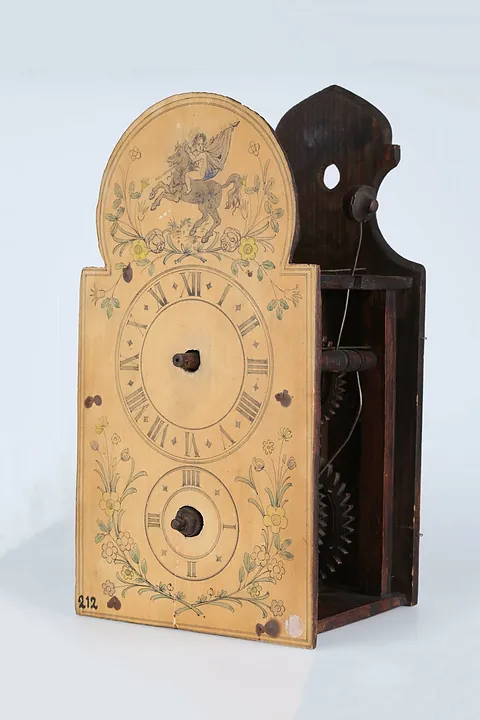
Clock by Georg Gfell, Germany, c. 1750
German Clock Museum