
Wristwatches · Wristwatch
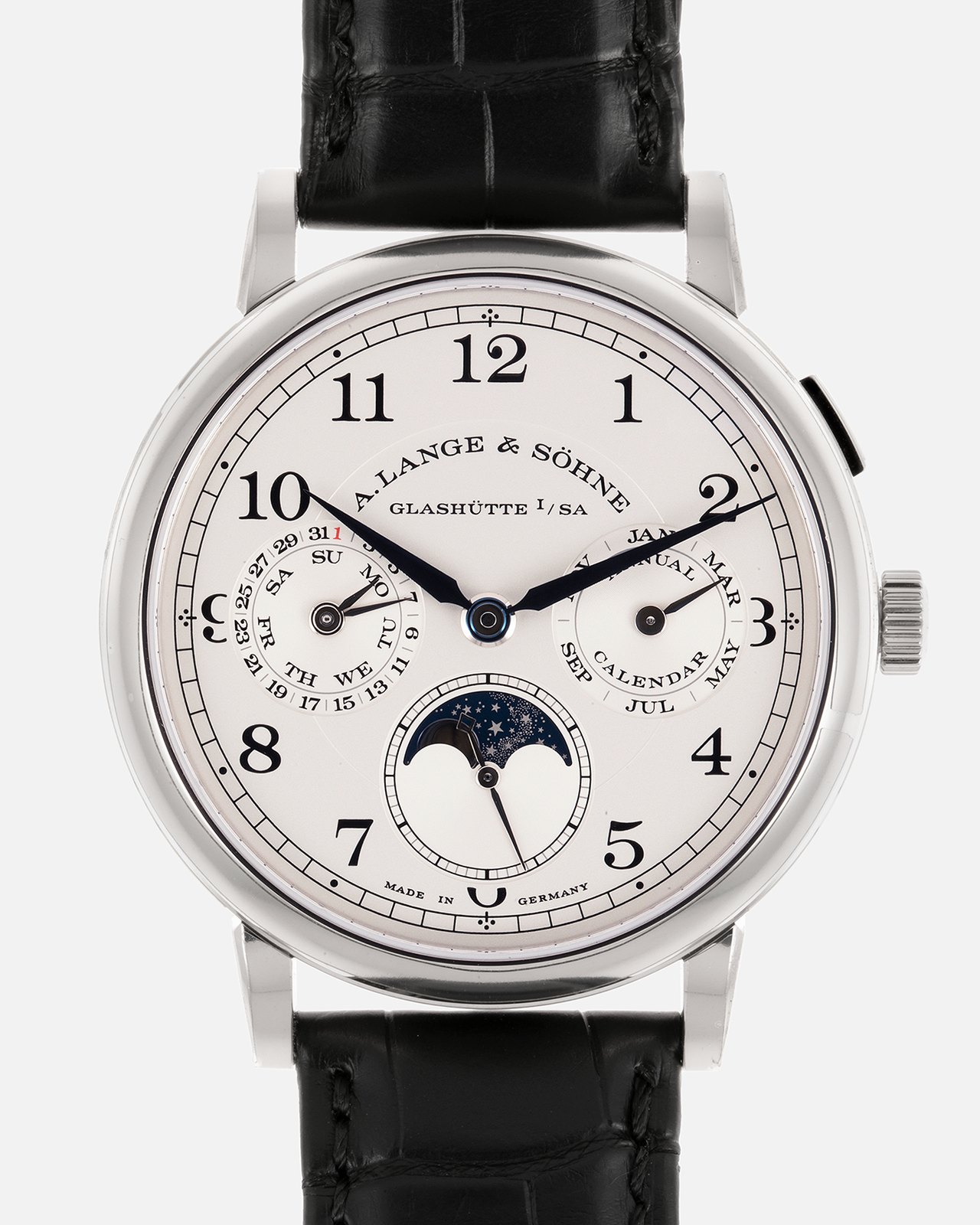
A. Lange & Sohne 1815 Annual Calendar Stickered, 2022
- Maker / attribution
- A. Lange & Sohne (maker)
- Date
- 2022
- Historical period
- Contemporary Horology (2010 – Present)
- Country of origin
- Germany
- Object type
- Wristwatch
- Dimensions
- Case 40 mm
- Stock no.
- Product 6824036434007
- Credit line
- Dealer listing, S.Song Watches (product 6824036434007)
- Catalogue title (original)
- A. Lange & Sohne 1815 Annual Calendar Stickered (English)
View the source record (dealer listing) ↗ (opens another website in a new tab)Suggest a correction
Record summary
Catalogued by S.Song Watches (dealer), Seattle (stock number Product 6824036434007), this is a wristwatch by A. Lange & Sohne, made in Germany, dated 2022. The Atlas places it in the Contemporary Horology period (2010 – Present) of its Wristwatches collection. Recorded dimensions: Case 40 mm. The record is illustrated with 6 photographs.
Assembled from the source record's structured fields. Dates and attributions are given as the source states them; where a field is missing the Atlas leaves it blank rather than estimating.
Catalogue description
Dealer description — S.Song Watches
When thinking of the real heavyweights in Haute Horlogerie, only a few big names come to mind- Patek Philippe, Vacheron Constantin, Audemars Piguet, and of course, the Germans next door, A. Lange & Sohne. While many see Swiss watches as the pinnacle of watchmaking, Lange serves as a reminder that this isn’t the case. In fact, one can say that in some areas, Lange is considered much better than its Swiss counterparts. The A. Lange & Sohne 1815 Annual Calendar is certainly a contender. Released in 2017, the Annual Calendar sits in the middle of the 1815 family and provides a practical and elegant dress watch that is just as appropriate in the boardroom as it is in the ballroom. Sized at a modern 40mm, the 18k white gold case sits nicely on the wrist and is well-balanced despite the larger size. This is largely in part due to the shorter, angled lugs and the contrasting brushed and polished finishes throughout that give it a more streamlined feel. All 1815 watches are characterized by the classic Lange-style Arabic numerals and this Annual Calendar is no exception. With a stunning matte silver dial that looks luminously porcelain-like, it is fitted with blued steel hands that match the beautiful 3D moon phase. While most watches have flat moon phases, I always love the depth achieved through Lange’s raised moon and stars. While the moon occupies the 6 o’clock subdial, the 9 o’clock subdial displays the day and date while the 3 o’clock sub dial displays the month. For that much information needing to be displayed, it is all very legible and well-designed. Rewinding back slightly, the annual calendar complication was invented and patented by Patek Philippe in 1996 as they realized that there was a gap between a simple calendar watch and the highly complicated perpetual calendar complication. While a simple calendar must be adjusted every month, and a perpetual calendar never needs to be adjusted, even on leap years, an annual calendar sits in the middle, where the user only has to adjust the watch once a year in February, while the mechanism takes care of the 30 and 31 days of the rest of the year. The highly expensive perpetual calendar was too inaccessible and the annual calendar provided the perfect balance between practicality and cost. As a result, many brands such as Lange began adopting this complication. What makes this Annual Calendar a bit different and even more usable, is the placement of a large pusher at 2 o’clock. While most calendar watches require you to set the watch via mini pushers, the Lange provides one extra step. This 1815 Annual Calendar has your traditional mini pushers, but once that is set, you can use the large pusher to move all of it at the same time, which means if you forget to wind your watch for a few days, you can easily bring the calendar back to the correct day, date and month with a few pushes. This Lange is powered by the in-house manual-winding Caliber L051.3. As with all Lange’s, this movement is beautiful both in its architectural design and its finishing. Made from German silver, you get a nice yellow patina on the three-quarter plate that gives a good contrast to the overall aesthetic. It has a power reserve of 72 hours and of course, features a beautifully hand-engraved balance cock. This A. Lange & Sohne 1815 Annual Calendar is a serious watch and is really up there with some of the best. You get a complicated watch that is both practical and beautifully designed, finished to the highest level.
Historical context
Contemporary Horology (2010 – Present)
Silicon components, connected watches, optical-lattice research clocks and a thriving independent scene.
Smartwatches became the world's best-selling watches, while mechanical watchmaking focuses on craft, innovation (silicon components, new escapements) and independent makers.
Read the period in the timelineMore wristwatches from this periodEarlier: Mechanical Renaissance
Atlas type guide
Calendar, moon-phase and perpetual calendar watches
Calendar complications range from a simple date to the perpetual calendar, which automatically allows for months of different lengths and leap years until 2100. Pocket watches with perpetual calendars were made in the eighteenth and nineteenth centuries; Patek Philippe made the first perpetual calendar wristwatch in 1925, and series production followed in 1941. The annual calendar (Patek Philippe, 1996) needs correction only once a year.
Moon-phase displays use a disc with two moons and 59 teeth advanced daily, approximating the 29.5-day lunation; more precise trains reduce the error to one day in over a century.
What to look for
- Apertures or subsidiary dials for day, date, month and leap year.
- Moon disc under a 'bosom' shaped aperture.
- Recessed correctors on the case band for setting the calendar.
Dating clues
- Triple-date wristwatches: popular c. 1940–1955.
- Perpetual calendar wristwatches: from 1925 (unique) and 1941 (series).
General guidance written by the Atlas editors about this kind of object. It is not a statement about this particular piece; for that, rely on the source record above and on physical examination.
Related records
Wristwatches · originally sold on 16 December 2001 (per the lot record)
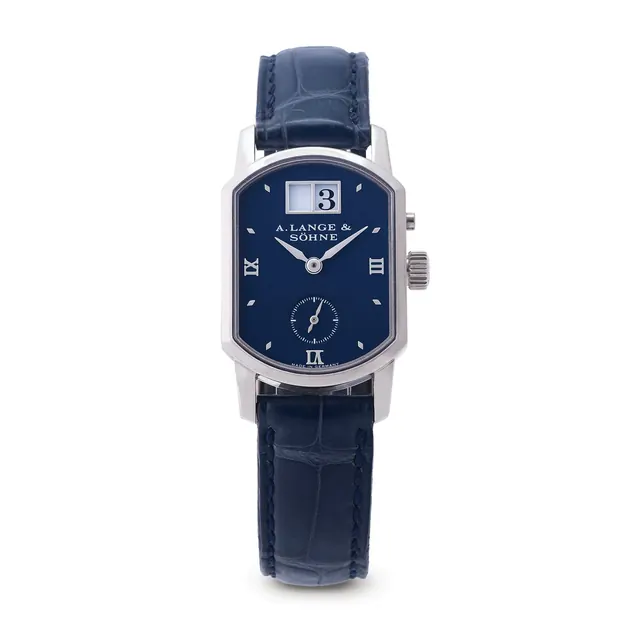
A. Lange & Sohne wristwatch, ref. 103.027, Arkade, originally sold on 16 December 2001
Antiquorum auction archive, Geneva
Instruments · c. 1942
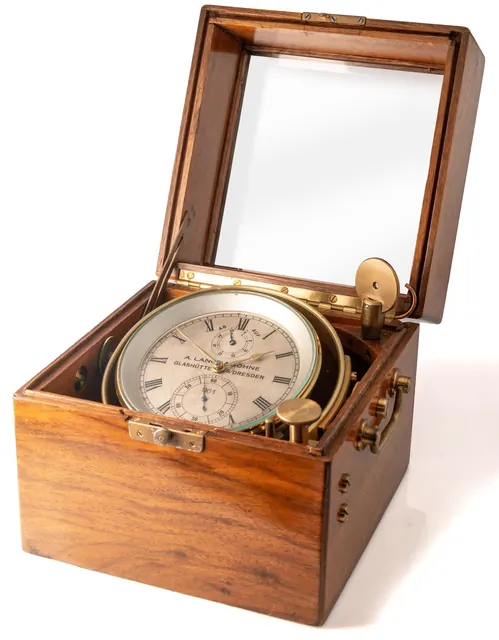
A. Lange & Sohne marine chronometer, Germany Wood, circa 1942
Antiquorum auction archive, Geneva
Wristwatches · 2004
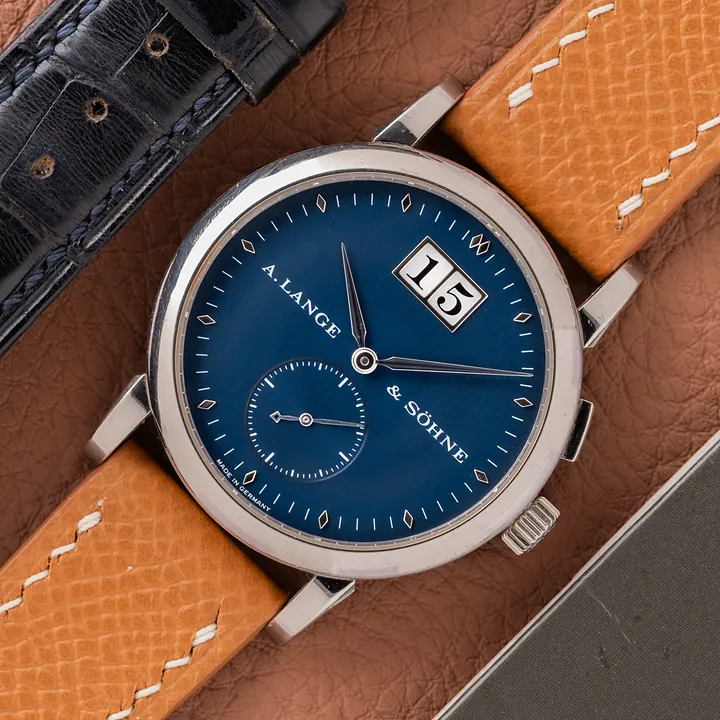
A. Lange & Söhne Saxonia Oversized Date Blue (Ref. 105.027), 2004
Huntington Company (dealer)
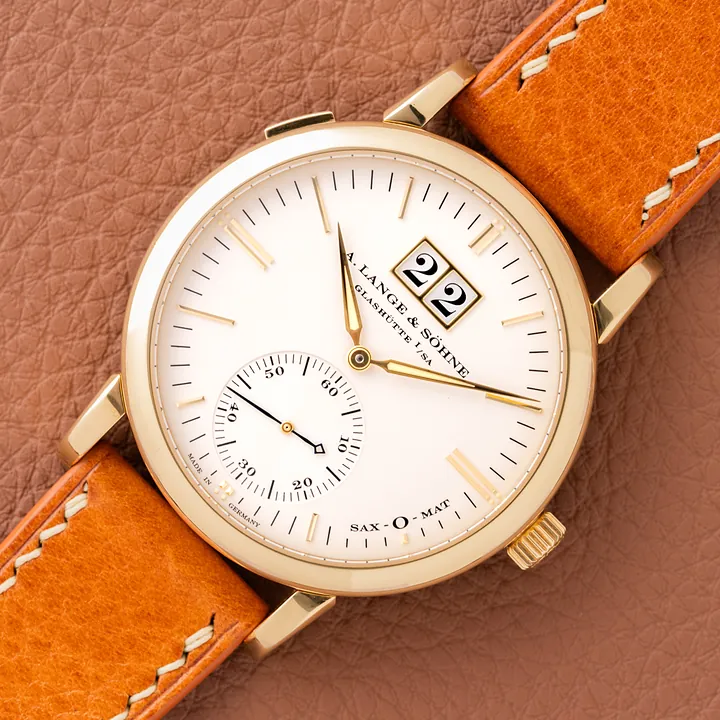
Wristwatches · 2000s
A. Lange & Söhne Langematik Oversized Date (Ref. 308.021), 2000s
Huntington Company (dealer)
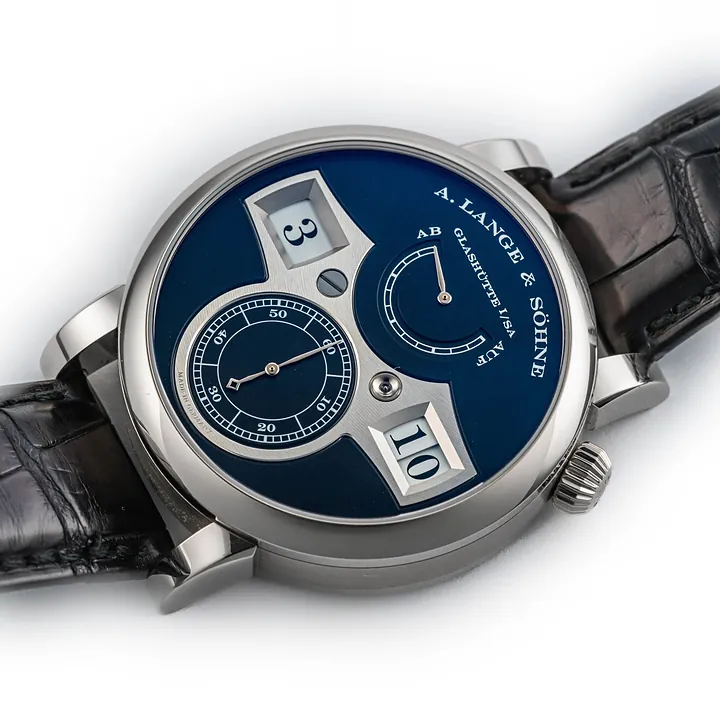
Wristwatches · c. 2018
A.Lange & Söhne Zeitwerk, ref. 140.029, c. 2018
Antiquorum auction archive, Geneva
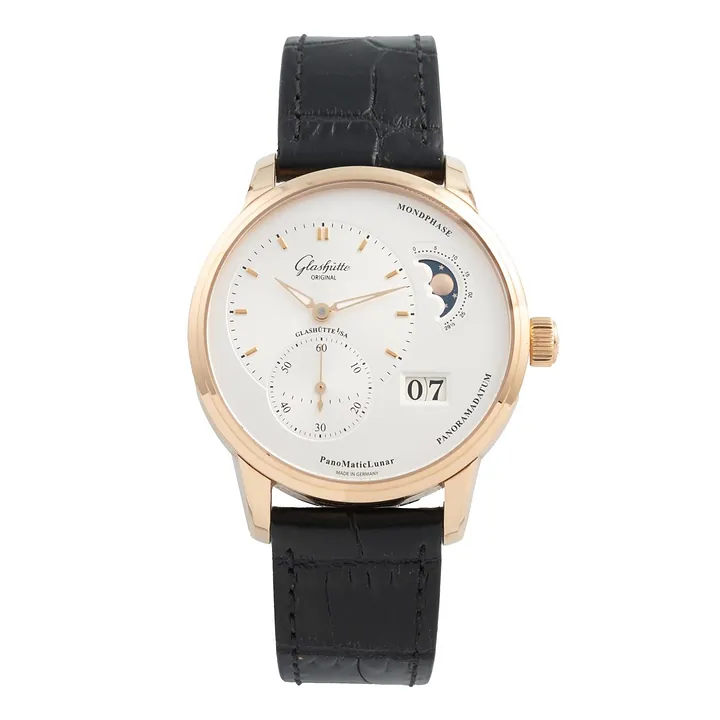
Wristwatches · originally sold in April 2022 (per the lot record)
Glashã¼tte Original Panomaticlunar, ref. 1-90-02-45-35-04, originally sold in April 2022
Antiquorum auction archive, Geneva
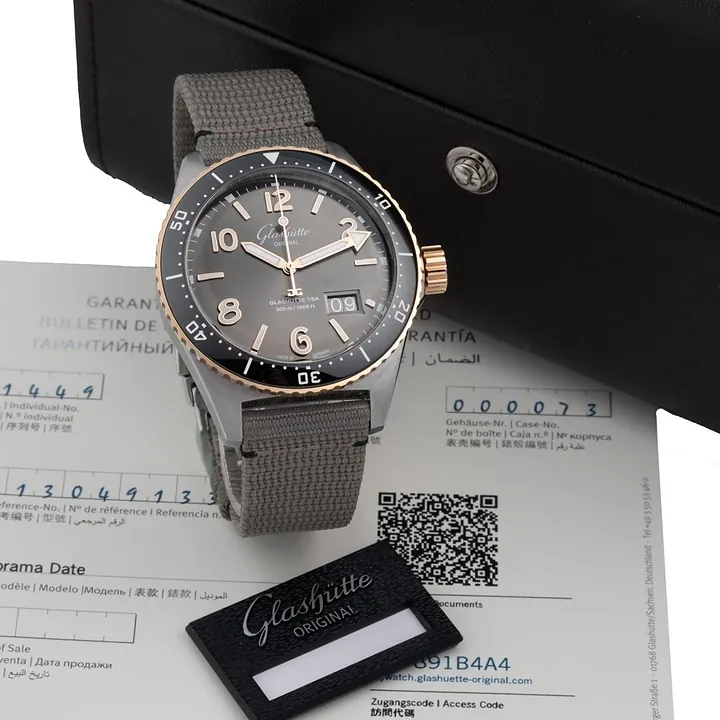
Wristwatches · c. 2022
Glashütte Original Seaq Panorama Date, ref. 1-36-13-04-91-33, c. 2022
Antiquorum auction archive, Geneva
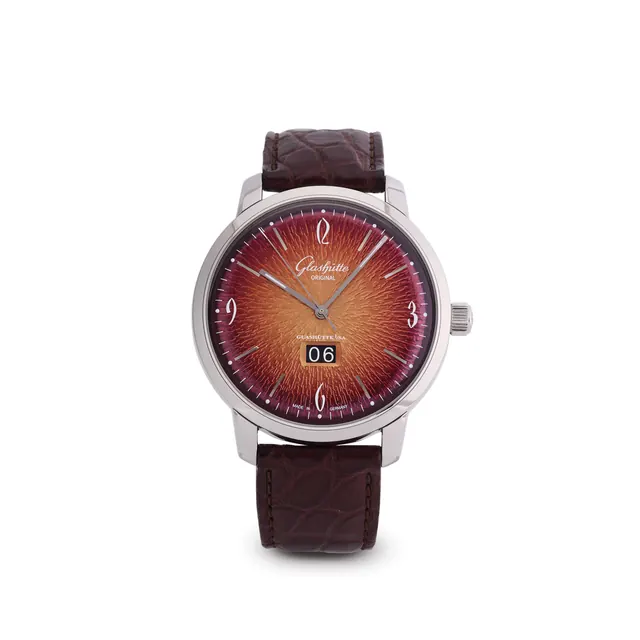
Wristwatches · originally sold in December 2021 (per the lot record)
Glashütte Original wristwatch, ref. W23947090204, Sixities Panorama Date Annual Edition, originally sold in December 2021 (per the lot record)
Antiquorum auction archive, Geneva