
Horological History · Historical feature
Painted in Fire: Enamel Watches of Paris, Blois, Geneva and The Hague, 1630–1700
Around 1630 French enamellers learned to paint miniature pictures in fired colour, and for seventy years the watch case became one of the most luxurious picture surfaces in Europe. How the technique worked, where the painters found their images, why so many cases now hold later movements, and what eighteen watches from five collections reveal.
Atlas Editorial · · 18 min read
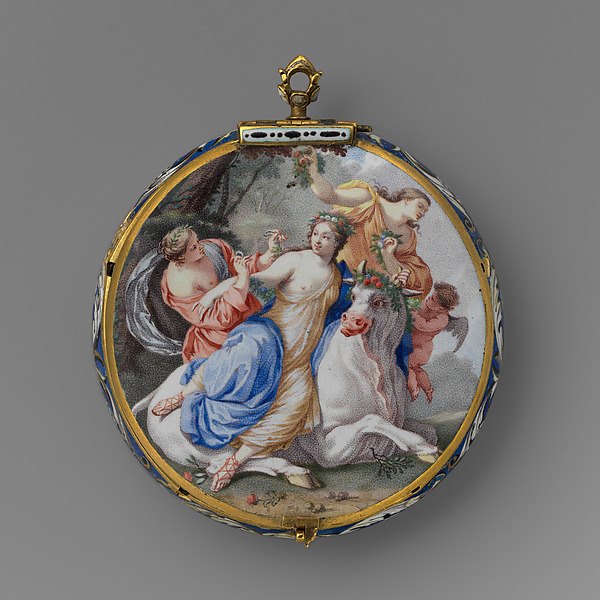
The Metropolitan Museum of Art, New York · CC0 1.0 (Met Open Access) · source (opens another website in a new tab)
Hold one of the painted enamel watches of the 1640s and the first surprise is how little of it looks like a timekeeper. The case is a small, slightly swollen disc of gold, and every surface — the back, the inside of the back, the cover over the dial, the narrow band around the edge — is covered with pictures: a Holy Family after Rubens, Venus and Cupid, a hunting scene, a river landscape with a fisherman. The dial may carry a further scene in its centre, framed by a white chapter ring. Only when the case is opened does the gilt-brass movement appear, with its fusee, verge escapement and pierced balance cock. The watch told the time, but before the balance spring only to within perhaps a quarter of an hour a day, and often worse. What its owner paid for was the painting.
The Victoria and Albert Museum's label for one of these watches puts the moment of change precisely: 'In about 1630 improved techniques made it possible to execute miniature painting in enamel in a wide range of colours.' For about seventy years afterwards — until the balance spring, the pair case and new fashions in decoration changed what a fine watch looked like — painted enamel was the most prestigious way to dress a watch in France, Geneva and the Low Countries. This feature follows the technique from its French beginnings to the Huaud workshop in Geneva and the Dutch watchmakers who used its cases, using eighteen watches and cases now in the Metropolitan Museum of Art, the V&A, the British Museum and the Cleveland Museum of Art.
Before painting: enamel as jewellery
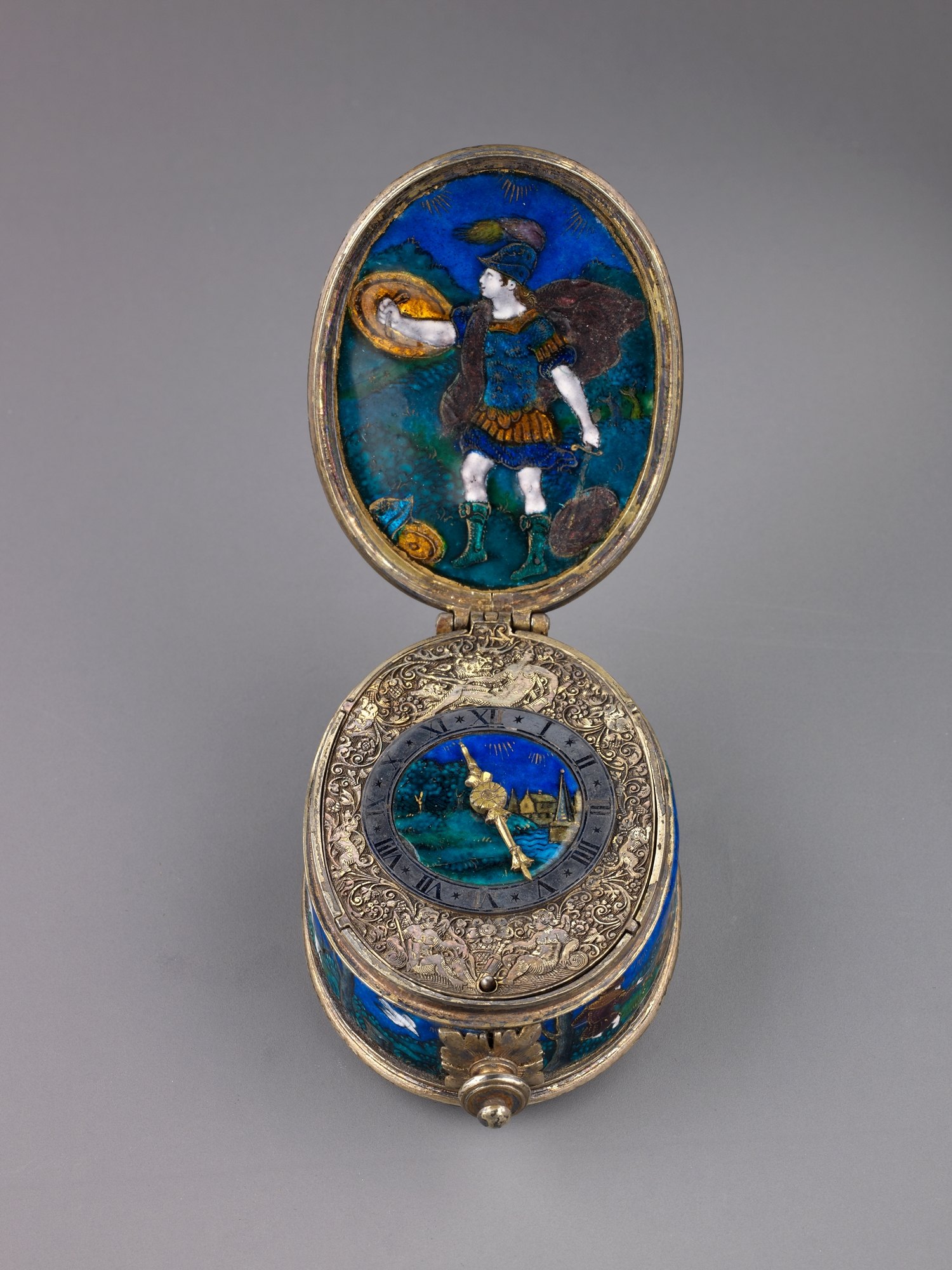
Enamel — powdered glass fused to metal by heat — was nothing new in 1630. Medieval goldsmiths filled engraved or cast recesses in copper and gold with opaque colour (champlevé), and from the fourteenth century translucent enamel was laid over engraved gold so that the pattern glowed through it (basse-taille). Renaissance jewellers covered small sculptural forms with enamel en ronde bosse, the technique used on the settings of many jewelled watches of the early seventeenth century. These methods produced colour, pattern and brilliance; what they could not easily produce was a picture.
The partial exception was Limoges. From the late fifteenth century Limoges workshops painted enamel onto copper plaques, building figures up in layers of white over a dark ground or in a limited range of strong colours. Watches occasionally carried such plaques. A watch in the Metropolitan Museum, dated to the first quarter of the seventeenth century, has a brass case set with painted enamel plaques on copper by Suzanne de Court, one of the few women enamellers of the period whose names are known; the plaques were made separately and mounted into the case like small paintings in frames.
About 1630: a new way of painting
The change that the V&A dates to around 1630 was in the painting itself. Its catalogue describes the process: 'The metal was covered with an enamel ground and fired in the kiln. It was then painted with metal oxides mixed with oil. Each colour had to be fired in turn to fuse it onto the enamel ground.' With an opaque white ground, a palette of finely ground colours and repeated firings at carefully controlled temperatures, an enameller could now work like a miniaturist: modelling flesh, rendering drapery and skies, and copying compositions that had been conceived as oil paintings. As the V&A puts it, 'previously it had not been possible to create enamel paintings in such a wide range of colours as to rival or to copy an oil painting.'
Who made the breakthrough is a question older writers liked to answer with a single name. The goldsmith and enameller Jean Toutin (1578–1644) of Châteaudun is the figure most often credited, and the V&A follows that tradition carefully: the key figures, it says, 'among whom the leading role is given to Jean Toutin', were enamellers and goldsmiths in Paris, Blois and Châteaudun with close links to watchmakers. That is a fair summary of current opinion. The new manner appeared within a small, interconnected group of workshops in the Loire valley and Paris, at the same time and in the same towns where watchmaking was flourishing, and it spread quickly from cases to lockets, boxes and portrait miniatures.
The technique changed the shape of the watch. 'Such was the potential of the new technique,' the V&A notes, 'that some watchcases became wider and flatter to provide an extensive surface for enamelling.' Compared with the small oval and octagonal watches of the 1620s, many enamel watches of the 1640s are broad discs between five and seven centimetres across, with gently domed backs that carry a single large composition.
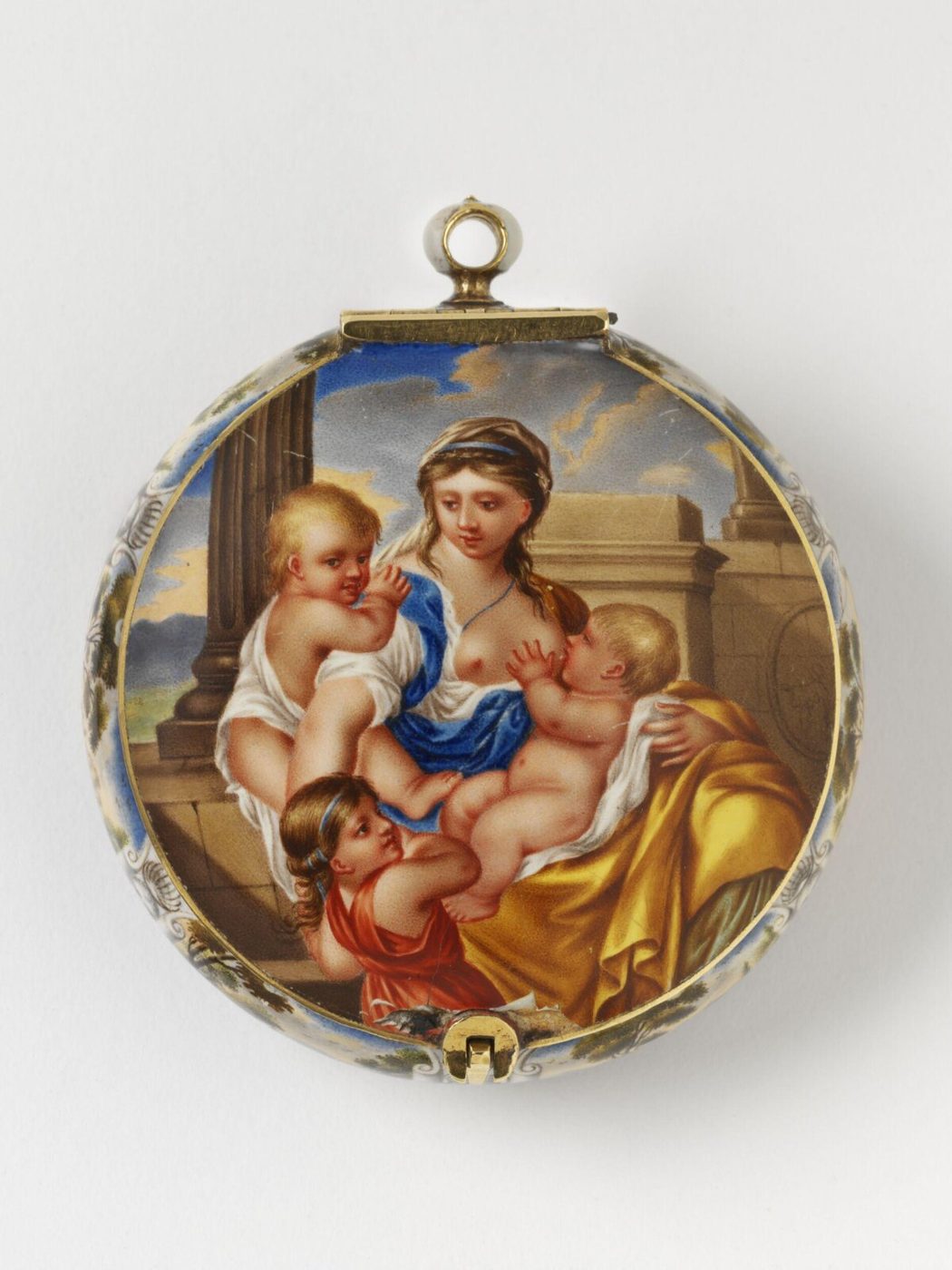
The V&A's watch with Faith, Hope and Charity is a textbook example. Its case is painted with Charity on the front and Faith and Hope on the back; the sides, the dial, the inside of the lid and the interior of the case are painted with landscapes. The movement, with its verge escapement, steel balance and fusee, is signed by Nicolas Bernard, who became a master of the Paris clockmakers' corporation in 1636 and died in 1670. The museum adds a detail that shows how embedded these men were in the institutions of their trade: in 1645 Bernard was one of five watchmakers who put forward the twenty-four articles of a new constitution for the corporation, approved by Louis XIV in February 1646.
| Technique | How it is made | Typical use on watches |
|---|---|---|
| Champlevé | Recesses cut or cast into the metal are filled with enamel and fired, then ground flush | Borders, chapter rings and ornament on cases and dials |
| Basse-taille | Translucent enamel over gold engraved in low relief, so the pattern shows through | Floral and foliate cases; the openwork floral case at the V&A uses basse-taille with opaque enamel |
| En ronde bosse | Enamel applied over small sculpted or chased forms | Jewelled watches, pendants and settings of the early 1600s |
| Painted enamel on copper (Limoges) | Layers of enamel painted on copper plaques, often in strong colours or white over dark | Plaques set into brass cases, as on the Suzanne de Court watch |
| Painted enamel on gold (after c. 1630) | White ground, then colours of metal oxides in oil, each fired in turn | Whole cases, inside and out, and dial centres; the subject of this feature |
Pictures from prints
Where did a case painter find a Holy Family or a Rape of Europa small enough to fit on a disc five centimetres wide? Almost always in an engraving. The seventeenth century was the great age of reproductive printmaking: paintings by Rubens, Simon Vouet, Jacques Stella and Nicolas Poussin were engraved in Paris and Antwerp and circulated across Europe, and enamellers worked from those prints, adapting the composition to a circle and inventing the colour themselves, since the print gave them none.
Museum catalogues are often able to name the source. A V&A watch with a movement by Jacques Goullons of Paris, made about 1640, has a case painted on the back with a Holy Family with Saint Anne after Rubens and on the front the Virgin and Child; inside are portraits of Louis XIII and Cardinal Richelieu, and the band carries scenes of the Flight into Egypt. The Metropolitan Museum's catalogue for another Goullons watch of about 1645–50 is more specific still. It credits enamel scenes 'based on [the] engravings' of Gilles Rousselet, after a painting by Jacques Stella, and an enamel landscape after the work of Nicolas Cochin — three printmakers and painters, none of whom touched the watch.
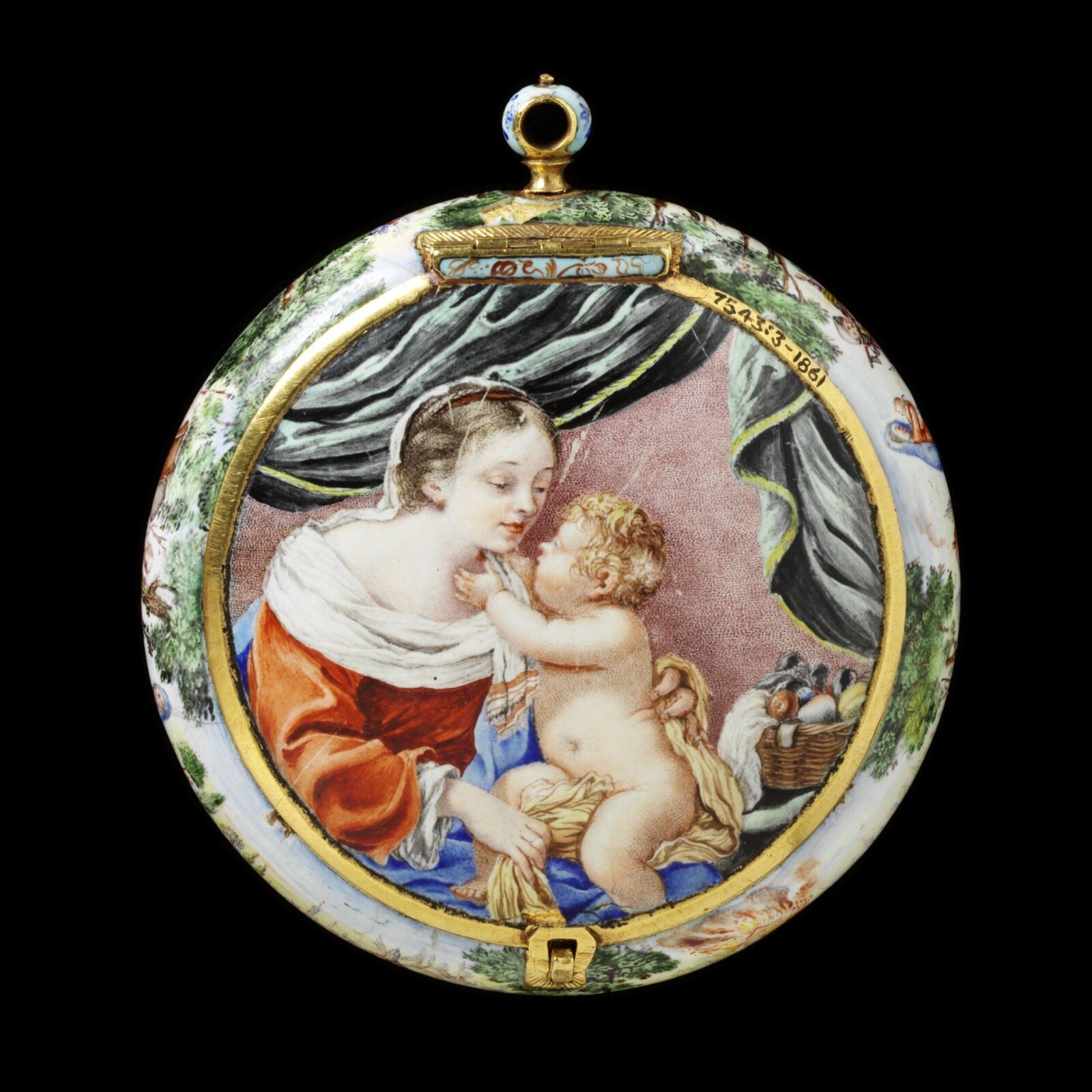
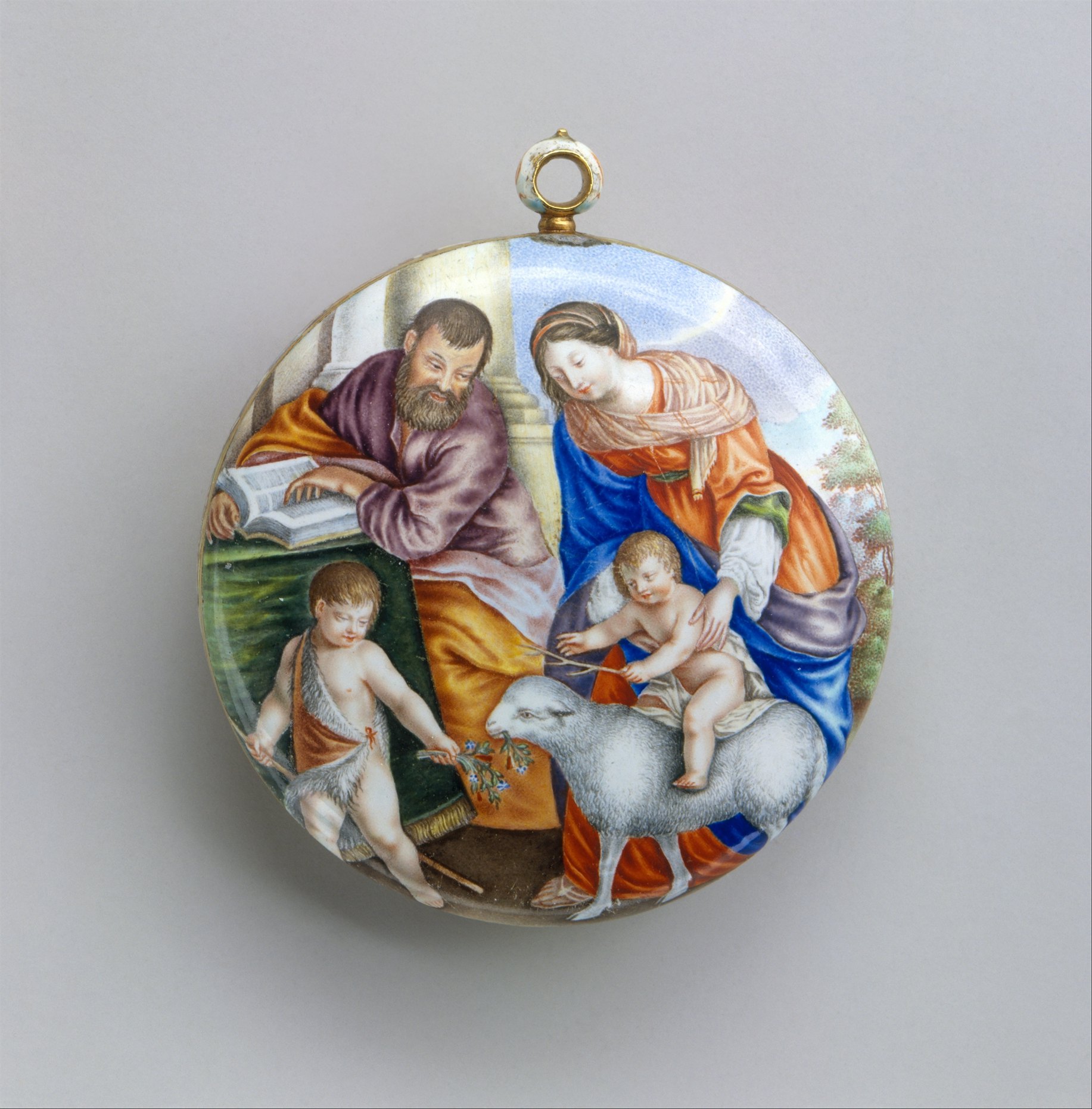
This matters for how such watches should be read. An enamel watch is a collaboration between several hands: a painter, often unnamed, who chose and adapted a print; a goldsmith who made the case; and a watchmaker whose signature on the movement is usually the only name on the object. When old catalogues describe an enamel watch as 'by' a watchmaker, they are naming the movement maker, not the artist.
Blois and Paris
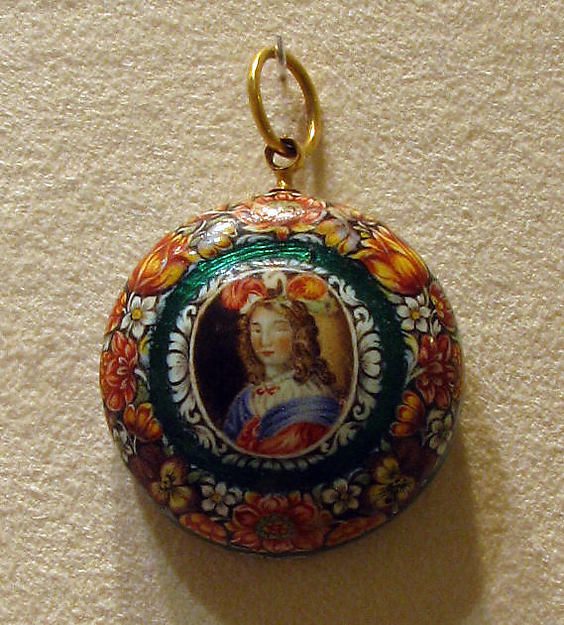
Blois, on the Loire, had a royal château and a watchmaking community of real importance in the first half of the seventeenth century, and it was home to several enamellers whose names recur in attributions. The most frequently cited is Robert Vauquer. The Metropolitan Museum attributes the enamel of two watches in this catalogue to him with different degrees of confidence: a Goullons watch of about 1650 whose case was 'possibly enameled by Robert Vauquer', and a watch with a movement by Nicolas Gribelin (the younger, the Met suggests with a question mark) whose case, probably of about 1650–60, is given to the 'school of Blois, probably Robert Vauquer'. The Met dates that watch's movement to about 1680 — a reminder that an earlier enamelled case could be fitted with a newer movement.
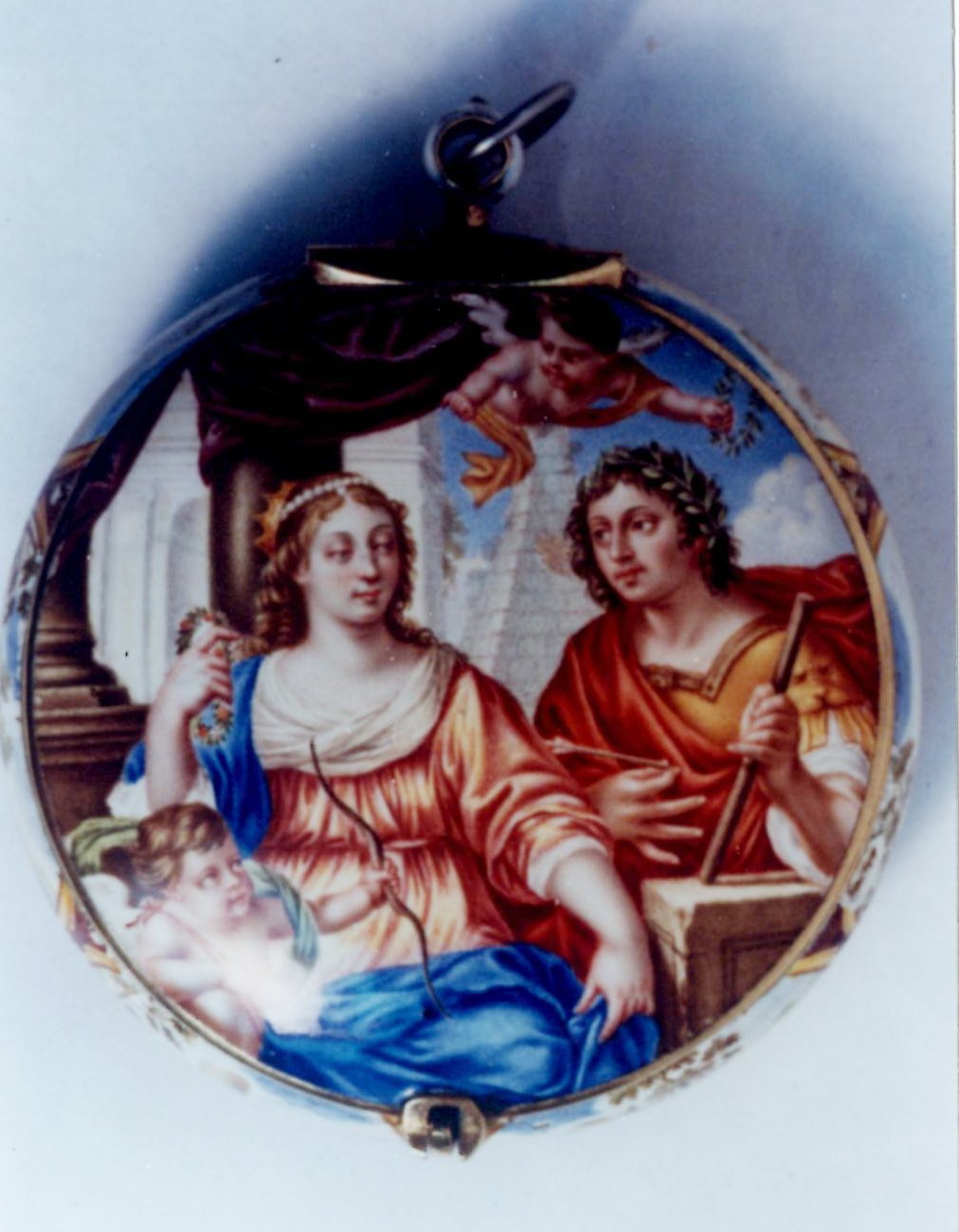
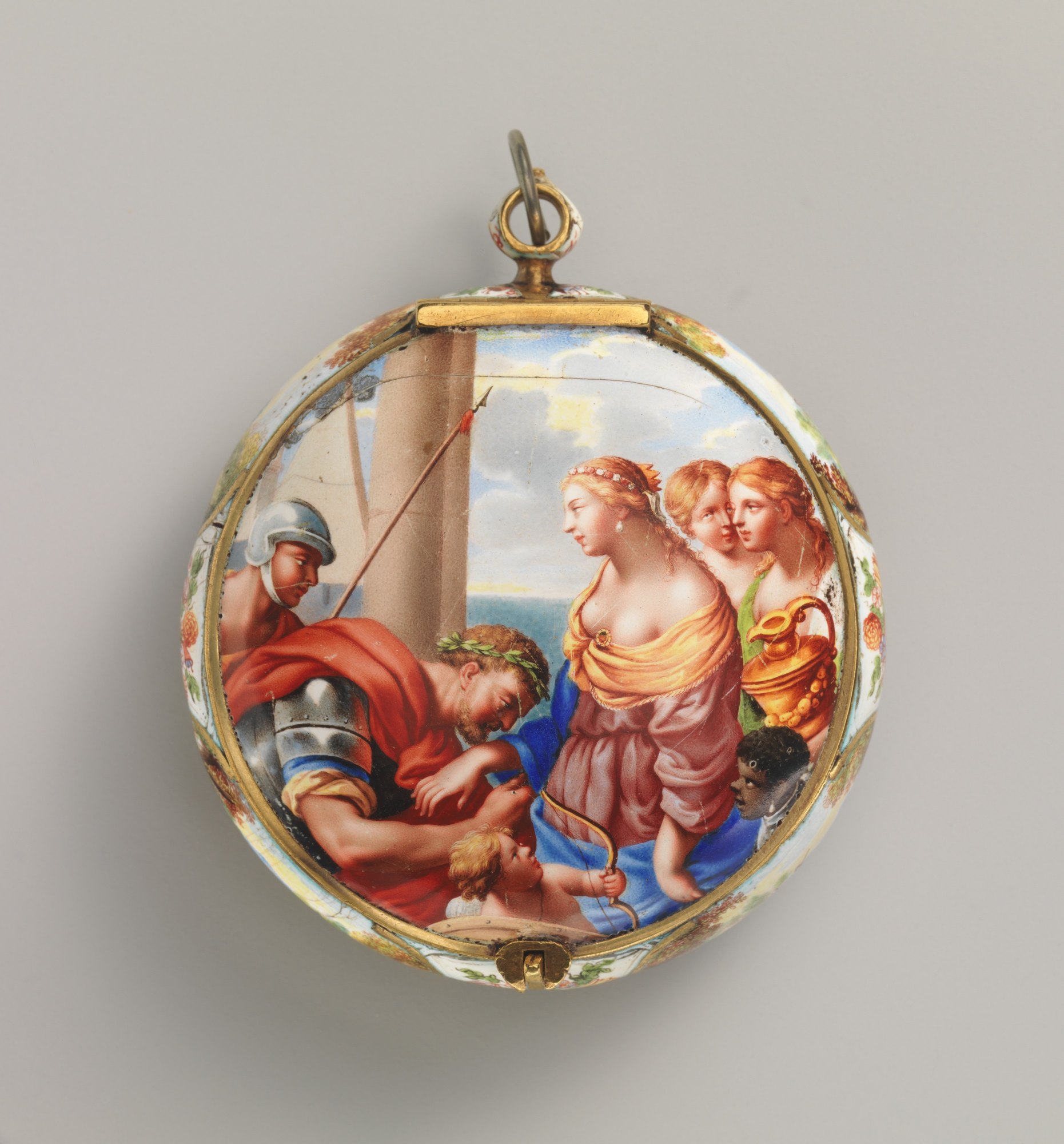
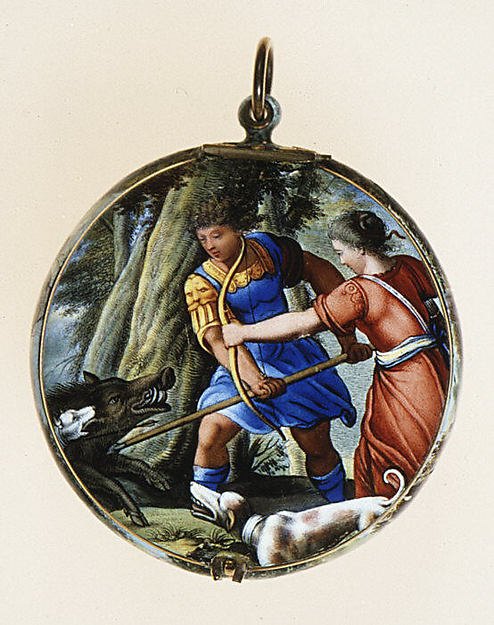
The Met also holds a watch of about 1645–50 by Auguste Bretoneau, catalogued as 'Paris or Blois', whose case is painted with the Hunt of the Caledonian Boar. Mythological hunts, the loves of the gods and biblical stories were the common repertoire. So were floral designs, fashionable from around the middle of the century: flowers painted in white and colours against a dark ground, or, on the most elaborate cases, modelled in enamel and pierced so that the case itself became a cluster of blossoms.
The cases that outlived their movements
A remarkable number of seventeenth-century enamel cases now contain movements made many decades later. The reason is simple: the case was the valuable part. When the balance spring arrived in 1675 and the minute hand became normal, a verge watch of the 1640s was suddenly old-fashioned as a timekeeper, but its painted case was still a treasure. Owners and dealers fitted new movements into old cases, and some empty cases were turned into boxes.
The catalogue records show every version of this story. The V&A's case by Jan Bernardus Vrythoff of The Hague, dated 1640–1660, is described by the museum in exactly these terms: 'Enamelled watchcases continued to be valued in the eighteenth century. Some were turned into gold boxes. Others, like this one, had a more [modern] movement inserted.' The Met's case painted with the Rape of Europa and Mercury and the Three Graces is French, probably Paris, of about 1645, but holds a movement by Lambertus Vrythoff of The Hague of about 1750. The Cleveland Museum of Art's watchcase of about 1640 'was later transformed into a simple box through the removal of the watch mechanism and ring.'
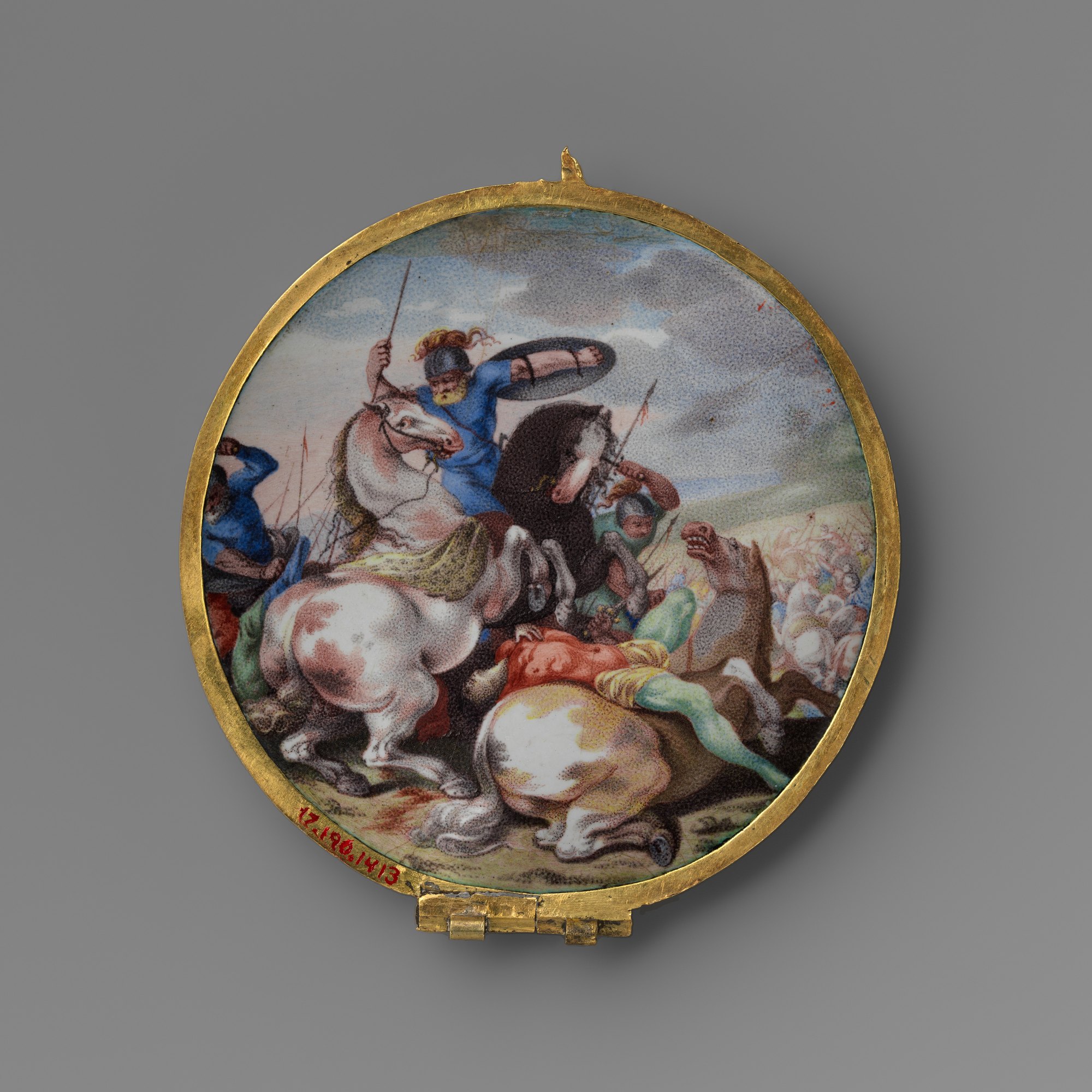
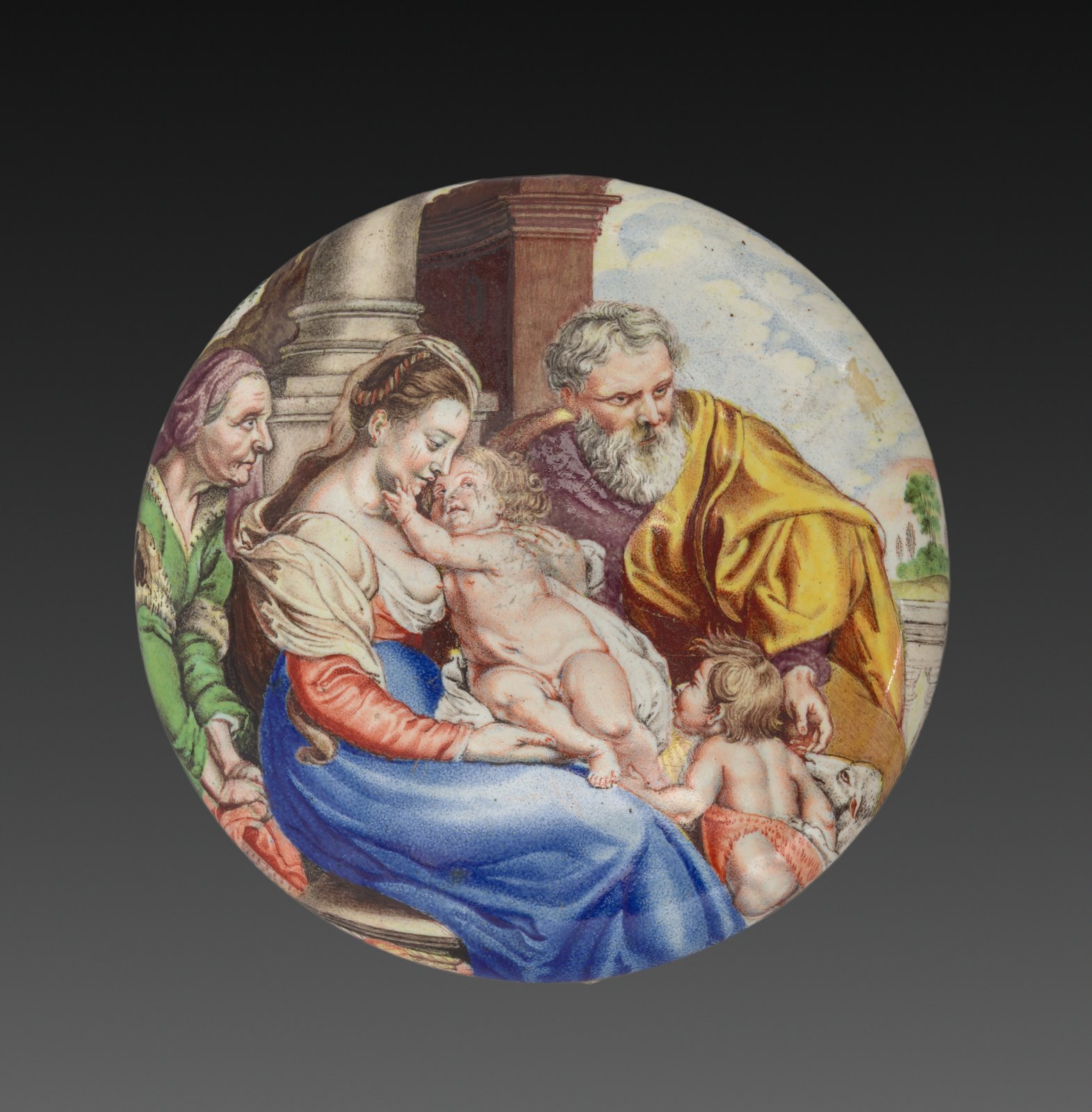
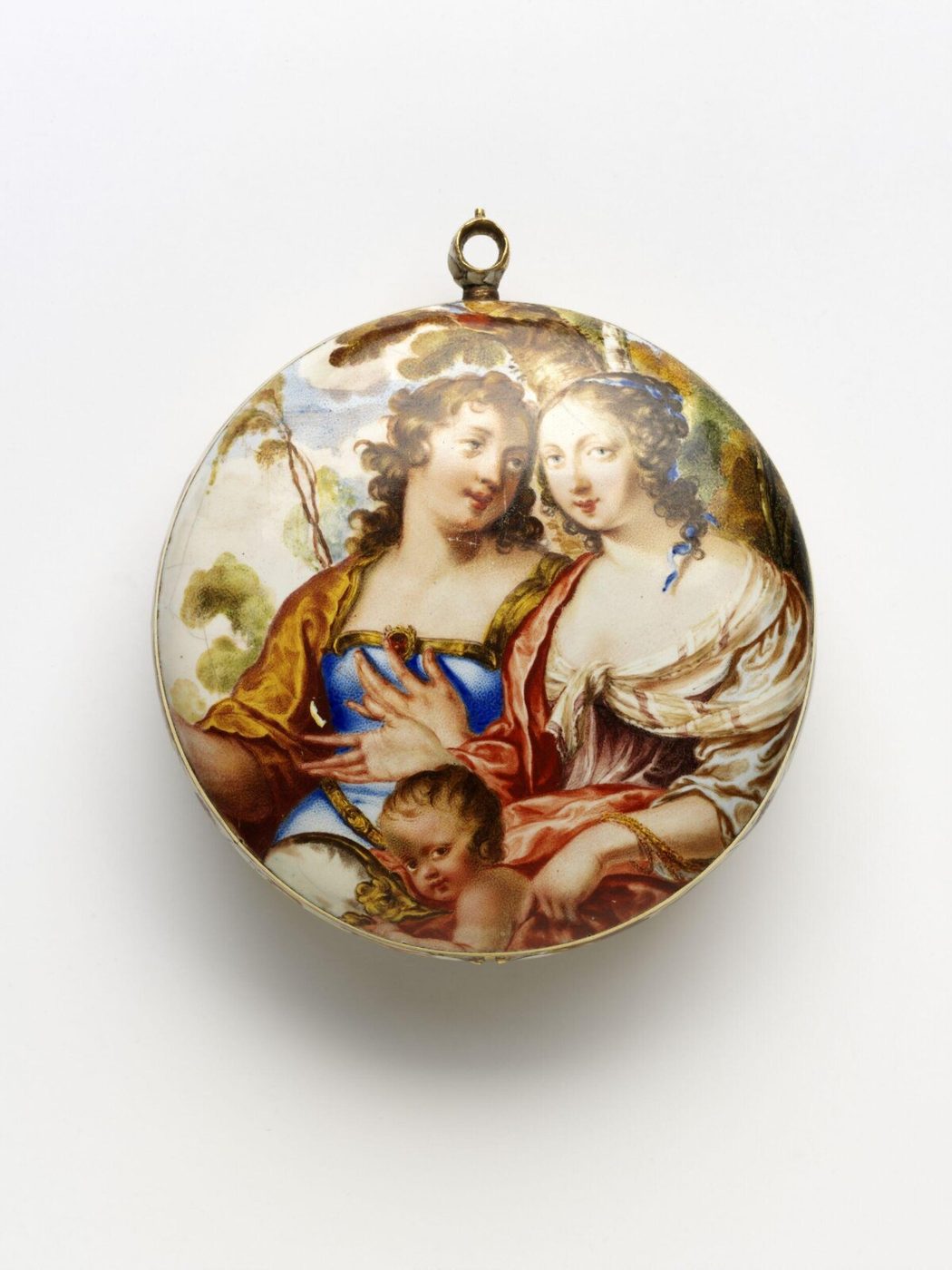
For anyone using the catalogue, the lesson is to read a record's date carefully. Museums increasingly give separate dates for case and movement — 'case c. 1645, movement c. 1750' — and the Atlas keeps those dates exactly as written. A single date on an enamel watch, especially an older record, may refer to either part.
Geneva: crystal, enamel and the Huauds
Geneva's watchmakers, many of them Protestant refugees from France, built their trade in the same decades, and the city became a centre for luxury cases of every kind. Rock crystal was one speciality. A British Museum watch of 1650–1660 with a movement signed by Jaques Sermand of Geneva has a body and lid of carved rock crystal, cut with twelve lobed facets, and gold rims painted with flowers in polychrome enamel; the dial carries a small painted landscape of a castle gatehouse over a moat. The museum's curators note that such watches were exported 'both as complete pieces with movements signed by Genevan watchmakers and as empty cases for use by foreign watchmakers', and cite an order of 1623 by Pierre Lourteau, a watchmaker in Lyon, for three crystal cases from the Genevan lapidary Paul Tillier. They also cite a Huygens family letter of January 1650, from Constantijn to Christiaan Huygens, describing a newly bought watch 'a la mode' with a rock-crystal case 'that permitted a view of the movement such as one would see if the case was made of ice'.
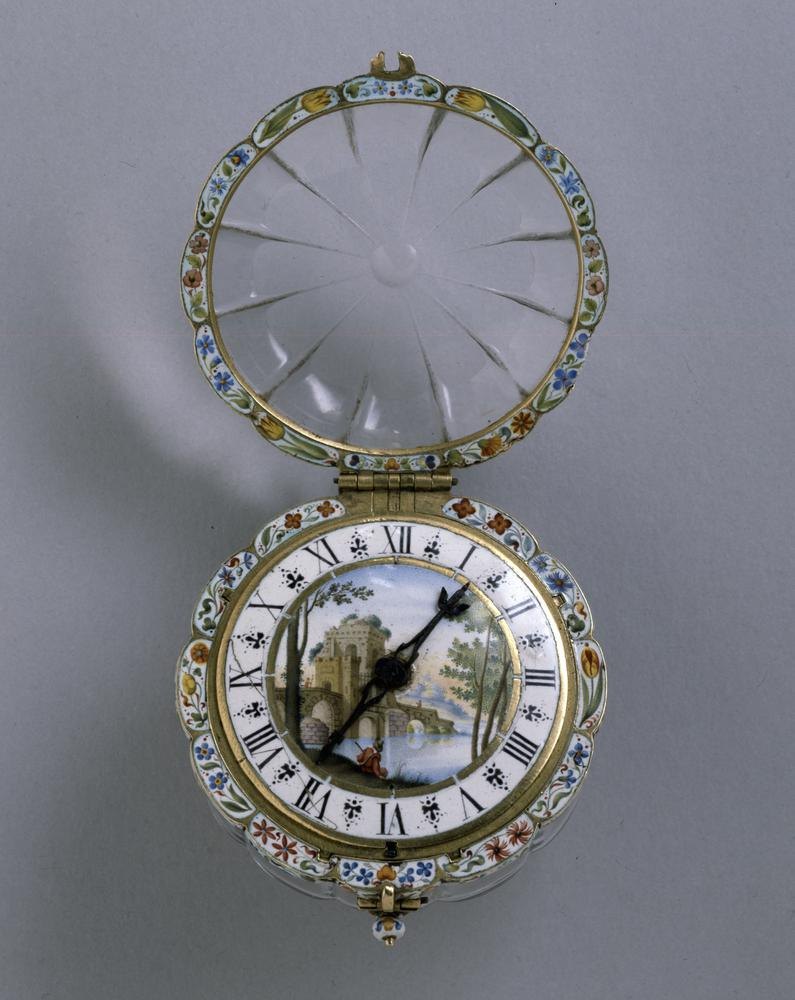
Painted enamel reached Geneva through people. The most important enamellers in the city's history, the Huaud family, descended from Pierre Huaud, a goldsmith from Châtellerault in France who settled in Geneva. Their work is the best represented of any seventeenth-century enamel workshop in the catalogue, and the records show how the family's attributions are graded. A small Met watch with a movement by Pierre Duhamel of Geneva, of about 1660–80, is given to 'Pierre Huaud (the elder, perhaps)'; a V&A watch also signed by Duhamel names Pierre Huaud as enameller outright.
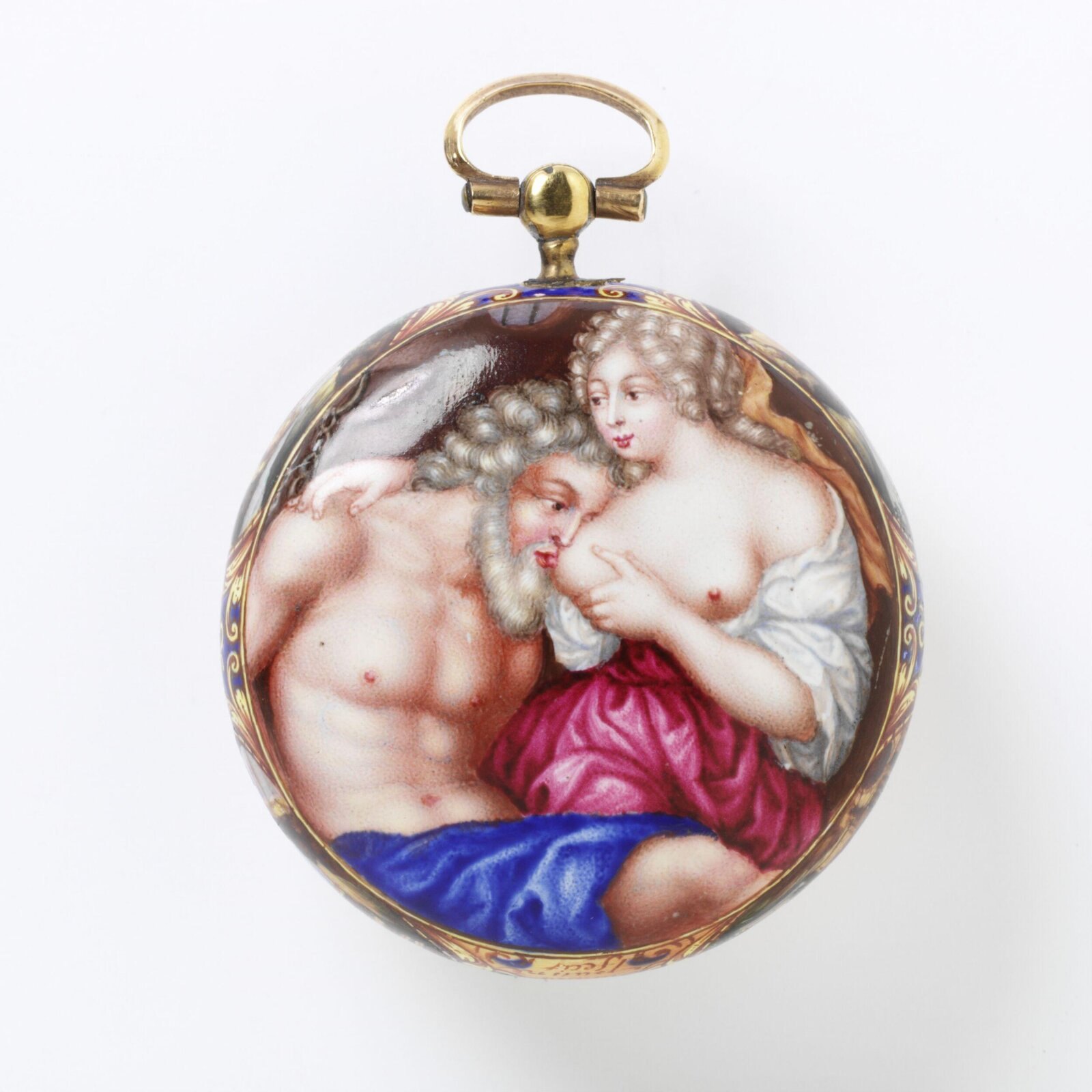
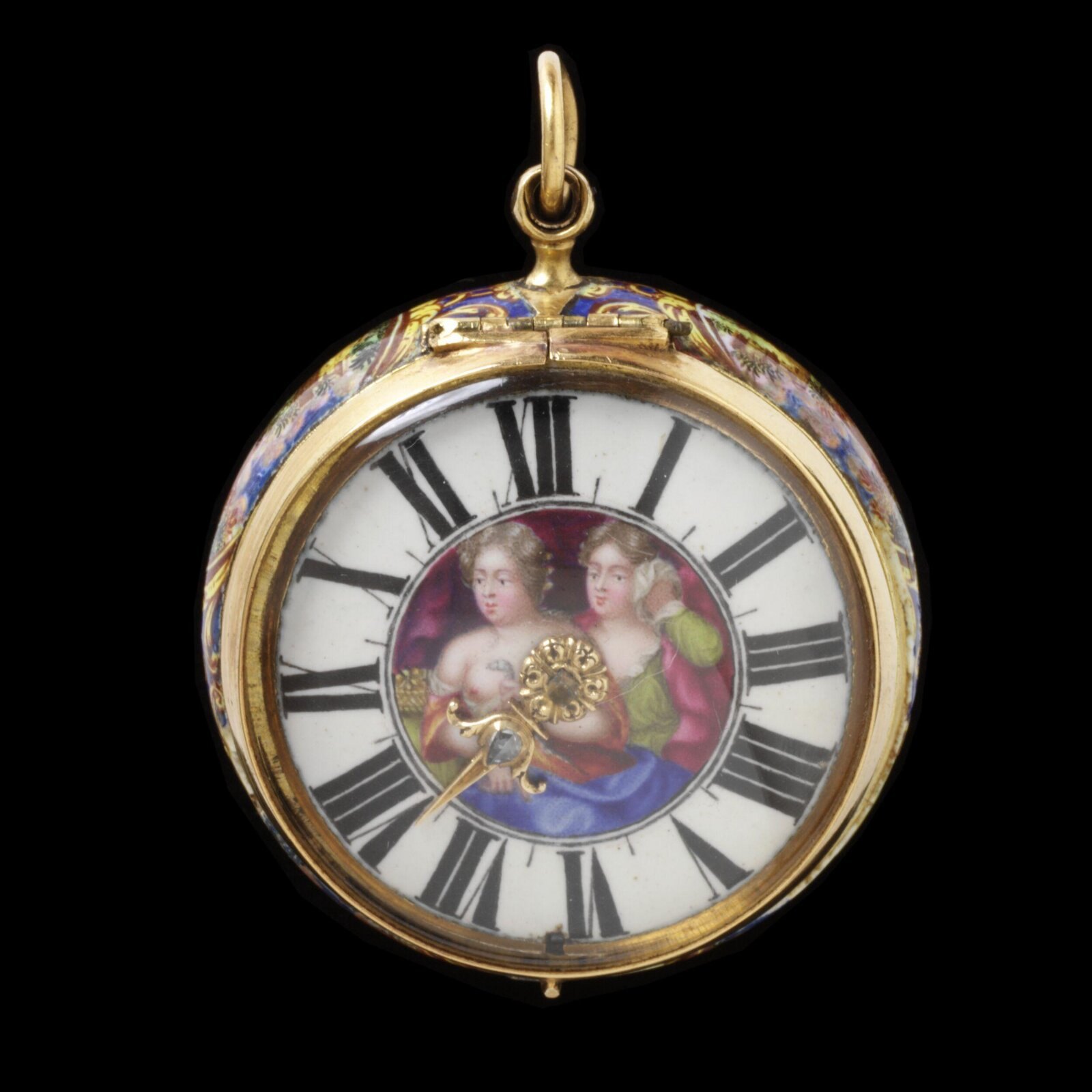
Pierre's sons signed more readily. A V&A watch of about 1680 is painted with Roman Charity — the story of Pero feeding her imprisoned father Cimon — after an engraving of a painting by Rubens, and is signed 'Huaud le puisné fecit', 'Huaud the younger made it', the signature of Jean-Pierre Huaud (1655–1723); its movement is a later replacement by Frederick de Mierre of Amsterdam, of about 1740. Another V&A watch, of probably 1682–86, treats the same subject after Claude Mellan's engraving of a painting by Simon Vouet and is signed 'Les deux frères Huaud les jeunes' — the two younger brothers, Jean-Pierre and Ami (1657–1724).
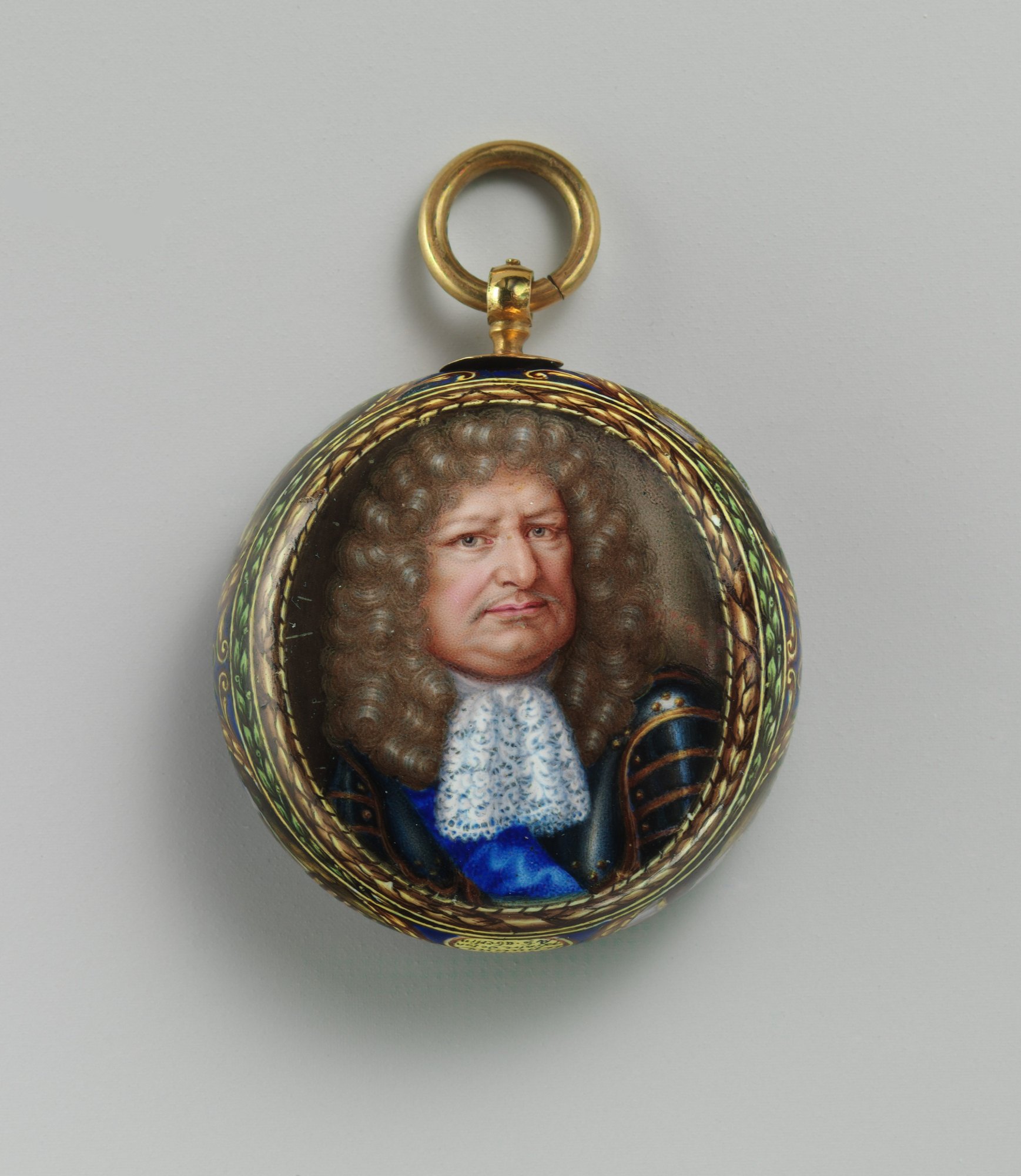
The brothers' reputation took them to Berlin, where they worked for the Elector of Brandenburg for several years from the later 1680s before returning to Geneva. A Met watch carries an enamel portrait of Friedrich Wilhelm, the 'Great Elector', who died in 1688; the case is catalogued as Geneva work of about 1688 and, like so many, now holds a much later Berlin movement, of about 1750. The Met does not name the painter, and the Atlas does not either.
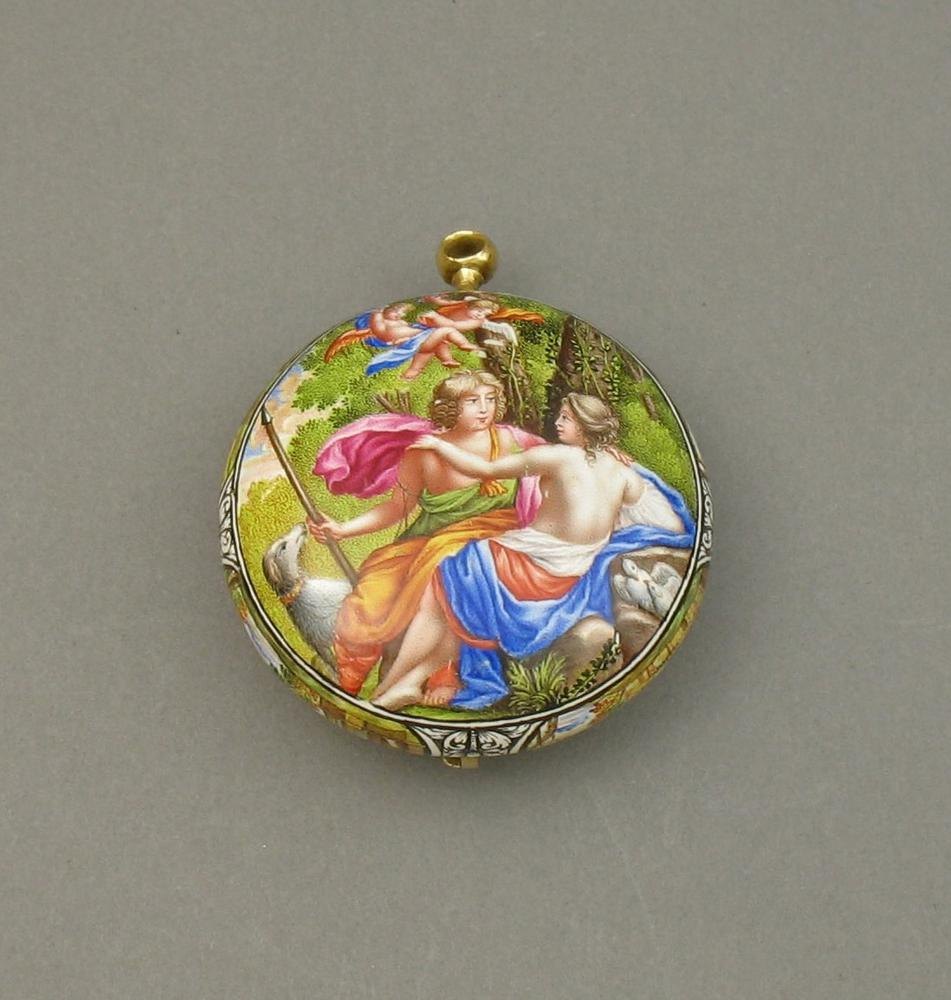
Other Geneva cases show the city's style beyond the Huauds. A gold watch in the British Museum, with a movement by Estienne Ester of Geneva and dated 1670–1675, is painted all over, inside and out: Venus and Adonis in a forest with a hound and two cupids on the back, four landscape vignettes alternating with black and white enamelled straps around the band, and a seated Diana with a hound in the centre of the dial. The movement is as carefully decorated as the case, with silver panels of winged cherubs over its pillars and a pierced blued-steel screen over the stop-work.
| Wording in the record | What it means | Example |
|---|---|---|
| 'Huaud le puisné fecit' | Signed by Jean-Pierre Huaud, the younger brother | V&A watch with Roman Charity, c. 1680 |
| 'Les deux frères Huaud les jeunes' | Joint signature of Jean-Pierre and Ami Huaud | V&A watch, probably 1682–86 |
| 'Pierre Huaud (the elder, perhaps)' | Attribution on style; no signature | Met watch by Pierre Duhamel, c. 1660–80 |
| 'possibly enameled by Robert Vauquer' | Tentative attribution to a named Blois painter | Met watch by Jacques Goullons, c. 1650 |
| 'School of Blois, probably Robert Vauquer' | Regional style, with a probable attribution | Met watch by Nicolas Gribelin, case c. 1650–60 |
| 'after Rubens' / 'after Vouet' | The composition is copied from an engraving of that painter's work | V&A Goullons and Huaud watches |
The Hague and the Dutch market
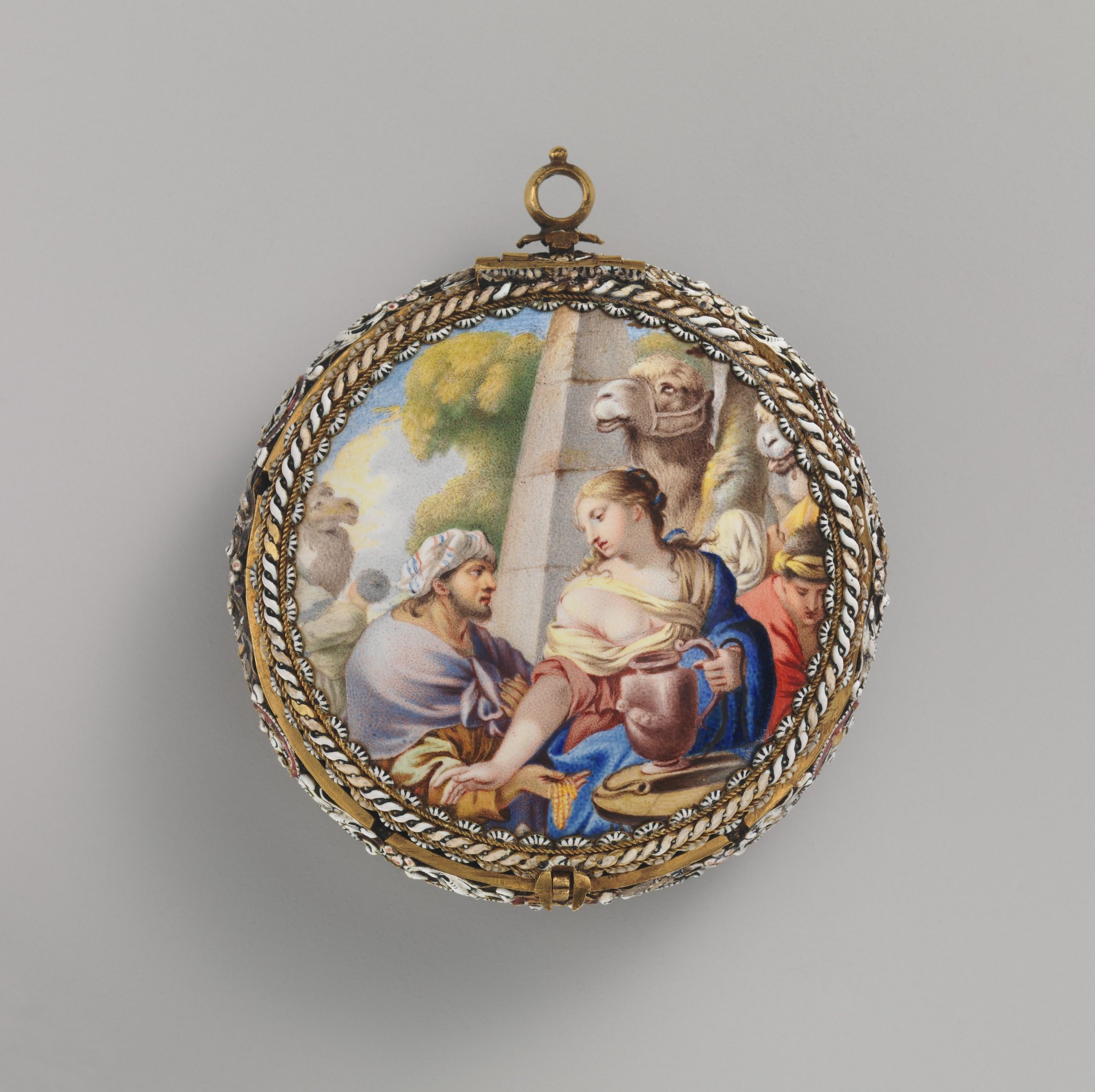
The Dutch Republic was one of the richest markets for luxury goods in seventeenth-century Europe, and The Hague, seat of the States General and of the stadholder's court, had an active community of watchmakers. Several of the enamel watches in the catalogue have Hague movements in French or Swiss cases. The Met's watch with scenes from the story of Rebekah at the well, of about 1676–80, combines a movement by Johannes van Ceulen of The Hague — a maker associated with early pendulum clocks and balance-spring watches — with a case from Paris painted in enamel and decorated with raised enamel. The V&A's watch signed 'Pieter Visbach Haghe', of 1660–1670, has an enamelled and gilt-brass case that the museum notes was possibly enamelled in Switzerland.
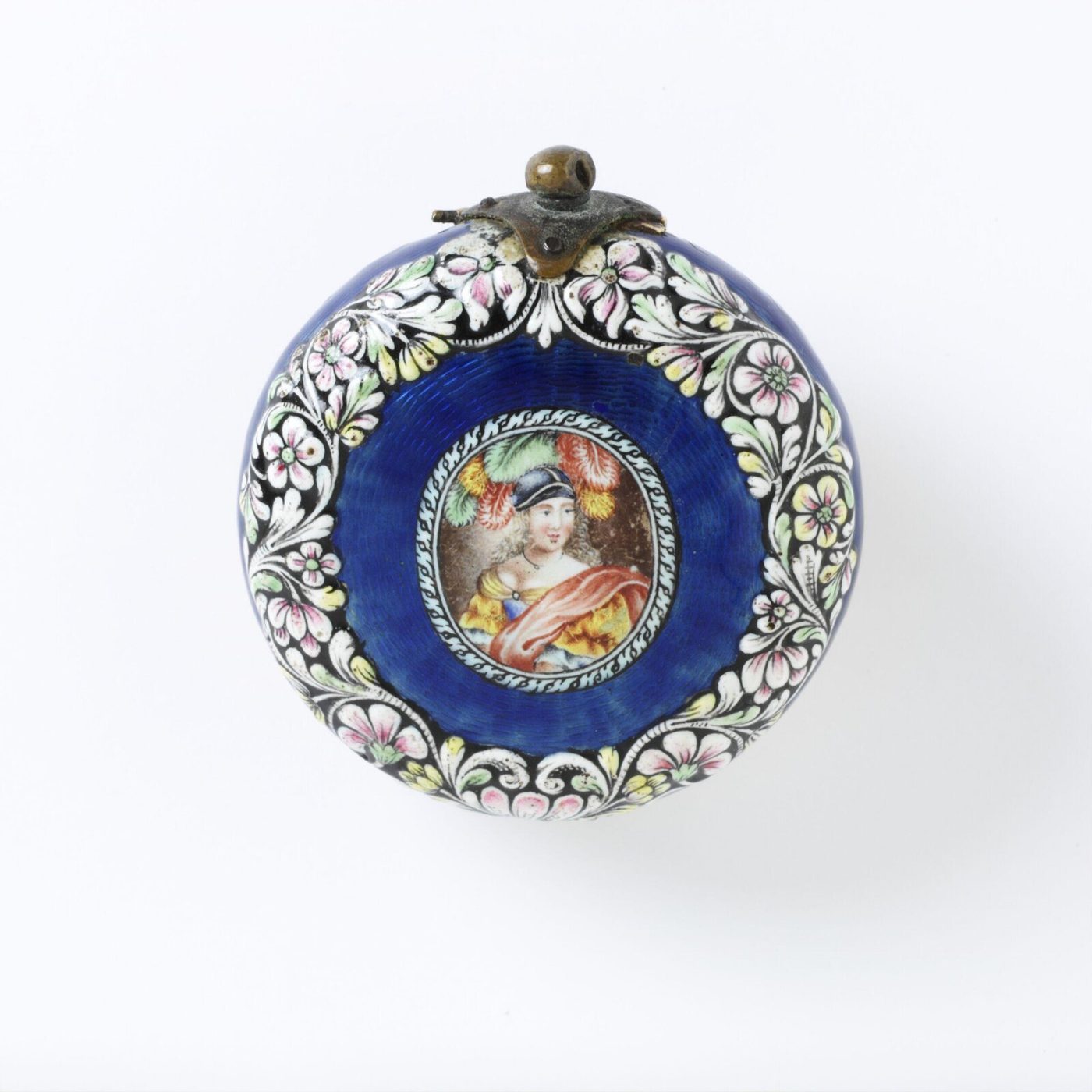
These combinations are a reminder that the luxury watch was an international product long before the nineteenth century. Cases travelled as easily as movements; a Geneva case could hold a London, Paris or Amsterdam movement, and the Atlas records the Huaud workshop's cases on movements from several countries. Reading the place of a watch from its signature alone is risky.
A puzzle from Vienna
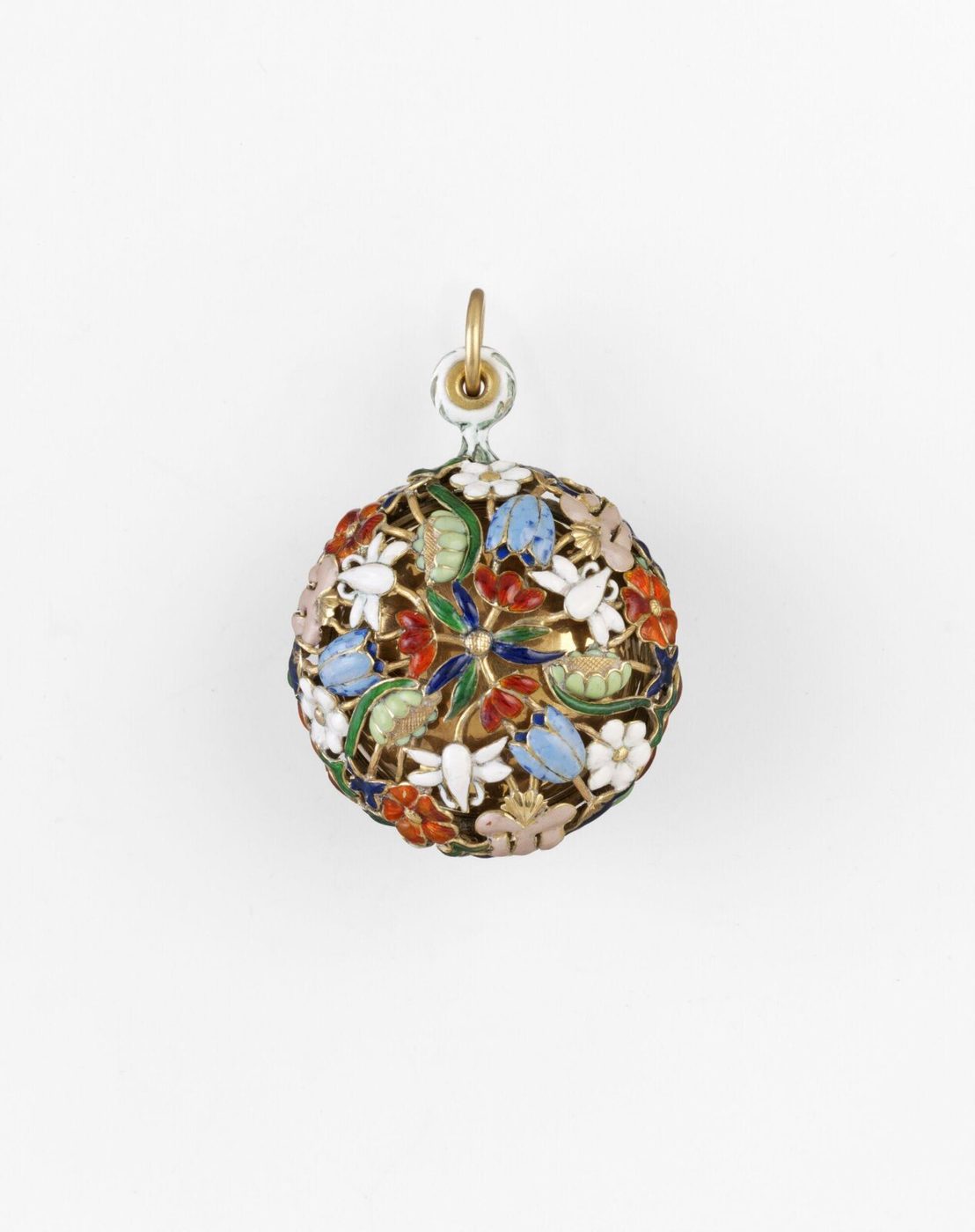
Not every enamel case is what it seems. The V&A's gold watch with a pierced case of enamelled flowers and gold stalks is catalogued as probably French, about 1650–70, but its movement, signed 'Samuel François Caille à Vienne', is of about 1750–75. The museum's discussion is unusually candid. A closely similar enamelled floral case already in the V&A has a gold inner case bearing the mark of Josef Weichberger senior, a Viennese goldsmith who specialised in enamelled work in historical styles, used in Vienna from 1872. Was one case copied from the other in nineteenth-century Vienna, where earlier enamel was much admired and imitated, or are both seventeenth-century cases from a common source? The museum leaves the question open.
How to look at an enamel watch
- Separate case and movement. Read the signatures and dates of each; museum records often give them separately, and the case is frequently older.
- Look for a painter's signature, usually small, on the inside of the case or the edge of a scene. Most cases are unsigned; signed Huaud cases are the main exception.
- Identify the subject and, if possible, the print it was taken from. A known engraving gives a date after which the painting must have been made.
- Check the condition of the enamel. Chips and cracks at the edges and around the hinge are normal; large areas of perfect enamel on a much-handled object deserve a second look.
- Note any repainting or replacement. Lost enamel was sometimes made good with cold paint, which is softer and duller than fired enamel.
- Consider the dial. Enamel dials with painted centres and white chapter rings are typical of the period; a later dial may accompany a later movement.
After 1700
Painted enamel never disappeared from watchmaking, but its place changed. The balance spring, introduced in 1675, made watches accurate enough for a minute hand, and the plain gold or silver pair case, protected by an outer case of leather, tortoiseshell or shagreen, became the standard form for a serious timekeeper, above all in England. In Geneva, enamelling remained a major craft through the eighteenth and nineteenth centuries, producing painted watch cases and dials for export in large numbers, often in more delicate, pastel styles than the robust colours of the 1640s.
The enamel watches of 1630–1700 belong to a particular moment: when the watch was still more a jewel than an instrument, when a new technique let goldsmiths compete with painters, and when the best watch cases in Europe were made in a handful of workshops in Blois, Paris and Geneva. Their afterlife — cases reused for new movements, turned into boxes, copied in Vienna — is part of their history too, and the museum records, read carefully, preserve it.
Further exploring in the Atlas
- The Huaud family profile, with the workshop's signatures and the catalogue's Huaud cases.
- The Early Modern period page (1600–1750) for the wider context of watchmaking before and after the balance spring.
- The verge escapement and fusee entries for the movements these cases contain.
- The catalogue, searchable by 'enamel', for more than four hundred enamelled watches and clocks from before 1800.
Sources & further reading
- Watches — David Thompson, British Museum Press (London), 2008.
- Old Clocks and Watches and Their Makers — F. J. Britten, B. T. Batsford (London), 1899 (first edition).
- Watchmakers and Clockmakers of the World — G. H. Baillie, N.A.G. Press (London), 1929 (first edition).
- Dictionnaire des horlogers français — Tardy (Henri Lengellé), Tardy (Paris), 1971–1972.
- Technique and History of the Swiss Watch — Eugène Jaquet and Alfred Chapuis, Urs Graf (Olten), 1945 (French); English editions from 1953.
- Antiquarian Horology — Antiquarian Horological Society, AHS (London), 1953 – present.
- Curiosities of Clocks and Watches from the Earliest Times — Edward J. Wood, Richard Bentley (London), 1866.