Pocket Watches · Watch
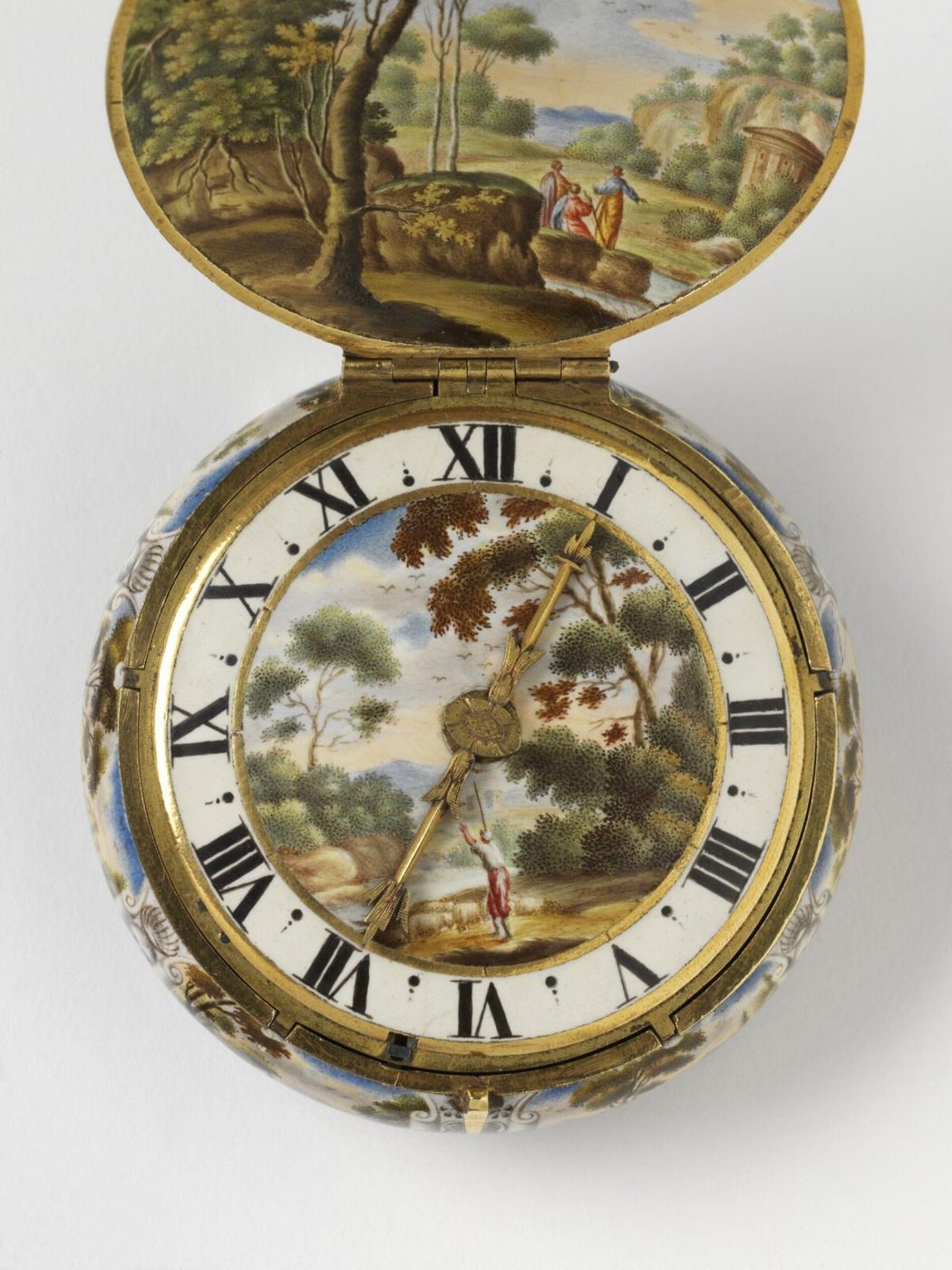
Watch with enamelled gold case depicting Faith, Hope and Charity, made by Nicolas Bernard, Paris, 1640-1650
- Maker / attribution
- Nicolas Bernard (watchmaker)
- Date
- 1640-1650
- Historical period
- Early Modern Horology (1600 – 1750)
- Country of origin
- France
- Place
- Paris
- Object type
- Watch
- Materials / technique
- Gold with painted enamel; gilt-metal, brass and blued steel movement
- Dimensions
- Diameter: 58 mm (east-west); Height: 70 mm; Depth: 23 mm
- Holding institution
- Victoria and Albert Museum, London
- Accession / object no.
- 2359-1855
Record summary
Held and catalogued by Victoria and Albert Museum, London (object number 2359-1855), this is a watch by Nicolas Bernard, made in Paris, France, dated 1640-1650. The Atlas places it in the Early Modern Horology period (1600 – 1750) of its Pocket Watches collection. Materials and techniques recorded by the source: Gold with painted enamel; gilt-metal, brass and blued steel movement. Recorded dimensions: Diameter: 58 mm (east-west); Height: 70 mm; Depth: 23 mm. The record is illustrated with 4 photographs.
Assembled from the source record's structured fields. Dates and attributions are given as the source states them; where a field is missing the Atlas leaves it blank rather than estimating.
Catalogue description
V&A — Summary
The case of this watch is a fine example of an important development in the history of enamelling. In about 1630 improved techniques made it possible to execute miniature painting in enamel in a wide range of colours. The metal was covered with an enamel ground and fired in the kiln. It was then painted with metal oxides mixed with oil. Each colour had to be fired in turn to fuse it onto the enamel ground. Such was the potential of the new technique that some watchcases, like this one, became wider and flatter to provide an extensive surface for enamelling. The technique was used to decorate watches and other goldsmiths' work as well as to paint portraits in minature. The key figures in this development, among whom the leading role is given to Jean Toutin (1578-1644), were enamellers and goldsmiths in Paris, Blois and Châteaudun who had close links with watchmakers. Nicolas Bernard, who put his name to the movement of the watch, became a master in the Paris Corporation of Clockmakers in 1636. He had a son in 1642 and died in 1670. In 1645 he was one of five watchmakers who put forward twenty-four articles to provide a new constitution for the Corporation, which received the approval of Louis XIV on 20 February 1646.
V&A — Physical description
Watch with gold case decorated with painted enamel, the movement of gilt brass and blued steel. The case is painted with Charity on the front, and Faith and Hope on the back. The sides, dial, reverse of the lid and interior of the case are painted with landscape scenes. The dial has a single double-ended hand, gilt and engraved. The movement has a verge escapement with steel balance wheel. The single-foot balance cock and the cover for the ratchet regulator are pierced and engraved. Brass plates and wheels. Fusee with renewed gut line.
V&A — Historical context
The case of this watch is a fine example of an important development in the history of enamelling. In about 1630 improved techniques made it possible to execute miniature painting in enamel in a wide range of colours. The metal was covered with an enamel ground and fired in the kiln. It was then painted with metal oxides mixed with oil. Each colour had to be fired in turn to fuse it onto the enamel ground. Such was the potential of the new technique that some watchcases, like this one, became wider and flatter to provide an extensive surface for enamelling. The technique was used to decorate watchcases and other goldsmiths' work as well as to paint portraits in minature. The key figures in this development, among whom the leading role is given to Jean Toutin (1578-1644), were enamellers and goldsmiths in Paris, Blois and Châteaudun who had close links with watchmakers. There has been considerable discussion about how the techniques employed in the new painted enamels differed from those which went before, but it is apparent that the effect was different: previously it had not been possible to create enamel paintings in such a wide range of colours as to rival or to copy an oil painting. Nicolas Bernard, who put his name to the movement of the watch, became a master in the Paris Corporation of Clockmakers in 1636. He had a son in 1642 and died in 1670. In 1645 he was one of five watchmakers who put forward twenty-four articles to provide a new constitution for the Corporation, which received the approval of Louis XIV on 20 February 1646.
V&A — Object history
Purchased at the auction by Christie's of the collection of Ralph Bernal (1783-1854), politician and art collector, in 1855. He held a seat in the House of Commons from 1815-52. After his death the Society of Arts proposed without success that the Government should buy his entire collection for the Museum of Ornamental Art then at Marlborough House which became the future South Kensington Museum, now the Victoria and Albert Museum. 730 lots were acquired for Marlborough House (Anthony Burton, Vision & Accident, V&A Publications, 1999, p. 34). After his father's death in 1811, Bernal inherited three large sugar estates and over 500 enslaved people in Jamaica. 'In 1835 and 1836 he was awarded compensation for slave ownership amounting to over £11,450' (Helen Davies, Ralph Bernal, Oxford Dictionary of National Biography, version dated 11 March 2021).
Inscriptions & marks
'Nicolas Bernard A Paris'
Historical context
Early Modern Horology (1600 – 1750)
Huygens' pendulum and balance spring transform accuracy; English makers develop the anchor and deadbeat escapements.
The balance spring (c. 1675) improved watches dramatically and introduced the minute hand. English pair-cased verge watches with pierced balance cocks and French oignons were typical; enamel painting at Blois and Geneva, and the repeating watch (1680s), made watches objects of great refinement.
Read the period in the timelineMore pocket watches from this periodEarlier: Renaissance Horology
Atlas type guide
Pocket watches
The pocket watch was the dominant personal timekeeper from the late seventeenth century until the First World War. Its development tracks the history of the escapement: verge watches with fusees until the late eighteenth century; Thomas Mudge's lever escapement (c. 1755) and the cylinder escapement popularised by George Graham and later by Swiss makers; and the Swiss and English lever watches of the nineteenth century. Lépine's bar-bridge calibre and keyless winding made watches thinner and easier to use.
Industrialisation transformed the trade: American factories such as Waltham (from 1850) and Elgin produced interchangeable parts by machine, and Swiss makers responded with their own mechanisation after the 1876 Philadelphia Exhibition. By 1900 a reliable watch was affordable to millions; the finest makers continued to produce complications and precision watches.
What to look for
- The escapement: verge (crown wheel), cylinder, duplex, English or Swiss lever.
- Key winding (a square arbor in dial or back) or keyless crown winding.
- Signatures and serial numbers on the movement, dial and inside case back.
- Hallmarks, case maker's marks and gold or silver standards stamped in the case.
- Dial material: enamel, silver, gold, later printed metal.
Dating clues
- Verge watches dominate before c. 1800; cylinder watches c. 1770–1900; lever watches after c. 1820.
- Keyless winding: increasingly common after c. 1860.
- Manufacturer serial number lists exist for Waltham, Elgin, Longines, Omega, Patek Philippe and others.
General guidance written by the Atlas editors about this kind of object. It is not a statement about this particular piece; for that, rely on the source record above and on physical examination.
Related records
Pocket Watches · 16th century
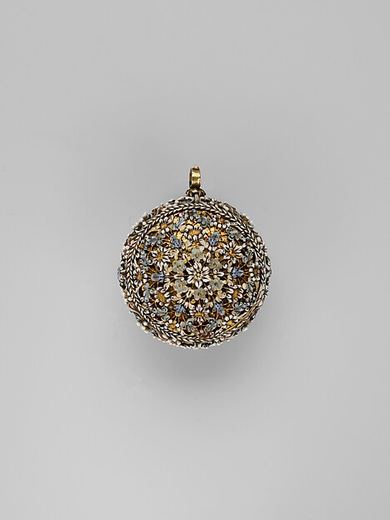
Watch by Nicolas Bernard, France, 16th century
The Metropolitan Museum of Art, New York
Pocket Watches · ca. 1570
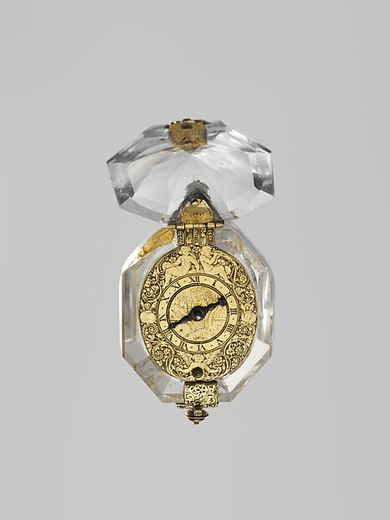
Watch by Nicolas Bernard, France, ca. 1570
The Metropolitan Museum of Art, New York
Pocket Watches · 1600
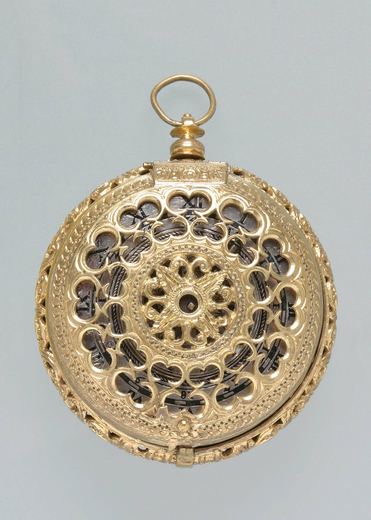
Pocket watch by Hans Reinboldt, France, 1600
German Clock Museum
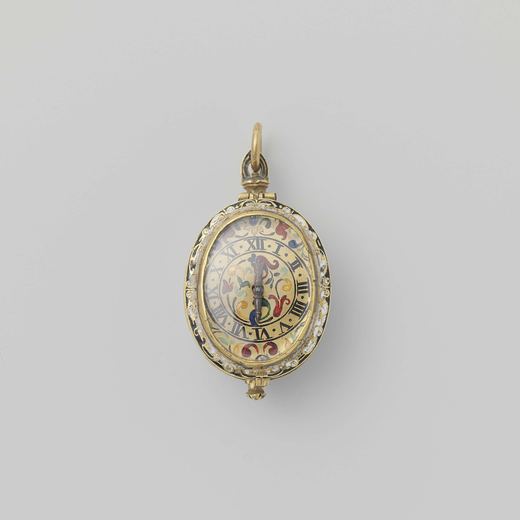
Pocket Watches · 1600
Pocket watch by anoniem, France, 1600
Rijksmuseum
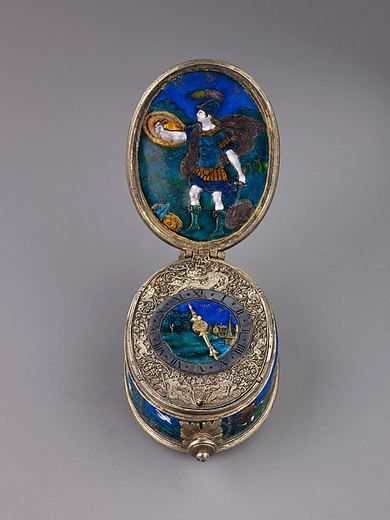
Pocket Watches · first quarter of 17th century
Watch by Suzanne de Court, France, first quarter of 17th century
The Metropolitan Museum of Art, New York
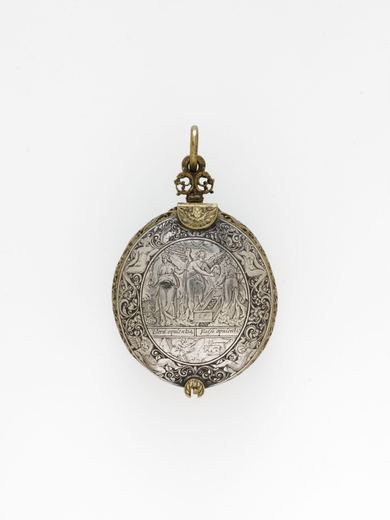
Pocket Watches · early 17th century
Watch of engraved and pierced silver and gilt brass, signed 'Noel Hubert A Rouen', France, early 17th century
Victoria and Albert Museum, London
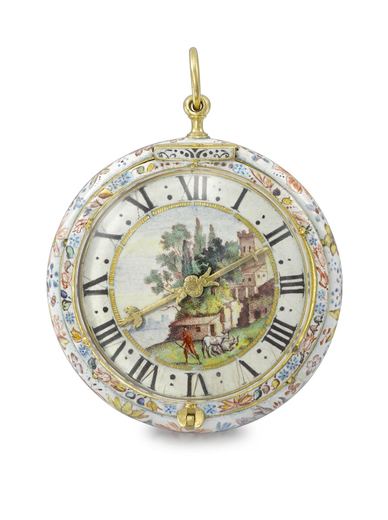
Pocket Watches · 1601-1700
Pocket watch by Margotin, D, France, 1601-1700
Science Museum Group, London
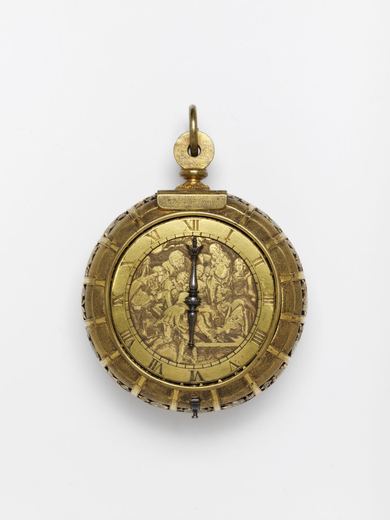
Pocket Watches · 1630
Carriage watch with gilt brass case and engraved dial by Nicolas Lemaindre, Blois, 1630
Victoria and Albert Museum, London