
Wristwatches · Wristwatch
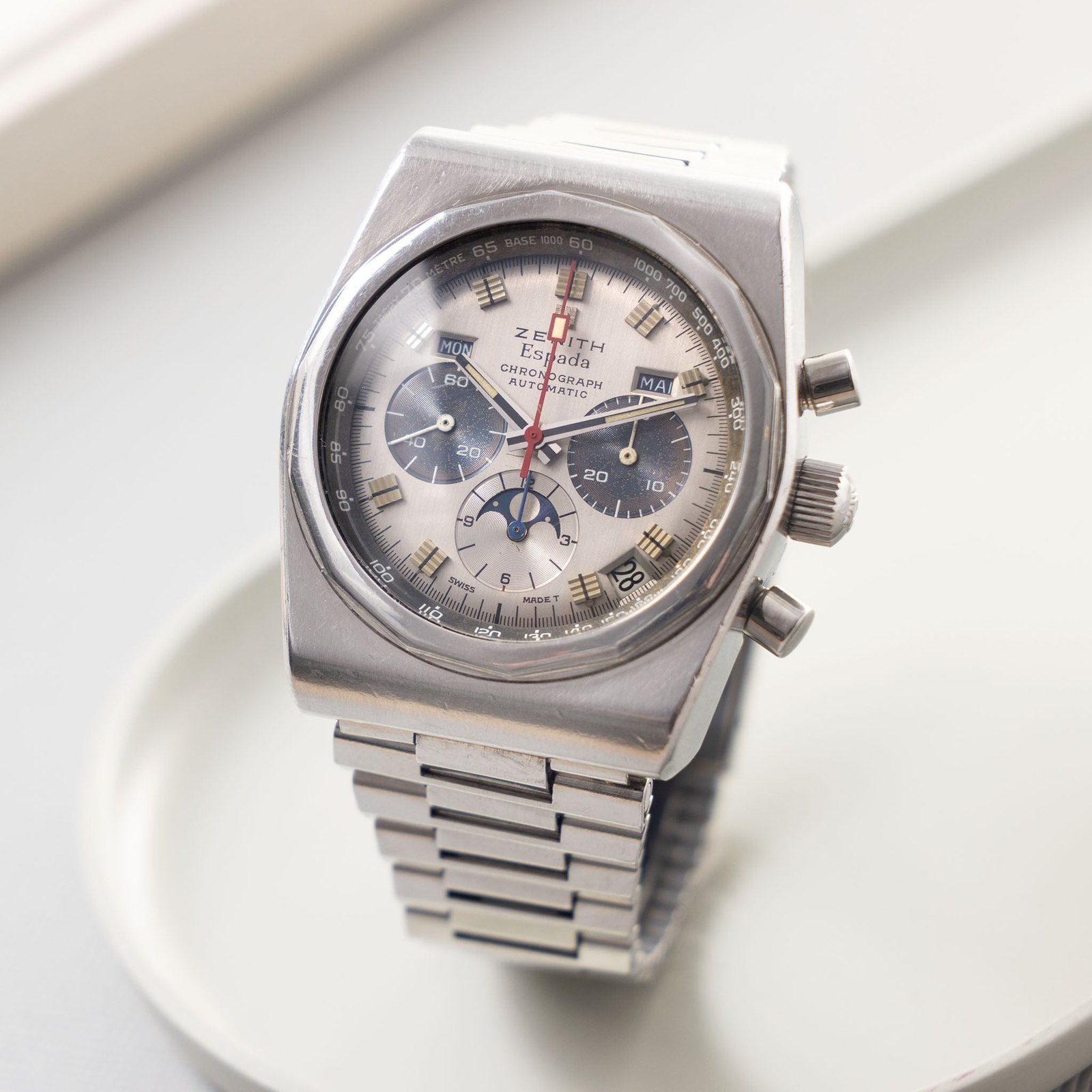
Zenith Espada silver dial Day-Date Chronograph ref 01.0040.418, early 1970s
- Maker / attribution
- Zenith (maker)
- Date
- early 1970s
- Historical period
- Quartz Revolution (1969 – 1990)
- Country of origin
- Switzerland
- Object type
- Wristwatch
- Materials / technique
- silver
- Dimensions
- Case 38 mm
- Stock no.
- W-3605
- Credit line
- Dealer listing, Bulang & Sons (W-3605)
- Catalogue title (original)
- Zenith Espada silver dial Day-Date Chronograph ref 01.0040.418 (English)
View the source record (dealer listing) ↗ (opens another website in a new tab)Suggest a correction
Record summary
Catalogued by Bulang & Sons (dealer), Copenhagen (stock number W-3605), this is a wristwatch by Zenith, made in Switzerland, dated early 1970s. The Atlas places it in the Quartz Revolution period (1969 – 1990) of its Wristwatches collection. Materials and techniques recorded by the source: silver. Recorded dimensions: Case 38 mm. The record is illustrated with 6 photographs.
Assembled from the source record's structured fields. Dates and attributions are given as the source states them; where a field is missing the Atlas leaves it blank rather than estimating.
Catalogue description
Dealer description — Bulang & Sons
Introduced at the dawn of the automatic chronograph era, the Zenith Espada arrived as a highly ambitious timepiece. It was not just another self-winding chronograph—it combined a full calendar and moonphase display, placing it among the most technically complex automatic chronographs of its time. In the early 1970s, Zenith collaborated closely with Movado, and the Espada shared strong visual and technical ties with the Movado Astronic, also known as “The Astronomer.” The family resemblance is unmistakable, reflecting a shared design language rooted in futuristic optimism and the experimental spirit of the era. The example offered here represents the second execution of the model. It features the updated Zenith logo—more squared and modern in appearance—replacing the earlier version that displayed a star above the script. This subtle evolution marks an important shift in the brand’s visual identity during the 1970s. Its 38 mm tonneau-shaped case perfectly captures the bold “space-age” aesthetic of the decade. The octagonal bezel enhances its architectural presence, while the original steel bracelet integrates seamlessly beneath the hidden lugs. The result is a design that feels both futuristic and fluid—technical, yet surprisingly organic on the wrist. The silver dial is rich in detail. A base-1000 tachymeter scale runs along the inner bezel, complemented by distinctive applied hour markers. Three subdials manage the chronograph functions, while apertures display the day, month, date, and moonphase—creating a dynamic yet harmonious layout that never feels overcrowded. Powering the watch is the legendary Zenith caliber 3019 PHF, fully serviced by our watchmaker. This high-frequency automatic chronograph movement represents one of the great technical achievements of its time. Yet the real charm of the Espada lies just as much in its design as in its mechanics. It feels like a watch born under disco lights and stage spotlights—perfectly at home on the wrist of a 1970s icon like Freddie Mercury. One could even argue that pieces like this didn’t just follow the disco movement—they helped start it. Get in touch. Specifications: Zenith El Primero Espada Chronograph reference 01.0040.418 Steel 38 mm steel case Serial 50xxx-11 dates to early 1970s Silver dial with inner tachymeter bezel and cut outs for day/date/ phase of moon functions Original Zenith steel bracelet Zenith El Primero 3019 PHF automatic movement Fully serviced by our watchmaker
Historical context
Quartz Revolution (1969 – 1990)
Seiko's Astron begins mass quartz timekeeping; traditional industries contract sharply.
Quartz and digital watches transformed the market after 1969. Swiss employment collapsed, Japanese and Hong Kong production soared, and the Swatch (1983) helped the Swiss industry recover; mechanical watches survived as luxury goods.
Read the period in the timelineMore wristwatches from this periodEarlier: Modern Mechanical Horology
Atlas type guide
Chronographs and split-seconds watches
A chronograph is a watch with an additional seconds hand that can be started, stopped and returned to zero independently of the timekeeping. Louis Moinet built an early example in 1816 and Nicolas Rieussec a recording 'chronographe' in 1821; Adolphe Nicole's heart-shaped reset cam (patented 1862) made the modern return-to-zero possible. Split-seconds (rattrapante) chronographs add a second hand that can be stopped for intermediate times; flyback chronographs restart instantly.
Chronographs were essential tools for doctors (pulsometer scales), artillery (telemeter), engineers and sport. In wristwatches, Valjoux, Venus, Lemania and later the automatic chronographs of 1969 (Zenith El Primero, the Chronomatic Calibre 11 group and Seiko 6139) are milestones.
What to look for
- Push-pieces on the case band or a single button in the crown (monopusher).
- Subsidiary registers for minutes and hours; tachymeter, telemeter or pulsometer scales.
- Column wheel versus cam control visible in the movement.
- Calibre markings of specialist makers (Valjoux, Lemania, Venus, Landeron).
Dating clues
- Pocket chronographs with heart cam reset: after 1862.
- Wrist chronographs: from c. 1910; two-button designs from the 1930s.
- Automatic chronographs: from 1969.
General guidance written by the Atlas editors about this kind of object. It is not a statement about this particular piece; for that, rely on the source record above and on physical examination.
Read next:Flyback chronographChronograph
Related records
Pocket Watches · 1900
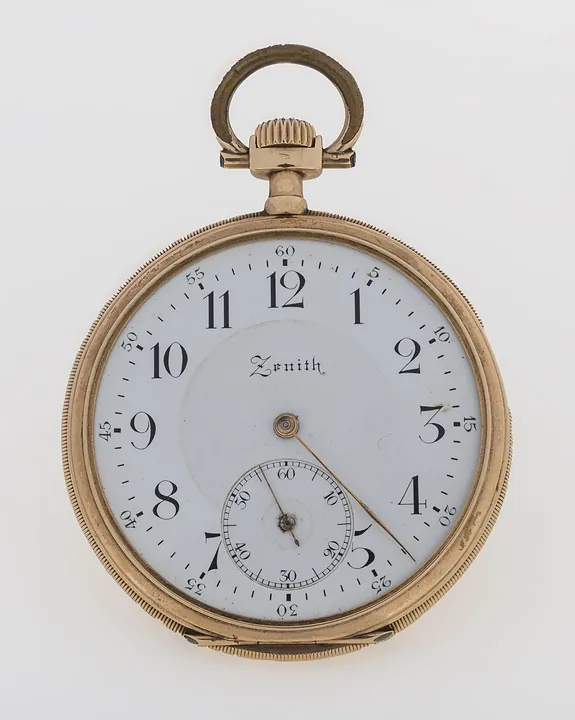
Pocket watch by Zenith, Switzerland, 1900
Museum Rotterdam
Pocket Watches · c. 1900s
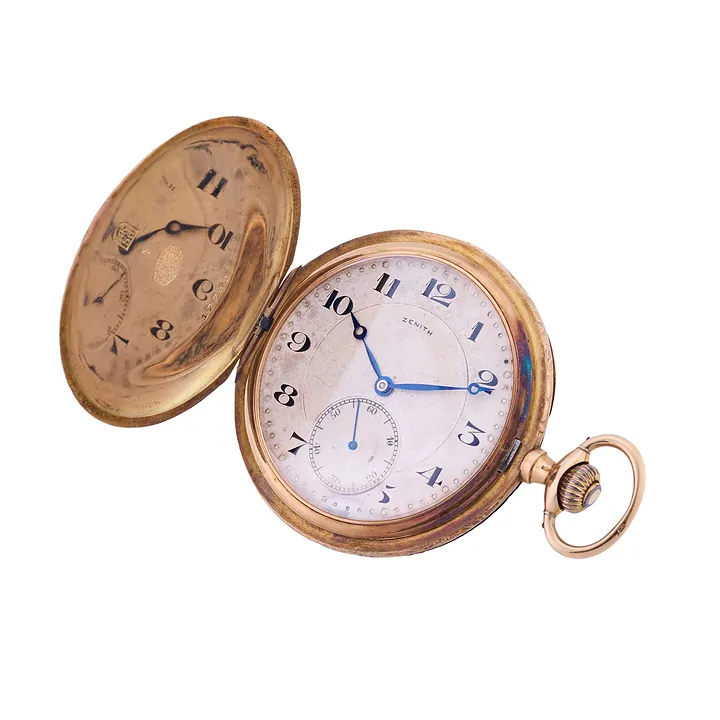
Zenith pocket watch, c. 1900s
Antiquorum auction archive, Geneva
Wristwatches · c. 1980s
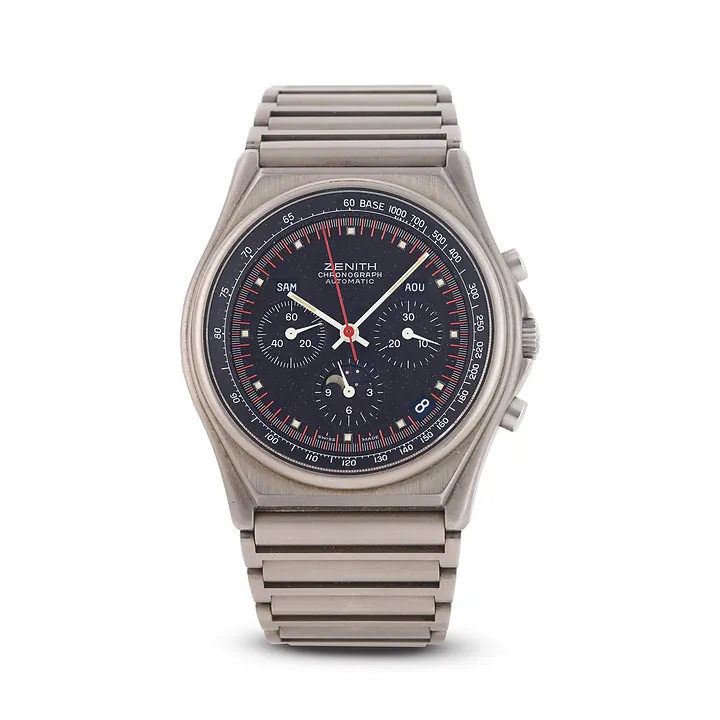
Zenith El Primero Triple Calendar Chronograph, ref. 95.0100.418, c. 1980s
Antiquorum auction archive, Geneva
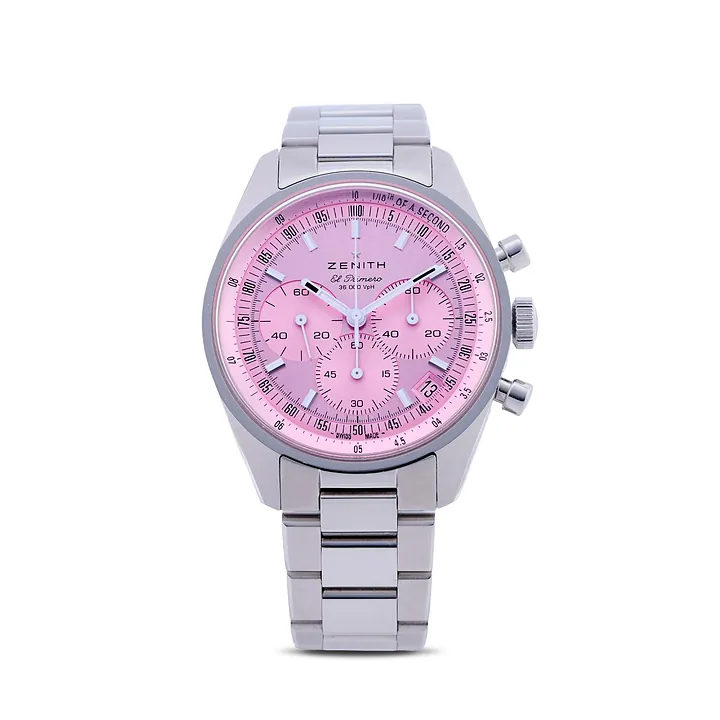
Wristwatches · originally sold in 2022 (per the lot record)
Zenith Chronomaster Original, ref. 03.3202.3600/33.M3200, originally sold in 2022
Antiquorum auction archive, Geneva

Wristwatches · 1970
Wristwatch by Heno, Switzerland, 1970
Museum Rotterdam

Wristwatches · 1960–1986
'Tri-Compax' calendar chronograph wristwatch in gold case, by Universal, Geneva, Switzerland, 1960–1986.
Science Museum Group, London

Wristwatches · 1969–1970
Beta 21 Quartz wristwatch movement, made in Switzerland, 1970.
Science Museum Group, London

Wristwatches · c. 1969
Omega Speedmaster Moonwatch, ref. 145022-69st, c. 1969
Antiquorum auction archive, Geneva