
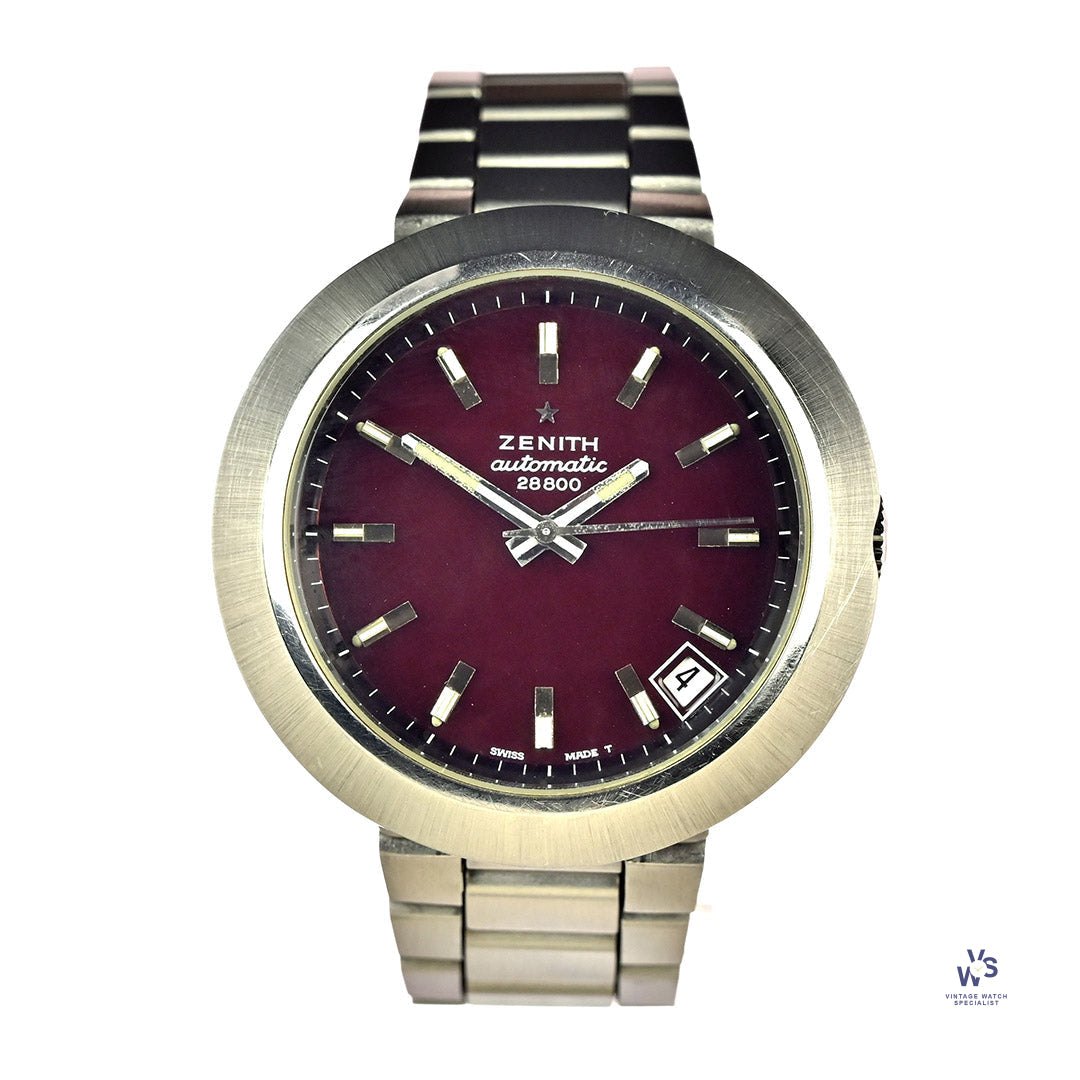
Wristwatches · Wristwatch
Zenith Disco Volante Date, Model 01-1190-290, UFO Case, Automatic Date, Maroon Dial, circa 1973
- Maker / attribution
- Zenith (maker)
- Date
- c. 1973
- Historical period
- Quartz Revolution (1969 – 1990)
- Country of origin
- Switzerland
- Object type
- Wristwatch
- Dimensions
- Case 40 mm
- Stock no.
- VWS3241
- Credit line
- Dealer listing, Vintage Watch Specialist (VWS3241)
- Catalogue title (original)
- Zenith Disco Volante Date - Model 01-1190-290 - UFO Case - Automatic Date - Stunning Maroon Dial - c.1973 (English)
View the source record (dealer listing) ↗ (opens another website in a new tab)Suggest a correction
Record summary
Catalogued by Vintage Watch Specialist (dealer), United Kingdom (stock number VWS3241), this is a wristwatch by Zenith, made in Switzerland, dated c. 1973. The Atlas places it in the Quartz Revolution period (1969 – 1990) of its Wristwatches collection. Recorded dimensions: Case 40 mm. The record is illustrated with 6 photographs.
Assembled from the source record's structured fields. Dates and attributions are given as the source states them; where a field is missing the Atlas leaves it blank rather than estimating.
Catalogue description
Dealer description — Vintage Watch Specialist
A Superb and Well-preserved 1970s Zenith Disco Volante Date, Model Ref: 01-1190-290, with a Beautiful Plum Dial and Retro UFO Inspired Case Zenith Watches, established in 1865 by Georges Favre-Jacot in Le Locle, Switzerland, is renowned for its precision and innovation in horology. Favre-Jacot's vision was to create the first integrated manufacture where all watchmaking processes were under one roof, ensuring unmatched quality control. Zenith quickly gained acclaim for its exceptional timepieces, winning numerous awards at international exhibitions. In 1969, Zenith revolutionized the industry with the El Primero movement, the world’s first high-frequency automatic chronograph. This groundbreaking mechanism operates at 36,000 vibrations per hour (vph), providing unparalleled accuracy and a smooth sweep of the seconds hand. Despite challenges like the Quartz Crisis of the 1970s, Zenith persevered by focusing on mechanical excellence. Today, Zenith continues to innovate while honouring its rich heritage. The brand remains a symbol of technical prowess and luxury in Swiss watchmaking, celebrated for both its historical significance and contemporary achievements. What's on Offer “Disco Volante,” meaning “flying saucer” in Italian seems a perfectly apt nickname for this watch - just look at the UFO-inspired case! We are pleased to offer this beautiful and unique piece for sale in such fine condition. It certainly nods heavily toward the free-spirited 1970s in which it was produced and serves as the epitome of retro chic! The rich plum dial is very well preserved and will certainly get you noticed but without it being "in your face". It boasts applied polished metal furniture including baton hour markers with luminous pips and chunky stick hands with a slight pencil tip, also with luminous inserts. There is an unusually placed date aperture between 4 and 5 o'clock, but it works and is a signature of the Zenith brand and they were probably the first brand to start putting a date window in this position! The dial is encapsulated underneath a mineral crystal and encases a wine-coloured jewel-like dial in that super-cool 40mm case. The watch is also paired with its original Zenith bracelet. This is a fairly rare and unusual watch, it looks fantastic on the wrist and is a worthy addition to any collection.
Historical context
Quartz Revolution (1969 – 1990)
Seiko's Astron begins mass quartz timekeeping; traditional industries contract sharply.
Quartz and digital watches transformed the market after 1969. Swiss employment collapsed, Japanese and Hong Kong production soared, and the Swatch (1983) helped the Swiss industry recover; mechanical watches survived as luxury goods.
Read the period in the timelineMore wristwatches from this periodEarlier: Modern Mechanical Horology
Atlas type guide
Automatic (self-winding) watches
Self-winding watches use the wearer's motion to wind the mainspring. Abraham-Louis Perrelet and Breguet made 'perpétuelle' pocket watches with oscillating weights in the late eighteenth century, but the principle only became practical in the wristwatch. John Harwood patented a bumper automatic in 1923; Rolex's Perpetual rotor (1931) winding in one direction, and later bidirectional rotors (Eterna, Felsa Bidynator), established the modern form. Micro-rotors (Universal Genève, Buren) and peripheral rotors made automatic watches thinner.
What to look for
- A semicircular rotor turning 360° over the movement, or a 'bumper' weight that rebounds between springs.
- 'Automatic', 'Perpetual' or 'Self-winding' on the dial.
- A sealed screw-back case, since automatic watches are wound less often by the crown.
Dating clues
- Bumper automatics: 1923–c. 1955.
- Full rotors: from 1931 (Rolex); widespread after c. 1950.
- Micro-rotors: from 1954–1958.
General guidance written by the Atlas editors about this kind of object. It is not a statement about this particular piece; for that, rely on the source record above and on physical examination.
Related records
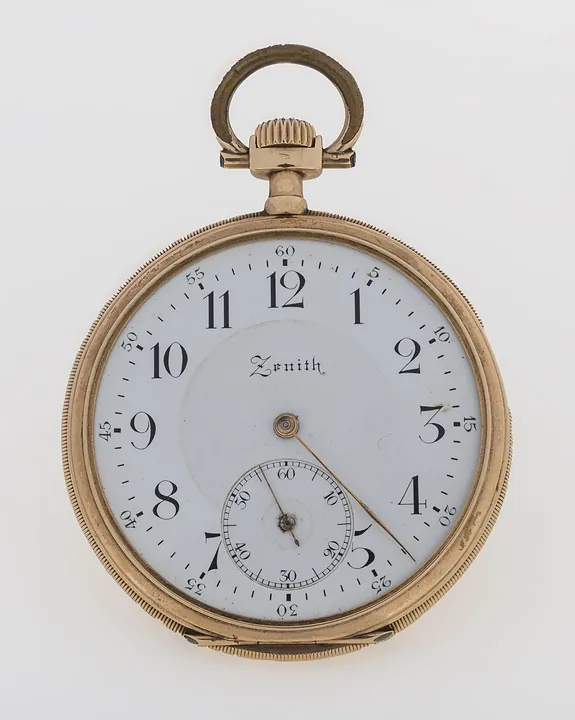
Pocket Watches · 1900
Pocket watch by Zenith, Switzerland, 1900
Museum Rotterdam
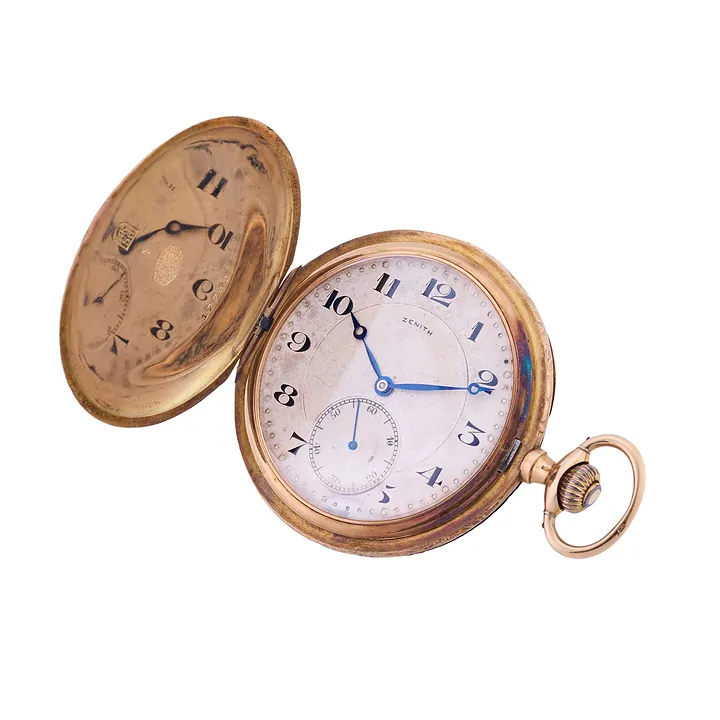
Pocket Watches · c. 1900s
Zenith pocket watch, c. 1900s
Antiquorum auction archive, Geneva
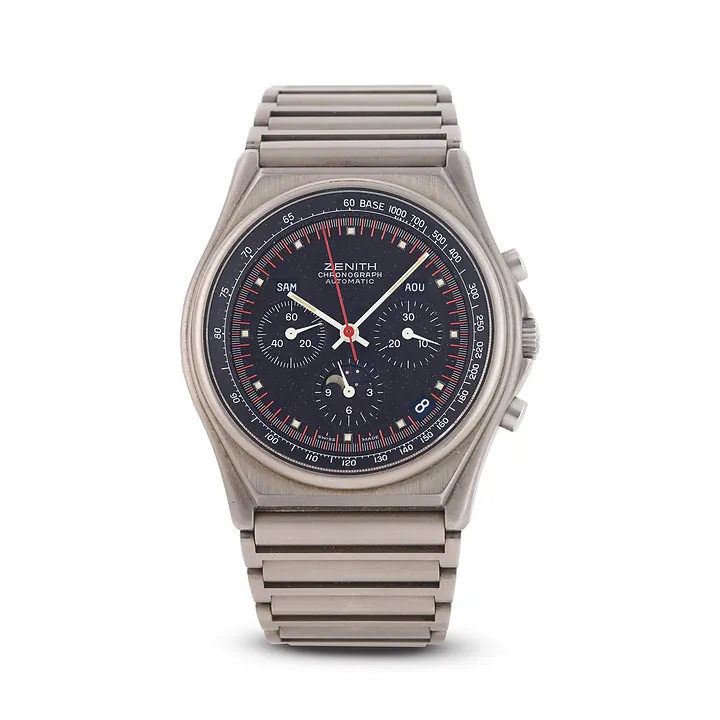
Wristwatches · c. 1980s
Zenith El Primero Triple Calendar Chronograph, ref. 95.0100.418, c. 1980s
Antiquorum auction archive, Geneva
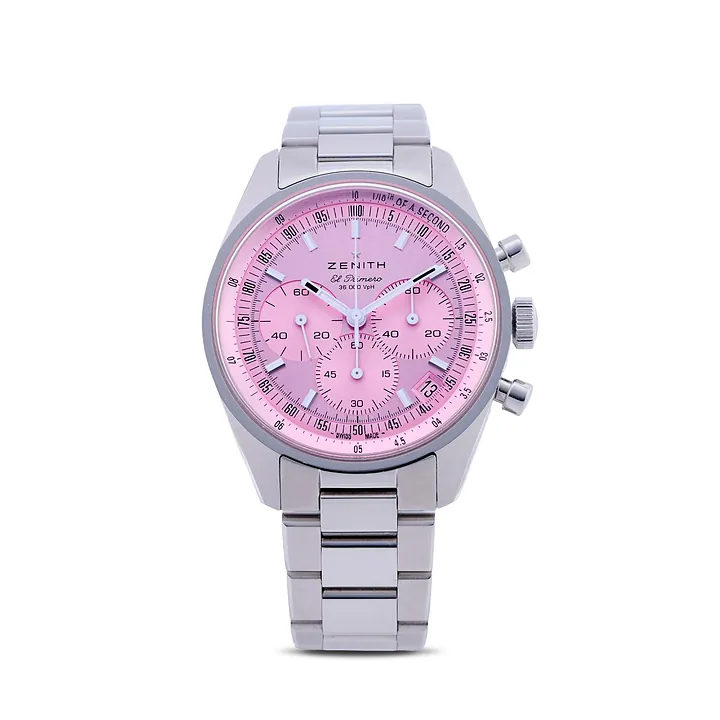
Wristwatches · originally sold in 2022 (per the lot record)
Zenith Chronomaster Original, ref. 03.3202.3600/33.M3200, originally sold in 2022
Antiquorum auction archive, Geneva

Wristwatches · 1970
Wristwatch by Heno, Switzerland, 1970
Museum Rotterdam

Wristwatches · 1960–1986
'Tri-Compax' calendar chronograph wristwatch in gold case, by Universal, Geneva, Switzerland, 1960–1986.
Science Museum Group, London

Wristwatches · 1969–1970
Beta 21 Quartz wristwatch movement, made in Switzerland, 1970.
Science Museum Group, London

Wristwatches · c. 1969
Omega Speedmaster Moonwatch, ref. 145022-69st, c. 1969
Antiquorum auction archive, Geneva