
Wristwatches · Wristwatch
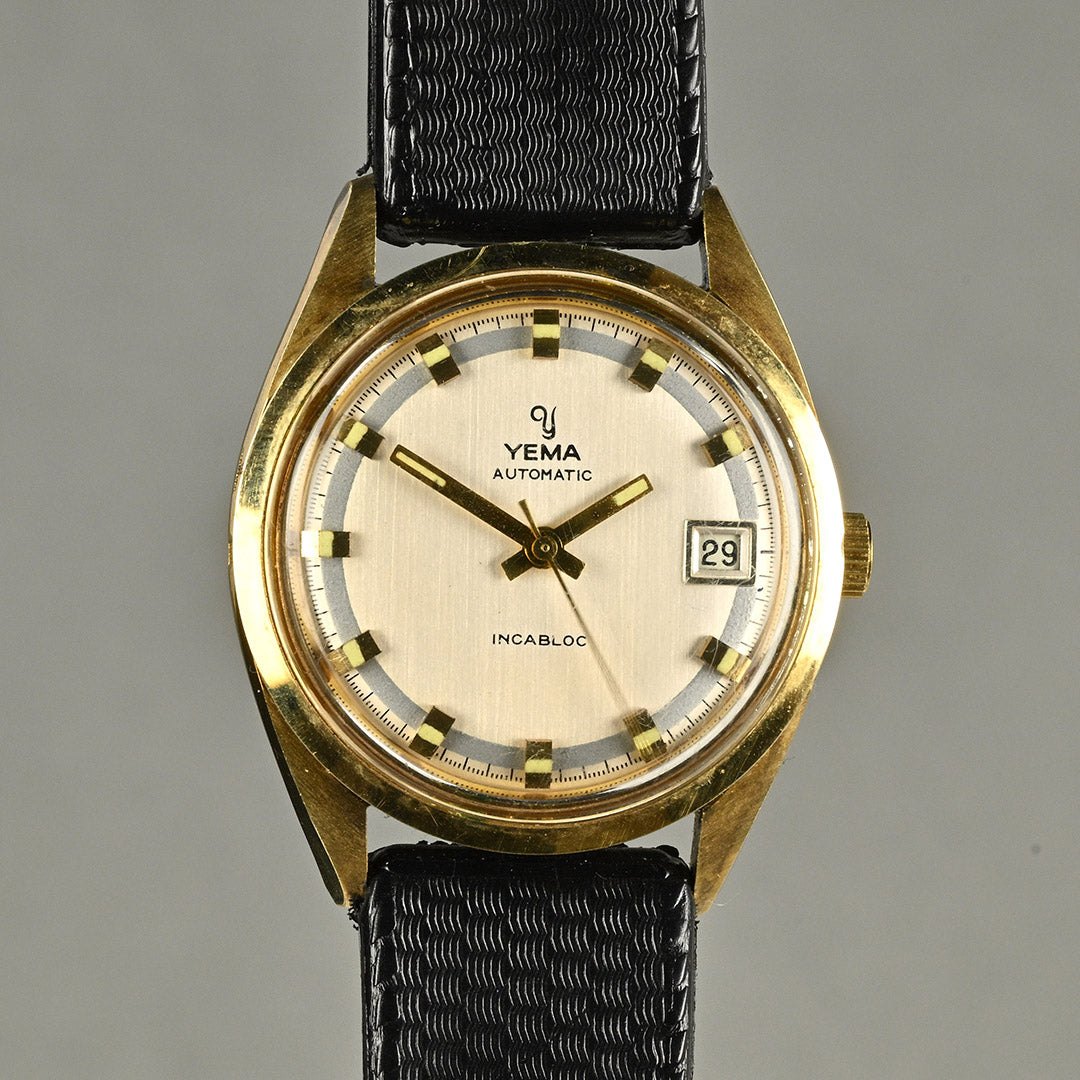
Yema Automatic Date, Gold-Tone Case, Silver Dial, ref. 368307, circa 1970
- Maker / attribution
- Yema (maker)
- Date
- c. 1970
- Historical period
- Quartz Revolution (1969 – 1990)
- Country of origin
- Unrecorded in source
- Object type
- Wristwatch
- Materials / technique
- gold
- Dimensions
- Case 34.5 mm
- Stock no.
- vws4485
- Credit line
- Dealer listing, Vintage Watch Specialist (vws4485)
- Catalogue title (original)
- Vintage Yema Automatic Date – Gold-Tone Case, Silver Dial, Reference 368307, c.1970 (English)
View the source record (dealer listing) ↗ (opens another website in a new tab)Suggest a correction
Record summary
Catalogued by Vintage Watch Specialist (dealer), United Kingdom (stock number vws4485), this is a wristwatch by Yema, dated c. 1970. The Atlas places it in the Quartz Revolution period (1969 – 1990) of its Wristwatches collection. Materials and techniques recorded by the source: gold. Recorded dimensions: Case 34.5 mm. The record is illustrated with 6 photographs.
Assembled from the source record's structured fields. Dates and attributions are given as the source states them; where a field is missing the Atlas leaves it blank rather than estimating.
Catalogue description
Dealer description — Vintage Watch Specialist
Founded in France in 1948 by Henry Louis Belmont, Yema established itself as a watchmaker with a particularly broad range, from practical everyday timepieces to professional sports watches. Although the brand is perhaps best known today for its Superman diving watches and motorsport-inspired chronographs, its catalogue also included an extensive selection of automatic dress watches. By the late 1960s and early 1970s, automatic winding and date displays had become increasingly desirable features for everyday wristwatches. Yema embraced these developments while experimenting with distinctive case shapes, dial finishes and applied hour markers. This example captures that period particularly well. Its sculpted gold-tone case, silver dial and contrasting geometric hour markers offer a more understated expression of 1970s styling, while the automatic movement provides the mechanical appeal that makes vintage watches so enjoyable to collect. What's on Offer Here we have a very attractive Yema Automatic Date, dating to approximately 1970, presented in very good vintage condition. The first thing that catches the eye is the beautifully balanced silver dial. Its subtle vertical brushing catches the light without becoming overly reflective, while a contrasting grey chapter ring adds depth and definition. Applied gold-tone hour markers sit prominently around the dial, complemented by matching baton hands with luminous inserts. At 3 o'clock, a framed date window provides a practical addition to an otherwise wonderfully uncluttered design. The Yema signature and distinctive emblem sit beneath 12, with 'Automatic' below, while 'Incabloc' appears above 6, referring to the movement's shock-protection system. The gold-tone case measures 34.5mm across, with a lug-to-lug measurement of 41.5mm and a 19mm lug width. Its most distinctive feature is undoubtedly the sculpted lugs, which curve elegantly away from the case and give the watch a more substantial appearance than its dimensions might suggest. The case displays the expected marks of wear for a watch of this age, particularly around the lugs and case edges, but retains plenty of its attractive vintage character. The stainless steel caseback features Yema's decorative crest, along with markings identifying its water-resistant construction. Protecting the dial is a domed Plexiglass crystal, which complements the watch's period styling beautifully. Inside beats the 17-jewel FE 3611 automatic movement , offering an approximate 38-hour power reserve. The movement has been serviced and is performing particularly well, with a timegrapher reading of 0 seconds per day and an amplitude of 311° at the time of testing. The watch is paired with a black textured leather strap, providing a pleasing contrast against the warm gold-tone case. An attractive and characterful vintage Yema that offers all the charm of early 1970s watchmaking without the oversized proportions often associated with the decade. Condition Report: Crystal: Very Good Dial: Excellent Bezel: Good Case: Good Movement: Serviced 0s/d 311° Overall: Very Good
Historical context
Quartz Revolution (1969 – 1990)
Seiko's Astron begins mass quartz timekeeping; traditional industries contract sharply.
Quartz and digital watches transformed the market after 1969. Swiss employment collapsed, Japanese and Hong Kong production soared, and the Swatch (1983) helped the Swiss industry recover; mechanical watches survived as luxury goods.
Read the period in the timelineMore wristwatches from this periodEarlier: Modern Mechanical Horology
Atlas type guide
Automatic (self-winding) watches
Self-winding watches use the wearer's motion to wind the mainspring. Abraham-Louis Perrelet and Breguet made 'perpétuelle' pocket watches with oscillating weights in the late eighteenth century, but the principle only became practical in the wristwatch. John Harwood patented a bumper automatic in 1923; Rolex's Perpetual rotor (1931) winding in one direction, and later bidirectional rotors (Eterna, Felsa Bidynator), established the modern form. Micro-rotors (Universal Genève, Buren) and peripheral rotors made automatic watches thinner.
What to look for
- A semicircular rotor turning 360° over the movement, or a 'bumper' weight that rebounds between springs.
- 'Automatic', 'Perpetual' or 'Self-winding' on the dial.
- A sealed screw-back case, since automatic watches are wound less often by the crown.
Dating clues
- Bumper automatics: 1923–c. 1955.
- Full rotors: from 1931 (Rolex); widespread after c. 1950.
- Micro-rotors: from 1954–1958.
General guidance written by the Atlas editors about this kind of object. It is not a statement about this particular piece; for that, rely on the source record above and on physical examination.
Related records
Wristwatches · 1970s
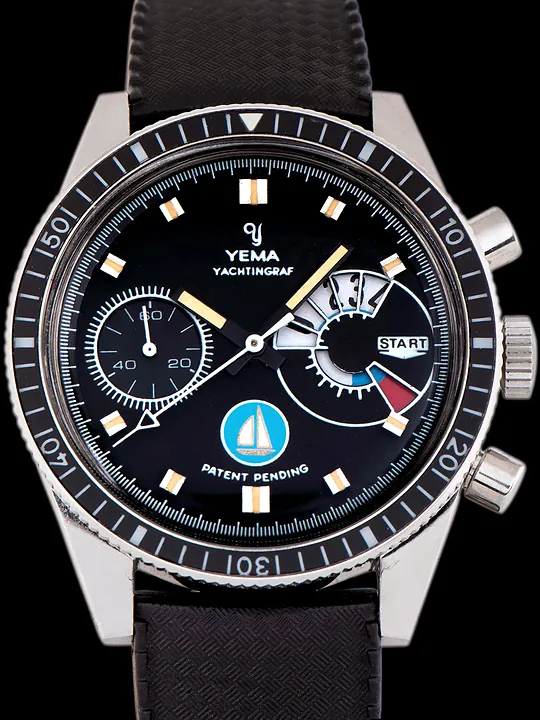
Yema Yachtingraf Régate (Ref. 5667370) "Blue Ship", 1970s
Craft & Tailored (dealer), Los Angeles
Wristwatches · 1960s
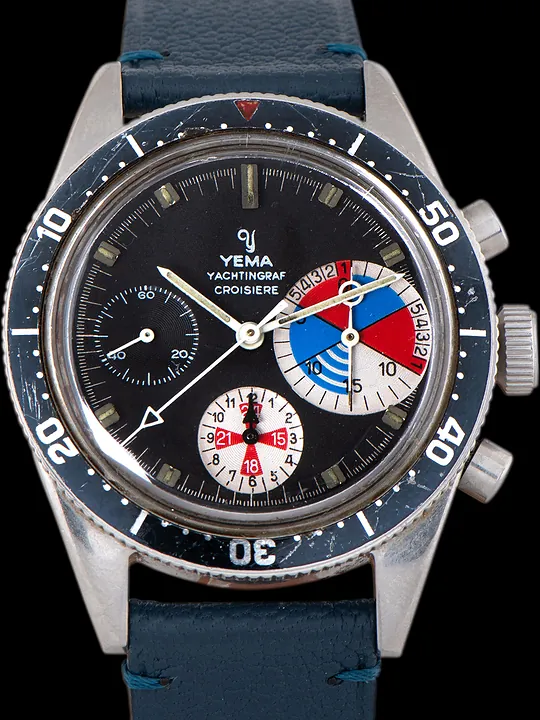
Yema Yachtingraf Croisière (Ref. 93012) "Big Eye", 1960s
Craft & Tailored (dealer), Los Angeles
Wristwatches · 1998
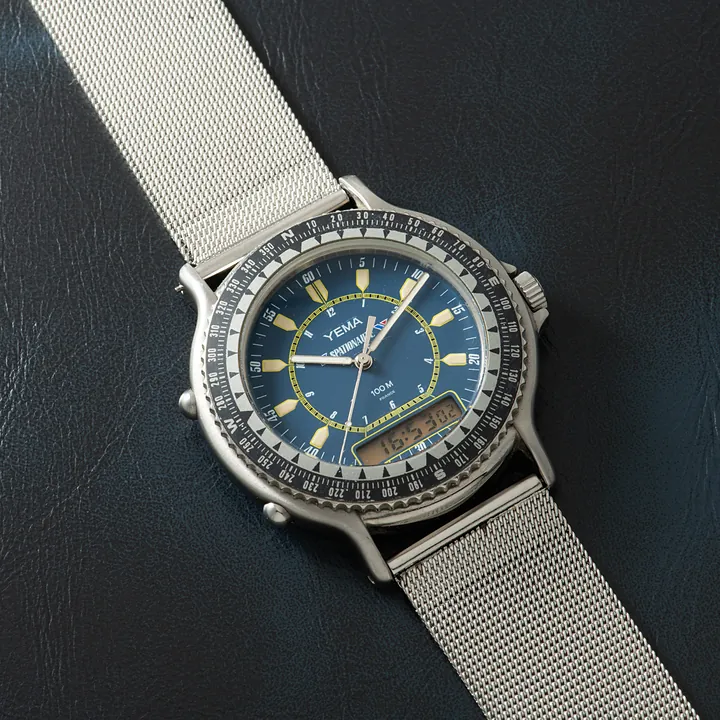
Yema Spationaute ISS, 1998
Analog/Shift (dealer), New York
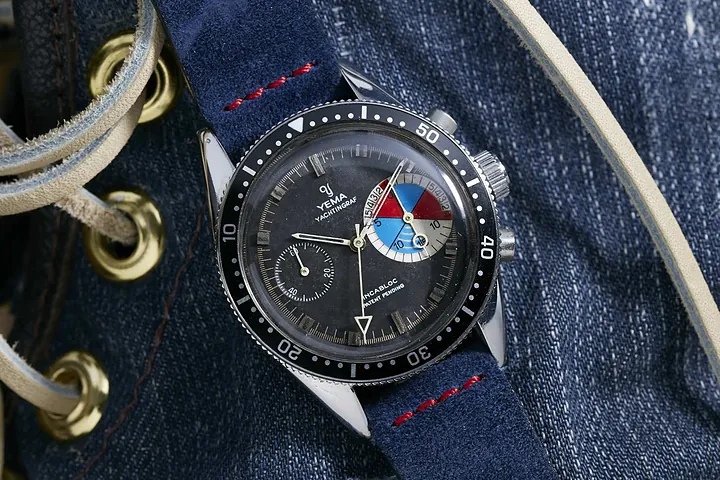
Wristwatches · late 1960s
Yema Yachtingraf, late 1960s
Analog/Shift (dealer), New York

Wristwatches · 1970
Wristwatch by Heno, Switzerland, 1970
Museum Rotterdam
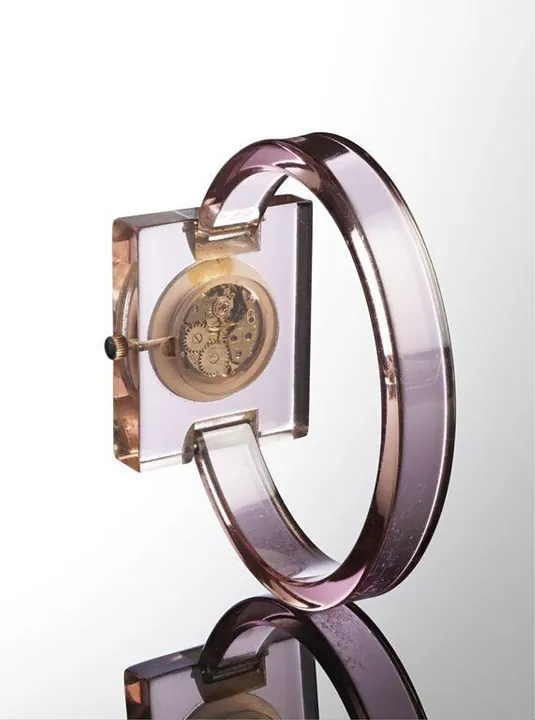
Wristwatches · 1970s
Wristwatch, plastic, by Gucci; Italy, 1970s.
Victoria and Albert Museum, London
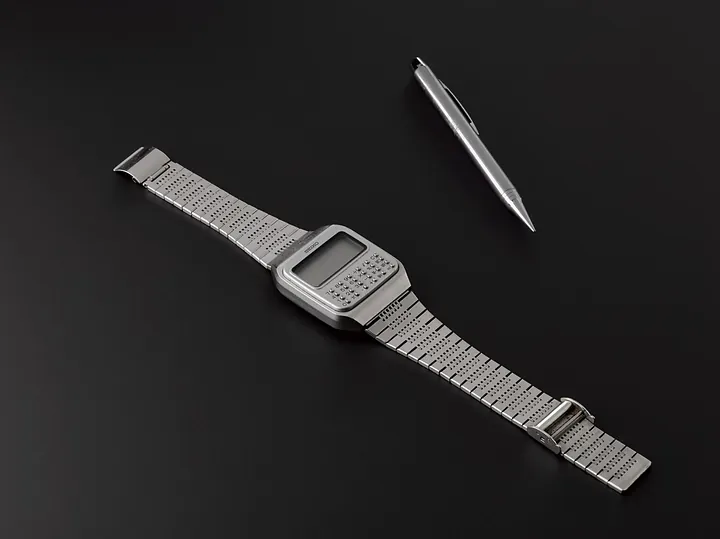
Wristwatches · 1978
Calculator wristwatch by Suwa Seikosha Co. Limited, Japan, 1978
Science Museum Group, London
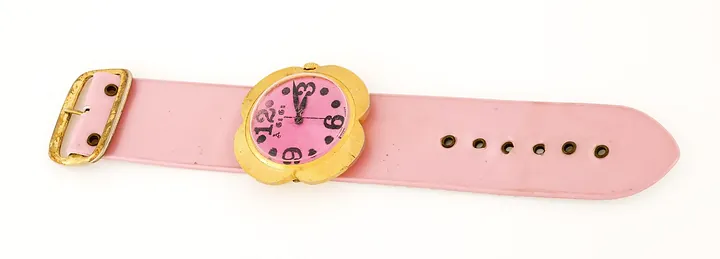
Wristwatches · 1980
Wristwatch, 1980 (no. 71413)
Museum Rotterdam