
Wristwatches · Wrist-watch
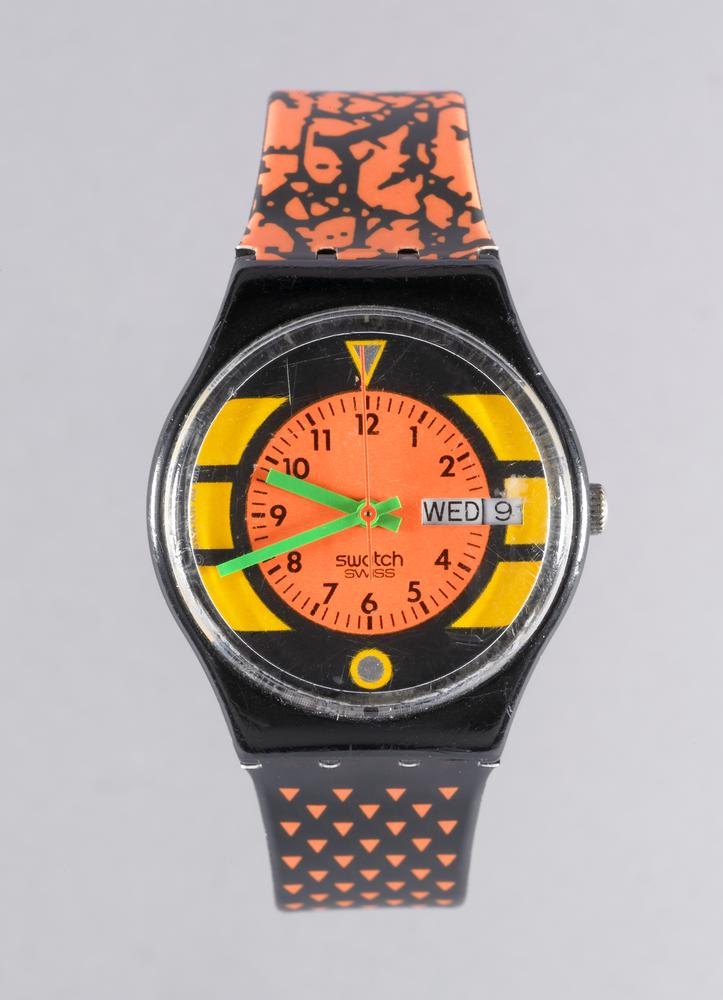
Wrist-watch Black plastic case with a screw-on battery compartment cover
- Maker / attribution
- Swatch (Made by)
- Date
- 1988
- Historical period
- Quartz Revolution (1969 – 1990)
- Country of origin
- Switzerland
- Place
- Switzerland
- Object type
- Wrist-watch
- Materials / technique
- plastic
- Dimensions
- Diameter: 31.20 millimetres (dial) Thickness: 9.50 millimetres (case)
- Holding institution
- British Museum
- Accession / object no.
- 2000,0707.8
- Credit line
- British Museum, London
- Catalogue title (original)
- Wrist-watch Black plastic case with a screw-on battery compartment cover (English)
View the source record ↗ (opens another website in a new tab)Suggest a correction
Record summary
Held and catalogued by British Museum (object number 2000,0707.8), this is a wrist-watch by Swatch, made in Switzerland, dated 1988. The Atlas places it in the Quartz Revolution period (1969 – 1990) of its Wristwatches collection. Materials and techniques recorded by the source: plastic. Recorded dimensions: Diameter: 31.20 millimetres (dial) Thickness: 9.50 millimetres (case). The record is illustrated with 2 photographs.
Assembled from the source record's structured fields. Dates and attributions are given as the source states them; where a field is missing the Atlas leaves it blank rather than estimating.
Catalogue description
Description — British Museum
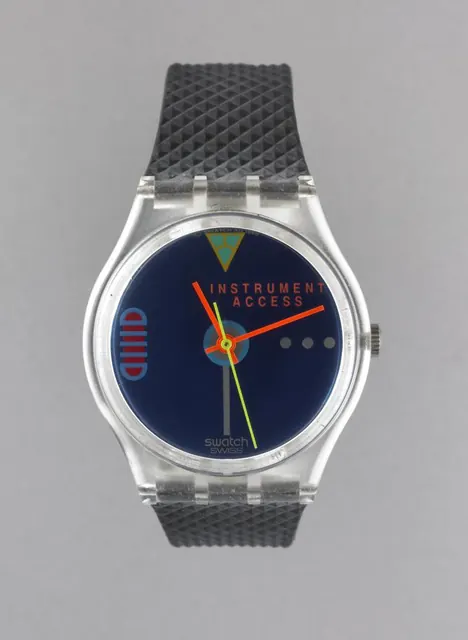
Wrist-watch Black plastic case with a screw-on battery compartment cover. Orange and black plastic wrist strap. Dial with yellow, black and orange design of horizontal bars. central dial with minute track and hours 1-12. a date aperture at 3 o'clock. Green hour and minute hands, orange centre-seconds hand.
Curator's comments — British Museum
Text from 'Watches', by David Thompson, London, 2008, p. 164-165 [comment relating to registration 1990,0508.1, 1997,0213.1 and 2000,0707.8]. Swatch PLASTIC CASED QUARTZ WRISTWATCHES BIEL, SWITZERLAND, 1980s-90s After the introduction of quartz watches in the 1970s, the watch market was so dominated by Japanese and American manufacturers that the Swiss watchmaking industry was under serious threat of collapse. By 1980 traditional and long-standing watchmaking companies that were still manufacturing mechanical watches were facing extinction, and large numbers of factories had already closed, causing widespread unemployment. What had been for centuries a major part of the Swiss economy was rapidly disappearing. At the time the two major companies involved in watchmaking in Switzerland were the Société Suisse de l'Industrie Horlogerie SA (SSIH) and the Allgemeine Schweizerische Uhren AG (ASUAG), which incorporated many well-known subsidiary watch manufacturers. In an attempt to curb this serious threat to the Swiss economy, a group of bankers called on Nicolas Hayek, head of Hayek Engineering AG, to investigate the feasibility of revitalizing the failing industry. In 1979 ASUAG devised a new watch, the 'Delirium', which at just under 2 mm thick was one of the thinnest models ever made. Hayek's plan was to develop this watch using new technology and to market it in Europe and in America. In 1981 the watch was finally produced and was launched on the market in 1982 under the name 'Popularis'. That same year the trade name 'Swatch' came into existence, a combination of the words 'second' and 'watch', coined to indicate a new concept in watch ownership. The project was an immediate success and as a further step towards revitalization, ASUAG and SSIH merged in 1983 to become the Société Suisse de Microélectronique et d'Horlogerie SA (SSMH), which, although best known for making Swatch watches, also includes such household names as Omega, Longines, Blancpain, Certina and Mido. The Swatch brand quickly became synonymous with fashion and design watches aimed at the younger buyer, with short-lived designs at affordable prices. Early on it was decided that the watch would be priced at no more than 50 Swiss francs to reach a huge market around the world; because the watch contained the latest quartz technology, accuracy far superior to any comparatively priced mechanical watch could be guaranteed. In competition with the established quartz watch manufacturers in America and Japan, the use of plastics for the cases and wristbands also allowed for a much cheaper product, lowering manufacturing costs and thus retail price. Swatch watches were an entirely new creation, which in no way attempted to imitate existing styles or the look of a traditional watch, also a factor that contributed to its success. New and different dials were of the essence, and in this respect the time-indication element took second place to the design. Bright colours and eye-catching images were the order of the day. Within two years of the founding of the new company, over ten million Swatches had been sold worldwide, proof of the concept's overwhelming success. SSMH is today the world's largest manufacturer of watches.
Inscriptions & marks
inscription; dial; SWATCH; SWISS; inscription; case back; 9152P; PATENTED WATERRESISTANT; SWISS MADE; 5755; BATTERY; 11,60 x 3,10; 1,55v; inscription; dial; © SWATCH AG 1988; Date of the Swatch design
Provenance
Donated by:, James Dowling
Historical context
Quartz Revolution (1969 – 1990)
Seiko's Astron begins mass quartz timekeeping; traditional industries contract sharply.
Quartz and digital watches transformed the market after 1969. Swiss employment collapsed, Japanese and Hong Kong production soared, and the Swatch (1983) helped the Swiss industry recover; mechanical watches survived as luxury goods.
Read the period in the timelineMore wristwatches from this periodEarlier: Modern Mechanical Horology
Atlas type guide
Wristwatches
Bracelet watches were worn by women from the early nineteenth century — Breguet made one for Caroline Murat, Queen of Naples, in 1810–12 — but the wristwatch only became a man's instrument with military use and aviation in the early twentieth century. Between the World Wars it overtook the pocket watch; the 1920s and 1930s brought rectangular Art Deco cases, water-resistant cases and the first automatic winding systems.
After 1945 the wristwatch became a carrier of identity — dress watches, sports and dive watches, chronographs, calendars — produced by Swiss, American, Japanese, German, Soviet and Chinese industries. The quartz revolution after 1969 and the mechanical renaissance since the 1990s, including the rise of independent watchmakers, complete the story.
What to look for
- The reference number (between the lugs or inside the case back) and serial number, the starting point for dating.
- The calibre: its maker and number are often stamped under the dial or on the bridge.
- Originality of dial, hands and crown — refinished ('redial') dials are common.
- Case material marks: 18K/750, 14K/585, stainless steel, gold-filled, plated.
Dating clues
- Wire-lug cases: before c. 1925.
- Water-resistant screw-down cases: from 1926.
- Quartz movements: from 1969; sapphire crystals widespread after c. 1980.
General guidance written by the Atlas editors about this kind of object. It is not a statement about this particular piece; for that, rely on the source record above and on physical examination.
Related records
Pocket Watches · 1985–1991
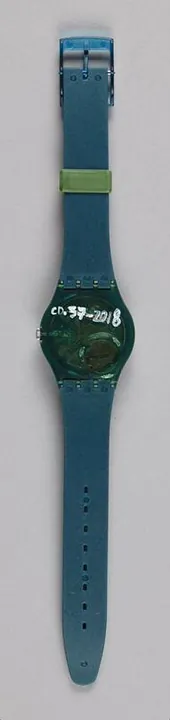
Swatch dummy watch: Blue Leaves GN104 design
Victoria and Albert Museum, London
Pocket Watches · 1985–1991
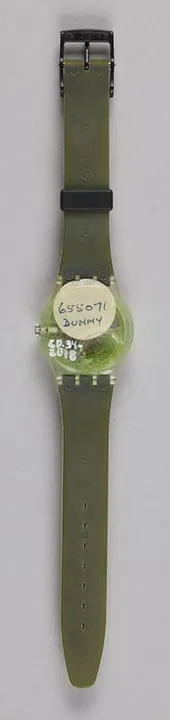
Swatch dummy watch: Technosphere GK101 design
Victoria and Albert Museum, London
Wristwatches · 2012 (year of issue)
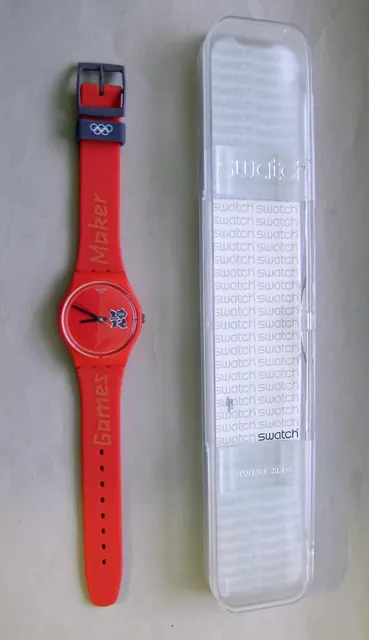
Wrist-watch Clear plastic presentation box with instruction leaflet
British Museum
Wristwatches · 1988
Battery-powered quartz controlled swatch wrist-watch with blue dial and orange hands
British Museum

Wristwatches · 1970
Wristwatch by Heno, Switzerland, 1970
Museum Rotterdam

Wristwatches · 1960–1986
'Tri-Compax' calendar chronograph wristwatch in gold case, by Universal, Geneva, Switzerland, 1960–1986.
Science Museum Group, London

Wristwatches · 1969–1970
Beta 21 Quartz wristwatch movement, made in Switzerland, 1970.
Science Museum Group, London

Wristwatches · c. 1969
Omega Speedmaster Moonwatch, ref. 145022-69st, c. 1969
Antiquorum auction archive, Geneva