
Clocks · Alarm clock
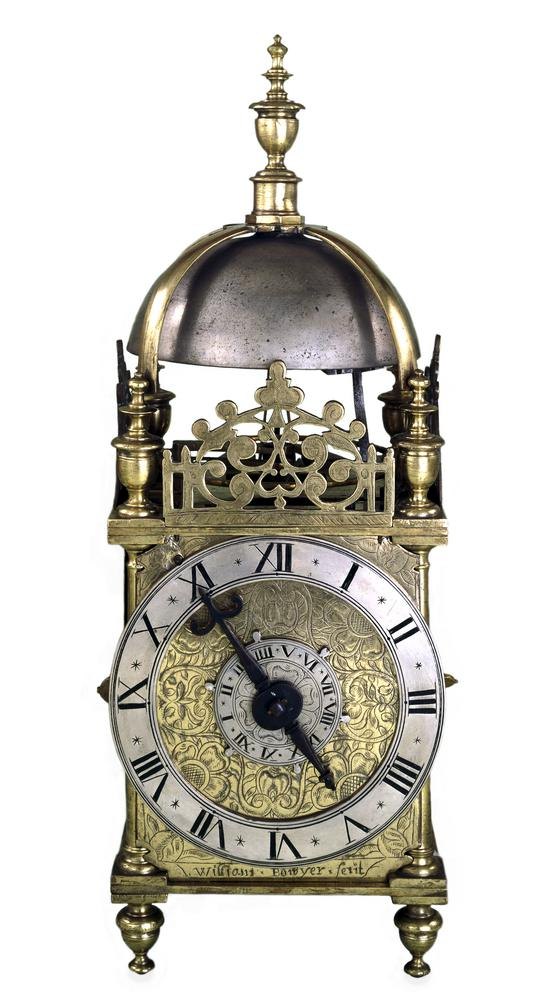
Weight-driven wall clock with alarm and hour striking
- Maker / attribution
- William Bowyer (Made by)
- Date
- 1625–1635
- Historical period
- Early Modern Horology (1600 – 1750)
- Country of origin
- England
- Place
- London (England)
- Object type
- Alarm clock
- Materials / technique
- brass
- Dimensions
- Height: 43.90 centimetres Width: 14.80 centimetres Depth: 14.70 centimetres
- Holding institution
- British Museum
- Accession / object no.
- 1958,1006.2094
- Credit line
- British Museum, London
- Catalogue title (original)
- Weight-driven wall clock with alarm and hour striking (English)
View the source record ↗ (opens another website in a new tab)Suggest a correction
Record summary
Held and catalogued by British Museum (object number 1958,1006.2094), this is an alarm clock by William Bowyer, made in London (England), dated 1625–1635. The Atlas places it in the Early Modern Horology period (1600 – 1750) of its Clocks collection. Materials and techniques recorded by the source: brass. Recorded dimensions: Height: 43.90 centimetres Width: 14.80 centimetres Depth: 14.70 centimetres. The record is illustrated with 5 photographs.
Assembled from the source record's structured fields. Dates and attributions are given as the source states them; where a field is missing the Atlas leaves it blank rather than estimating.
Catalogue description
Description — British Museum
Weight-driven wall clock with alarm and hour striking. Brass wall lantern clock; verge escapement with balance; weight-driven; alarum mechanism mounted on the exterior of the back-plate; striking-train (hours only). Train-counts: Going train Great wheel 56 Second wheel 54 pinion 7 Crown wheel 19 pinion 6 Extended gt wheel arbor with pinion of 4 driving hour-wheel of 48. Striking train Great wheel. 56 With 8 pins. Pinion of report of 4 drives count wheel of 39. Hoop wheel 56 pinion 7 Warning wheel 54 pinion 6 Fly 6 Alarm. Crown wheel. 17.
Curator's comments — British Museum
The following text is the entry for this object from the unpublished catalogue of pre-pendulum clocks by John Leopold, former Assistant Keeper of Horology at the Museum. This information is unedited and should be used accordingly. xxxxxxxxxxxxxxxxxxxxxxxxxxxxxxxxxxxxxxxxxxxxxxxxxxxxxxxxxxx LANTERN CLOCK, BY WILLIAM BOWYER. London,… ca.1630. Ilbert No. 333 Q: ex Clowes, May 1943: ex Drummond Robertson and Iden. Bibliography. Britten 3 (1911) 458, 460 (J.Drummond Robertson) Britten 4 (1919) 205, 207. Britten 5 (1922) 477, 479. Drummond Robertson (1931) 135. Britten 6 (1932) 521, 523 (dito) Cescinsky (1938) 23 (no owner but thanks Iden in preface). Exhib.cat. Birmingham 1953-4 No.4. Britten 7 (1956) 25. Exhib.cat. London 1958 No.17. Cat.Ilbert (1958) No.31. Dawson etc. (1958) 162-163 (ex Drummond Robertson). Gardner (1958) 197. Tait (1968) 28-9, pl.20-21. Blakemore (1969) 155 Britten 8 (1972) 25. Abeler (1975) 57. Britten 3 2 (1977) 344. Jagger (1977) 101. Pearson (1979) 18. Smith (1979) 249. Britten 9 (1982) 26. Dawson etc. (1982) 59, 62, 67. Hutchinson (1983) no.43. Tait (1983) 19, front cover. Cat. Iden (1987) 200-201. White (1989) 67, 86, 101 (fig.126), 500 ff. Hooper (1998) 124 (considers this one of the early Bowyers). Also: P.Macquoid & R.Edwards, The Dictionary of English Furniture II 100. Compare HJ July 1924 p.218: Bowyer clock in Webster coll. Analysis of hoop wheel, countwheel and "Back Strike Plate": White (1989) 500 ff. Signature: Engraved at the bottom of the dial plate: "William * Bowyer * fecit". Engraved at the foot of the left-rear pillar (rear side), engraved "VII" (across the base of the pillar, the edge of the plate and the top of the foot) 1). Scratched on the back of the dial plate: "William White May 21(?) 1811". Scratched on the inside of the left door: "Tims Decmber 4 1844". Scratched on the dial side of the front bar: "T Bowles 1862". Description: Case and dial. Lantern clock, consisting of a posted frame movement to which have been fitted four vertical panels, three frets and a bellstrap with bell: these parts together constitute the case, constructed largely of brass. The front vertical panel is secured at the bottom by two lugs on the panel, which fit into holes in the bottom plate of the movement, and at the top by two pins in the top plate. The panel is engraved at the corners with flowers, at the centre with a ring of flowers, tendrils and strapwork, and at the bottom with the signature. The silvered chapterring, pinned by four feet, is marked I - XII with small stars as half-hour marks. In the middle of the dial is the silvered alrm disc, engraved I - XII with small stars as half-hour marks around a six-petalled rose. On the chapter ring the heavy strokes of the figures X in X, XI and XII are reversed (IX is conventional). On the alarm disc the X's in IX, X and XI are reversed. There is a steel hour hand. Back panel of brass, with the alarm mechanism attached. There are no traces of spurs on the plate, which is probably a replacement. There are plain brass doors, hinged between the movement plates. The hinge pins at the top of both doors have been repaired, that on the right hand in steel. The latches inside the doors are of steel. The doors are replacements. Three frets, pierced in the traditional strapwork design, are screwed (two screws each) to the top plate of the movement. The side frets are plain, but the front one is engraved, and its back has bits of trial engraving. The cast bell strap is sprung by steel pins into the top finials of the movement. The bell is attached by a steel screw which is secured by the top finial. This finial is similar to the corner ones, with a cylindrical base ("cotton reel", see Commentary). Movement. Posted frame movement, constructed largely of brass. Two rectangular plates connected at the corners by turned pillars, which are screwed at top and bottom by turned finilas and feet. The steel suspension hoop is riveted to the top of the top plate (two steel rivets). All wheels have four crossings except the dial-wheel, which is solid. All pivot holes have been rebushed. Going train. Train count: 4 ║ 56 54 ── ║ ── ── 19 (x 2) 12-hour ← 48 ║ 7 6 Great wheel: cordwheel with a brass and a steel disc; steel face click mounted on the steel disc, acting on the crossings of the wheel. The pinion-of-report is squared on the end of the arbor, and is original. Escapement: brass wheel balance and brass cock. Dial wheel: brass wheel mounted on the arbor with a steel spring-disc; the arbour carries the brass starwheel for unlocking the striking. On the arbor rides the brass unlocking piece of the alarm, being held against the wheel by a steel spring washer. Striking train. Traincount: 4 ║ 56 54 54 ── ║ ── ── ── 12-hour ← 39 ║ 7 6 6 Great wheel: 8 lifting pins. Cordwheel with one brass disc and a steel one, the steel disc with a steel face-click acting on the crossings of the wheel. 2nd wheel: single brass hoop, riveted to the band of the wheel. 3rd wheel: one steel pin for warning. Heavy brass fly. Countwheel: steel disc with brass wheel. Steel detends. Warned striking, with locking and indexing on the 2nd wheel and warning on the 3rd. Alarm. The alarm assembly is mounted on the back plate; there is a steel stirrup around the verge to hold the wheel. Traincount: 17 (x 2) Scapewheel: brass cord wheel with face-click acting on the crossings of the wheel. The cordwheel has two brass discs. The inside of the outer one has remains of engraving for a lunar volvelle (re-used brass). Steel detend, pivoted in holes in the dial plate and in the back plate. Wheel and verge, and probably also the detend, are replacements. Conversions: Although White (1989) 105 states that no undisputably original escapements survive in lantern clocks of this period. This is undoubtedly true as far as the actual verge is concerned, but otherwise there is a large consensus that a few clocks remain very largely untouched. Indeed the present clock has long been held.
Inscriptions & marks
signature; William * Bowyer * Fecit [dial]
Provenance
Previous owner/ex-collection:, Courtenay Adrian Ilbert, Previous owner/ex-collection:, W J Iden, Previous owner/ex-collection:, J Drummond Robertson; Donated by:, Gilbert Edgar
Historical context
Early Modern Horology (1600 – 1750)
Huygens' pendulum and balance spring transform accuracy; English makers develop the anchor and deadbeat escapements.
Huygens's pendulum (1656–57) improved clock accuracy from about a quarter of an hour to under a minute a day. The anchor escapement (c. 1670) and the long seconds pendulum created the longcase clock; London makers such as Fromanteel, Knibb, Tompion and Quare led European clockmaking, and French makers created the Boulle pendule.
Read the period in the timelineMore clocks from this periodEarlier: Renaissance Horology
Atlas type guide
Alarm clocks
Alarm work is among the oldest clock functions: monastic clocks woke monks for night prayers, and Renaissance table clocks often carried an alarm disc set by a pin. A separate spring or weight is released at the set time and drives a hammer against a bell. Some early alarms also lit a candle by striking a flint — the 'tinder pistol' alarm.
The cheap, mass-produced alarm clock arrived in the second half of the nineteenth century. American firms such as Seth Thomas and Westclox (the 'Big Ben' of 1910) and German makers such as Junghans and Kienzle made millions of drum-shaped alarms with pin-pallet escapements. Electric, quartz and digital alarm clocks followed in the twentieth century.
What to look for
- A separate alarm-setting dial or disc and an extra winding key.
- Twin bells on top (common after c. 1920) or a bell enclosed in the base.
- Pin-pallet escapements in inexpensive factory alarms.
- Trademarks and patent dates on dial or back.
Dating clues
- Renaissance alarm table clocks: sixteenth to seventeenth centuries.
- Drum alarm clocks: from the 1870s.
- Luminous dials with radium paint: c. 1910–1960.
General guidance written by the Atlas editors about this kind of object. It is not a statement about this particular piece; for that, rely on the source record above and on physical examination.
Read next:Anchor (recoil) escapement
Related records
Clocks · 1598–1603
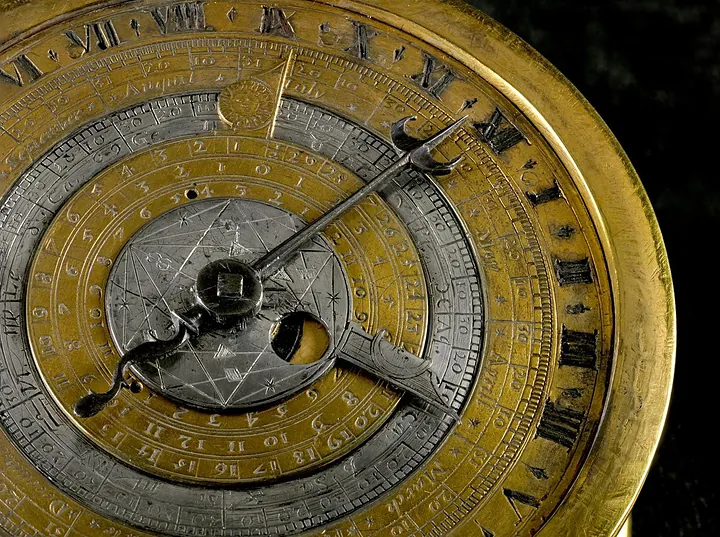
Circular table-clock with calendrical and lunar indications made by Nicholas Vallin in London between 1598 and 1603.
Science Museum Group, London
Clocks · 1611
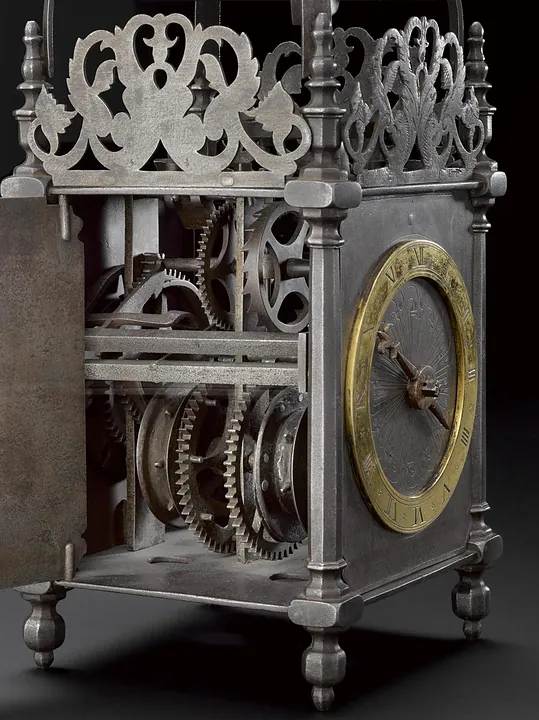
English iron lantern clock, with wheel balance, by John Holloway, Market Lavington, Wiltshire, England, 1611.
Science Museum Group, London
Clocks · 1630
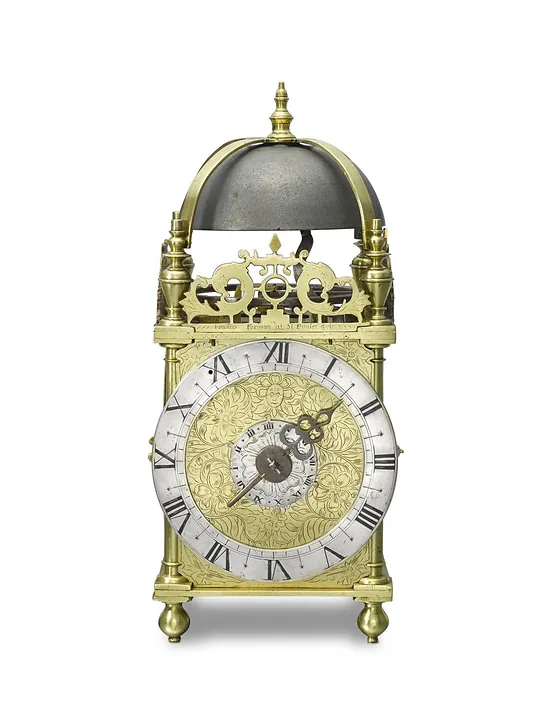
Lantern clock by Francis Forman, England, 1630
Science Museum Group, London
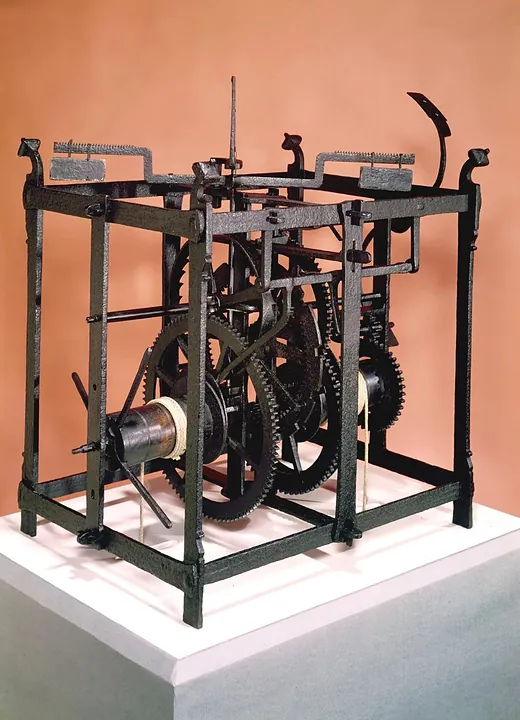
Clocks · 1632–1640
Turret clock, England, 1632–1640
Science Museum Group, London
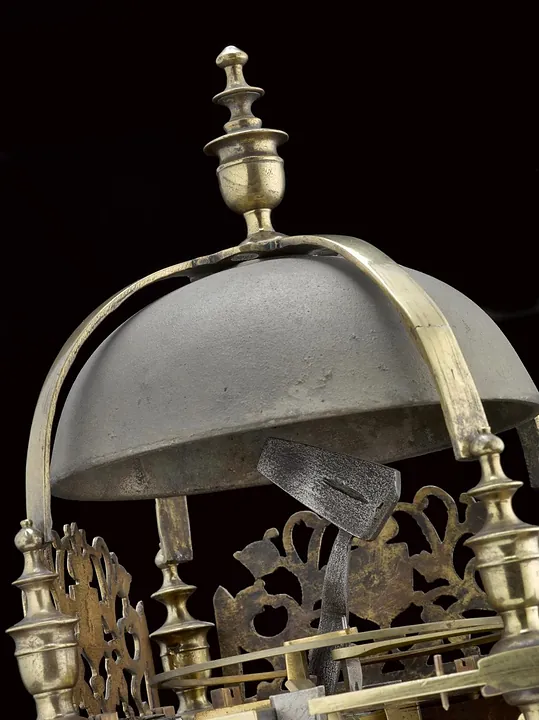
Clocks · 1645–1655
Balance-wheel brass lantern clock, with two driving weights and one counterweight, by Thomas Knifton, Cross Keys, Lothbury, London, England, 1645–1655.
Science Museum Group, London
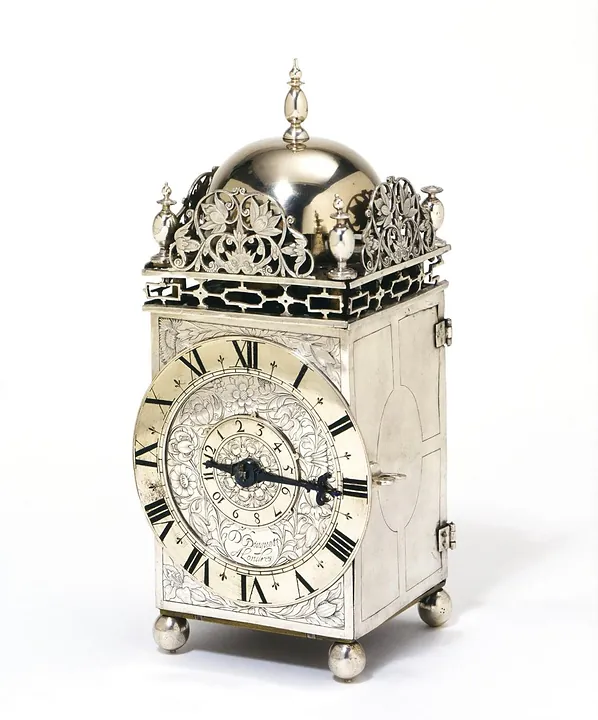
Clocks · c. 1650
Lantern alarm clock, silver, by David Bouquet, circa 1650
Victoria and Albert Museum, London
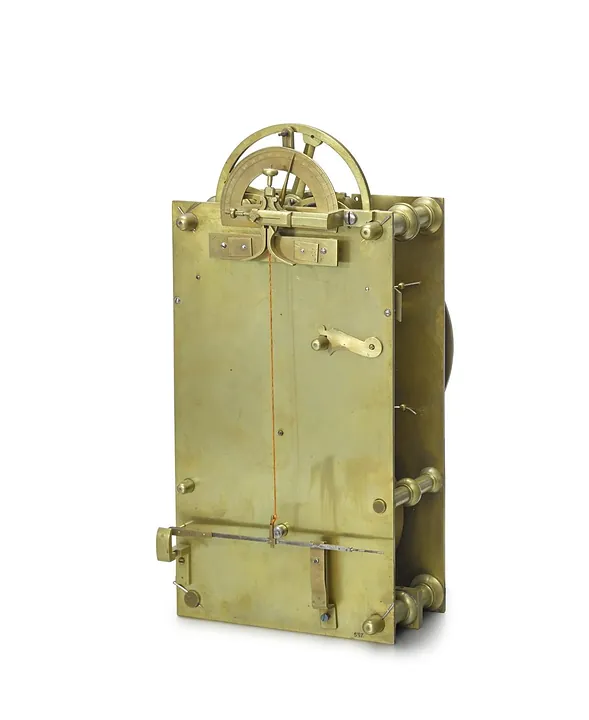
Clocks · 1650–1660
Lantern clock by Peter Closon, England, 1650–1660
Science Museum Group, London
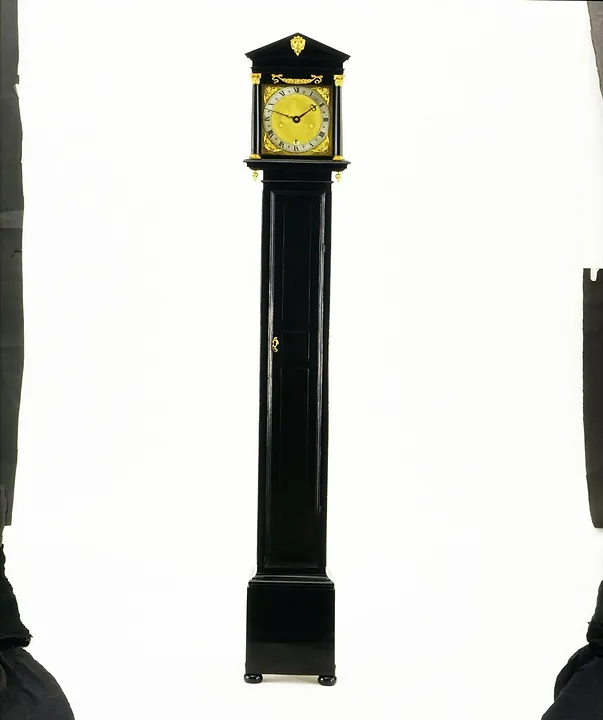
Clocks · c. 1660
Longcase clock, c. 1660, English, made by Ahasuerus Fromanteel
Victoria and Albert Museum, London