
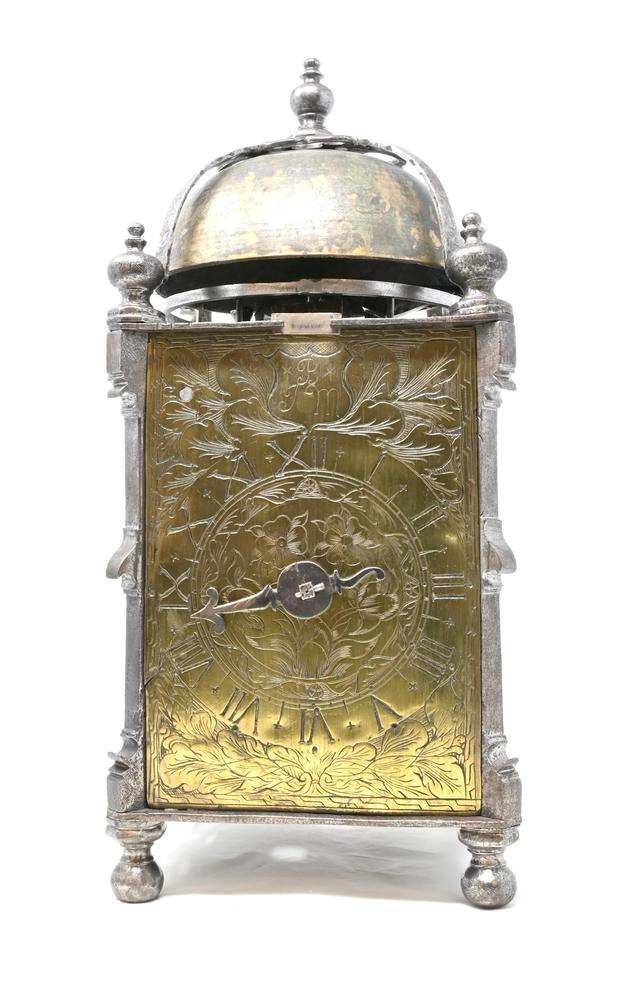
Clocks · Bracket clock
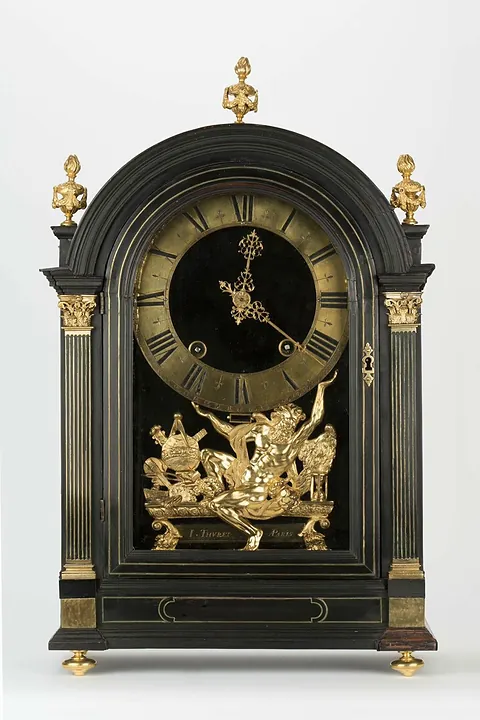
Wall bracket clock
- Maker / attribution
- Unrecorded in source
- Date
- 17thC(late)
- Historical period
- Early Modern Horology (1600 – 1750)
- Country of origin
- France
- Place
- France (?)
- Object type
- Bracket clock
- Materials / technique
- brass, iron
- Dimensions
- Height: 12.50 inches
- Holding institution
- British Museum
- Accession / object no.
- 1958,1006.2096
- Credit line
- British Museum, London
- Catalogue title (original)
- Wall bracket clock (English)
View the source record ↗ (opens another website in a new tab)Suggest a correction
Record summary
Held and catalogued by British Museum (object number 1958,1006.2096), this is a bracket clock, made in France (?), dated 17thC(late). The Atlas places it in the Early Modern Horology period (1600 – 1750) of its Clocks collection. Materials and techniques recorded by the source: brass, iron. Recorded dimensions: Height: 12.50 inches. The record is illustrated with 6 photographs.
Assembled from the source record's structured fields. Dates and attributions are given as the source states them; where a field is missing the Atlas leaves it blank rather than estimating.
Catalogue description
Description — British Museum
Wall bracket clock; iron and brass; weight-driven; verge escapement with balance; count-wheel striking; of transitional design it incorporates 'Gothic' features together with English 'lantern' clock features; dial is not original. Train count. Going train. Great wheel 64 2nd wheel 64 8 Escape wheel 25 6 Motion work Hour wheel pinion 5 (on extended arbor of great wheel) Hour wheel 54 Striking train Great wheel 64 Hoop wheel 64 8 Warning wheel 54 6 Fly 6 Countwheel 39 Count wheel pinion 4.
Curator's comments — British Museum
The following text is the entry for this object from the unpublished catalogue of pre-pendulum clocks by John Leopold, former Assistant Keeper of Horology at the Museum. This information is unedited and should be used accordingly. xxxxxxxxxxxxxxxxxxxxxxxxxxxxxxxxxxxxxxxxxxxxxxxxxxxxxxxxxxx WALL CLOCK. Southern France, middle of the 17th century. Ilbert No. ---. Bibliography. Lloyd (1938) 9. Symonds (1947) pl.16, 17. Lloyd (1951) pl.4. HJ 95 no.1142 (November 1953) 716. Britten 7 (1956) 24. Exh.cat.Nottingham (1958) front cover (the clock was not in the exhibition!). Cat.Ilbert (1958) no.244. Dawson etc. (1958) 162 Lloyd 3 (1964) pl.9a. Britten 8 (1972) 24. Jagger (1977) 99. Britten 9 (1982) 25. Tardy 5 (1982) 224 (dial removed). Dawson etc. (1982) 56-7. White (1989) 500 ff. The clock appears in a photograph of a portion of the Ilbert collection, sent by Ilbert to T.D.Kendrick at the BM in February 1944 but probably dating from ca.1939 (see 1944,11-1,1). Analysis of great wheel and count wheel: White (1989) 500 ff. Signature: No signature or mark. At the top of the present brass dial a shield with the inscription * B * I M DESCRIPTION. General. Posted frame movement, constructed entirely of steel except for the wheels, which are of brass. The frame consists of four profiled pillars set diagonally and screwed to plates with decorative nuts. On the left side the top nut at the back and the bottom nut at the front have been replaced. The bars are secured by two round extensions at bottom and by wedges at the top. The spider with bell is sprung into holes in the top nuts (spider and bell are modern). The bottom plate has two holes along each of its edges, for securing sides, back and dial; in addition it has a rectangular hole which may have held a spring to load the striking detend. The top plate has similar holes for the sides and a single one for the back (at the front the dial is held by a wedge). In addition the plates have holes in the corners for hinged doors. Both the present dial and the back-plate are restorations, and there are now no side-panels. The top plate has a decorative aperture for the verge and a plain one for the fly. All wheels have four crossings and all arbors run in brass bushes. Dial. The present dial and hand are modern fabrications. The original dial was probably attached in the same way: two extensions of the dial-plate fitting holes in the bottom plate, and the top secured by a wedge in the top plate. The central butresses of the front pillars have at some time been partly sawn off, showing that at that time there has been a wider dial. The mutilated parts have since been carefully restored. Movement. Going train. Traincount: 5 ║ 64 64 ── ║ ── ── 25 (x 2) 12-hour ← 54 ║ 8 6 Great wheel pinned to the arbor. The wheel has been reversed, and its teeth are individually marked. Brass puley (replaced: there is a second groove for the spring-washer). Ring-click acting on the crossings. The pinion-of-report is a lantern of 5 cut into the end of the arbor. 2nd wheel: pinned to the arbor. Scape wheel: riveted to a collar (wheel not original); the original pinion is likely to have been 8 (compare striking train). The scape wheel is pivoted in a brass potence (restoration). Balance and verge new; its bottom end runs in a brass block and is supported by a steel block, the top is pivoted in a steel cock (all new; the cock has no locating pin, so that the escapement is difficult to adjust). Hour-hand wheel: friction-tight on the arbor, which is solid with the steel starwheel for unlocking. The wheel is a restoration with unexpected count (55 would be more likely). Striking train. Traincount: 4 ║ 64 64 54 ── ║ ── ── ── 12-hour ← 39 ║ 8 6 6 Great wheel: 8 steel lifting pins. Wheel pinned to the arbor. Brass pulley with ring-click acting on the crossings. The pinion-of-report is a lantern of 4 cut into the end of the arbor. 2nd wheel: steel single hoop, dovetailed into the band. The individual teeth are marked. Arbor and pinion replaced; the wheel is now riveted to a collar but retains traces of the original pin. 3rd wheel: pin for warning (there is a hole opposite, for another pin). Arbor and pinion replaced (the pinion should be 8, see commentary) and the wheel now riveted to a collet. Heavy brass fly. The disc of the count wheel has been replaced (there are two unused holes for rivets in the wheel). The arbor for the hammer is pivoted between two pillars; the assembly, which is much repaired, is loaded with a spring screwed to the bottom plate, and the hammer strikes against a spring riveted to the top plate. Two detends: the warning detend is pivoted between the pillars, and has arms for unlocking and warning (the last one also lifting the locking detend); the locking detend is formed as a pipe around the end of the warning detend (concentric detends), and carries the lifting arm and the arm for indexing and locking. Warned striking with hammer-lifting off the greatwheel (pinwheel), locking on the hoop of the 2nd wheel and warning on a pin on the 3rd wheel. Conversions: The extensive restoration this clock has undergone makes it difficult to acertain what the old conversions are. Presumably the clock had at one time a pendulum, since the present escapement is certainly modern (there is a filled hole in the top plate opposite the present hole for the cock). The replaced arbors in the striking train may also date from before the restoration: these pinions show wear, and the hole for a second warning pin (3rd wheel) also shows that the clock at one time was made to work with the wrong pinion. When it came into the hands of the restorer it must have been in a sad state, with the dial, back and doors as well as the spider missing. Clearly it was thought that this was a very early lantern clock and so it was restored accordingly (note the empty hole in the top left corner of the dial, for a non-existent alarm!). Performance: Going train: great wheel - .9 revs. per hour (21.6 revs.
Inscriptions & marks
monogram; dial; BTM
Provenance
Previous owner/ex-collection:, Courtenay Adrian Ilbert; Donated by:, Gilbert Edgar
Historical context
Early Modern Horology (1600 – 1750)
Huygens' pendulum and balance spring transform accuracy; English makers develop the anchor and deadbeat escapements.
Huygens's pendulum (1656–57) improved clock accuracy from about a quarter of an hour to under a minute a day. The anchor escapement (c. 1670) and the long seconds pendulum created the longcase clock; London makers such as Fromanteel, Knibb, Tompion and Quare led European clockmaking, and French makers created the Boulle pendule.
Read the period in the timelineMore clocks from this periodEarlier: Renaissance Horology
Atlas type guide
Bracket, table and spring-driven clocks
Spring-driven clocks freed timekeeping from the hanging weight. The coiled mainspring, documented from the fifteenth century, made portable table clocks possible; to even out its declining force, makers used the fusee, a conical pulley connected to the barrel by a gut line or chain. Renaissance table clocks from Augsburg and Nuremberg — drum-shaped, square or tower-shaped in gilt brass — were luxury scientific objects, often with astronomical dials and alarms.
After the pendulum, English makers developed the bracket clock: a wooden case with a carrying handle, a short pendulum with a verge escapement, and often repeating work to sound the hours on demand at night. Later examples use the anchor escapement. In the nineteenth century, 'table clock' became a broad term for spring clocks of every nationality.
What to look for
- A fusee in the movement (cone-shaped pulley) and the type of line — gut or chain.
- Verge escapement with a short bob pendulum, often with a decoratively engraved backplate.
- Repeat cords or buttons that make the clock strike again on demand.
- Gilt-brass engraved cases and horizontal dials on Renaissance pieces.
- Case shapes: inverted bell, bell top, break-arch, lancet or balloon.
Dating clues
- Drum and tower table clocks: c. 1520–1650.
- Ebony veneered English bracket clocks with verge escapements: c. 1670–1800.
- Engraved backplates were usual on English clocks until c. 1800, then generally plain.
General guidance written by the Atlas editors about this kind of object. It is not a statement about this particular piece; for that, rely on the source record above and on physical examination.
Read next:FuseeAnchor (recoil) escapement
Related records
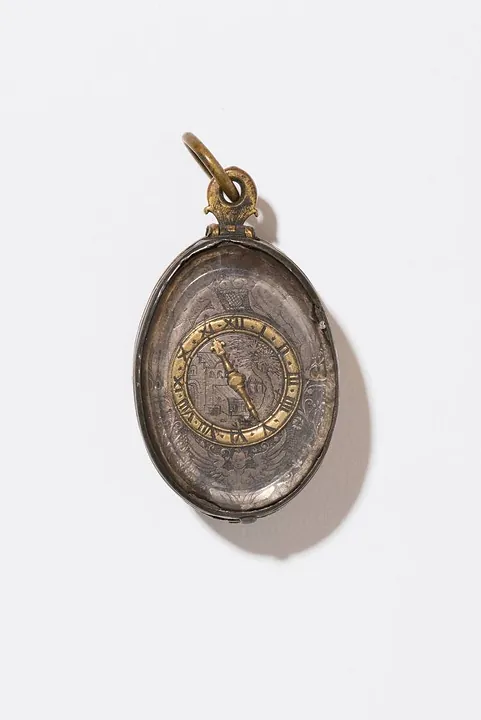
Clocks · 1590–1610
Clock, France, 1590–1610
MAK – Museum of Applied Arts
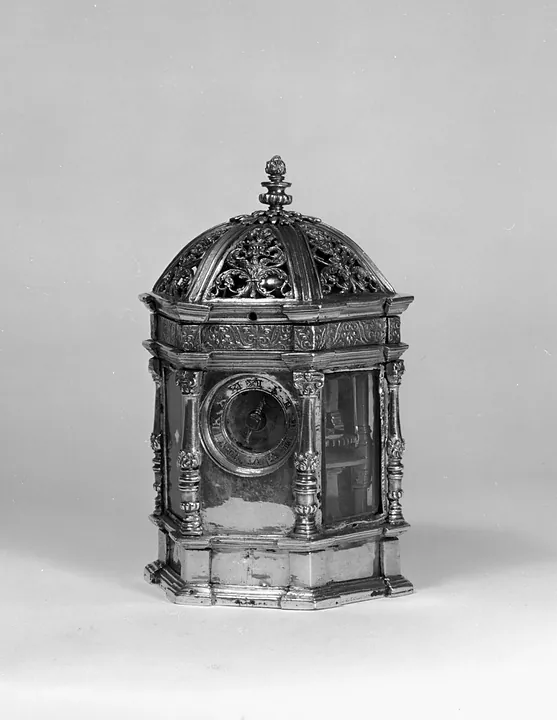
Clocks · c. 1600
Table Clock, sheet brass, engraved, pierced and gilt, Paris, ca.1600, signed 'B(?) Pichard, à Paris'
Victoria and Albert Museum, London
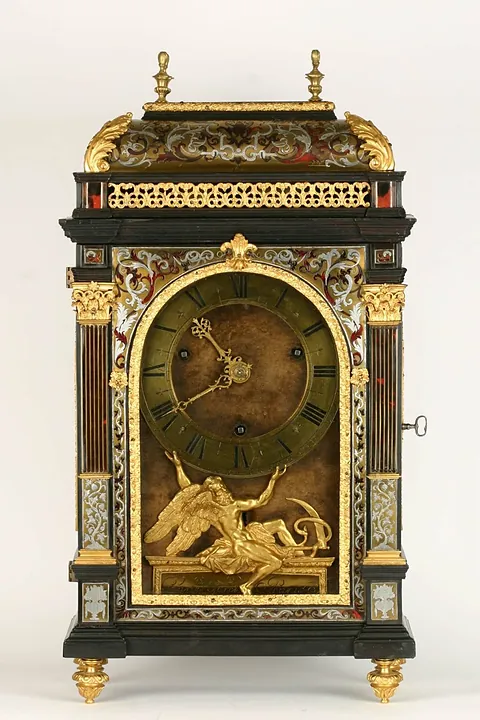
Clocks · 1600–1699
Table clock by Charles Goret, France, 1600–1699
German Clock Museum
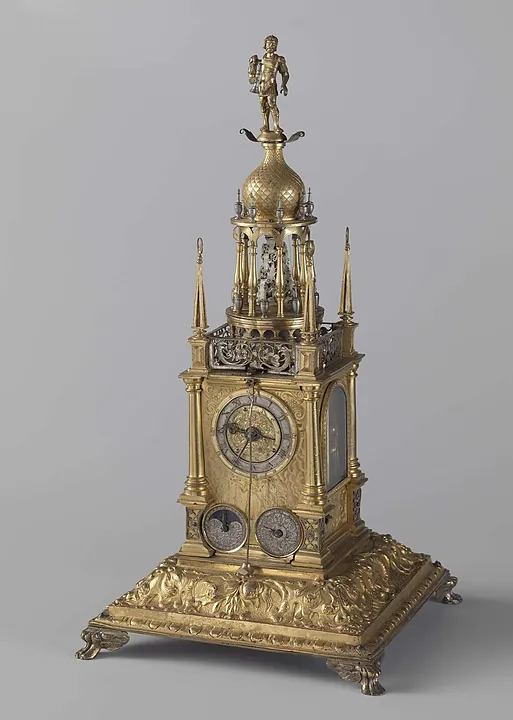
Clocks · 1640
Table clock, France, 1640
Rijksmuseum
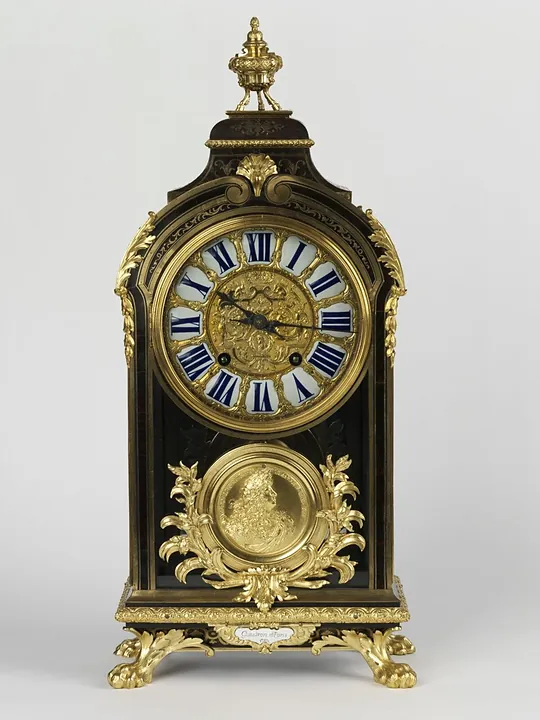
Clocks · late 17th century
Clock with case of tortoiseshell inlaid with brass, Paris, late 17th century
Victoria and Albert Museum, London
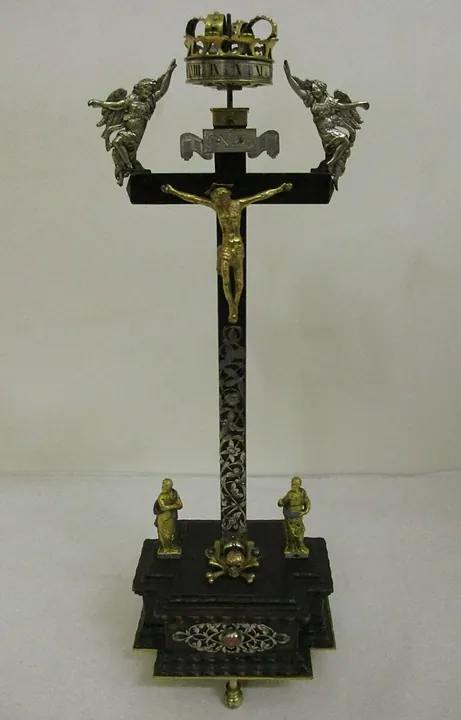
Clocks · 1650
Crucifix Clock, signed W. H. Arnstad, mid- 17th century.
Victoria and Albert Museum, London
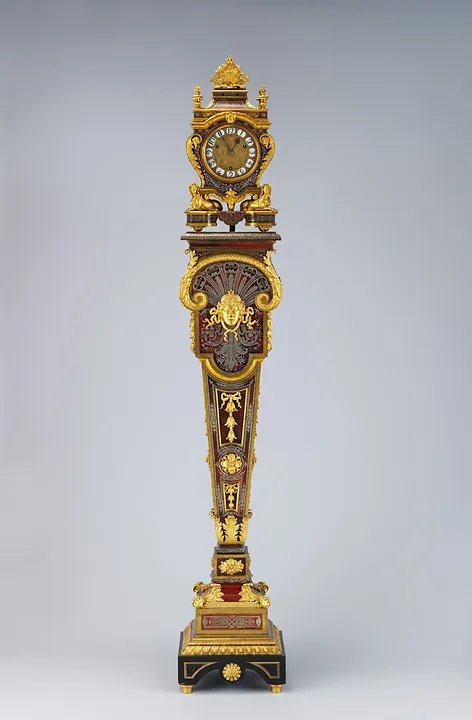
Clocks · c. 1690
Clock with pedestal, case attributed to André Charles Boulle, France, c. 1690
The Metropolitan Museum of Art, New York
Clocks · c. 1690
Table clock by Marc Boucher, France, c. 1690
German Clock Museum