Clocks · Crucifix clock
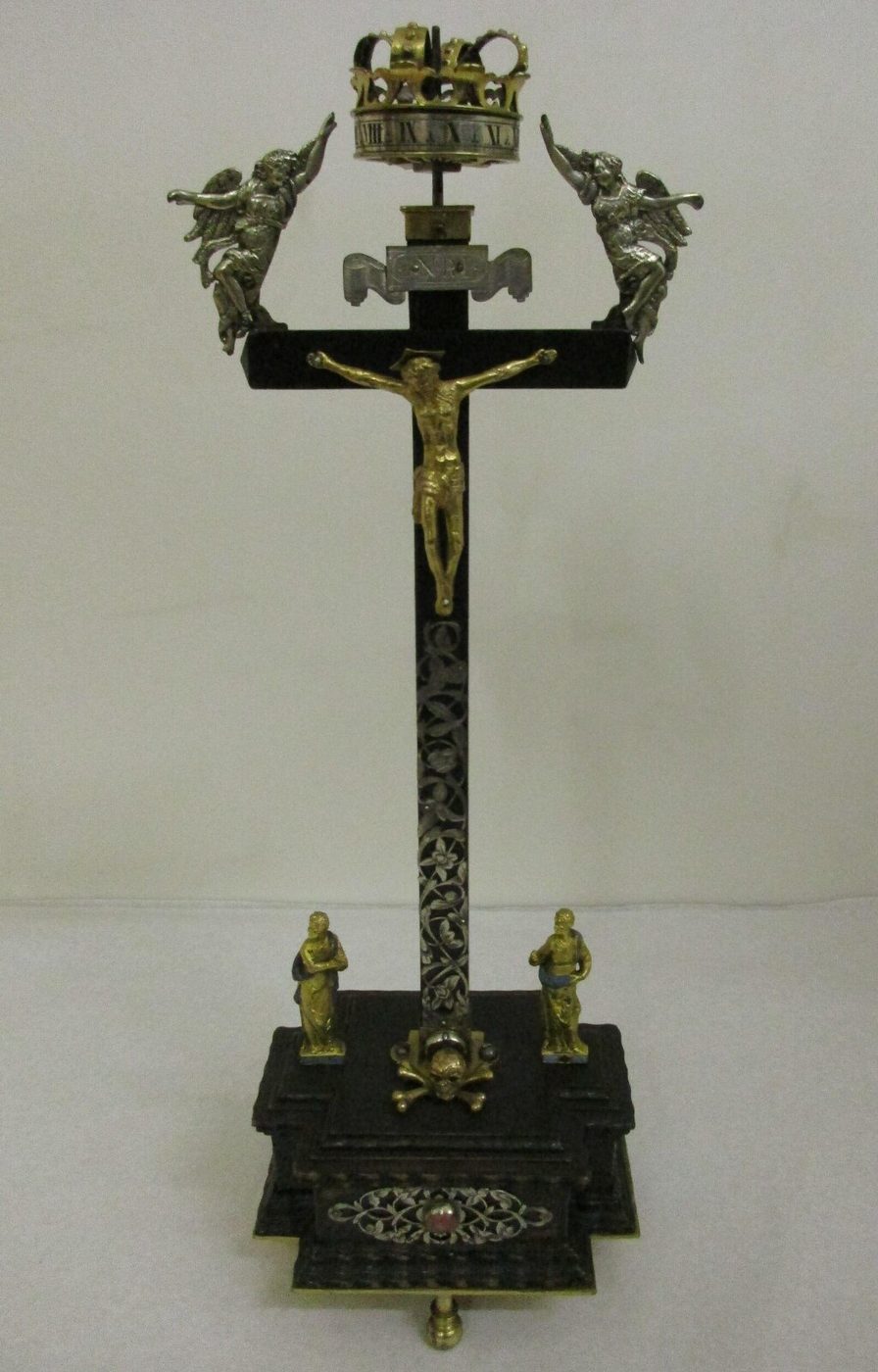
Crucifix Clock, signed W. H. Arnstad, mid- 17th century.
- Maker / attribution
- Unrecorded in source
- Date
- 1650
- Historical period
- Early Modern Horology (1600 – 1750)
- Country of origin
- France
- Place
- France
- Object type
- Crucifix clock
- Materials / technique
- Ebony, silver, precious-stones, gilt-metal, gilt-brass.
- Dimensions
- Height: 36.7 cm; Width: 12.4 cm; Depth: 9.2 cm
- Holding institution
- Victoria and Albert Museum, London
- Accession / object no.
- 4095-1857
- Credit line
- Purchased 1857
Record summary
Held and catalogued by Victoria and Albert Museum, London (object number 4095-1857), this is a crucifix clock, made in France, dated 1650. The Atlas places it in the Early Modern Horology period (1600 – 1750) of its Clocks collection. Materials and techniques recorded by the source: Ebony, silver, precious-stones, gilt-metal, gilt-brass. Recorded dimensions: Height: 36.7 cm; Width: 12.4 cm; Depth: 9.2 cm. The record is illustrated with 4 photographs.
Assembled from the source record's structured fields. Dates and attributions are given as the source states them; where a field is missing the Atlas leaves it blank rather than estimating.
Catalogue description
V&A — Summary
A table clock in the form of a Crucifix on a pedestal of ebony with applied silver ornaments, the figures of Christ, the Virgin and St John are gilded metal; the clock movement in the pedestal turns a crown shaped dial at the top of the cross; two angels on the arms of the cross point to the revolving dial. French, 17th century
V&A — Physical description
Case: In the form of a crucifix on a pedestal; ebony with applied silver ornaments set with stones; the figure of gilt-metal. Rectangular pedestal with re-entrant corners, resting on three turned gilt-metal feet; figures of the Virgin and St. John standing on either side of the crucifix, with a skull and cross-bones at its foot. The motto INRI appears on a silver scroll applied above the head of Christ; this is flanked by silver angels cast in low relief and chased. Dial: Above is the dial, consisting of a silvered ring, rotating once in 12 hours and forming the drum-shaped part of a gilt-silver crown, engraved with Roman numerals I to XII with quarter-hour divisions between. Movement: The clock movement is contained within the pedestal; it has plated 4.8 cm square, the bottom plate signed "W. H. Arnstad". All wheels are of brass. The going train with an unprotected spring, its stopwork now missing . Verge escapement, and balance now fitted with a spring and Tompion-type regulator. Locking-plate striking train also with an open spring; outside count-wheel. The bell is strapped to a hinged door in the bottom of the pedestal.
V&A — Object history
Purchased by the South Kensington Museum in 1857
Inscriptions & marks
W. H. Arnstad; INRI
Historical context
Early Modern Horology (1600 – 1750)
Huygens' pendulum and balance spring transform accuracy; English makers develop the anchor and deadbeat escapements.
Huygens's pendulum (1656–57) improved clock accuracy from about a quarter of an hour to under a minute a day. The anchor escapement (c. 1670) and the long seconds pendulum created the longcase clock; London makers such as Fromanteel, Knibb, Tompion and Quare led European clockmaking, and French makers created the Boulle pendule.
Read the period in the timelineMore clocks from this periodEarlier: Renaissance Horology
Atlas type guide
Astronomical, musical and automaton clocks
Astronomical clocks display more than the hour: the positions of the sun and moon in the zodiac, the phase of the moon, the calendar, sometimes the planets and eclipses. From Richard of Wallingford's and Giovanni de' Dondi's fourteenth-century clocks to the Prague Orloj and the Strasbourg cathedral clocks, they demonstrated the order of the cosmos. Renaissance makers in Augsburg and Nuremberg built celestial globe clocks and monstrance clocks as princely treasures.
Automaton and musical clocks entertained as well as informed: figures move, birds sing, organs and carillons play tunes from pinned cylinders. The eighteenth-century trade with China ('sing-songs') and Ottoman Turkey created a market for elaborate English, Swiss and French automata.
What to look for
- Subsidiary dials for moon phase, calendar, zodiac and planetary positions.
- Celestial globes or armillary spheres turned by the movement.
- Pinned cylinders, bellows and pipes or bells for music.
- Figures on cams and levers; separate trains for automaton work.
Dating clues
- Renaissance astronomical table and globe clocks: c. 1550–1650.
- English and Swiss automaton clocks for the Chinese market: c. 1760–1820.
- Picture clocks (clockwork pictures) are mostly nineteenth century.
General guidance written by the Atlas editors about this kind of object. It is not a statement about this particular piece; for that, rely on the source record above and on physical examination.
Read next:Fusee
Related records
Clocks · 1590–1610
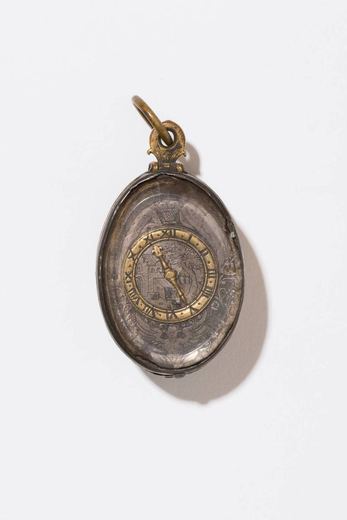
Clock, France, 1590–1610
MAK – Museum of Applied Arts
Clocks · 1600–1699
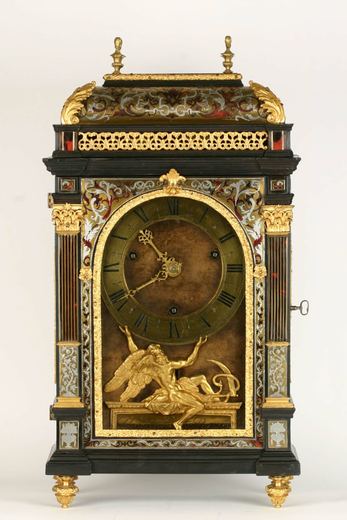
Table clock by Charles Goret, France, 1600–1699
German Clock Museum
Clocks · 1640
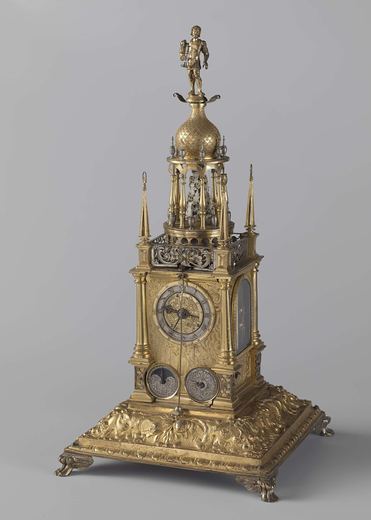
Table clock, France, 1640
Rijksmuseum
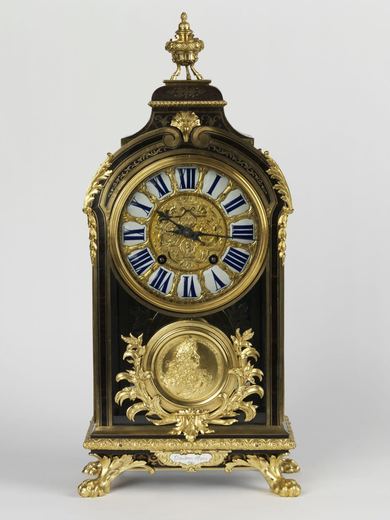
Clocks · late 17th century
Clock with case of tortoiseshell inlaid with brass, Paris, late 17th century
Victoria and Albert Museum, London
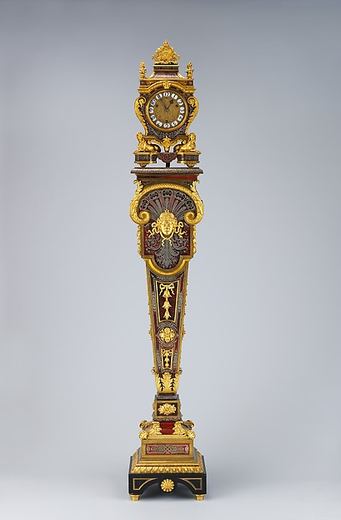
Clocks · ca. 1690
Clock with pedestal by Case attributed to André Charles Boulle, France, ca. 1690
The Metropolitan Museum of Art, New York
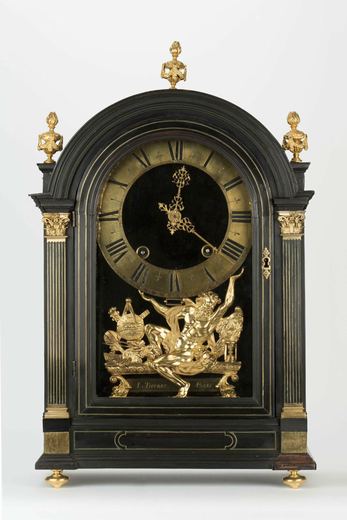
Clocks · 1690
Table clock by Marc Boucher, France, 1690
German Clock Museum
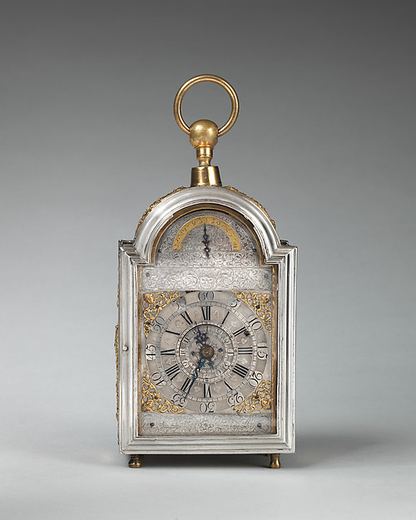
Clocks · ca. 1700–1710
Traveling clock with alarm and calendar by Probably by Joseph Paulet, France, ca. 1700–1710
The Metropolitan Museum of Art, New York
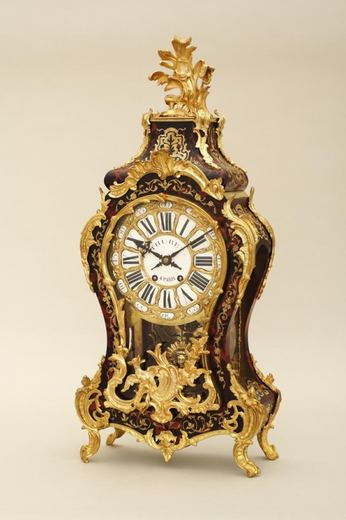
Clocks · 1700–1799
Mantel clock by Isaac (1630-1706) Thuret, France, 1700–1799
Museum of Applied Arts Budapest